
North, West and East Shoal Lakes IBA Blitz Report
On August 26th, 2018, the Manitoba IBA Program were joined by 20 volunteers to go forthwith and count birds in the North, West and East Shoal Lakes IBA. And what a lovely morning was had by all! Tim Poole summarises a morning of haze, sunshine, and a fair few birds.
Manitoba sunrises can be quite spectacular, and Sunday morning was no different. The drive to Shoal Lakes seemed to offer the ideal conditions for sunrise photography: the mist appeared to hover over the waters and trees; the sky above was perfectly clear and; the sun peaked over the horizon with perfect timing.
It seems I was not the only person to think this, and the below offerings were taken by volunteers out and about on Sunday morning.

Early morning smoky haze. Copyright: Sabina Mastrolonardo
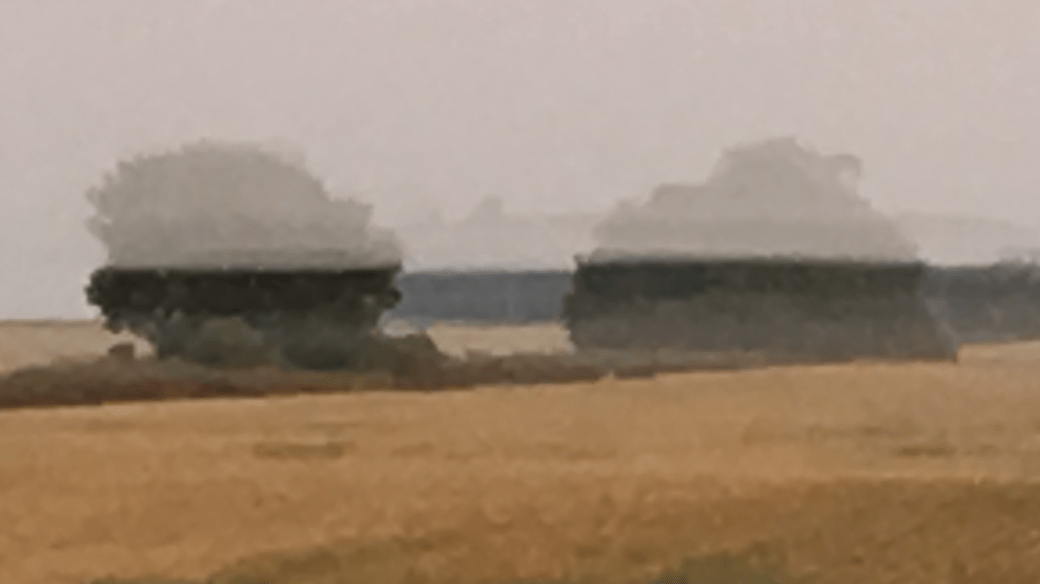
Hovering clouds (note where they were on Sabina’s photo above). Copyright Jo Swartz
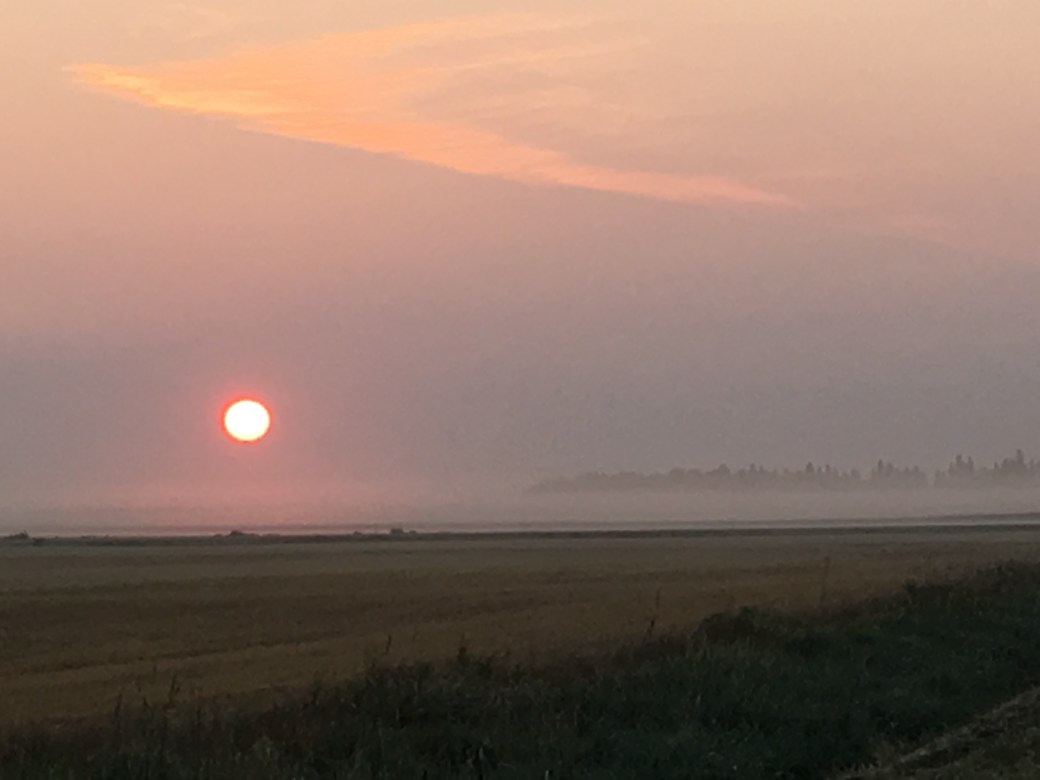
Red sky in the morning, something about a warning. Copyright Jo Swartz
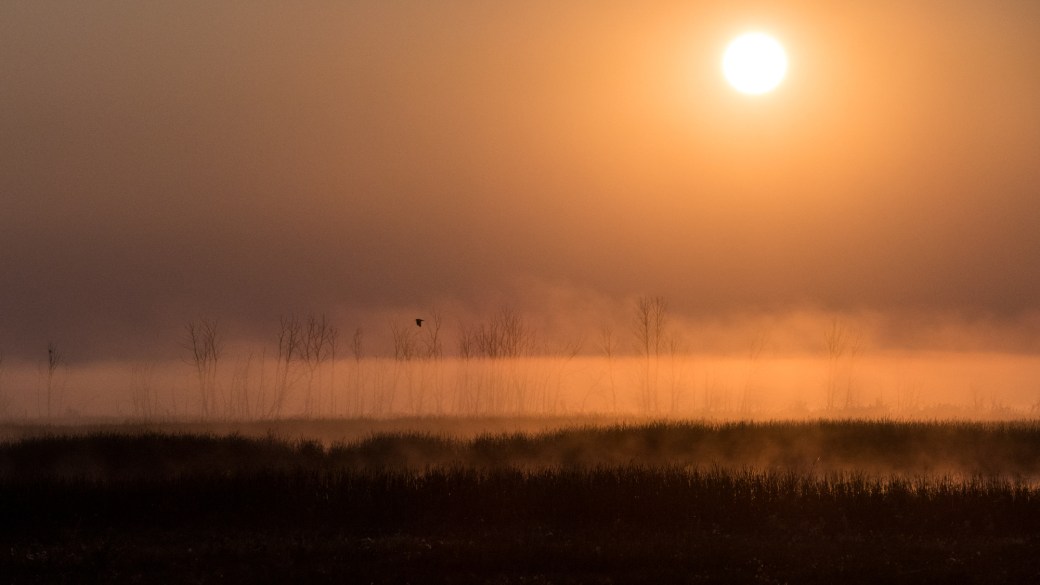
Haunting clouds in the early morning sunrise. Copyright Lynnea Parker
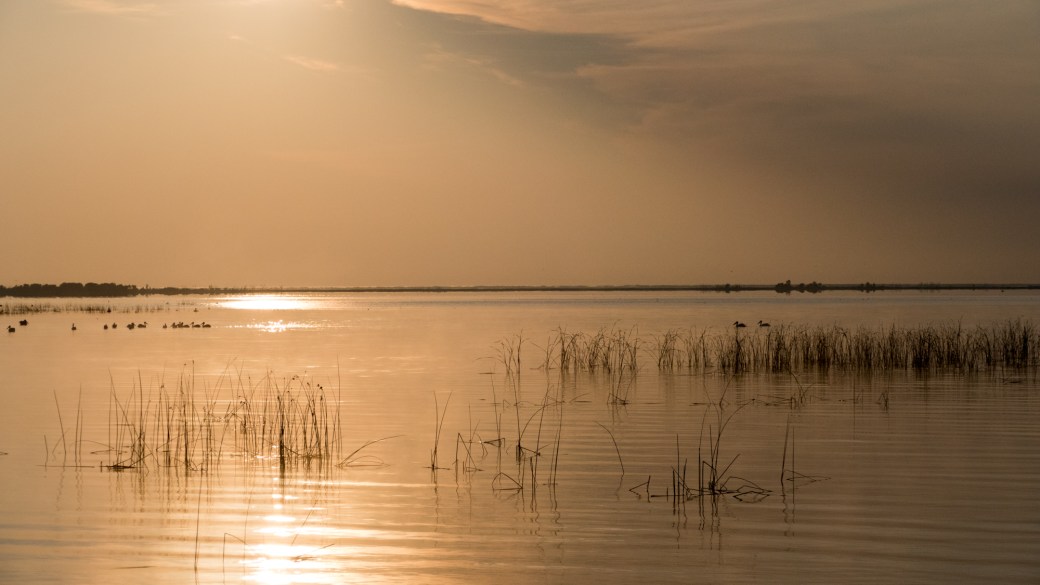
West Shoal Lake pelicans. Copyright Lynnea Parker

Pelicans on West Shoal Lake in the dawn. Copyright Tim Poole
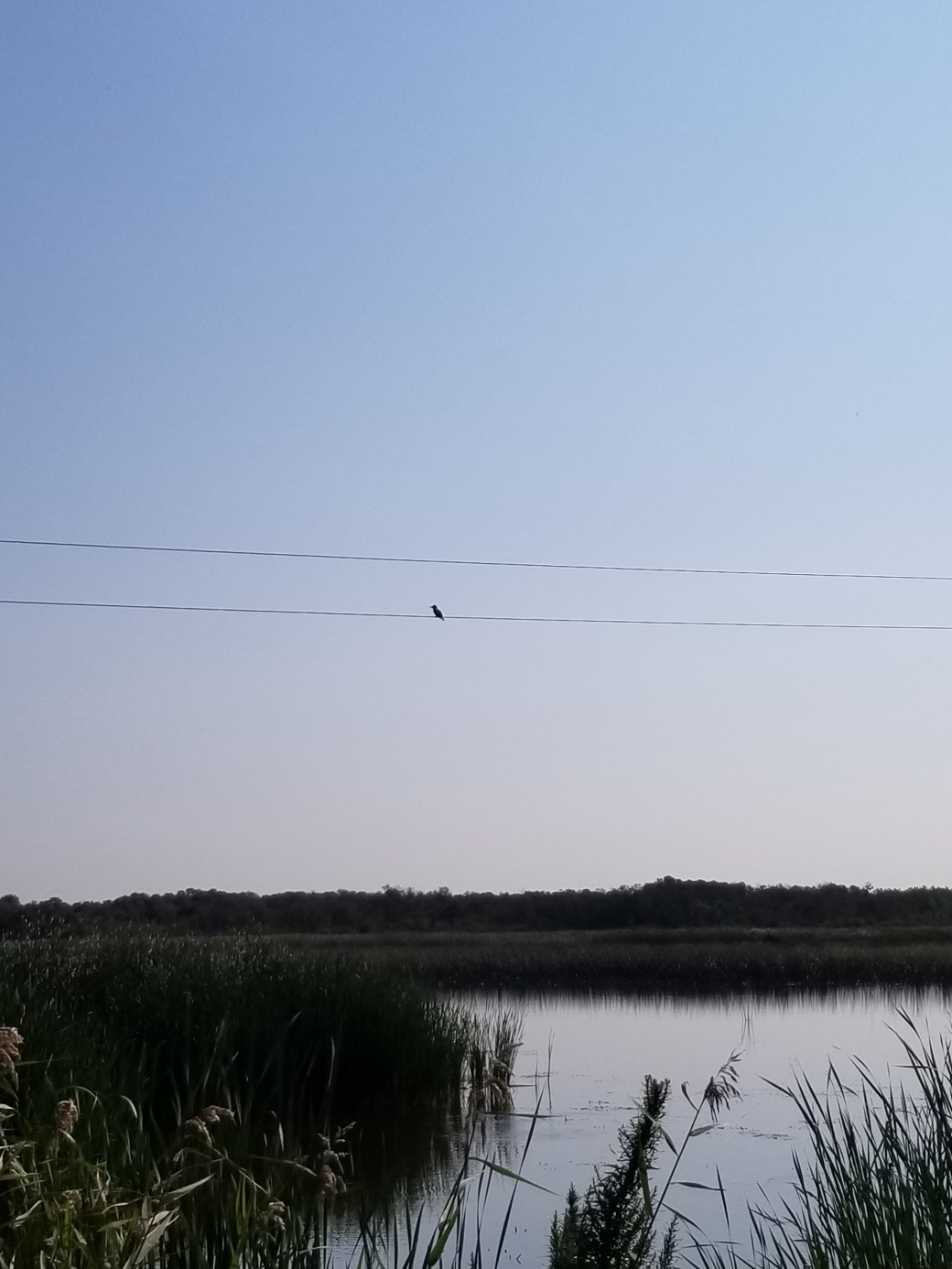
Belted Kingfisher silhouette looking for a meal. Copyright: Sabina Mastrolonardo

Spot the pro! Copyright Garry Budyk
Well, that was quite some trail of images. I guess anyone still reading by this point will be impressed with: a) the photography skills of our volunteers and; b) the inspiration of a Manitoba Interlake sunrise.
‘BUT WHAT ABOUT THE BIRDS’ I hear you shout. Well, they were pretty great too. After all, Shoal Lakes is a birding spot which rarely disappoints.
We had 20 volunteers turn out Sunday morning in total. Most had attended at least one IBA event previously, but we were also fortunate to have master birder, Rudolf Koes, and Master of Ornithology, Jenny Yoo, join us for their first ever IBA events. We decided with such good numbers to split the IBA into 5 areas, and even add a sixth on the northeastern boundary, looking to see if there were any significant avian gems in this relatively underexplored area. Below is our survey area for the morning.

Each group set out to count as many birds as possible, focusing also on those all important Species At Risk. Here we offer a quick summary from each group.
Group 1 (checklist 1, checklist 2, checklist 3, checklist 4, checklist 5, checklist 6, checklist 7)
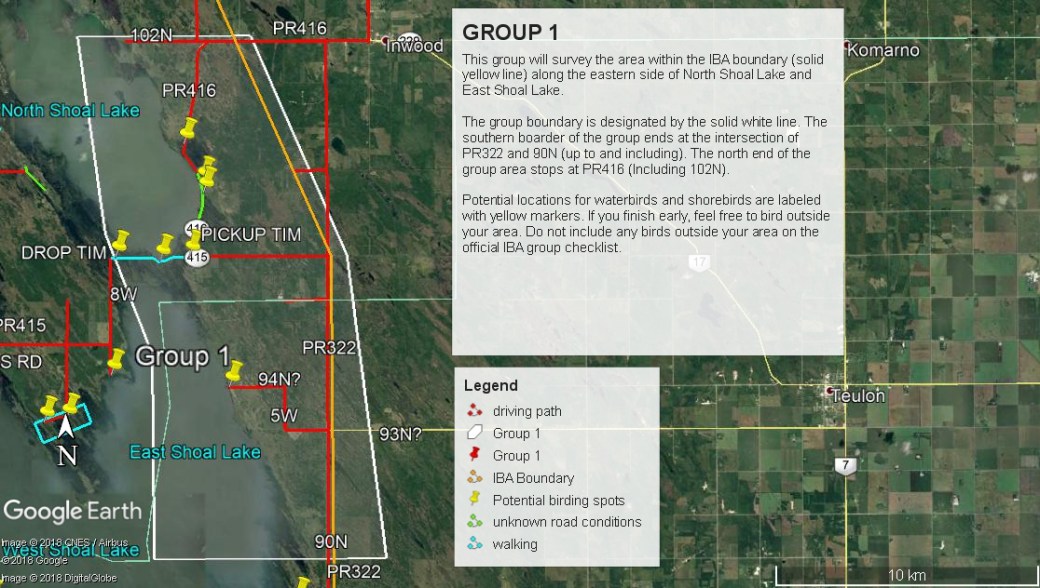
Our first group consisted of Jo, Betsy and Sabina. We set them the task of birding the eastern side of the IBA. They began at East Shoal Lake east of Erinview. One of the highlights was a Peregrine Falcon, always a highlight bird on a blitz (usually because it has the effect of putting up every other bird present in the area).

Peregrine Falcon with a Gull sp. lurking behind and to the right of the falcon. Copyright: Sabina Mastrolonardo
Raptors would feature heavily in most groups over the day, and Cooper’s Hawk was seen relatively frequently.
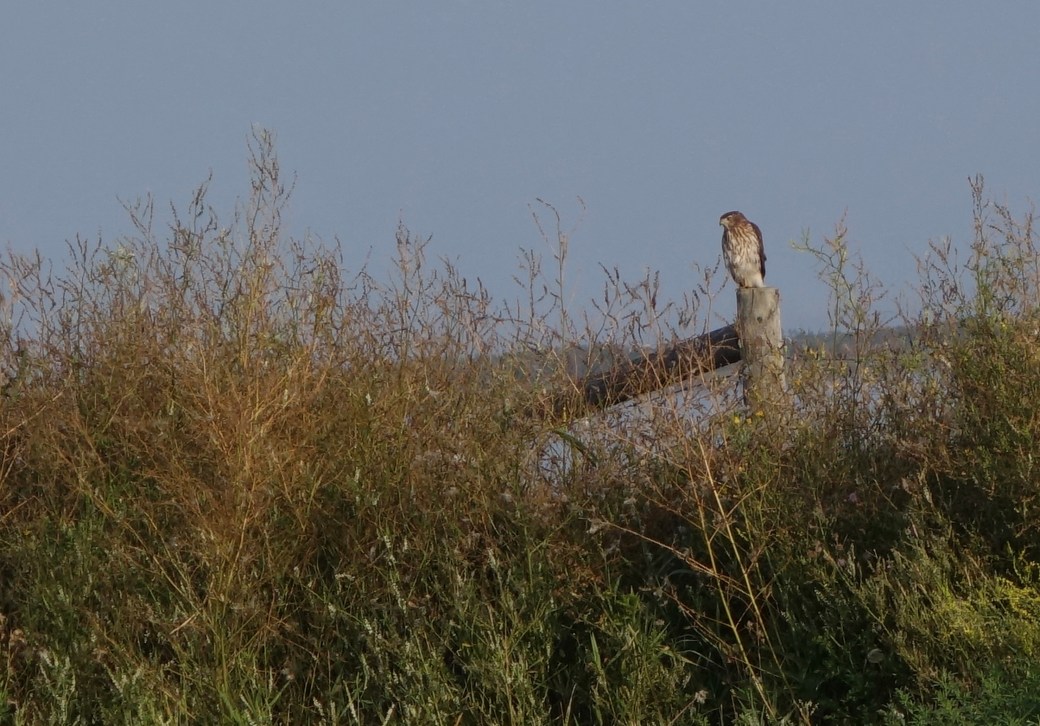
Cooper’s Hawks are showing up really well right now. Copyright Betsy Thorsteinson
Of course, waterbirds were going to always be a highlight in a lake system IBA, and here was no different. 150 Western Grebes were counted at East Shoal Lake. A further 44 were spotted on North Shoal Lake from the now accessible PR416 where it turns to the north along the lake shore. Indeed, the shorelines were beginning to recede along the lake, providing habitat for long-legged waders such as the Great Blue Heron and Great Egret. Before lunch, they also managed to find one of the Least Bitterns along the north side of North Shoal Lake – a good thing, as the bird was obviously hunkered down when other groups drove through the area.

Great-blue Heron with Bald Eagle in the background. Copyright: Sabina Mastrolonardo
Group 2 (checklist 1, checklist 2)
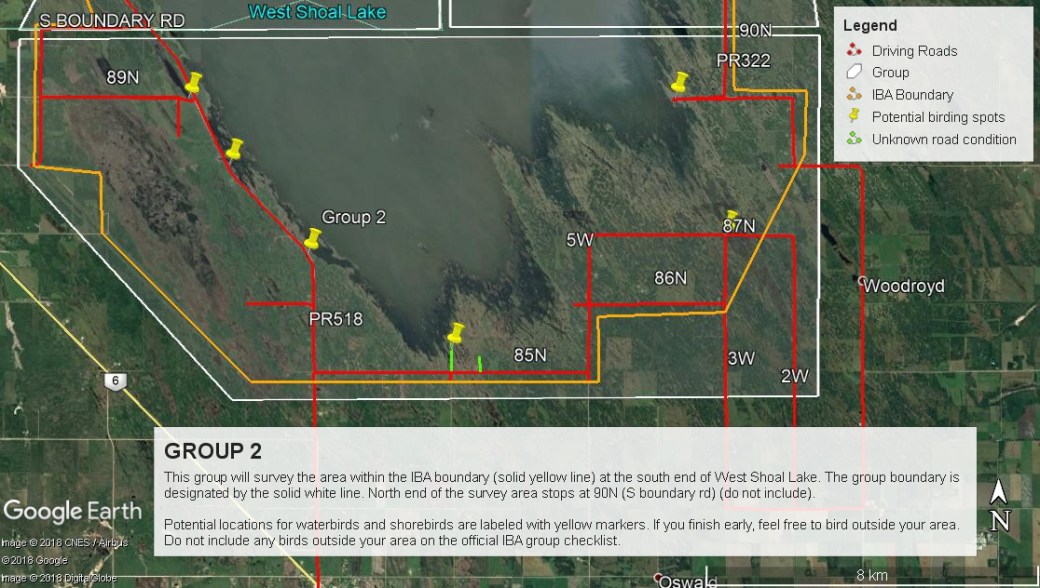
Our southern group consisted of Lewis, Ken, Jock and Chris. This group were tasked with discovering whether there were spots to access the lake from the south, and counting from where the lake can be accessed at the south ends of East and West Shoal Lakes. The group managed to find 39 western Grebes, and 7 species of shorebirds, including Semipalmated – Plover and Sandpiper – and a few Baird’s Sandpiper.
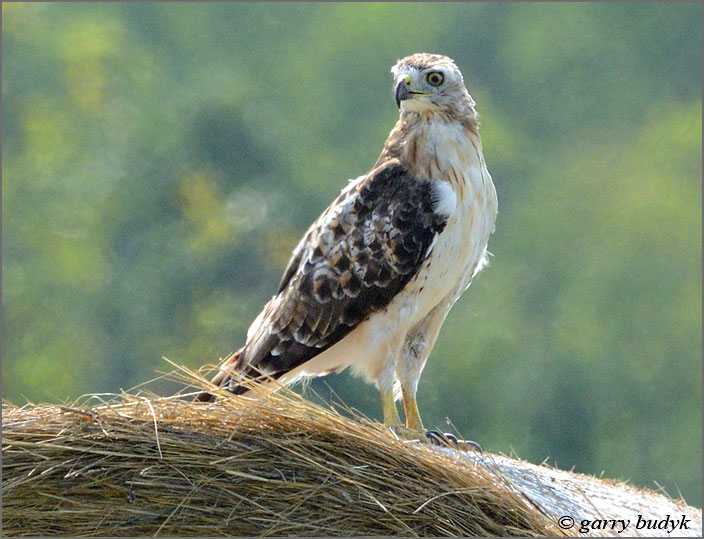
This group counted 9 Red-tailed Hawk alone. Copyright Garry Budyk
Chris was scribe for the morning and made a couple of interesting observations, comparing what he was seeing with what was noted at Delta Marsh earlier in the month:
‘Just a couple of observations, especially after doing the Delta count two weeks ago. As we mentioned in the car, total blackbird numbers were way down, with no Brewers seen. Also no swallows identified except Barn. There were also a lot of singleton sightings (15 species by a quick count).’
You will see at the end if the observations about low numbers of blackbirds and swallows was the same for other groups, but let’s just say that these comments appear pertinent…
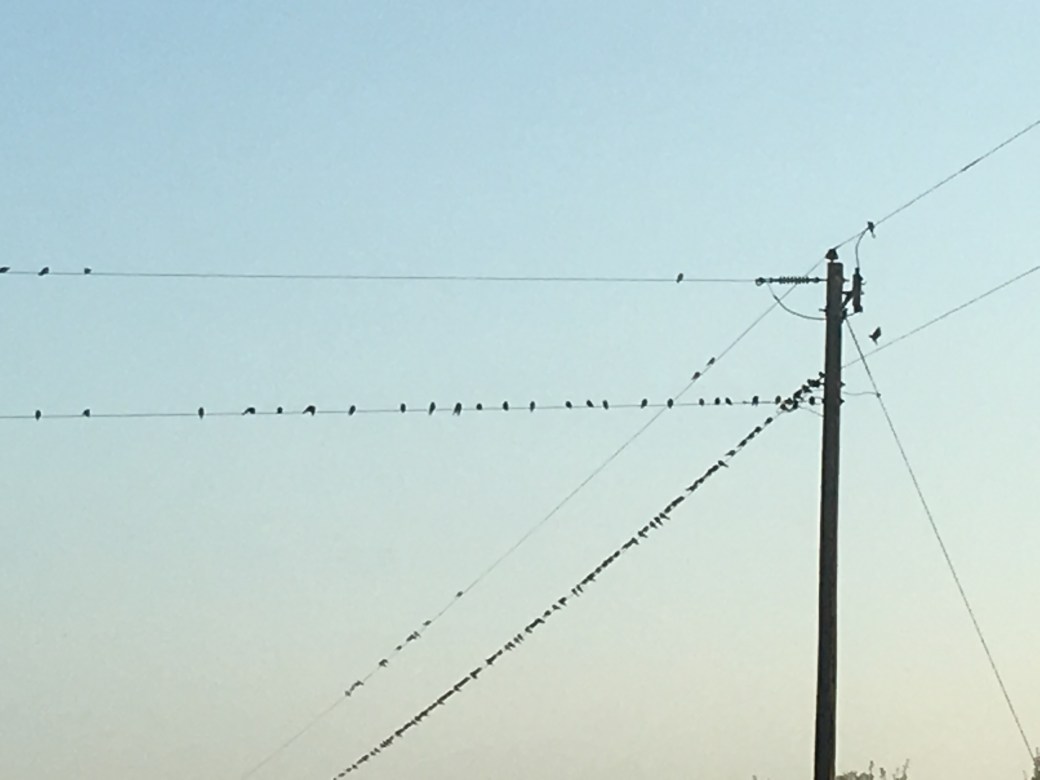
Although swallows were present, numbers were notably fewer than Delta Marsh earlier in August. Copyright Jo Swartz
Group 3 (checklist)
The below was written by Lynnea Parker. En route to the start, this group were fortunate to spot a posing Bald Eagle in the early morning sunshine.
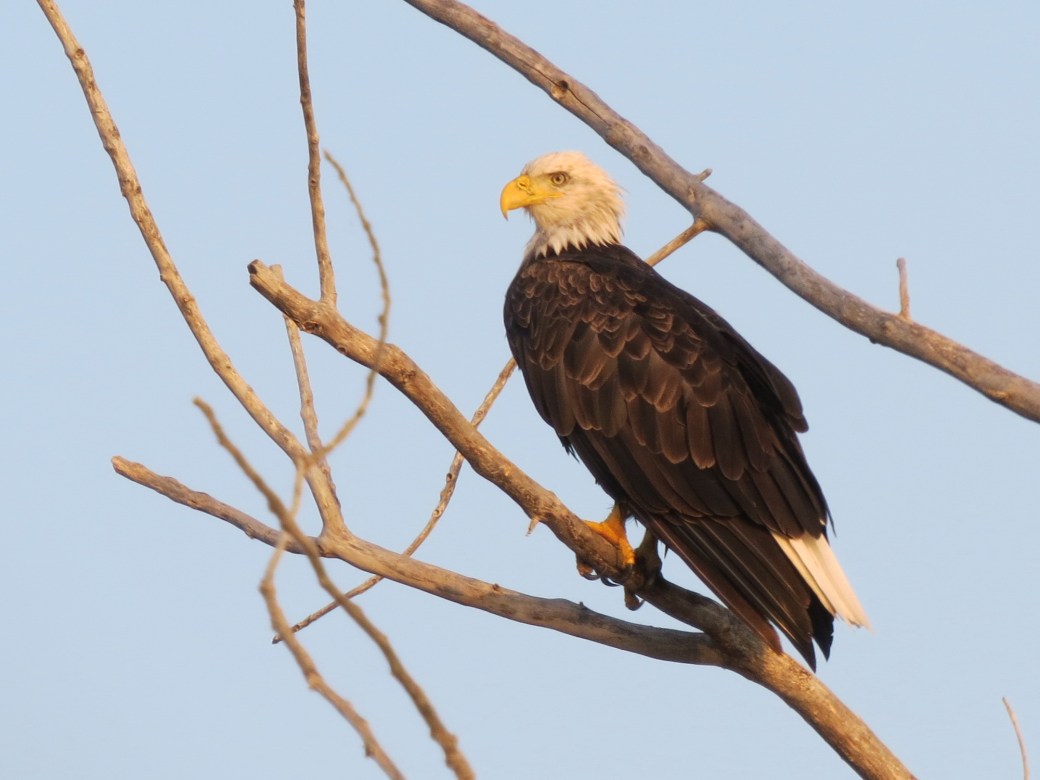
Gorgeous Bald Eagle. Copyright Katharine Schulz
‘Group 3 was located on the west side of the three lakes and contained the north half of West Shoal Lake and the northwestern side of East Shoal Lake. Tim Poole was dropped off at the crossing of North and East Shoal Lake to walk across the decommissioned road as part of group 1. After dropping Tim off to fend for himself, Jenny, Katharine and myself (Lynnea) decided to head back south to the beginning of our survey area. We found good numbers of Western Grebe on West Shoal Lake despite their distance and obscurity in the scope. This first stop along the shoreline also provided a good learning opportunity to get reacquainted with the differences between Forester’s Tern and Common Tern.
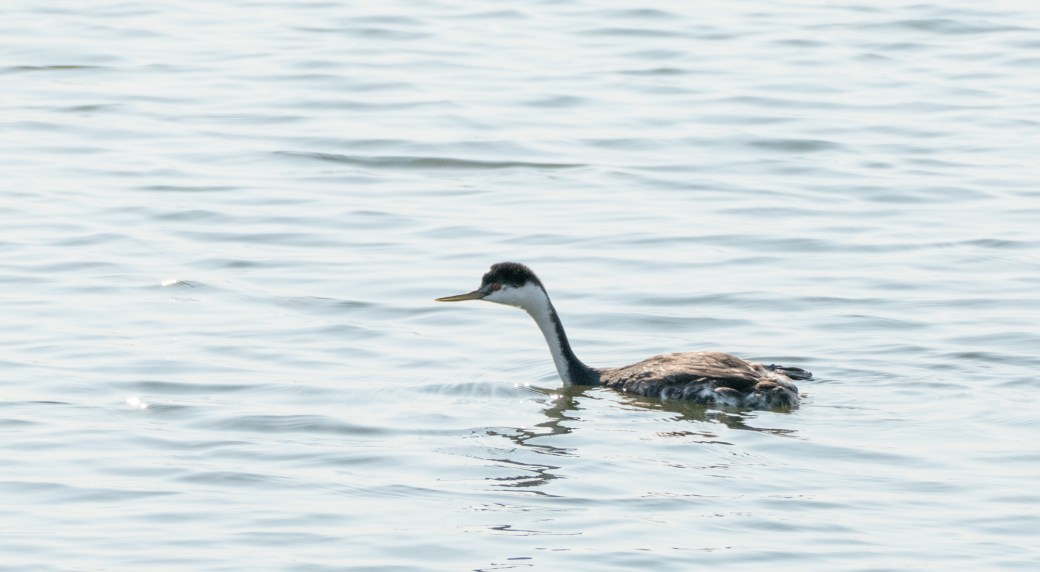
Western Grebe in East Shoal Lake. Copyright Lynnea Parker
At East Shoal Lake, we had very limited access to look for waterbirds. The cattails were very tall and stretched out far into the lake. Despite this, we were able to find a piece of ground just elevated enough to count grebes on the lake with a scope. We were also surprised to hear American Avocets calling from the opposite side of the cattails.
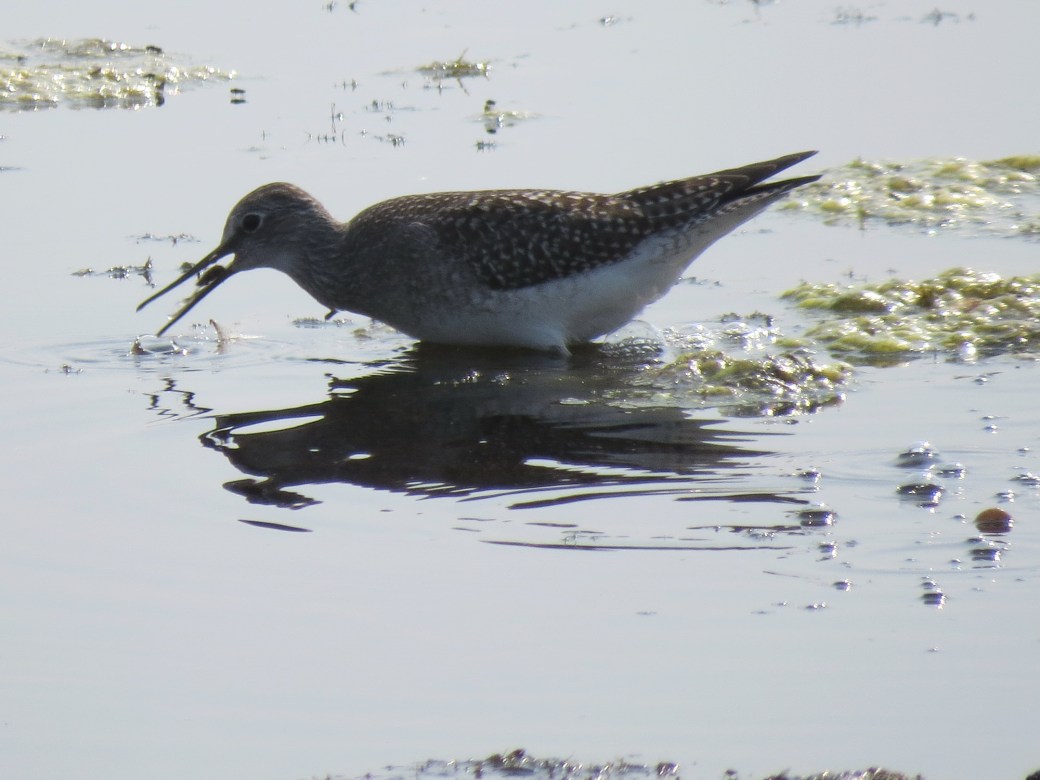
Feeding Lesser Yellowlegs. Copyright Katharine Schulz
Our most interesting observation of the day however was watching Common Grackles feed on acorns. The birds at first appeared to be Brewer’s Blackbirds, but we realized a short while later that they were actually Grackles which were molting and had rather unusual looking tails. Some birds even had a starling-like profile in flight, with no tail at all!
We finished off our survey with a fantastic Red-headed Woodpecker that Katharine spotted as we were leaving. We quickly backtracked to the area she had seen it disappear and were able to confirm the sighting. This event was also Jenny’s first time participating in an IBA event, and she did a great job as notetaker and learning the avian 4-letter codes.’
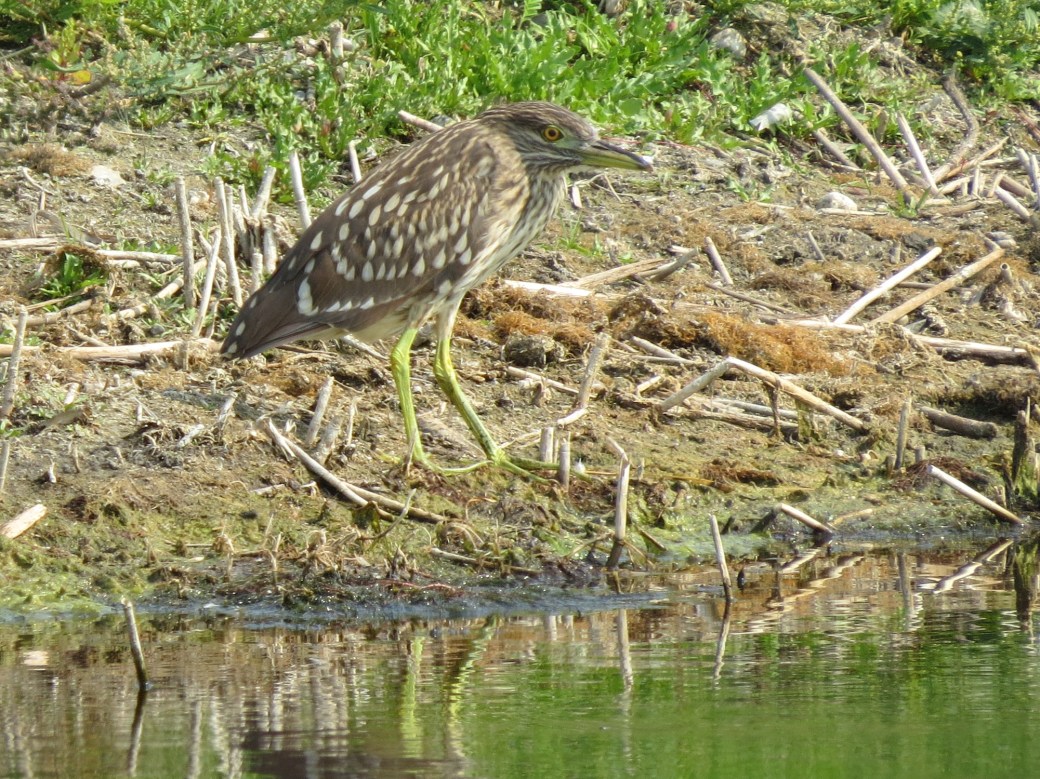
A juvenile Black-crowned Night Heron. Copyright Katharine Schulz
Group Tim (checklist 1, checklist 2)
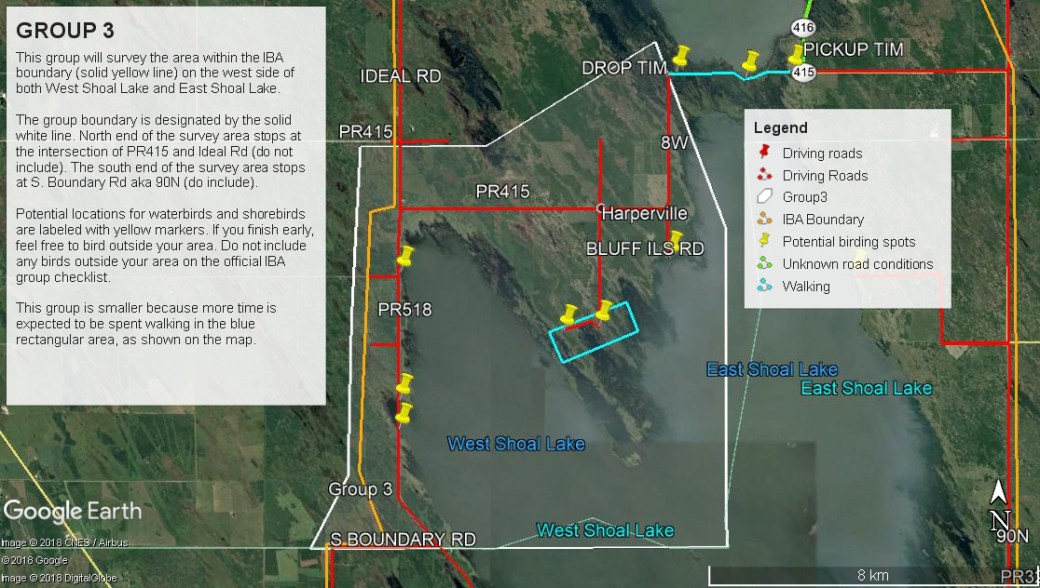
Look at the map for Group 3, and you will spot points mentioning “DROP TIM’ and ‘PICKUP TIM’. My role in this blitz was to put my life in danger, and walk the flooded PR415 from west to east. This is a route previously walked in blitzes by Christian (for example August 2015, October 2015 and May 2018). In the past, the walk was impressive due to the large number of Sora and Virginia rails scuttling across the road. I had high expectations obviously that these birds would be much obliging on this occasion. The Common Yellowthroat numbers have previously also been impressive along here
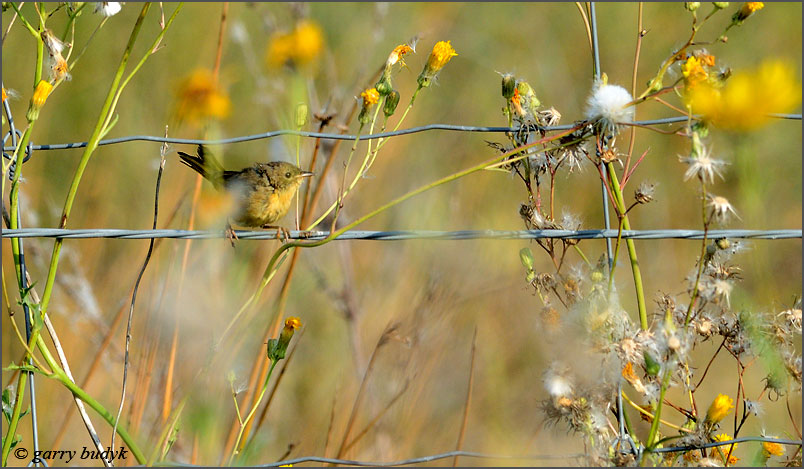
Ok, I confess, the line above was put in as an excuse to use Garry’s lovely capture of this Common Yellowthroat! Copyright Garry Budyk
Lynnea, Katharine and Jenny dropped me at my start point, and I was immediately impressed by the cacophony of calling songbirds, Western Grebes and corvids. There were two Eastern Wood-Pewee’s calling from the trees – or was it three pewees?Regardless, over a short period, I was able to detect six species of flycatcher (Yellow-bellied, Great-crested, Least, Alder, Eastern Wood-Pewee and Eastern Phoebe), and 11 species of Wood Warbler (American Redstart, Magnolia, Cape May, Blackburnian, Black-and-White, Yellow, Tennessee, Nashville, Palm, Common Yellowthroat and Northern Waterthrush). A Lincoln’s Sparrow was also quickly followed by a Le Conte’s Sparrow.
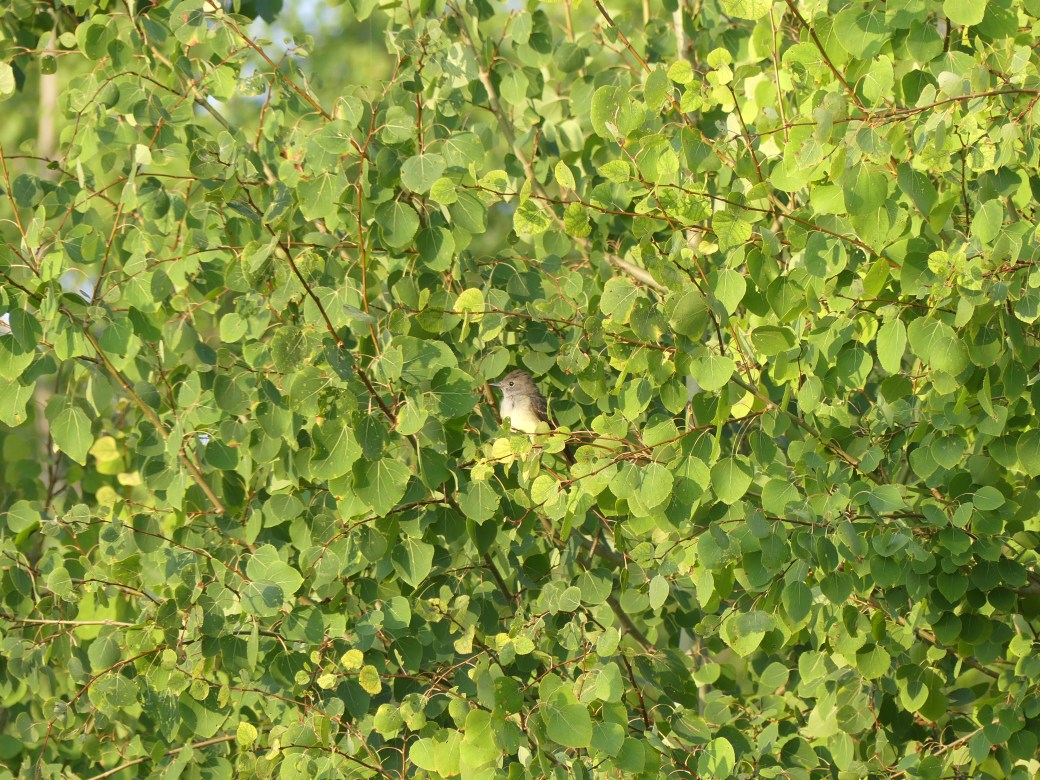
Great-crested Flycatcher hiding in the shrubbery. Copyright Tim Poole
Onward I trotted. Well, not too far. Being elevated on a track, it was easy to spot the 78 Western Grebes bobbing up and down along the northern shore of East Shoal Lake. Cutting down into the mud, there was space to walk and check for shorebirds along the edge. Lesser and Greater Yellowlegs, Least Sandpiper, and the obligatory Killdeer were present here. A quick check, and with ducks, overhead herons and pelicans, I must have counted around 60 species, and I was not even an hour in. In fact, I probably covered only a few hundred metres that first hour, focusing as it were, on getting closer to the lake.
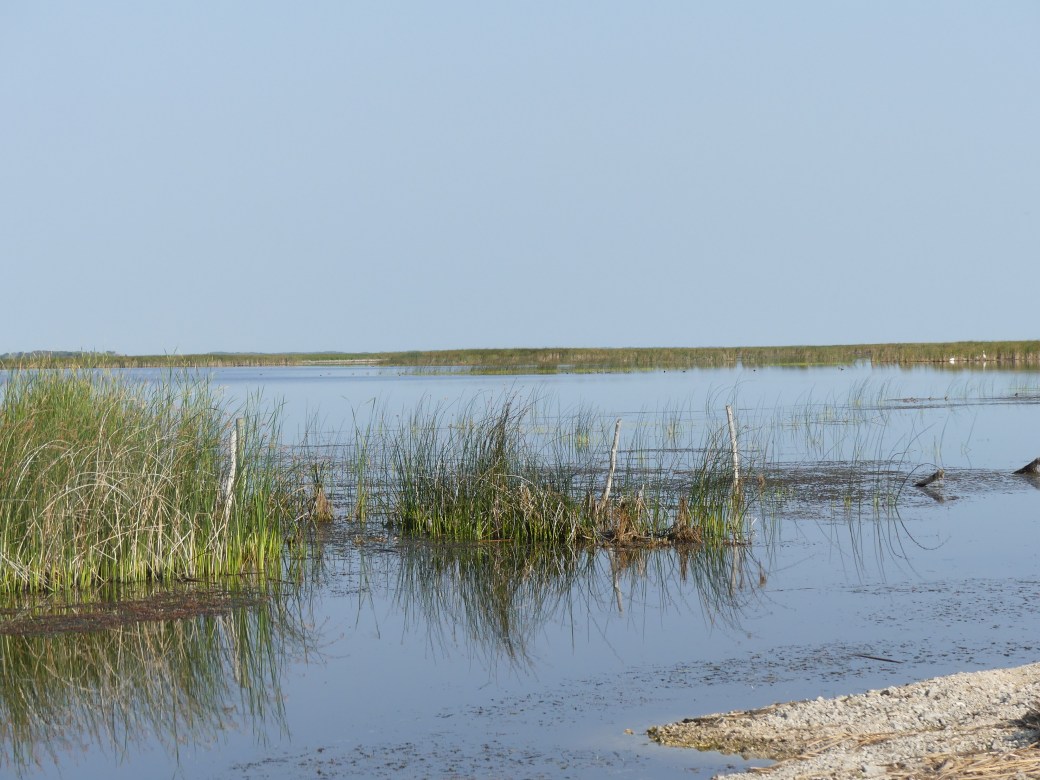
Typical wetland habitat on the side of PR415. Copyright Tim Poole
The shorebird list started to pick up. Pectoral Sandpipers flew overhead. Least Sandpipers were appearing and Semipalmated Plover were spotted distantly feeding on mudbanks in what must have been flooded fields. Pelicans and Caspian Tern also gathered on the shores in small groups. Great Egrets were also regularly popping up, as were the obligatory Bald Eagle and Northern Harrier.
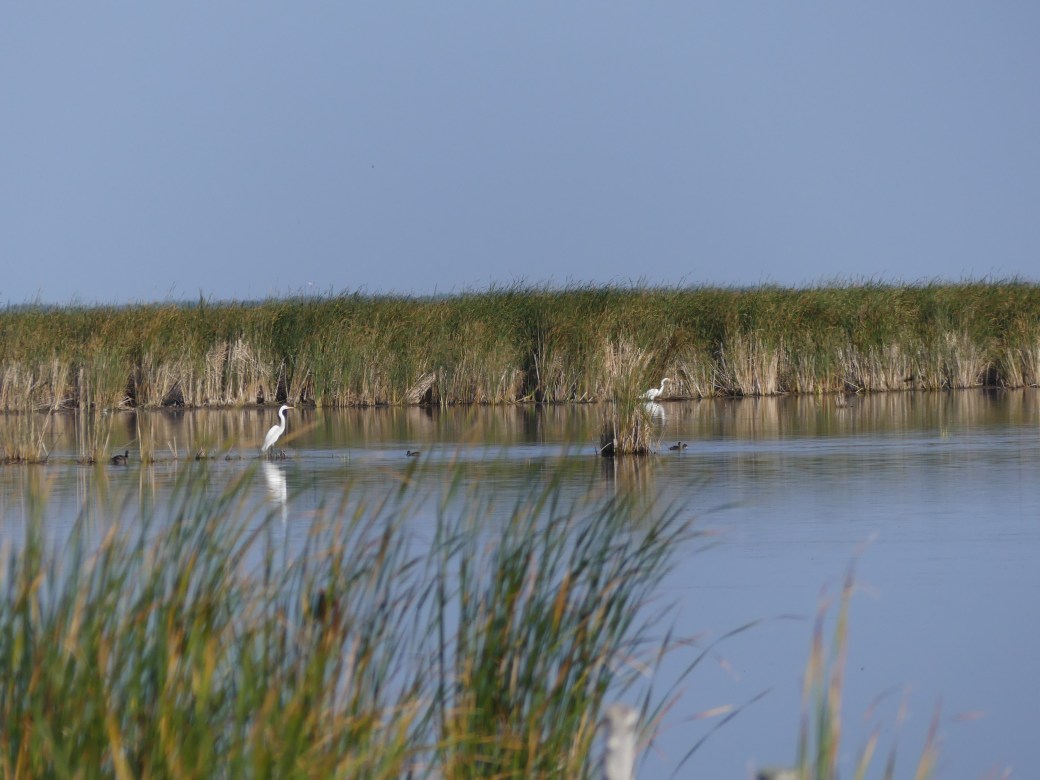
Great Egrets were relatively abundant along PR415, at least 26 being spotted. Copyright Tim Poole
Around the bend, and things would not slow up. eventually, about a mile from the east shoreline of North Shoal Lake, I could make out Western Grebes, both on within the adjacent wetlands, and in the lake itself. Over 150 were present here. A couple of juvenile Blac-crowned Night Heron flush, followed by a duck, and lo and behold, a Least Bittern, a marvelous miniature heron. Stilt Sandpipers also made an appearance south of the road, near an abandoned hut. In fact, the hut may not be completely abandoned as evidenced by quad tracks, and a couple walking their dog.
Eventually I could see my rescuers on the far end of the track, Jo, Betsy and Sabina, and I made my way to safety. Well, I say safety, but to my surprise, the Sora and Virginia Rail numbers were not what I expected, the road being completely dry in all but one slightly muddy spot.
In total I noted 86 species of bird, including 12 species of shorebird. numbers were not significant in any areas, but it is clear to me that if the lake levels continue to drop, the habitat is going to become very VERY suitable for shorebirds.
Finally, a note on the road. This road has been closed since the three Shoal Lakes became one (didn’t the Spice Girls sing a song about this?). Most of the road would be driveable now, if it were not for some small areas of extreme damage. The western end is especially bad, probably due to people attempting to drive on a flooded road. There is also a hole in the road in the east end, which would be impossible for a vehicle to drive over. On the other hand, it is an excellent walk. I wore rubber boots (wellies), and needed them briefly when I left the road, and at one low point, but even then, the water was very shallow.
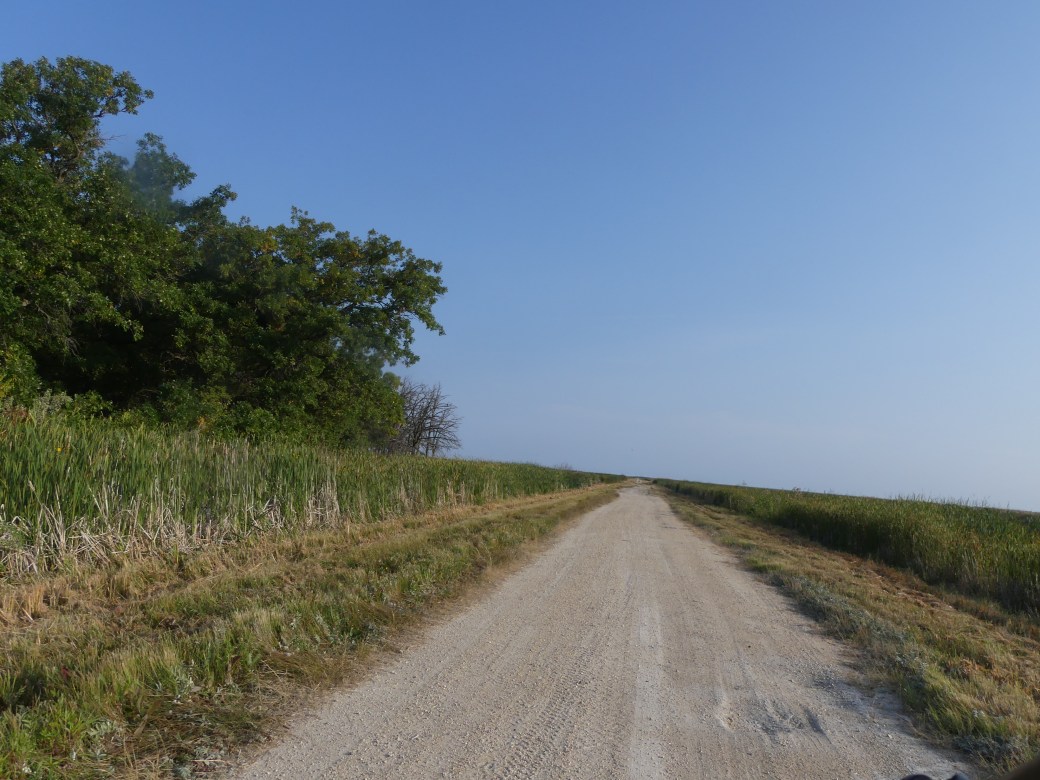
Typical image of PR 415. Some spots are more vegetated, and there are a few pinch points where the road is impassable, but a pleasant, easy walk all the same. Copyright Tim Poole
Group 4 (checklist)
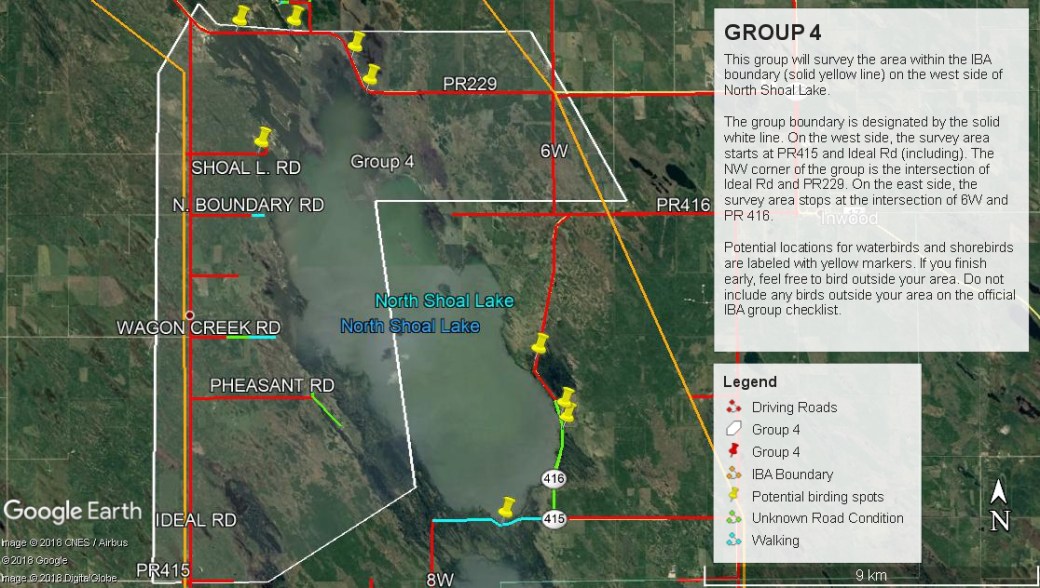
Has any IBA blitz group been as overloaded with very highly regarded birders as this one? Gene Walz (author of ‘Happiness is a Rare Bird), Rudolf Koes, and Peter Taylor (all three were contributors to the ‘Birds of Manitoba’, Rudolf doing the spectacular paintings, and Peter being the editor-in-chief, plus Rudolf and Peter are editors of the Manitoba Breeding Bird Atlas). That’s some team – no pressure guys!
This group counted around the northern end of North Shoal Lake. In total they found 86 species, including 10 species of shorebird. Highlights included 47 Semipalmated Plover, and 58 Killdeer. They also found 5 Red-headed Woodpecker.
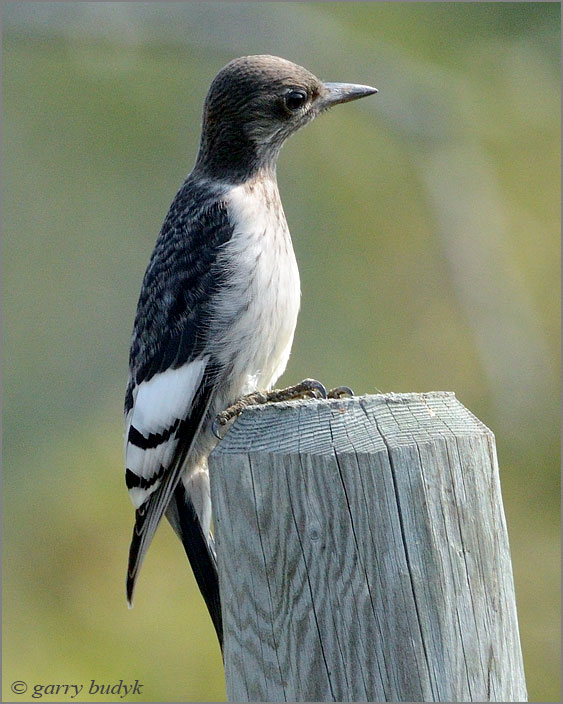
Recently fledged Red-headed Woodpecker. Copyright Garry Budyk
Group 5 (checklist 1, checklist 2)
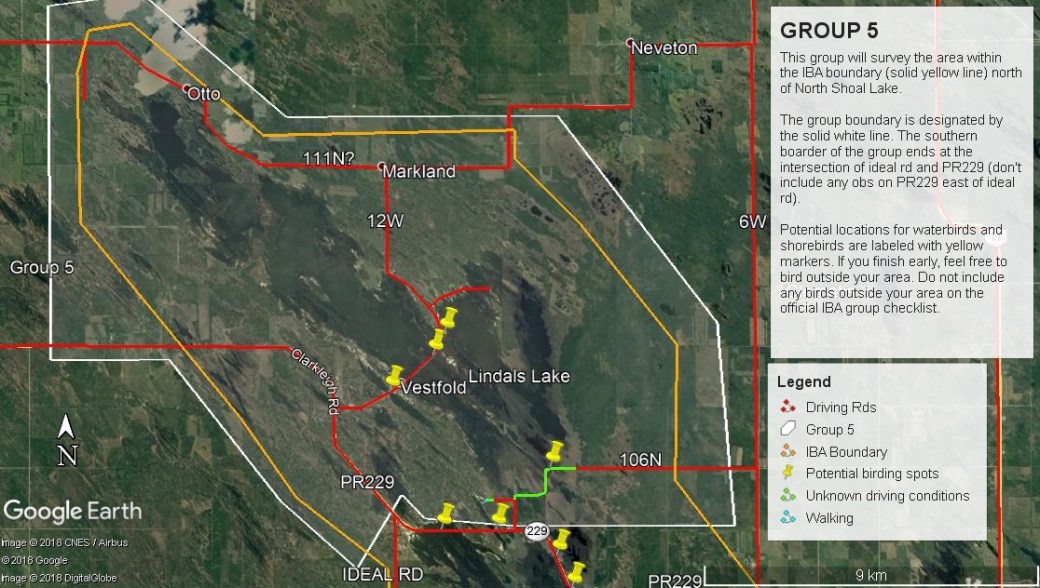
A couple of years ago, we designed an IBA extension to take in an area north of North Shoal Lake around Lindal’s Lake. this area was covered by Garry, John W and John H.

The two John’s attempting to find a bird in the early morning mist. Copyright Garry Budyk
This group also managed to find a fair few Red-headed Woodpecker, a total of 9 including 5 juveniles. Another Species-at-risk recorded was the Bobolink, the group finding 4 in total.
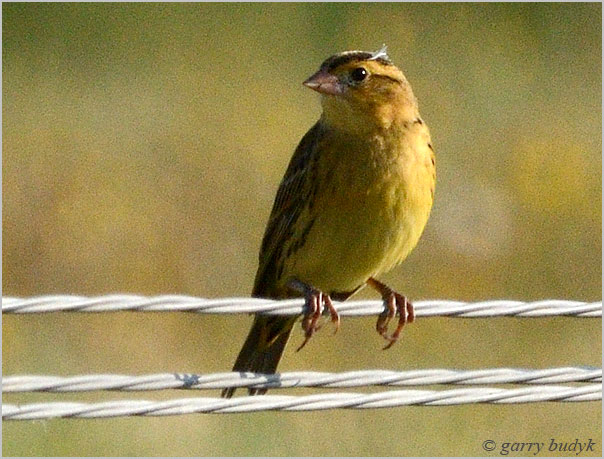
Bobolink on a wire. Copyright Garry Budyk
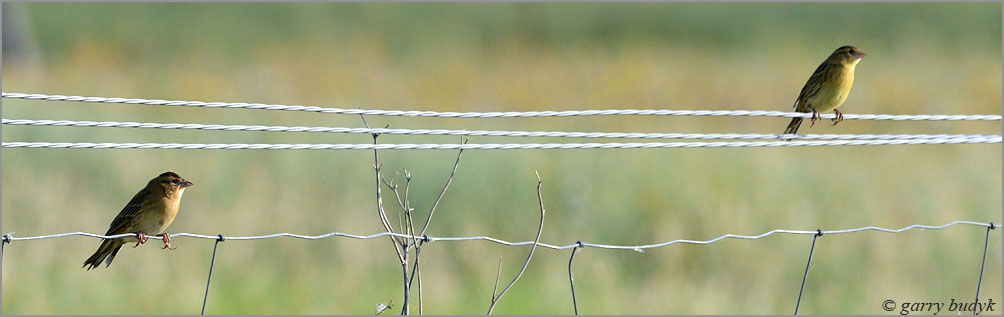
Two Bobolinks on a wire. Copyright Garry Budyk
Another treat was the group of 12 Trumpeter Swans, a species which is a great success story having once been extirpated from our province.
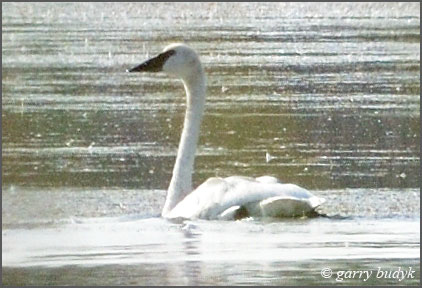
Trumpeter Swan on Lindal’s Lake. Copyright Garry Budyk
Group 6 (checklist)
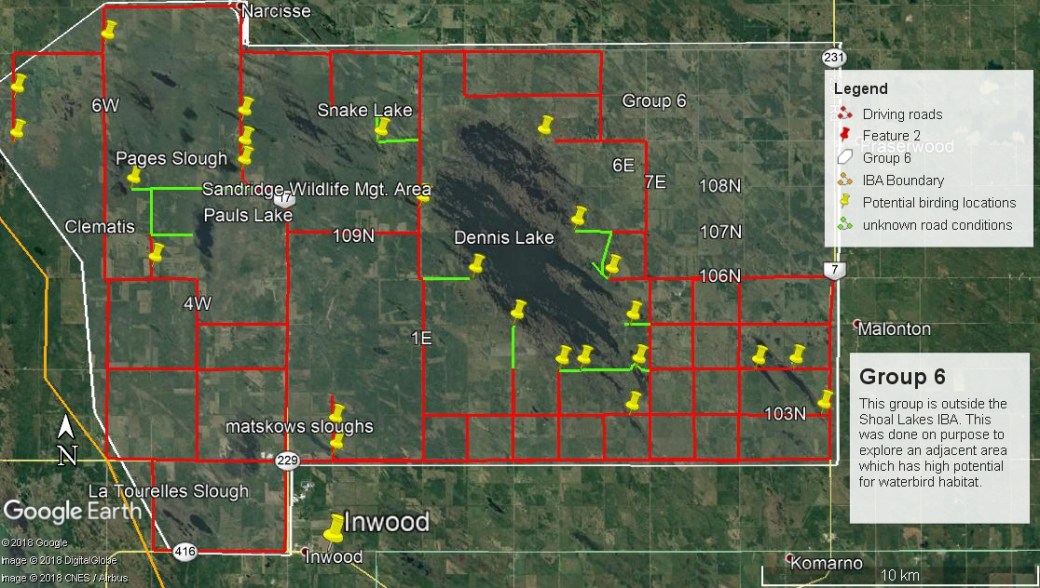
Bonnie, Pat and Dave were our final group, and we set them a task of looking for birds around Dennis Lake, north of Inwood, and outside the IBA boundary. This was an interesting section, very little in the way of waterbirds, but with a fair few Red-headed Woodpeckers, at least 6 in total. Sharp-shinned Hawk was another highlight. There appeared to be good numbers of Barn Swallows, over 200 in fact, and even a couple of Brown Thrasher.
Thanks!
Before heading to the results section, thank you to everyone, Jo, Betsy, Sabina, Chris, Jock, Ken, Lewis, Katharine, Jenny, Lynnea, Rudolf, Peter, Gene, Garry, John W, John H, Pat, Dave, and Bonnie. Thank you especially to the anonymous donor who paid for lunch for everyone at Rosie’s in Inwood, and our other supporters, including Environment and Climate Change Canada, Manitoba Fish and WIldlife Enhancement Fund, TD Friends of the Environment Foundation, and Noventis Credit Union.

Blitz groups 1, 3 and 6. Copyright Tim Poole

Blitz groups 2, 4 and 5. Copyright Lynnea Parker
Results
A total of 152 species and 7,868 individuals was impressive. This included 15 species of shorebird. The most abundant species was the Barn Swallow, with 994 individuals counted, and followed by western Grebe, a very tidy 900 individuals. Least Bittern were spotted on two occasions.
Red-headed Woodpecker – Before posting the total number of birds, we thought it would be good to show a map of the distribution of Red-headed Woodpeckers. 18 were recorded in the IBA, and this would equate to a trigger under the national criteria. We also counted 7 outside the IBA boundary, to give a total of 25.

| Canada Goose | 440 |
| Trumpeter Swan | 12 |
| Wood Duck | 13 |
| Blue-winged Teal | 441 |
| Northern Shoveler | 29 |
| Gadwall | 63 |
| American Wigeon | 1 |
| Mallard | 546 |
| Northern Pintail | 6 |
| Green-winged Teal | 26 |
| dabbling duck sp. | 150 |
| Canvasback | 52 |
| Redhead | 13 |
| Ring-necked Duck | 21 |
| Lesser Scaup | 5 |
| Bufflehead | 1 |
| Common Goldeneye | 8 |
| Hooded Merganser | 13 |
| Ruddy Duck | 27 |
| duck sp. | 128 |
| Pied-billed Grebe | 51 |
| Red-necked Grebe | 3 |
| Eared Grebe | 2 |
| Western Grebe | 900 |
| Rock Pigeon | 12 |
| Mourning Dove | 31 |
| Ruby-throated Hummingbird | 1 |
| Virginia Rail | 1 |
| Sora | 5 |
| American Coot | 220 |
| Sandhill Crane | 38 |
| American Avocet | 9 |
| Semipalmated Plover | 59 |
| Killdeer | 84 |
| Stilt Sandpiper | 20 |
| Baird’s Sandpiper | 13 |
| Least Sandpiper | 98 |
| Pectoral Sandpiper | 34 |
| Semipalmated Sandpiper | 13 |
| peep sp. | 41 |
| Long-billed Dowitcher | 1 |
| Short-billed/Long-billed Dowitcher | 6 |
| Wilson’s Snipe | 23 |
| Spotted Sandpiper | 3 |
| Solitary Sandpiper | 12 |
| Greater Yellowlegs | 62 |
| Willet | 2 |
| Lesser Yellowlegs | 87 |
| Greater/Lesser Yellowlegs | 23 |
| shorebird sp. | 30 |
| Bonaparte’s Gull | 22 |
| Franklin’s Gull | 10 |
| Ring-billed Gull | 113 |
| Herring Gull | 4 |
| gull sp. | 113 |
| Caspian Tern | 11 |
| Common Tern | 3 |
| Forster’s Tern | 16 |
| Common Loon | 1 |
| Double-crested Cormorant | 40 |
| American White Pelican | 480 |
| American Bittern | 4 |
| Least Bittern | 2 |
| Great Blue Heron | 13 |
| Great Egret | 64 |
| white egret sp. | 1 |
| Black-crowned Night-Heron | 6 |
| Turkey Vulture | 8 |
| Northern Harrier | 16 |
| Sharp-shinned Hawk | 2 |
| Cooper’s Hawk | 7 |
| Bald Eagle | 28 |
| Red-tailed Hawk | 51 |
| Belted Kingfisher | 12 |
| Yellow-bellied Sapsucker | 21 |
| Red-headed Woodpecker | 25 |
| Downy Woodpecker | 9 |
| Hairy Woodpecker | 13 |
| Pileated Woodpecker | 1 |
| Northern Flicker | 16 |
| woodpecker sp. | 1 |
| American Kestrel | 26 |
| Merlin | 9 |
| Peregrine Falcon | 1 |
| Eastern Wood-Pewee | 9 |
| Yellow-bellied Flycatcher | 1 |
| Alder Flycatcher | 1 |
| Least Flycatcher | 21 |
| Empidonax sp. | 1 |
| Eastern Phoebe | 8 |
| Great Crested Flycatcher | 6 |
| Western Kingbird | 1 |
| Eastern Kingbird | 24 |
| Warbling Vireo | 28 |
| Red-eyed Vireo | 5 |
| Blue Jay | 29 |
| Black-billed Magpie | 60 |
| American Crow | 108 |
| Common Raven | 52 |
| Purple Martin | 5 |
| Tree Swallow | 12 |
| Bank Swallow | 2 |
| Barn Swallow | 994 |
| swallow sp. | 55 |
| Black-capped Chickadee | 19 |
| Red-breasted Nuthatch | 4 |
| White-breasted Nuthatch | 7 |
| House Wren | 7 |
| Sedge Wren | 26 |
| Marsh Wren | 139 |
| Eastern Bluebird | 13 |
| Swainson’s Thrush | 2 |
| American Robin | 60 |
| Gray Catbird | 45 |
| Brown Thrasher | 6 |
| European Starling | 251 |
| Cedar Waxwing | 70 |
| House Finch | 1 |
| Purple Finch | 1 |
| American Goldfinch | 86 |
| Chipping Sparrow | 13 |
| Clay-colored Sparrow | 39 |
| White-throated Sparrow | 5 |
| LeConte’s Sparrow | 1 |
| Savannah Sparrow | 14 |
| Song Sparrow | 47 |
| Lincoln’s Sparrow | 2 |
| Swamp Sparrow | 9 |
| sparrow sp. | 13 |
| Yellow-headed Blackbird | 42 |
| Bobolink | 5 |
| Western Meadowlark | 14 |
| Baltimore Oriole | 1 |
| Red-winged Blackbird | 100 |
| Brewer’s Blackbird | 33 |
| Common Grackle | 126 |
| blackbird sp. | 52 |
| Northern Waterthrush | 9 |
| Black-and-white Warbler | 5 |
| Tennessee Warbler | 6 |
| Nashville Warbler | 7 |
| Common Yellowthroat | 64 |
| American Redstart | 4 |
| Cape May Warbler | 1 |
| Magnolia Warbler | 1 |
| Blackburnian Warbler | 1 |
| Yellow Warbler | 11 |
| Blackpoll Warbler | 1 |
| Palm Warbler | 7 |
| Yellow-rumped Warbler | 4 |
| Rose-breasted Grosbeak | 2 |
| House Sparrow | 42 |
Blast from the past: Historical observations and fall birding in southern Manitoba
In Manitoba, birding in the fall can be either be an exciting time or a drab experience depending on what your goals are. As September draws closer, the soundscape steadily becomes hushed except for the occasional call note or song. While the dawn chorus we all love has become rather muted of late, there is still much to be seen with a keen eye and some spare time.
Fall warblers are currently migrating through southern Manitoba, providing many excellent opportunities to see species which you may have missed in the short window of spring migration. Although, I must admit that identifying fall warblers is much more challenging than in the spring. If you are like me, you will need a refresher on how to ID warblers in their fall plumage. A great resource can be found here, by the McGill Bird Observatory. Great places to visit for fall warblers include forested areas along the Assiniboine River in Brandon, Portage la Prairie, and Winnipeg. In Winnipeg, visiting the English Gardens at Assiniboine Park is a must!
- Other great places to search for fall warblers in Winnipeg:
- English Gardens at Assiniboine Park
- Bruce Park
- Kings Park
- La Barriere Park
- Kildonan Park
- Bunn’s Creek Centennial Park
If warblers do not peak your interest, maybe migratory waterfowl and cranes will. As the evenings begin to get cooler, you may have noticed the slight return of cranes, geese, and ducks in larger numbers. Numbers will continue to build until October-November, when massive flocks can be seen in the air, agricultural fields, and wetland areas. Good places to witness these magnificent congregations of birds for yourself include:
Oak Hammock Marsh
The South Interlake region of Manitoba includes Oak Hammock Marsh, a well-known and appreciated birding destination. Huge numbers of migratory birds have been recorded here in the past. Some noteworthy historical observations from Oak Hammock Marsh include:
- 210,000 Snow Geese and 150,000 Canada Geese on October 19th, 1985 (R. Parsons)
- 585 Tundra Swan on November 11th, 1978 (W. Neily)
- 10,000 Mallard on November 1st, 1993 (R. Parsons)
- 1,500 Blue-winged Teal on August 30th, 2010 (K. Jensen)
- 51,000 Red-winged Blackbirds on September 20th, 2016 (E. Jenkins)

Large flocks of Snow Goose, photo by Tim Poole.
North, East, & West Shoal Lakes IBA
This Important Bird Area is located an hour northwest of Winnipeg. These three lakes support large numbers of migratory waterbirds including grebes, pelicans, geese, swans, and ducks. While viewing access can be limited, a good birding scope and some pointers on where to look are sure to be rewarding. If you need advice on how to access good birding locations at Shoal Lakes IBA, please email a request for information to our program coordinator Tim Poole.
On Sunday August 27th, we led a Bioblitz to this IBA with 20 birders, enabling us to get coverage of the whole IBA. This event will be detailed in an upcoming blog post.

Three American White Pelicans at West Shoal Lake, early morning. Photo by Lynnea Parker.
Oak Lake and Plum Lakes IBA
Like clockwork, large flocks of Sandhill Cranes arrive in southwestern Manitoba each fall. Stubble fields around Oak Lake and Plum Lakes IBA are a good place to look for these prehistoric sounding birds. Amazingly, Tim Poole and Christian Artuso stumbled upon 7,363 cranes within the IBA, on the western side of Oak Lake on October 24th, 2017. Other notable historic counts include:
- 863 Tundra Swan on October 27th, 2017 (T. Poole)
- 815 Canvasback on October 26th, 2017 (C. Artuso)
- 900 Ruddy Duck on September 13th, 2015 (G. Richards)
- 400 American Golden Plover on October 8th, 1990 (Birds of Manitoba Archive)

Flock of Sandhill Cranes by Oak Lake, photo by Linda Boys.
Whitewater Lake IBA
Whitewater Lake is arguably one of Manitoba’s top birding destinations. Despite its claim to fame, it is one of the less well known IBAs in southern Manitoba. While Whitewater Lake is a worthy destination in spring and summer, it is also worth taking a trip in the fall. Just last week Lynnea Parker and Tim Poole attended this IBA to conduct a series of shorebird surveys.
Exceptional counts from Whitewater include:
- 1,884 Eared Grebe and 963 Stilt Sandpiper on August 6th, 2017 (C. Artuso)
- 20,000 Bank Swallow on August 7th, 2018 (R. Parsons)
- 1,900 Western Grebe on August 6th, 2017 (Manitoba IBA)
- 3,133 American Avocet on August 7th, 2016 (C. Artuso)
- 1,640 Tundra Swan on November 14th, 2016 (C. Artuso)
- 50,000 Snow Geese and 10,000 Canada Geese on October 26th, 2006 (D.M. Bell)
- 270 Cattle Egret on September 14th, 2005 (R. Parsons)
- 3,000 Lapland Longspur on September 23rd, 2002 (R. Parsons)

Large gatherings of Bank Swallows at White Water Lake, photo by Lynnea Parker
International Shorebird Survey at Whitewater Lake, Survey 2
What a site, what a moment. The sky is alive with shorebirds – hundreds, thousands! As a birdwatcher, it is moments like this that you wait for, and moments like this that make shorebirds such an appealing and wonderful group of birds.

The sky is alive with shorebirds! Copyright Tim Poole
This is our second ISS report for fall migration, 2018. A quick reminder first. Manitoba IBA are working with Manomet, Bird Studies Canada, NCC and Environment and Climate Change Canada to establish the International Shorebird Survey (ISS) in Manitoba. In July, Manitoba’s first ISS surveys were carried out at Whitewater Lake and Oak Lake (a detailed report, with full results and photos, can be viewed here). These surveys were carried out successfully, although Whitewater was notably more productive than Oak Lake in terms of shorebird numbers (Plum Lakes were overflowing, likely due to drainage outside of Manitoba). The most impressive numbers of shorebirds at Whitewater back in late July pertained to both dowitcher species, notably, and surprisingly, Long-billed Dowitcher, a species more commonly associated with late fall in Manitoba.
On Thursday, August 22nd, Lynnea Parker and I (Tim Poole), left Winnipeg early morning, before the sun had risen and the birds were chipping (it being fall of course birds tend to chip more than sing). A quick detour to collect some forgotten binoculars and check the check engine light, and we were off. Highway number 2 was fairly quiet, just a few Red-tailed Hawks, and the occasional mass gathering flocks of pre-migratory blackbirds to keep us company.
Arriving at Whitewater Lake, we decided to begin with the eastern ISS route. This meant we would not have the sun low directly behind any birds when we eventually arrived in the west. The eastern route is based in the northeastern corner of the IBA (see map below). In July, we ran out of time to look at the hatched area referred to as WWL_E3 below, but we made time on this occasion.

Stop 1, and there were fewer birds than last time. A possible sign of what was to come? Sharp-tailed grouse were feeding on the grass near the edge of the water, and a couple of Bald Eagles were standing on the ground at the waters edge. Interestingly, the shorebirds appeared to pay little attention to the eagles on the ground. I suspect they would have been a lot less relaxed if the eagle was in the air! Water levels appeared, if my memory is correct, to have receded since July.
We had good numbers of shorebirds, but nothing spectacular. The most interesting count was of 66 Black-bellied Plover, feeding in the grasslands at the edge of the water. 174 Least Sandpipers was the highest total of any species. There were also 78 American Avocet, a sharp drop from over 400 in July. There were also a 22 Marbled Godwit.

Marbled Godwit in flight. Copyright Tim Poole
Onto transect 2, and a Semipalmated Sandpiper managed to get itself caught on the road ahead. The wetlands appeared if anything, even drier than the sparse state encountered in July, the road was bone dry, and a poor sandpiper did not know where to go! This was the only shorebird on this transect – and it did eventually move off the road. We decided we would do the entire transect 3. Before heading west to the start of the transect, Lynnea spotted an American Bittern, and then even better, she spotted a group of juvenile Black-crowned Night Herons!

How many herons can you spot? Copyright Tim Poole

Where did the spare come from? Copyright Tim Poole
As the designated drive, Lynnea took her life in her own hands, and decided to drive her truck down the overgrown track, marked as the cross hatch on the map above. I thought better of it, and walked in front, the road looking somewhat disastrous in my eyes. In fact, we would need the truck for monitoring purposes, for reasons which will imminently become clearer.
Smaller flocks of peeps were darting around our heads as we made our way along the track. A large muddy field on the south side of the track did not look promising – until inspecting a shrinking pool of water a bit closer. At least 400 shorebirds were mingling out here, including Black-bellied Plover, Semipalmated Plovers (at least 80), and plenty of smaller sandpipers. A couple of Buff-breasted Sandpiper were also foraging in the sparse grass, although the strong sun and distance made identification a challenge. Eventually, we teased out that the flock was dominated by Least Sandpipers, with a few scattered Baird’s and Semipalmated Sandpipers.
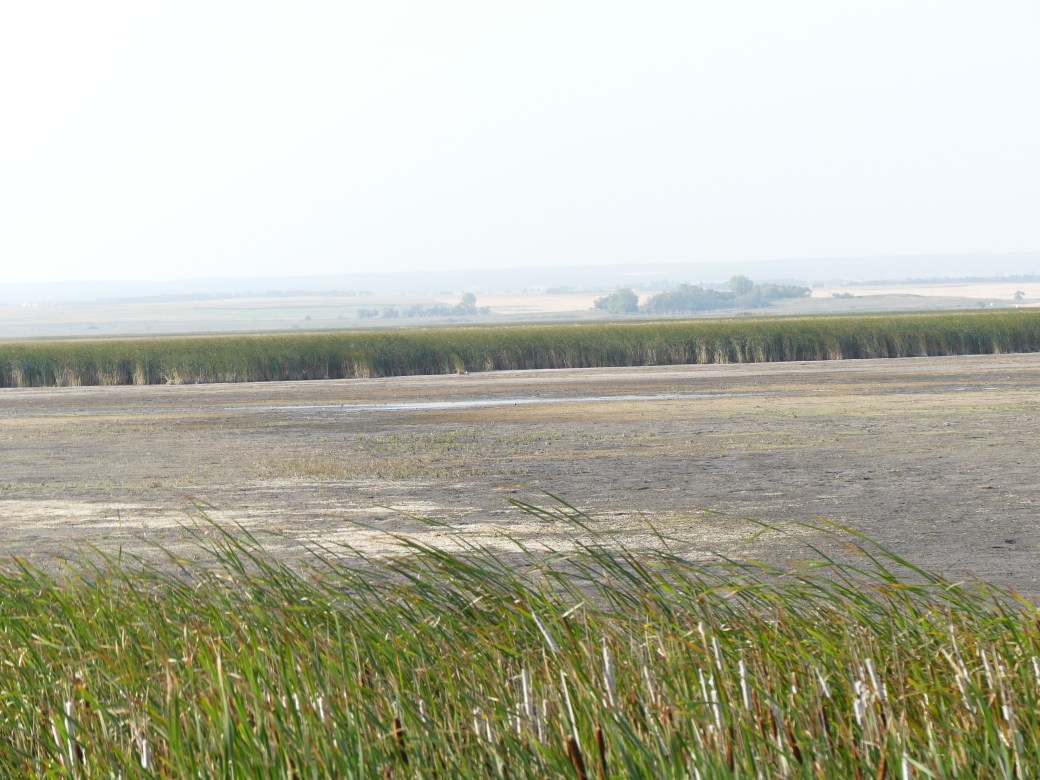
A muddy puddle, habitat to over 400 shorebirds. Copyright Tim Poole
While counting these birds, my eyes kept straying north and west, being pulled over by a mass of birds flying around. Thousands of shorebirds seemed to be flocking together, a wish to be counted evident in their continuous straining for our attention. This would be a challenge. We finished up on the south, and Lynnea edged the truck forward, hoping to avoid getting stuck in one of the many holes. A warning to anyone wishing to do ISS, or any birding here, the track is rough, very overgrown, and full of deep holes, so please be careful if you walk or drive.

A small sample of a larger whole. Copyright Tim Poole

Gulls and shorebirds. Look carefully at the back for a lot more shorebirds in a second flock, and along the shore at the rear. Copyright Tim Poole
The truck was very helpful though, one might even say, critical. It allowed us to watch the shorebirds from an elevated height, standing on the bed to look over the tall cattails. Sizeable flocks of smaller sandpipers, dominated by Semipalmated Sandpipers was our reward to getting up higher and scoping across. Given an estimated of 80% of this species, and an estimated flock size of over 4,000, we had a total area count of 3,290 Semipalmated Sandpipers. There were also Least’s and Baird’s Sandpipers in small, but still reasonably good numbers.
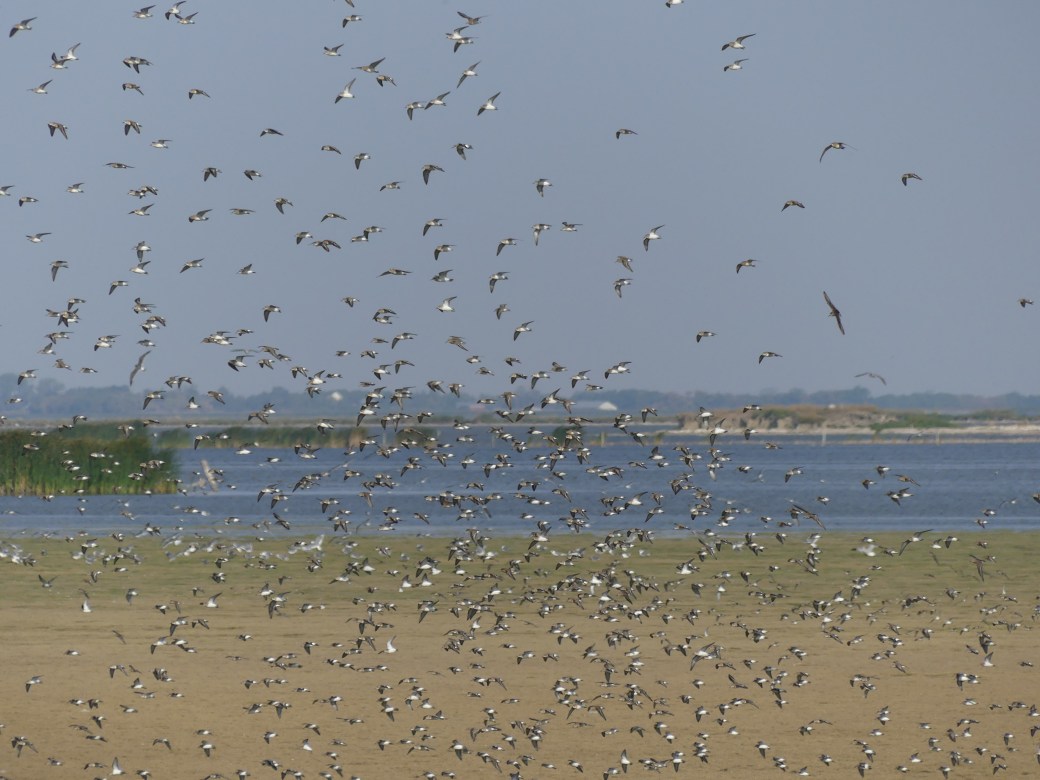
Large flock of shorebirds. The flock kept flushing and scattering, so that at times, we were losing birds, and times finding more. At one point, there were at least 6,000-8,000 shorebirds in sight. Copyright Tim Poole
A large flock of Franklin’s Gulls would flush and seemingly ‘dance’ with the flocking shorebirds, neither mixing, but both together, like oil and water.
Franklin’s Gulls on top, shorebirds underneath. Note the shorebirds along the shore behind the gulls in the left of the photo. Copyright Tim Poole
I pulled out three Buff-breasted Sandpiper, and tried to point them out to Lynnea. This would turn out to be a lifer for her. She found four – even better. When I asked her where her ‘buffies’ were, she pointed to the left of my three. When the entire surrounding flock of peeps took off, we were left with seven, yes SEVEN Buff-breasted Sandpipers. It was a remarkable support of our counting, given we had picked them out from the hundreds of other sandpipers!

Ok, not great, but I still think you can see these are Buff-breasted Sandpipers, even with such a lousy photo. Copyright Tim Poole
By my count, there were several thousand shorebirds along the shore, too distant to identify, apart from a flock of at least 100 Pectoral Sandpiper which flushed at an opportune moment, and at least 50 Marbled Godwit in the water. There were also some Canada Geese, and various distant ducks and waterbirds.

Canada Geese and various waterbirds at Whitewater. note the dotted shorebirds along the shore. The furthest corner of this bay had very high concentrations, which were too far even to be worth trying to photograph. Copyright Tim Poole
Lynnea executed a thirty point turn, and we were back on the main gravel road soon enough. The last mile of the transect being pretty much birdless. We headed over to the west, stopping briefly at Sexton’s for an extra ISS point. Here we saw little in the way of shorebirds, a Spotted Sandpiper, Killdeer and yellowlegs alone. We then drove to our western ISS start (map below).

By my estimate, water levels have been dropping all summer, and still are. There was very little water left in many ephemeral wetlands, to the extent that shorebirds numbers were much thinner on the ground. We were able, for the most part, to drive through much of this route quickly, checking where there was water for shorebirds, but seeing relatively few. Our total number of dowitchers for example, would total just over 2% of the total we counted in July. These species appeared to have moved on already.
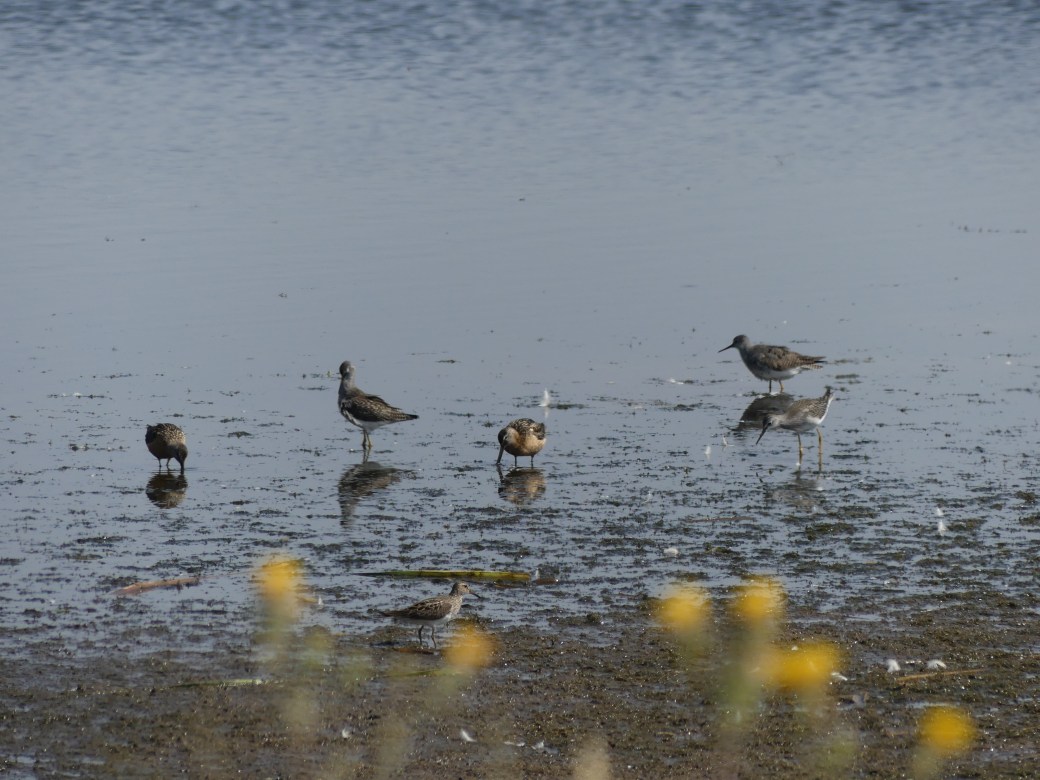
The dowitcher totals were miniscule compared to July. Seen here with Lesser Yellowlegs and Pectoral Sandpiper. Copyright Tim Poole
The lake water levels on the third transect were intriguing, with a line of ‘beach’ beginning to develop in areas which, just two years ago, were under water. Away from the lake, there were no shorebird spots. There was a nice coyote though!
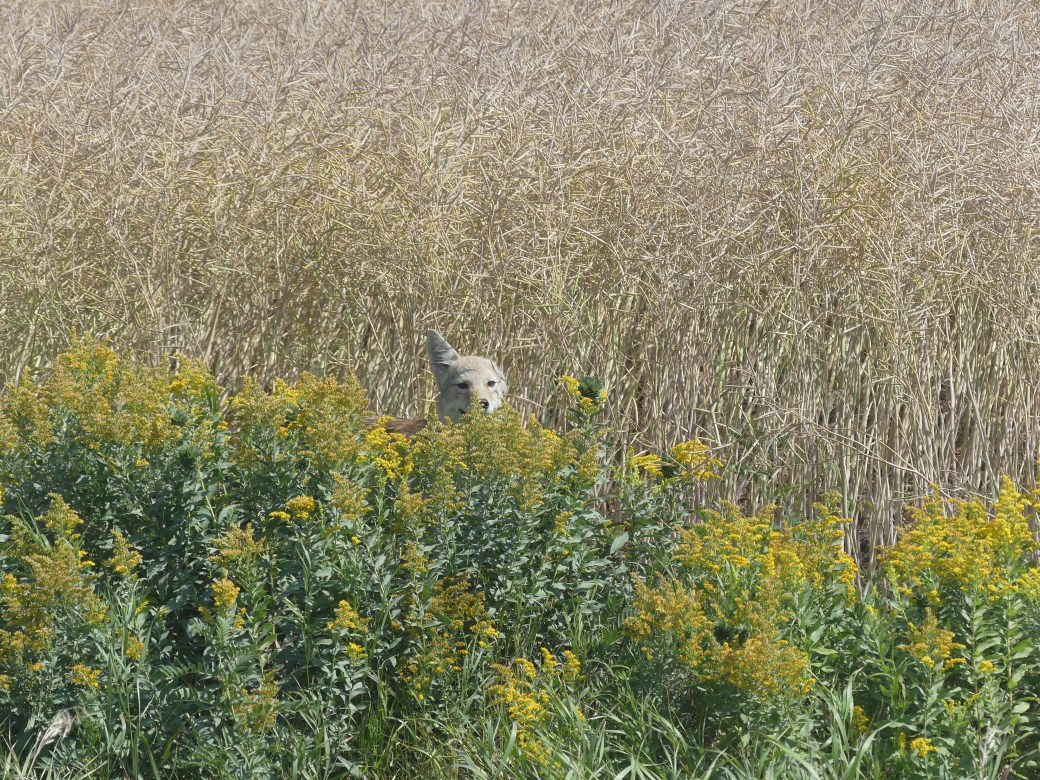
Coyote trying to hide. Copyright Tim Poole
Lynnea was introduced on our drive back to Boissevain to the glories of swallows in fall! Tree’s, Bank’s and Cliff’s were dispersed all over the road. Not as many were present as in July, but it was still pretty impressive. You can view three of her photos below.

Swallows! Copyright Lynnea Parker

More swallows! Copyright Lynnea Parker

Bank Swallows! Copyright Lynnea Parker
Here are the round 1 and 2 totals for ISS at Whitewater Lake:
| Species Name | July Visit | August Visit |
| Black-bellied Plover | — | 68 |
| Semipalmated Plover | 39 | 80 |
| Killdeer | 68 | 41 |
| Upland Sandpiper | 1 | — |
| Hudsonian Godwit | 1 | — |
| Marbled Godwit | 82 | 72 |
| Stilt Sandpiper | 23 | — |
| Baird’s Sandpiper | 28 | 255 |
| Least Sandpiper | 40 | 989 |
| Buff-breasted Sandpiper | 16 | 9 |
| Pectoral Sandpiper | 139 | 143 |
| Semipalmated Sandpiper | 5 | 3,302 |
| peep sp. | — | 2,023 |
| Short-billed Dowitcher | 533 | — |
| Long-billed Dowitcher | 1,440 | 2 |
| Short-billed/Long-billed Dowitcher | 970 | 66 |
| Wilson’s Phalarope | 234 | 1 |
| Red-necked Phalarope | 2 | 1 |
| Spotted Sandpiper | 6 | 1 |
| Solitary Sandpiper | 1 | — |
| Greater Yellowlegs | 27 | 61 |
| Willet | 6 | 12 |
| Lesser Yellowlegs | 237 | 116 |
| shorebird sp. | 1 | 865 |
We hope to get the Oak Lake ISS completed for a second time by the end of this week, and then we are determined to get the third visit completed by mid-September. If you are interested in helping out, please let us know – email iba@naturemanitoba.ca.
The Weed Pull for Plovers Event
On August 16th 24 volunteers came out to the Riverton Sandy Bar IBA to help clear invasive vegetation from this bird sanctuary, jutting out into Lake Winnipeg. The presence of vegetation on this sand bar has reduced habitat quality over the past 10 years for shorebirds, gulls, and pelicans. In previous years many colonial species had used the IBA for nesting and foraging. In fact, the IBA was originally designated primarily with Piping Plover, a federally and provincially Endangered species, in mind. The annual weed pull events, which were initiated by Joanne Smith in 2016, are geared towards habitat restoration through the manual removal of vegetation (2016 post, 2017 August post, 2017 September post). Our hope is that birds will return to the sand bar to nest, with special considerations for the Piping Plover. An article was written about this event in the Express Weekly News. If you would like to read it, select the August 23rd, 2018 issue and flip to page 3.
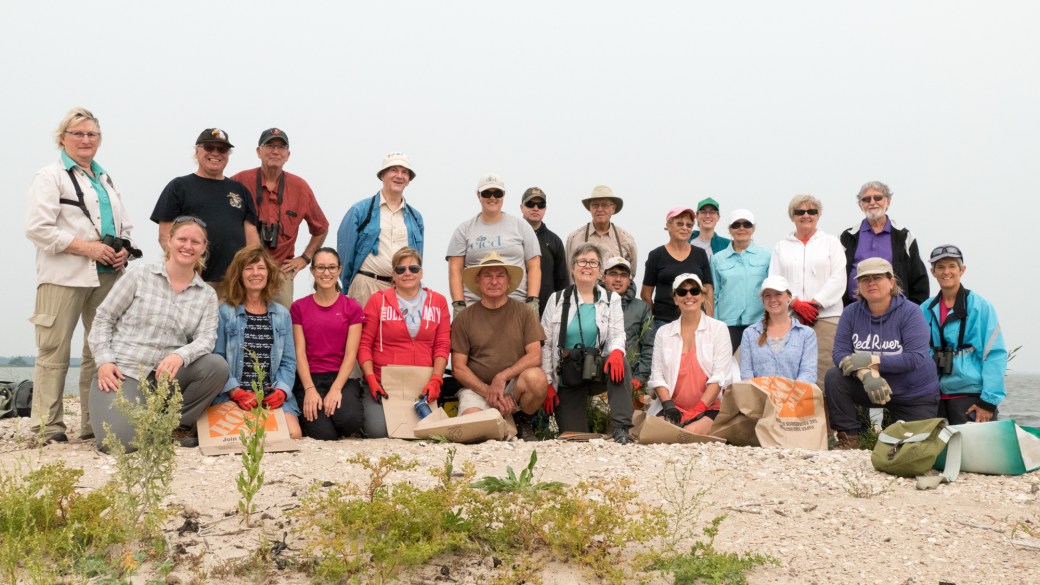
Volunteers (mentioned in no particular order): Bonnie, Lynnea, Sabina, Joanne, Peter, Al, Linda, Thor, Jock, Walter, Dries, Janice, Bridgitte, Heather, Cameron, Katie, +7 more.
On the morning of the 16th, Sabina and myself (Lynnea) (Representatives from the IBA program) drove to Sandy Bar beach from Winnipeg. We were both shocked by how smoky the sky was as we approached Gimli, which had been cast in an dark yellow haze from forest fires in British Columbia (reminded me of a post-apocalyptic movie!). The smoke in Winnipeg had been much less pronounced. By the time we arrived in Riverton the air quality had improved considerably, but the smoke did remain over the whole region. On a more positive note, the smoke likely played a role in lowering the overall day-time temperatures. It turned out to be a great day for such an event, with a mild wind and roughly 20 degrees.
At 9:00am we had muffins and donuts at the parking lot for a meet and greet before dividing up all the supplies to be carried out to the Sandy Bar (the IBA program will remember to add coffee to the order next time! Sorry folks). The area we were going to be working was approximately a 1-kilometer walk along the shoreline from the parking lot. I was very appreciative of everyone’s willingness to divvy up and help carry gloves, bags, drinks, and snacks.
When we reached our working location, it was easy to see which areas had been covered in 2017, and which had not. Areas not covered were densely vegetated with little to no open sand. Volunteers started off the morning by going over the areas covered last year to remove any additional plants that were missed or had become re-established. From there we worked outward, expanding the section of open sand bar as much as we could.
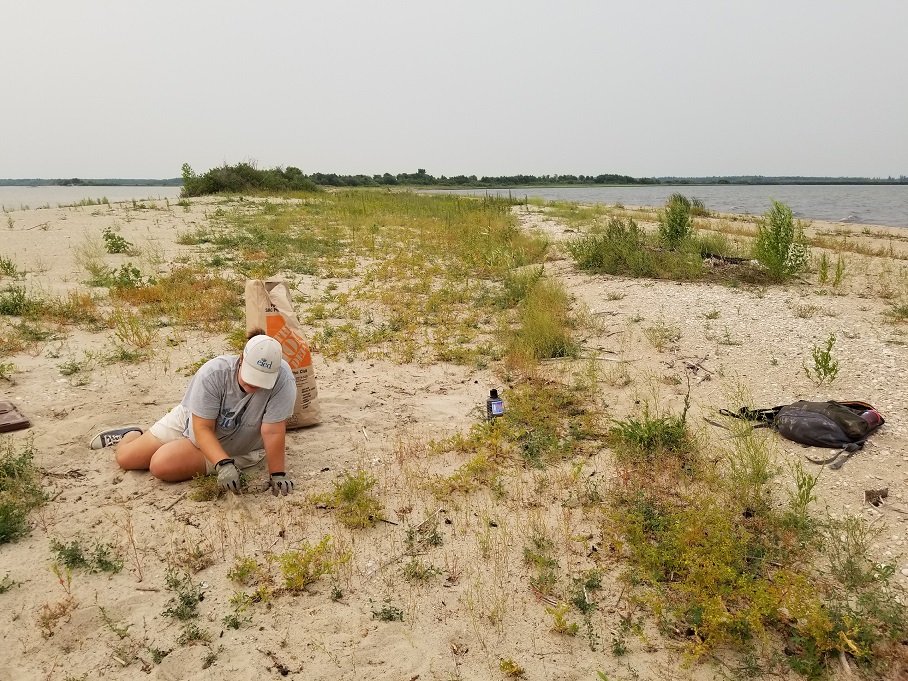
Example of a vegetated section of the bar, photo by Sabina M.
I think it is safe to say that our restoration efforts are paying off, and I am eager to see which species of birds will start to re-colonize the area. Because these weed pull events are both popular and successful, the IBA program is hoping to organize another event this fall with Joanne.
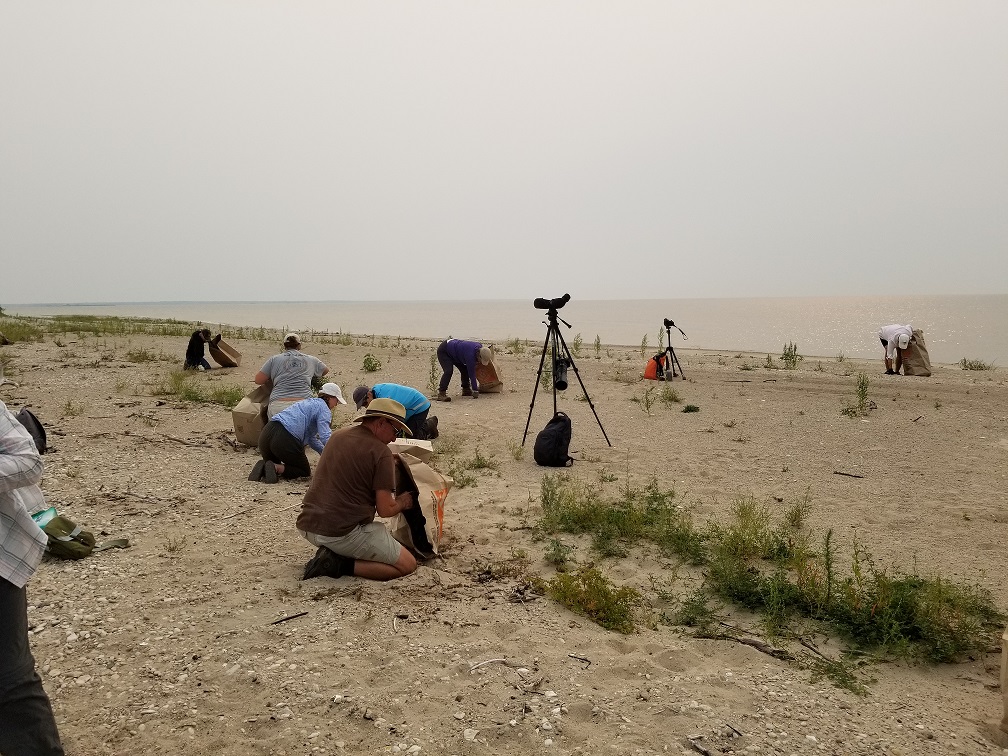
Volunteers hard at work! We did manage to completely remove all the vegetation from this area, photo by Sabina M.
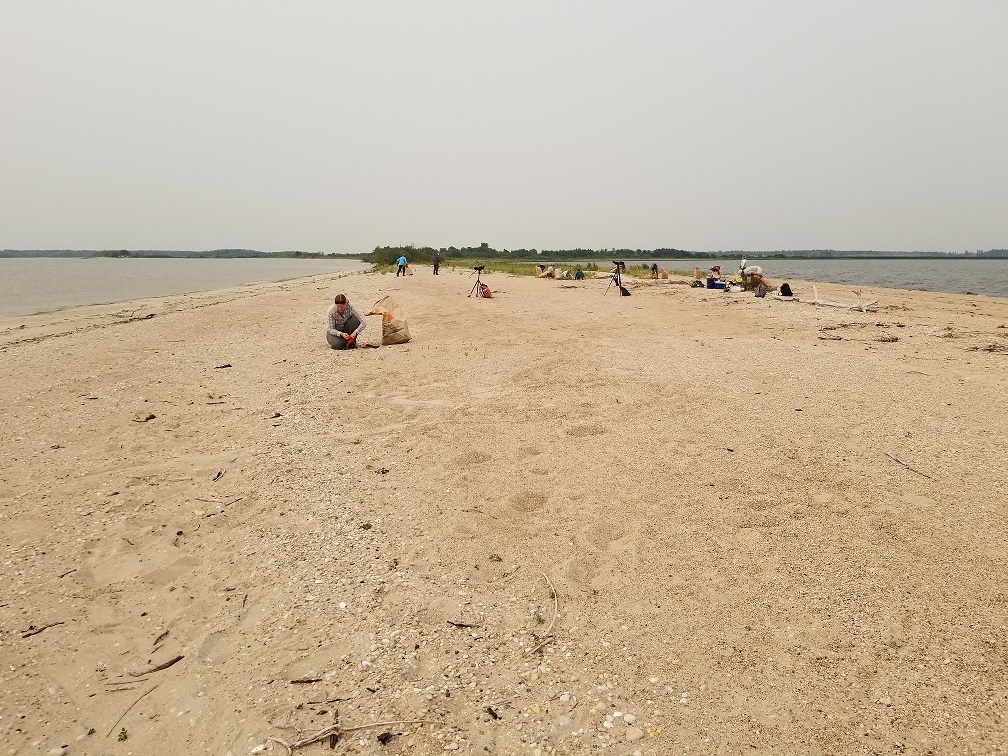
Example of the vegitation removed from an area of the sand bar, photo by Sabina M.
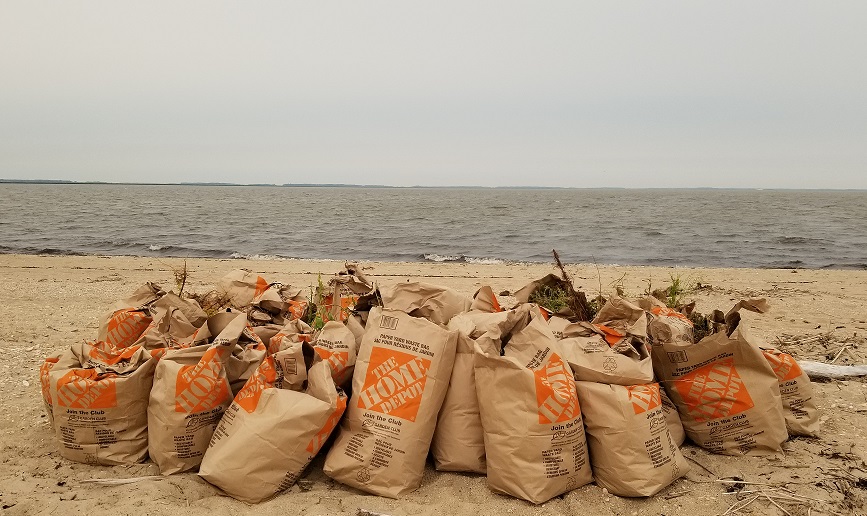
We filled approximately 40 bags of vegetation from the bar in a couple of hours #TEAMWORK! 🙂 Photo by Sabina M.
Thank you everyone for coming out and helping restore endangered species habitat here in Manitoba!

Several volunteers with their loot! Some people had already departed. Photo by Lynnea P.
For those of you interested in the bird list for the day, please see this checklist on ebird! A total of 33 species were seen, including 8 shorebirds (Black-bellied Plover, Semipalmated Plover, Least Sandpiper, Semipalmated Sandpiper, Red-necked Phalarope, Spotted Sandpiper, Solitary Sandpiper, and Greater Yellowlegs).
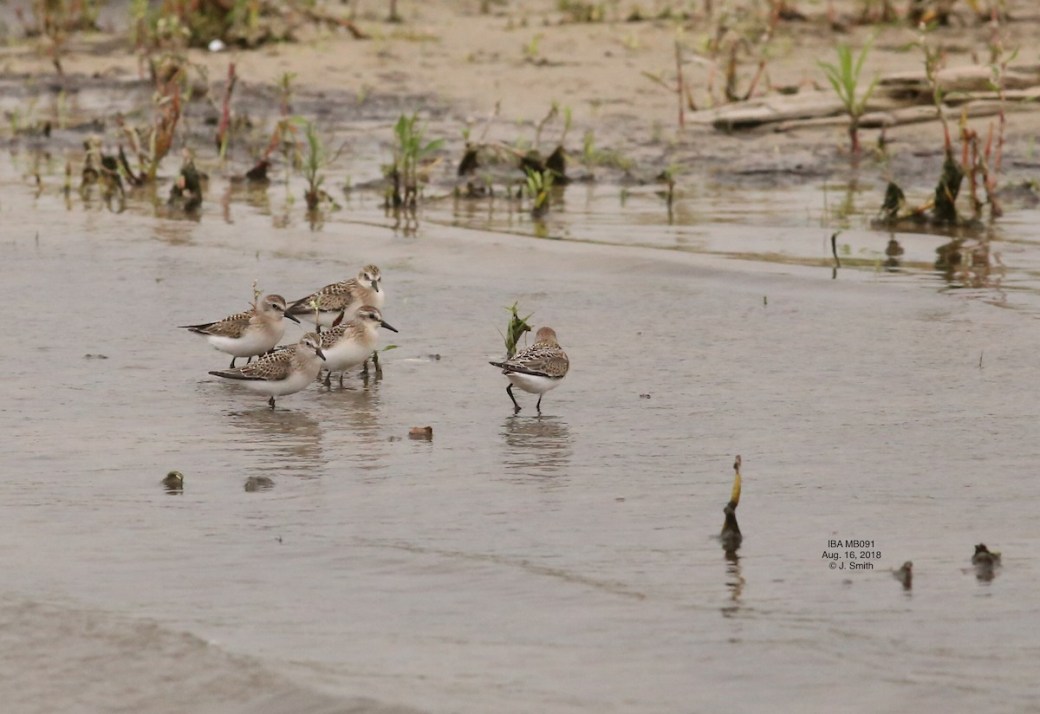
Semipalmated Sandpipers at Riverton Sandy Bar IBA, photo by Joanne S.
Thank you to the 24 willing volunteer for coming along, including the Thor and the volunteers from the town of Riverton, Nature Manitoba members, and the excellent East Interlake Conservation District. Of course, one person deserves special mention – Joanne, our leader and instigator in chief! Thank you also to our various funders, including Environment and Climate Change Canada, Manitoba Fish and Wildlife Enhancement Fund, TD Friends of the Environment Foundation, and Noventis Credit Union.
We will return!
The Results of the Delta Marsh IBA Blitz
August 12th was the day of the Manitoba IBA Programs Delta Marsh blitz. Forecasts of 36 degrees, smoke from the forest fires of western Canada and high humidex indices had given us some hard thinking before going ahead. We did, and Tim Poole reports on how the morning progressed.
The confusion started on Thursday morning. An email arrived in my inbox advising that the forecast would cause difficulties for the health and wellbeing of our volunteers. We originally planned to begin at 7am, early(ish) to ensure that we were complete ahead of the midday heat. What I had not envisioned was that the forecast would threaten record temperatures, humidity would soar, and that the dry summer in Manitoba was being experienced elsewhere, notably in western Canada, where winds had been pushing smoke from forest fires into the eastern prairies.
So I postponed – or more accurately, provisionally warned that I was inclined to postpone.
Then, following some further information during the day, I reconsidered. What if we could get things done earlier, and get out sooner? The heat would in fact only be an issue for the small group of volunteers walking on St Ambroise and Twin Lake Beaches. So, we came up with a compromise. We would make sure those walking would be finished by 10:30am, and therefore start at 6:30am. By Friday, we had done our refreshment shopping, and we were all set for a Sunday blitz.
We had set up five groups. Cal and Gord would be taking the area of the IBA west of the diversion. Gene, John and Garry would be active east of the diversion up to the main road into Delta Beach. Lynnea, Chris, Natalie and Dick birded along the northern edge of the IBA between St Ambroise and Delta Beach, and then Jo, Betsy, Bonnie and Emily took on the St Ambroise and St Marks area. Finally, Pat, Dave and Wally were to do the eastern stretch around Lake Francis and up to St Laurent. These were our driving groups. Our walking groups consisted of Christian (to Clandeboye Bay), and Randy, Jock, Amanda and Sabina (St Ambroise and Twin Lake). Me? I took on the role of support driver, water carrier, and walking assistant, making sure everyone was safe in the heat. As mentioned, we split the IBA to 5 main areas, and here is how we did it:

The intention of the blitz was to find groups of waterbirds, such as grebes, pelicans and cormornats and try to seek out any large groups of shorebirds. We had previous in this area (we had 3 reports, day 1, day 2 boating and our final tally), and went in with some hope of repeating the success of our 2016 blitz.
Lake water levels have certainly dropped in the past year. The sand bars and mudflats would surely provide habitat for high concentrations of shorebirds, especially those stopping over during their long migration. Many of these shorebirds are extreme long-distant migrants – that is they fly from the Arctic where they breed, all the way to South America. Many of these long-distant migrants are declining significantly, and therefore it is imperative that we are able to produce good quality data to demonstrate the importance of Manitoba wetlands to this group of birds.
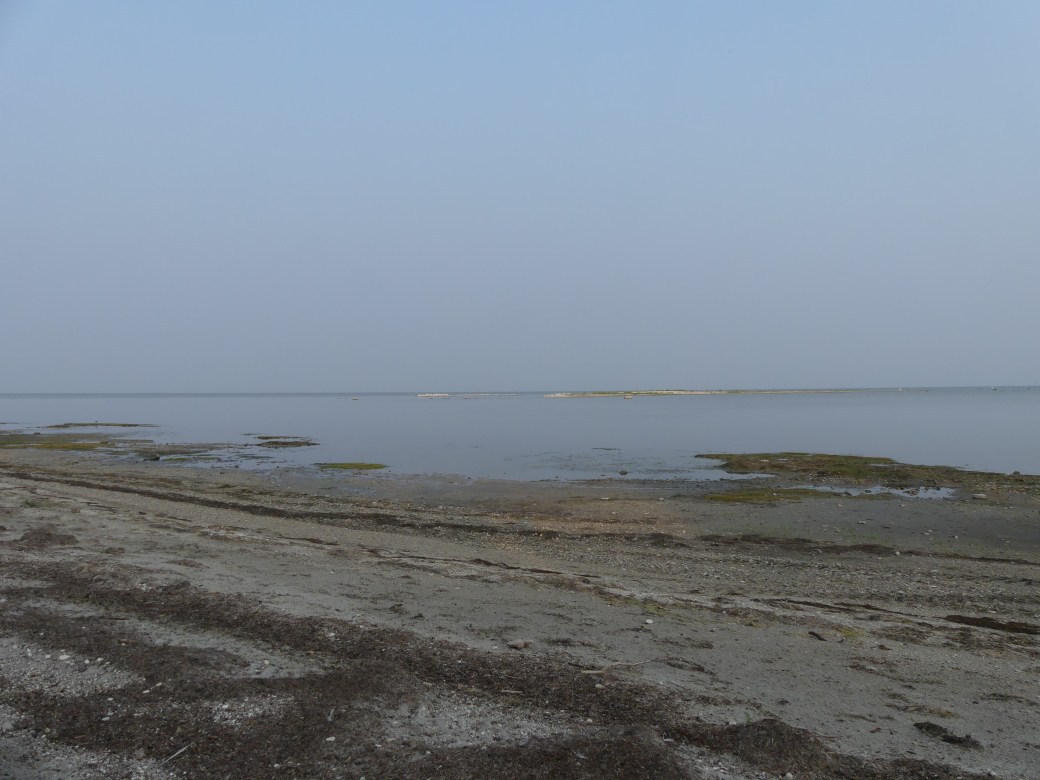
The receding water levels created plenty of promising patches of shorebird foraging habitat along Lake Manitoba. Copyright Tim Poole
Christian was heading for Clandeboye, an area which has previous for high numbers of shorebirds. Cal and Gord were also heading to the area where over 3,000 Semipalmated Sandpiper were counted during that same 2016 blitz. The habitat at St Ambroise appeared to offer a multitude of foraging opportunities. High hopes indeed!
But where were the shorebirds? Overall we had some fairly good numbers of some species, but the high concentrations we were expecting. Maybe our lower numbers reflect the news coming from the Arctic that many shorebirds have failed to breed in 2018.

A bit typical, some tasty looking habitat, but only the odd shorebird foraging within it. Copyright Tim Poole
Personally, I could see that shorebirds were few and far between. I found a Black-bellied Plover on a stony outcrop at St Ambroise, but the larger concentrations noted were of Double-crested Cormorant, American White Pelican and various gulls and terns. Twin Lakes Beach had some wonderful mudflats, but also those all too familiar Manitoba ATV tracks along the sand.

ATV’s – possibly scaring any remaining wildlife away – there were a handful of shorebirds in this ‘ideal’ habitat. Copyright Tim Poole
The most obvious birds were the yellowlegs, Spotted Sandpipers and Killdeer.
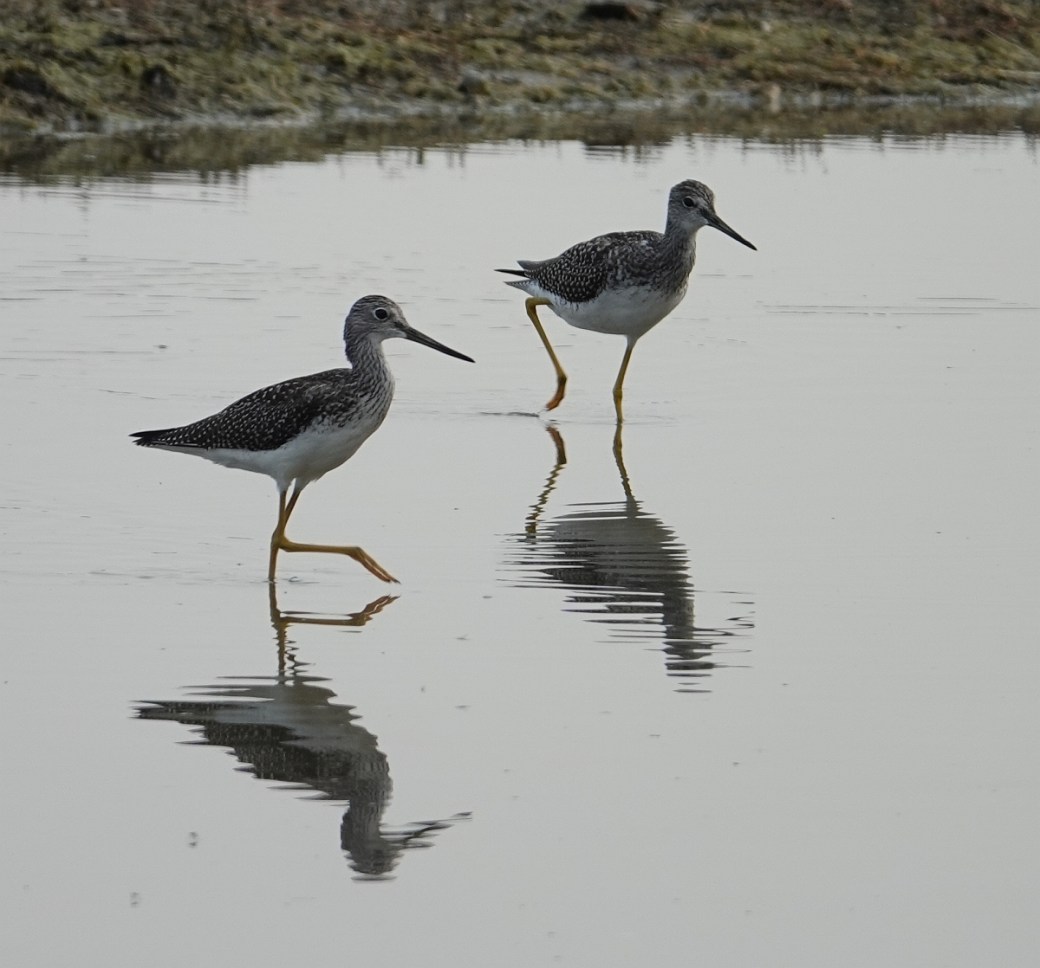
Comical is as comical does. Greater Yellowlegs as with many shorebirds always give the impression of being a wee bit ‘funny’. Copyright Randy Mooi
Randy, being the Curator of Zoology at the Manitoba Museum, always finds something to keep himself entertained, this time the movement of Canada Toads across the beach.

Canada Toad. For size comparison, Randy sprinkled sand grains on its back! Copyright Randy Mooi
He also found Leopard Frogs.

Leopard Frog, apparently hopeless at camoflague. Copyright Randy Mooi
By around 8, having birded west from the end of 430 on St Ambroise, I had met up with Jock, who had been delayed, and Randy who had walked east from the St Ambroise parking lot.

Gadwall’s ahoy! Tim and Jock trying to make them into Mexican Ducks (anyone familiar with the latest eBird update might get this comment). Copyright Randy Mooi
At this point, we headed for the car, and went to meet Sabina and Amanda, who had done the first stretch of Twin Lakes, from the end of PR430 east around the headland. They managed to score five Ruby-throated Hummingbirds, a Black-billed Cuckoo, and a very tidy count of 256 Double-crested Cormorant. In terms of shorebirds, there were only a few Killdeer and yellowlegs noted.

Silhouette of Ruby-throated Hummingbird. Copyright Randy Mooi
The most interesting feature of the drive were the counts of swallows on the powerlines, primarily Purple Martin and Tree Swallows. Maybe not as many as Whitewater Lake recently, but none the less, still an impressive sight!

A nice mixed flock of swallows on the powerline. Copyright Randy Mooi
Randy, Amanda, Jock, Sabina and I arrived at Twin Lake, passing another group, Wally, Pat and Dave on the way. This group found 5 species of shorebird from Lake Francis to Saint Laurent. A field of Mallards totaled over 300, and they also found 20 Sandhill Cranes, a species which will soon be on the move in higher numbers. A total of 57 species was pretty impressive for the morning, and included some higher numbers of blackbirds and swallows. Lake Francis itself is apparently an area with good numbers of shorebirds and grebes, but very hard to access. We need a boat obviously!

Semipalmated Plover and Least Sandpiper with gulls and Caspian Tern in the background. Copyright Randy Mooi
The walking group arrived at Twin Lake and with time short available, I immediately tried to whip them into shape…well, sort of! As with Saint Ambroise, the shorebird habitat was impressive, and we did at least find a single Semipalmated Plover, a nice small flock of Least Sandpiper, and various waterbirds including some handsome Caspian Terns.

Sabina, Jock and myself searching the beach. Amanda has been reduced to a foot! Copyright Randy Mooi
Bonnie and Emily, and Jo and Betsy separated into two groups to cover their area. Bonnie and Emily recorded 71 species, including some good numbers of ducks, 46 Canvasback being a standout. They also came across some fall warblers, including Northern Waterthrush, Sharp-shinned Hawk and Lark Sparrow. Jo and Betsy found 68 species, including a flock of 29 Great Egret flying over, and also two groups of the nationally threatened Red-headed Woodpecker. Nice! Again, shorebirds were thin on the ground, only 5 species noted.
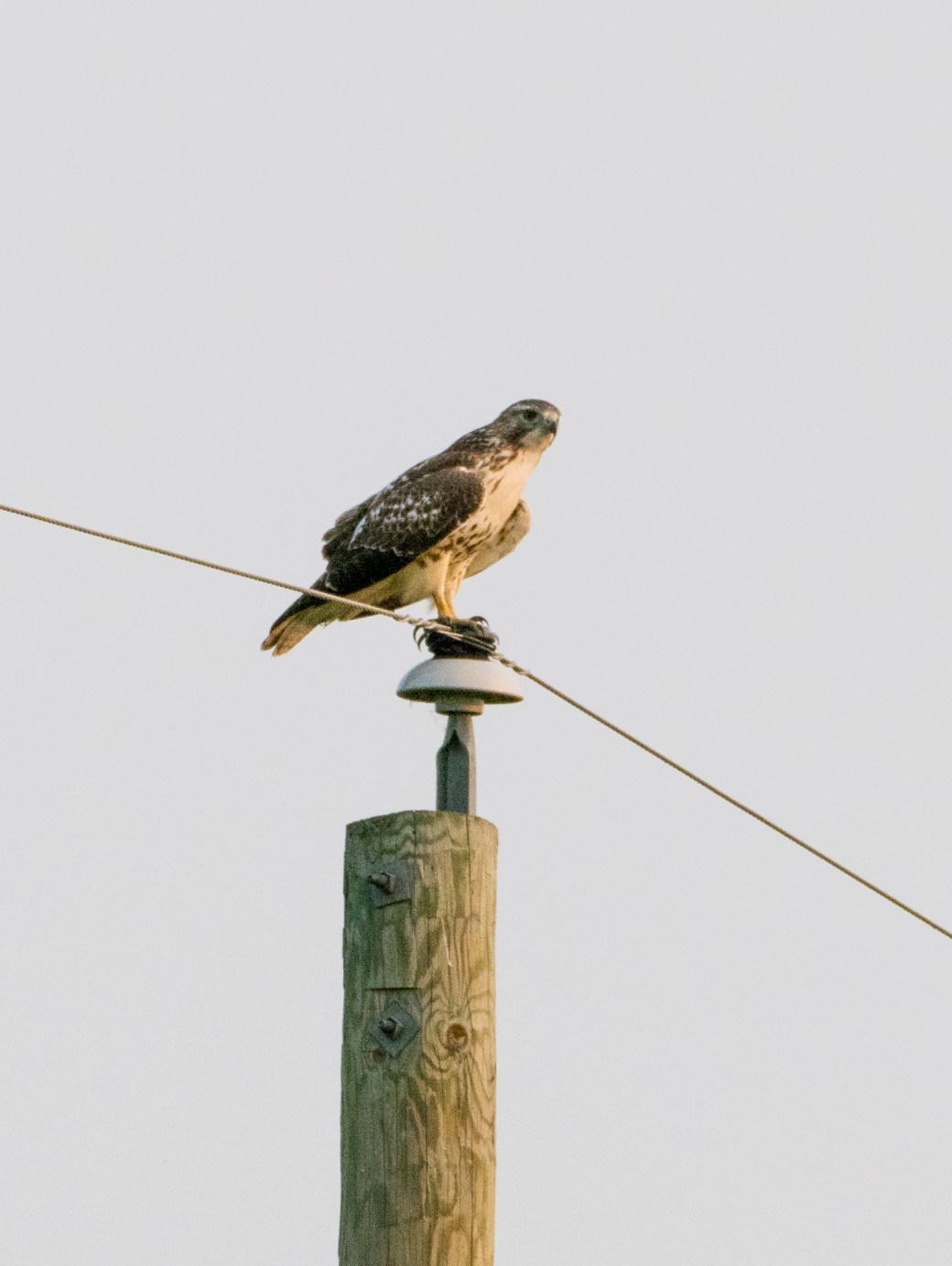
Red-tailed Hawk at Delta. Photo copyright Lynnea Parker.
Christian had better luck, recording 89 species on walk from St Ambroise to Clandeboye Bay along the foreshore. He was more successful with migrant songbirds, including 12 species of Wood Warbler. Canada Warbler, Bay-breasted Warbler and Magnolia Warbler were all noted. There were 9 species of shorebird in the bay, including 143 Least Sandpiper, and 8 Semipalmated Plover. Christian being Christian, he also managed to find Least Bittern and a Lesser Black-backed Gull. There were also good numbers of pelican and cormorant.

Lots of pelicans and gulls were gathered on the mudbars. Copyright Randy Mooi
These groups met just after 10:30 for refreshments at St Ambroise. The other groups were based around Delta Beach in the west.

Walking along the beach for birds. Copyright Randy Mooi
At this point, I will break off to thank our intern, Lynnea Parker for coordinating refreshments with these groups. Her group took on an area north and east of Delta Beach. The early morning sunrise certainly gave opportunity for some nice photos!

Blackbirds early morning at Delta. Copyright Lynnea Parker
Following our long, dry summer, many of the fields were completely dry, and this was reflected in the IBA totals for the day, with this group only finding two species of shorebird. The birding highlight was a Solitary Sandpiper, and a lifer Le Conte’s Sparrow for Chris. They were joined by Dick and Natalie from Alonsa.

Le Conte’s Sparrow. Copyright Lynnea Parker
The three amigos, Garry, Gene and John, had a slow start, but ended well. Unfortunately, John was unable to find the Red Knot, Western Sandpiper, and Curlew Sandpiper, species which I had promised beforehand, but they seemed to have a good time regardless. They had some nice shorebirds, including Stilt Sandpiper along the diversion. They also spotted a flock of 30 Bobolink! This group finished at Delta Beach where they were greeted by 30 Sanderling, and over 700 Franklin’s Gull.

Photo of the day from Garry Budyk. He really should take up photography more seriously!
Cal and Gord were most enamored with Prairie Falcon, a regular late summer visitor to Manitoba, but always a great find. Cal was also delighted to get his first of the year Baird’s Sandpiper. They noted 18 species of shorebird, including 38 Pectoral Sandpiper, 144 Least Sandpiper, and a Red-necked Phalarope. Many of these birds were seen on the west side of the diversion, and in wet mud along creek crossings.
Thank you to all who came to help out – I hope you enjoyed a fun morning out. Here are the final scores:
Total Species: 156
Total individuals counted: 19,564
Most abundant species: Red-winged Blackbird, 2,093
Number of Shorebird Species: 19 Species
Most Abundant Shorebird: Least Sandpiper, 388 individuals
| Canada Goose | 703 |
| Wood Duck | 99 |
| Blue-winged Teal | 385 |
| Northern Shoveler | 19 |
| Gadwall | 20 |
| American Wigeon | 10 |
| Mallard | 1,789 |
| American Black Duck | 1 |
| Green-winged Teal | 44 |
| Canvasback | 48 |
| Redhead | 3 |
| Ring-necked Duck | 3 |
| Lesser Scaup | 22 |
| Bufflehead | 1 |
| Common Goldeneye | 2 |
| Hooded Merganser | 18 |
| Ruddy Duck | 6 |
| duck sp. | 50 |
| Gray Partridge | 15 |
| Pied-billed Grebe | 4 |
| Western Grebe | 10 |
| Rock Pigeon | 21 |
| Mourning Dove | 140 |
| Black-billed Cuckoo | 2 |
| Ruby-throated Hummingbird | 22 |
| Sora | 2 |
| American Coot | 6 |
| Sandhill Crane | 26 |
| Black-bellied Plover | 1 |
| Semipalmated Plover | 44 |
| Killdeer | 222 |
| Marbled Godwit | 93 |
| Stilt Sandpiper | 29 |
| Baird’s Sandpiper | 22 |
| Least Sandpiper | 388 |
| White-rumped Sandpiper | 2 |
| Pectoral Sandpiper | 38 |
| Semipalmated Sandpiper | 91 |
| peep sp. | 118 |
| Short-billed Dowitcher | 3 |
| Short-billed/Long-billed Dowitcher | 4 |
| Wilson’s Snipe | 7 |
| Wilson’s Phalarope | 9 |
| Red-necked Phalarope | 1 |
| Spotted Sandpiper | 49 |
| Solitary Sandpiper | 16 |
| Greater Yellowlegs | 158 |
| Willet | 5 |
| Lesser Yellowlegs | 141 |
| Greater/Lesser Yellowlegs | 6 |
| Bonaparte’s Gull | 81 |
| Franklin’s Gull | 390 |
| Ring-billed Gull | 1,563 |
| Herring Gull | 109 |
| Lesser Black-backed Gull | 1 |
| Caspian Tern | 22 |
| Black Tern | 51 |
| Common Tern | 55 |
| Forster’s Tern | 185 |
| Common Loon | 1 |
| Double-crested Cormorant | 1,307 |
| American White Pelican | 418 |
| American Bittern | 5 |
| Least Bittern | 1 |
| Great Blue Heron | 15 |
| Great Egret | 35 |
| Turkey Vulture | 8 |
| Northern Harrier | 31 |
| Sharp-shinned Hawk | 4 |
| Cooper’s Hawk | 3 |
| Bald Eagle | 33 |
| Broad-winged Hawk | 4 |
| Swainson’s Hawk | 5 |
| Red-tailed Hawk | 68 |
| Buteo sp. | 4 |
| Great Horned Owl | 2 |
| Belted Kingfisher | 9 |
| Yellow-bellied Sapsucker | 1 |
| Red-headed Woodpecker | 5 |
| Downy Woodpecker | 5 |
| Hairy Woodpecker | 2 |
| Northern Flicker | 16 |
| American Kestrel | 25 |
| Merlin | 18 |
| Peregrine Falcon | 1 |
| Prairie Falcon | 1 |
| Eastern Wood-Pewee | 10 |
| Alder Flycatcher | 2 |
| Least Flycatcher | 10 |
| Eastern Phoebe | 6 |
| Great Crested Flycatcher | 1 |
| Western Kingbird | 17 |
| Eastern Kingbird | 326 |
| Warbling Vireo | 6 |
| Red-eyed Vireo | 10 |
| Blue Jay | 7 |
| Black-billed Magpie | 1 |
| American Crow | 57 |
| Common Raven | 40 |
| Horned Lark | 1 |
| Purple Martin | 612 |
| Tree Swallow | 1,325 |
| Bank Swallow | 180 |
| Barn Swallow | 321 |
| Cliff Swallow | 48 |
| swallow sp. | 470 |
| Black-capped Chickadee | 2 |
| White-breasted Nuthatch | 3 |
| House Wren | 8 |
| Sedge Wren | 16 |
| Marsh Wren | 39 |
| wren sp. | 5 |
| Eastern Bluebird | 2 |
| American Robin | 115 |
| Gray Catbird | 16 |
| Brown Thrasher | 2 |
| European Starling | 117 |
| Cedar Waxwing | 39 |
| Purple Finch | 1 |
| American Goldfinch | 99 |
| Chipping Sparrow | 19 |
| Clay-colored Sparrow | 47 |
| Lark Sparrow | 1 |
| White-throated Sparrow | 46 |
| Vesper Sparrow | 6 |
| LeConte’s Sparrow | 4 |
| Savannah Sparrow | 60 |
| Song Sparrow | 142 |
| Swamp Sparrow | 29 |
| sparrow sp. | 158 |
| Yellow-headed Blackbird | 473 |
| Bobolink | 33 |
| Western Meadowlark | 82 |
| Orchard Oriole | 1 |
| Baltimore Oriole | 32 |
| Red-winged Blackbird | 2,093 |
| Brown-headed Cowbird | 6 |
| Brewer’s Blackbird | 179 |
| Common Grackle | 1,516 |
| blackbird sp. | 815 |
| Ovenbird | 1 |
| Northern Waterthrush | 13 |
| Black-and-white Warbler | 2 |
| Tennessee Warbler | 7 |
| Nashville Warbler | 2 |
| Common Yellowthroat | 39 |
| American Redstart | 42 |
| Magnolia Warbler | 1 |
| Bay-breasted Warbler | 1 |
| Yellow Warbler | 317 |
| Blackpoll Warbler | 1 |
| Yellow-rumped Warbler | 9 |
| Canada Warbler | 1 |
| Rose-breasted Grosbeak | 2 |
| House Sparrow | 13 |
| passerine sp. | 55 |
The International Shorebird Survey (ISS) in Manitoba – an Encouraging Start
Many readers will recall two excellent reports from Sabina and Lynnea, describing a workshop we attended in May. The Workshop was organised by Manomet, NCC, Environment and Climate Change Canada, BSC, and ourselves, and was hosted by NCC at their Jiggin’s Bluff property in the Oak Lake and Plum Lakes IBA. It also included a trip to Whitewater Lake IBA. Our ultimate goal was to establish the International Shorebird Survey (ISS) in Manitoba, and this blog covers the first ever shorebird surveys delivered as part of this program.
ISS Methods
ISS requires long-term monitoring of predetermined transect routes. For anyone familiar with the Nocturnal Owl Survey or Breeding Bird Survey, it is similar in that the route is set, and does not change (with the usual caveats). The transects (and points) are driven (you can walk but it might take a few days). Every shorebird encountered within 200m either side of the transect is recorded. Shorebirds outside this transect are not recorded under ISS, but can be included on separate checklists. Data is entered on eBird under the International Shorebird Survey Protocol, and each transect is entered separately. Non-shorebirds can be added on the ISS protocol on eBird. We are also entering shorebirds which were not seen as a zero in eBird, which is not obviously something we usually do. If you are concerned about not getting significant data under IBA Protocol, contact us, and we will work something out!
Oak Lake and Plum Lakes IBA ISS Route
Christian Artuso (BSC), Rebekah Neufeld and Josh Dillabough (NCC), and Ward Christianson (IBA volunteer), trialed this route on July 26th. Shorebirds were thin on the ground due to high water levels in creeks which feed the ephemeral lakes and wetlands around Oak Lake. The high water levels were not due to rain (the grass was apparently yellow and dry), but most likely due to water being drained into waterways outside of Manitoba. The route started north of Oak Lake Resort, and four different transects were run within the total survey area. A fifth area was inaccessible as a road was covered with water. The idea was to cover all the best known shorebird spots in this IBA.
You can view the map of the survey area below (thanks to Rebekah Neufeld of NCC for making the maps).
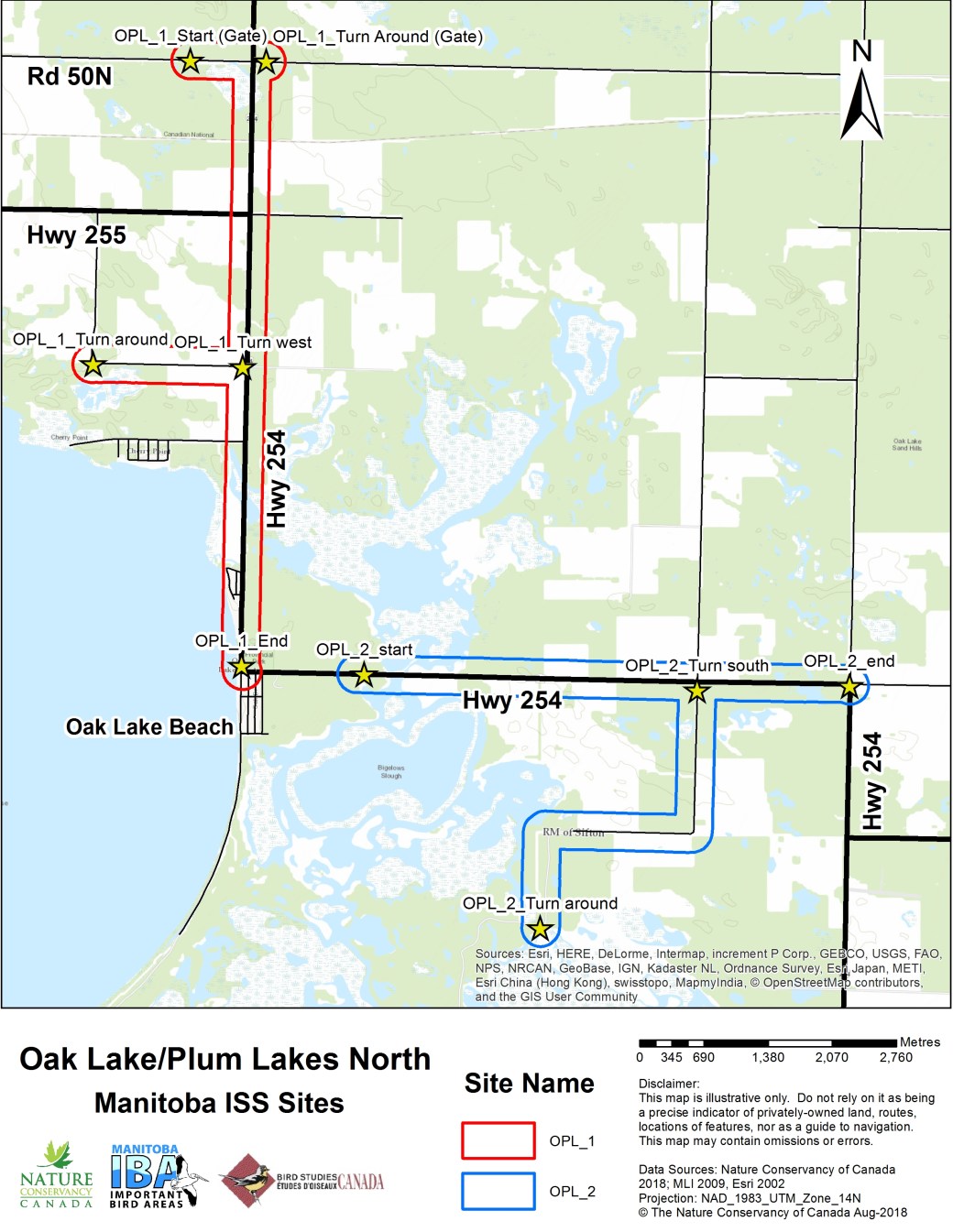
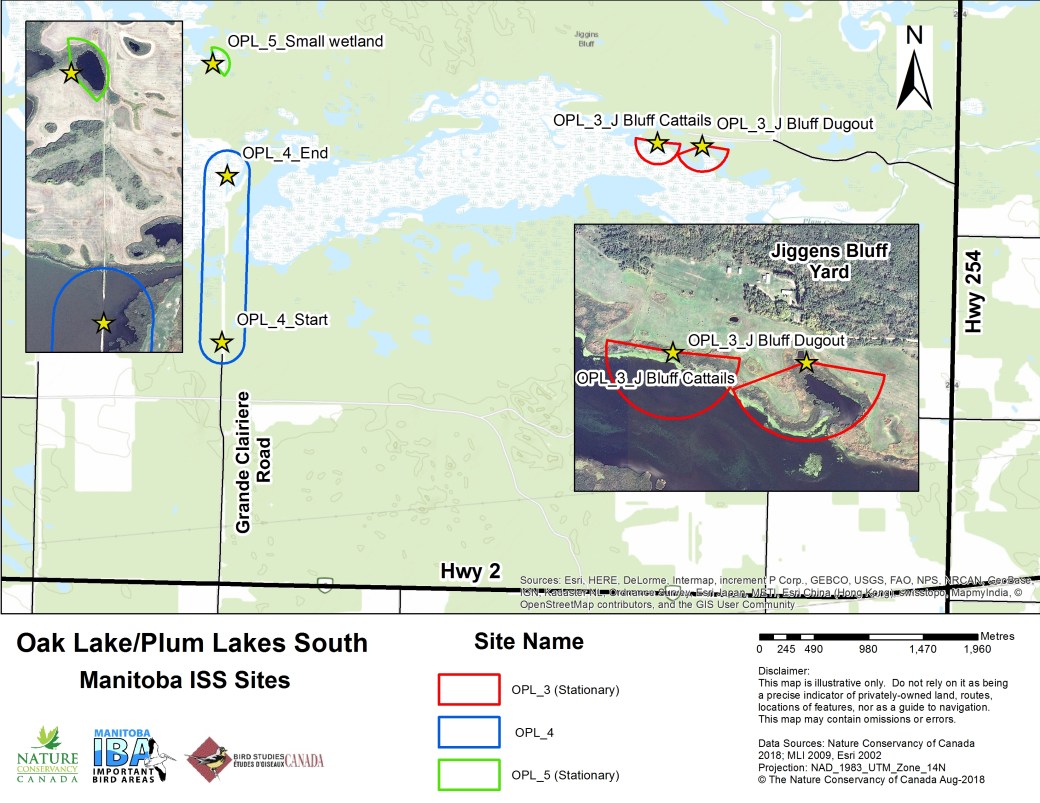
The most abundant shorebird species across the four transects was the Lesser Yellowlegs, followed by Killdeer and Wilson’s Phalarope. In total, 12 species were recorded. This contrasted with a count of over 1,000 Lesser Yellowlegs in August 2017 by Garry Budyk, John Weier and Rudolf Koes, all in the NCC Jiggin’s Bluff Property. The contrast is stark, demonstrating how shorebird habitat can be localised, variable – and under threat due to changes in land management activities from outside the local area.
| American Avocet | 1 |
| Killdeer | 39 |
| Upland Sandpiper | 10 |
| Marbled Godwit | 3 |
| Least Sandpiper | 6 |
| Pectoral Sandpiper | 1 |
| Short-billed Dowitcher | 3 |
| Wilson’s Snipe | 2 |
| Wilson’s Phalarope | 31 |
| Spotted Sandpiper | 6 |
| Greater Yellowlegs | 12 |
| Lesser Yellowlegs | 53 |
The count is due to be repeated in mid-August.
Whitewater Lake IBA ISS West and East
Due to its large size, variable water levels and usual high concentrations of shorebirds, it was decided to establish east and west ISS surveys at Whitewater Lake. The idea is that a group could either run both on a single day, or if they chose, only run one. This would save time, and hopefully increase the number of surveys delivered in a year (we hope some visitors will elect to do an ISS as part of their birding trip to Whitewater).
On July 29th, Christian Artuso (BSC), Colin Blyth and Gillian Richards (IBA Caretakers), and Tim Poole (MB IBA), ran all of the western transect and part of the eastern, time running out to complete the east due to a prearranged engagement. The western route took around 3 hours, reflecting not so much the vast amounts of driving but actually the impressive numbers of shorebirds, and the time taken to tease out the differences between each species of dowitcher. The eastern took an hour, but let’s say it should take usually under 2 hours all things considered.
Here are the maps (thanks again Rebekah).
Of interest here were the water levels. In contrast to Oak Lake, we had a different issue Low water levels due to low rainfall had dried out some ephemeral wetlands. Some of these provided excellent foraging habitat for shorebirds during the May visit. The photo below was taken in May of shorebirds in a wetland on the west side of Whitewater Lake. Note that the water level was pretty much at the level of the dowitchers belly.
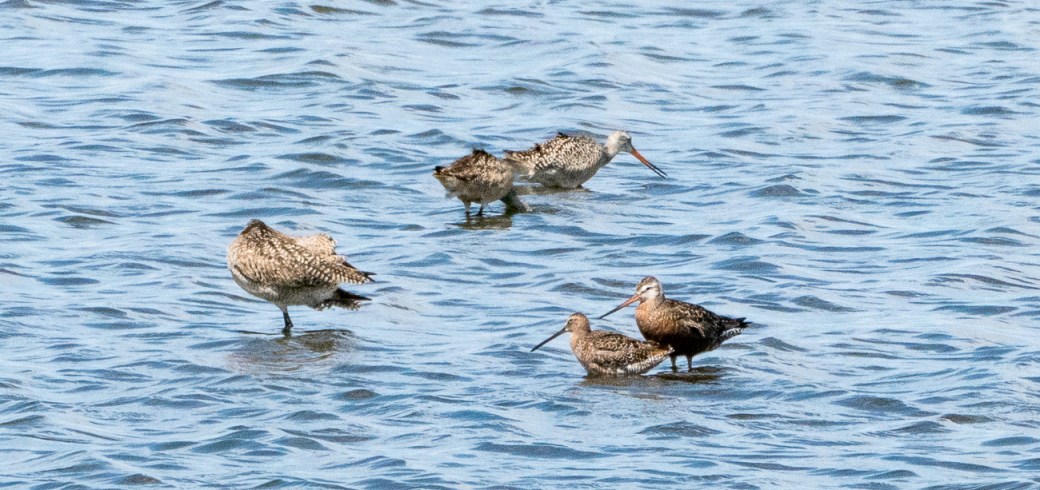
3 Marbled Godwit (Left), 1 Long-billed Dowitcher standing in front of 1 Hudsonian Godwit (Right), Photo by Lynnea Parker
In contrast, this is the same spot in July, a barren desert for shorebirds:
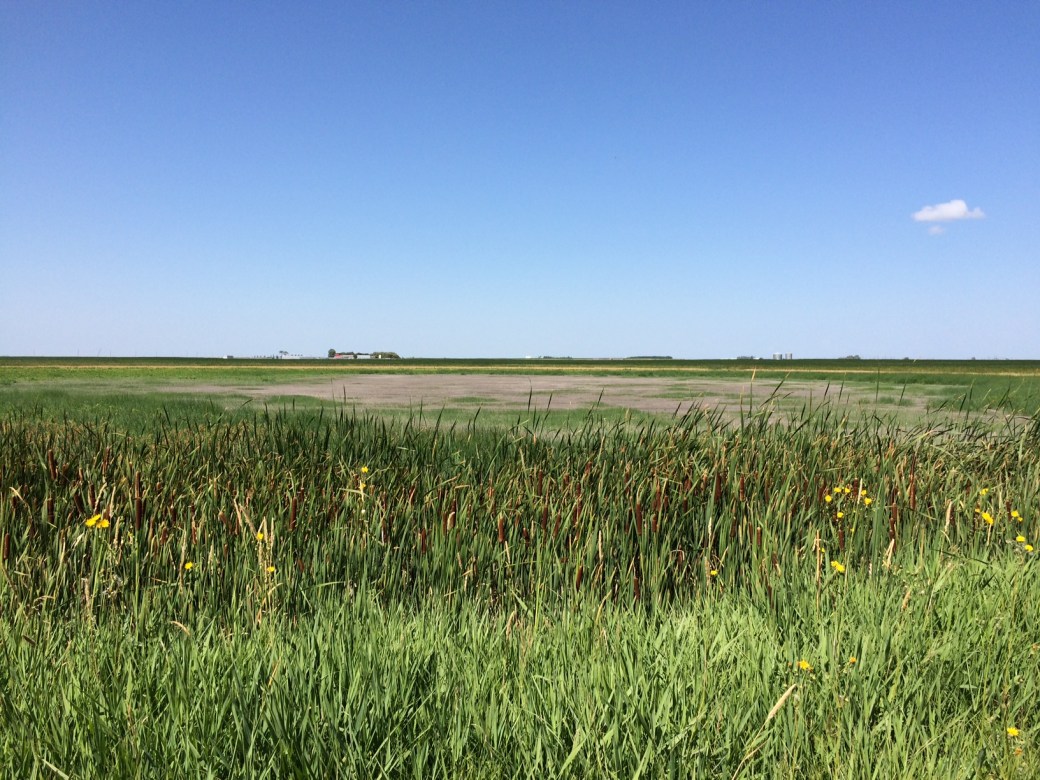
Baked brown earth where once stood shorebirds in May. Photo by Gillian Richards
Or is it? Check again, your eyes may not see everything:
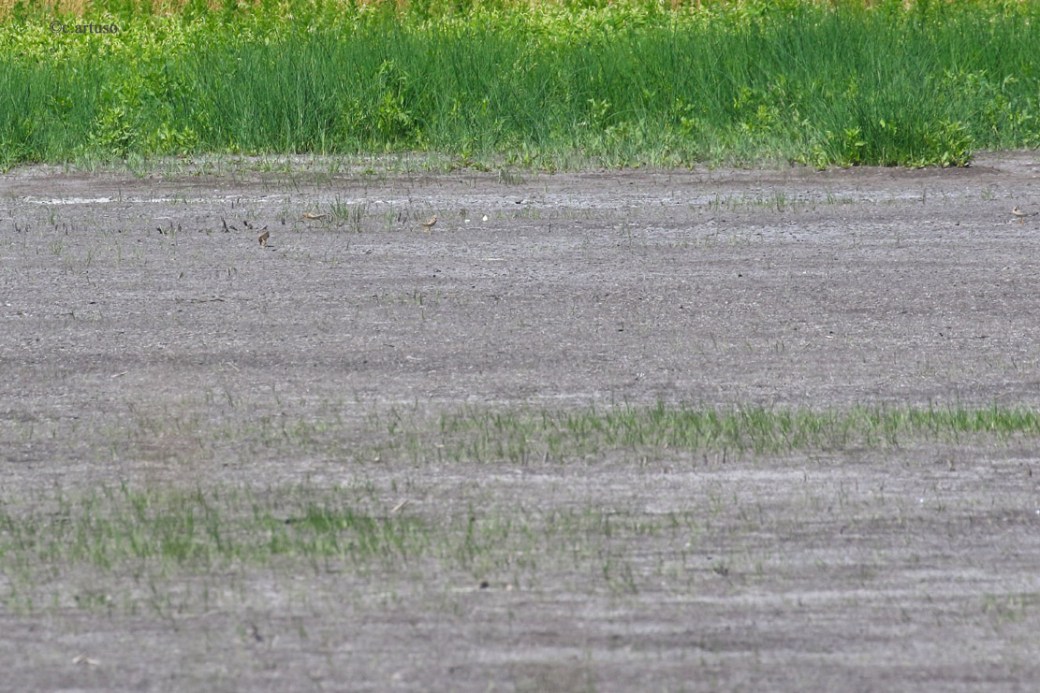
What’s are those brown blobs on the dried mud? Copyright Christian Artuso
Hmm, let’s zoom in….
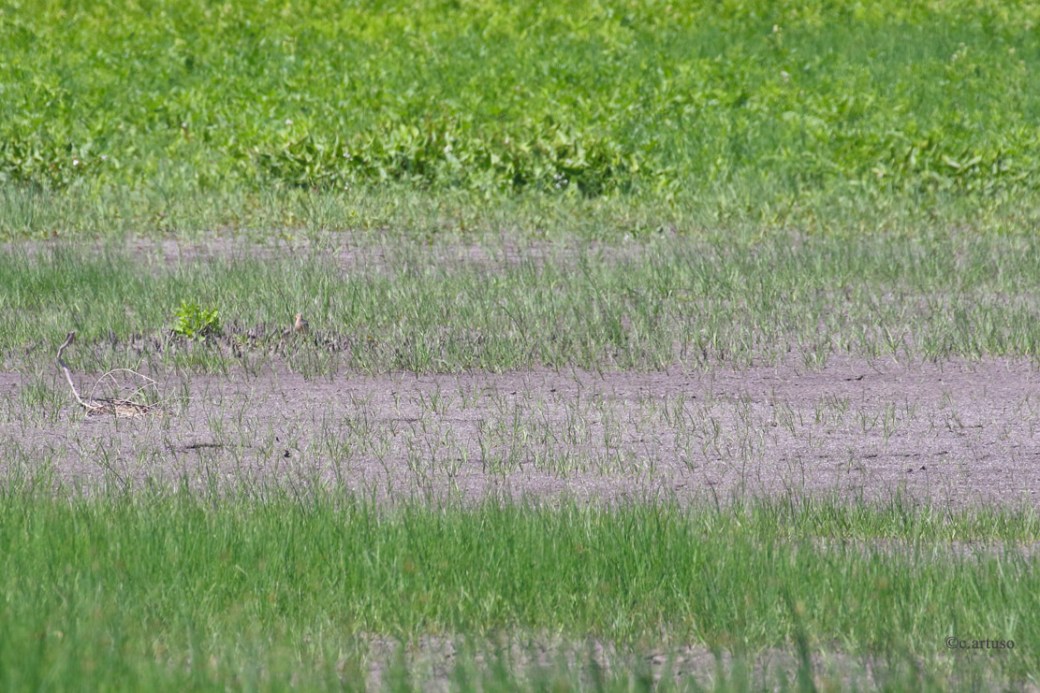
There’s something in the grass…. Copyright Christian Artuso
Buff-breasted Sandpiper!
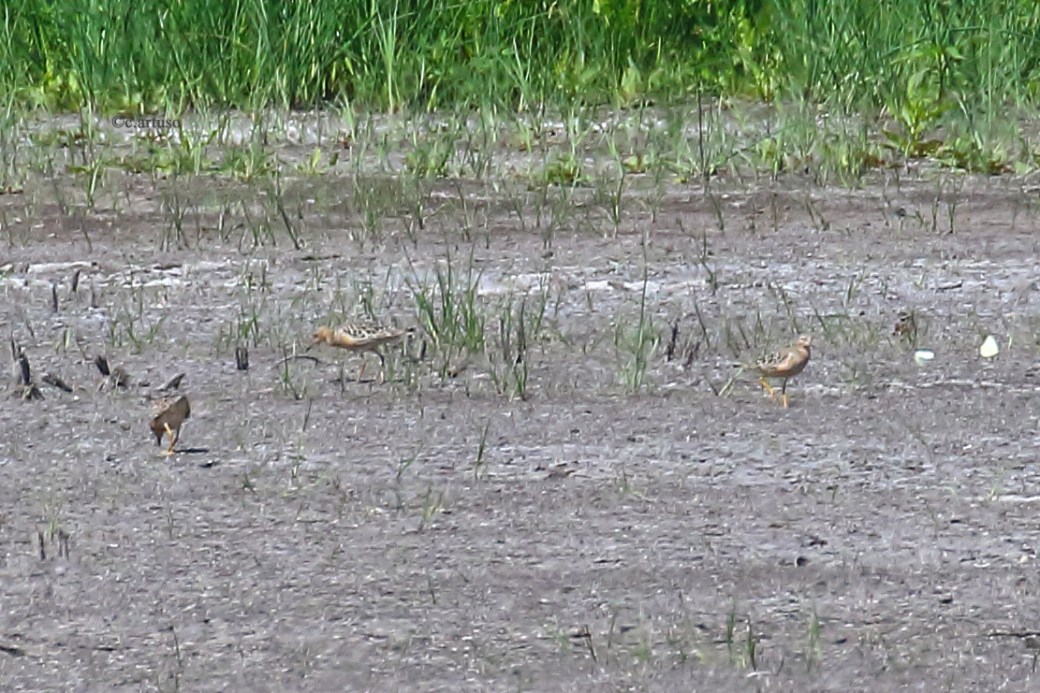
Buff-breasted Sandpipers in the mud. Copyright Christian Artuso
In total, there were 16 Buff-breasted Sandpiper, a pretty good exchange for Hudsonian Godwit, Marbled Godwit and Long-billed Dowitcher! This species, globally Near Threatened, is one of the long-distant migrants of high conservation concern. They breed in the High Arctic and spend the winter in South American grasslands. In Manitoba, they are most often seen during fall migration, foraging in wet grasslands, sod fields and, in this case, a dry basin, with wet mud under the mud cracks where grass has begun to regrow.
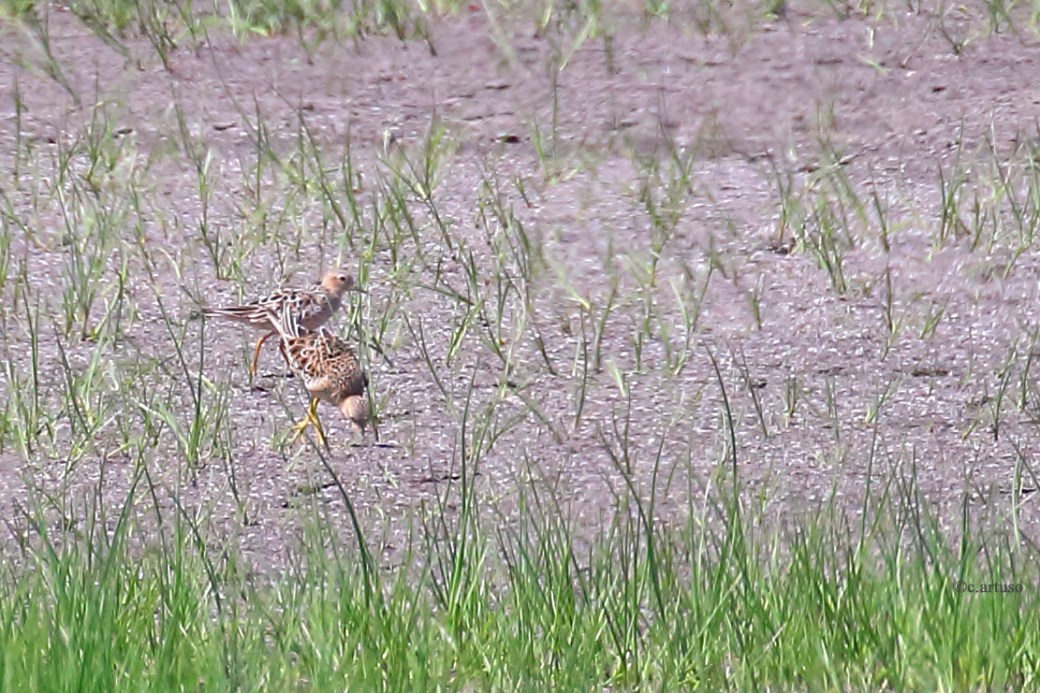
Elegance! Buff-breasted Sandpiper, certainly a prize catch for a Manitoba birder. Copyright Christian Artuso
The total of dowitchers in the west were also impressive, nearly 2,000, primarily on roads closest to the lake. Most shorebirds are still in ephemeral wetlands right now, but the lake is dropping and more habitat is set to appear over the coming months. As mentioned above, the dowitchers were the greatest challenge, but were in most cases identified to species using a combination of sound, juvenile tertial markings and adult breeding plumage – we estimated totals via percentage of each species identified per flock.
You can read more on dowitcher identification on a previous IBA blitz blog from Whitewater Lake.
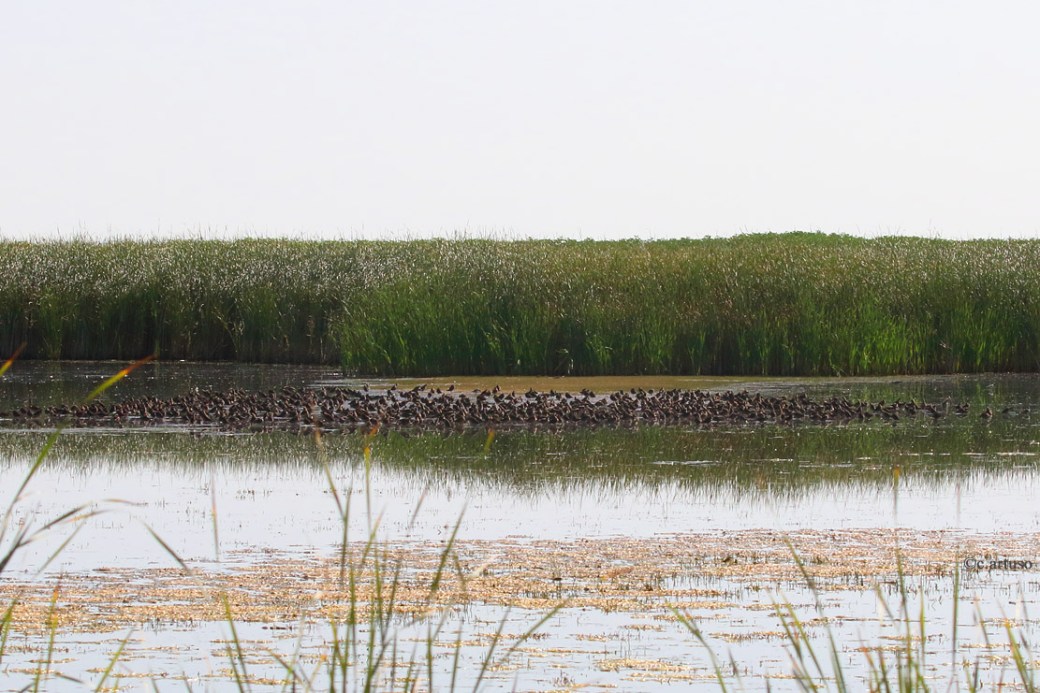
A carpet of dowitchers (and other shorebirds). pick a short-billed out of that! Copyright Christian Artuso
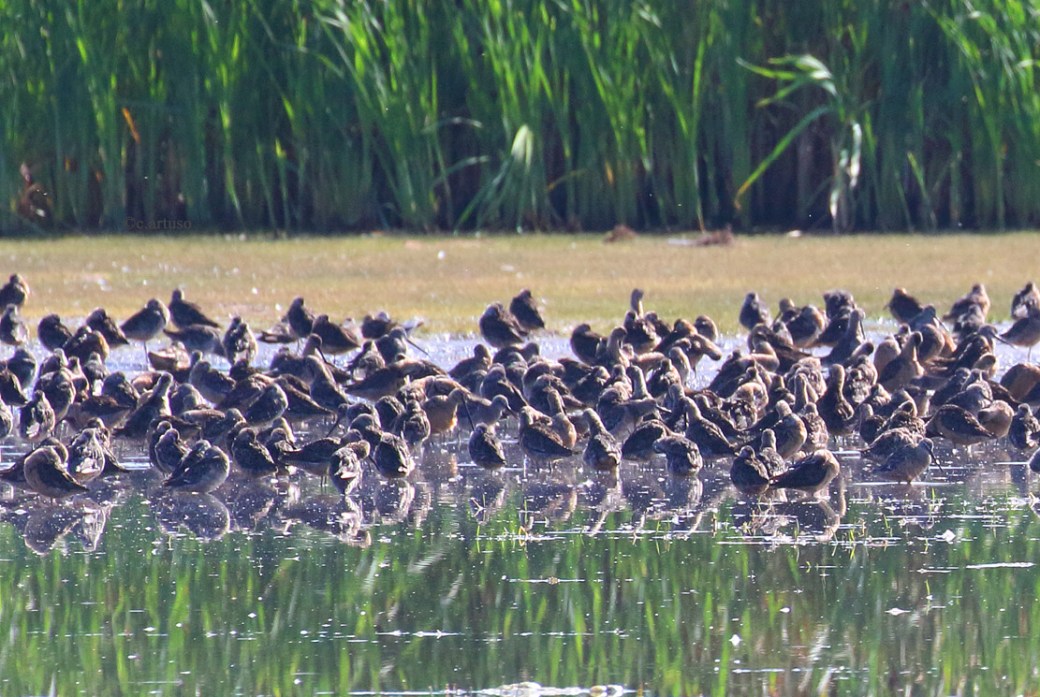
Close-up of a dowitcher carpet. Copyright Christian Artuso
The east had an excellent spot, which included a Hudsonian Godwit among others. This was in a bay on the lake itself rather than int he adjacent fields and wetlands. The ephemeral wetlands which were full of shorebirds in August 2017 had dried out completely, another demonstration of how these birds are tied to ephemeral, seasonal habitats.
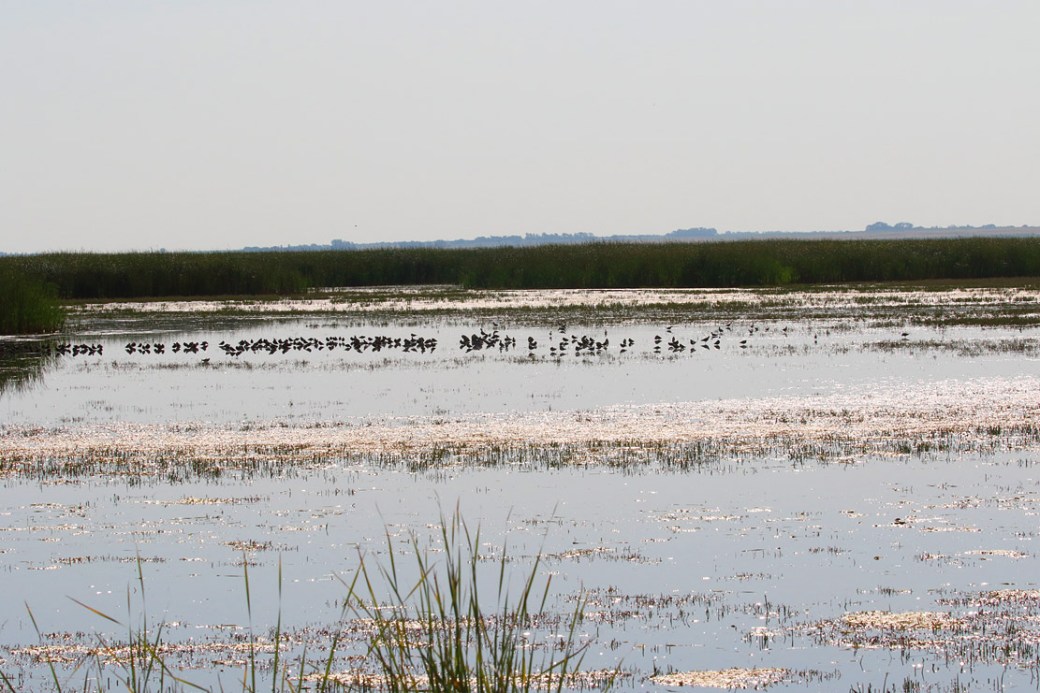
Ok, this is still in the west, but another great shot of Whitewater Lake shorebirds. Copyright Christian Artuso
Here is a summary of the shorebirds submitted under the ISS protocol on eBird, Long-billed Dowitcher being our surprisingly most abundant species, followed by dowitcher sp, Short-billed Dowitcher and American Avocet.
| American Avocet | 418 |
| Semipalmated Plover | 39 |
| Killdeer | 86 |
| Upland Sandpiper | 11 |
| Hudsonian Godwit | 1 |
| Marbled Godwit | 82 |
| Stilt Sandpiper | 23 |
| Baird’s Sandpiper | 28 |
| Least Sandpiper | 40 |
| Buff-breasted Sandpiper | 16 |
| Pectoral Sandpiper | 141 |
| Semipalmated Sandpiper | 5 |
| Short-billed Dowitcher | 533 |
| Long-billed Dowitcher | 1,440 |
| Short-billed/Long-billed Dowitcher | 970 |
| Wilson’s Phalarope | 236 |
| Red-necked Phalarope | 2 |
| Spotted Sandpiper | 6 |
| Solitary Sandpiper | 1 |
| Greater Yellowlegs | 28 |
| Willet | 6 |
| Lesser Yellowlegs | 272 |
| shorebird sp. | 1 |
Finally, a few other highlights. In addition to the usual Whitewater specialties of egrets and ibises, we can report a Prairie Falcon on the east side, and over 24,000 Bank Swallows, phenomenal numbers in an area which is obviously a significant pre-migratory spot for this species.
Over to you – and an opportunity
We are keen to roll out ISS in Manitoba outside these southwestern sites. However, for now, our priority is to get these routes up and running, and deliver replicates throughout the fall, at least two more being required at each route outlined above in the maps. To this end, we will run another training route, probably at Whitewater in the week of August 20th. If you are interested in attending, to learn about how to deliver ISS, how to identify shorebirds, and how to enter the data in eBird (really easy), then please email Tim at iba@naturemanitoba.ca.
If you cannot make this, but are interested in participating, again, please email at the above, and let’s see what we can do!

North, West and East Shoal Lakes IBA Blitz – August 26th

Riverton Sandy Bar Weed Pull For Plovers!
Surveying for Grassland Species At Risk in the Southwestern MB Mixed-Grass Prairie, and Oak Lake and Plum Lakes IBAs
Outside of the main Manitoba IBA volunteer programs, we have also been involved in a project with a number of partners to conserve grassland Species at Risk in southwestern Manitoba. We will publish a report on our monitoring efforts later this year, but we thought people may be interested in a short update from Lynnea Parker on what was done.
In June, I helped Dr. Christian Artuso of Birds Studies Canada (BSC) conduct a series of bird surveys from Lyleton, north to Kirkella. These surveys were conducted as part of the Manitoba Species at Risk Partnerships on Agricultural Lands (SARPAL) program, ‘Keep Grazing‘. The primary goal of ‘Keep Grazing’ is to offer landowners, primarily beef producers, incentives to adapt grazing regimes and incorporate beneficial management actions in the most important corridor for mixed-grass prairie Species at Risk remaining in Manitoba. BSC and the Manitoba IBA Program are providing bird surveys to support the incentives program. These surveys provide a baseline of what birds are present, and will, we hope, provide opportunities to further engage local landowners in grassland bird conservation schemes. 2018 marked the third year of the program, and the second year of field work, and bird surveys have been completed for 50 landowners encompassing 60 properties.
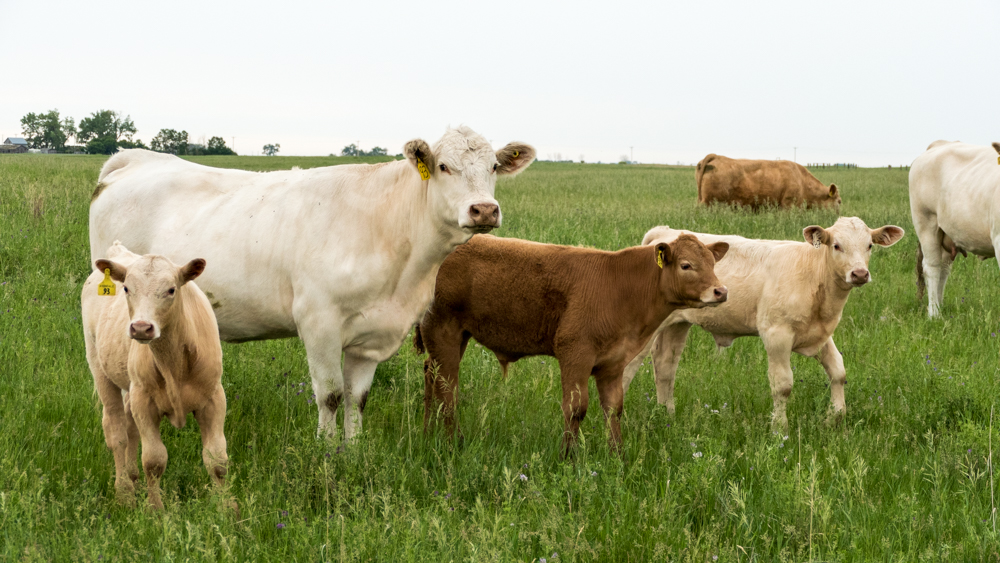
A herd of cattle graze a pasture of mixed-grass prairie in southwestern Manitoba, photo by Lynnea Parker
I have always held a deep appreciation for field work as it connects me to the land and nature in ways that sightseeing from the road cannot. As I hiked across mixed-grass prairie this summer, I was reacquainted with how unique and diverse every remaining parcel of this threatened ecosystem is. While each section of grassland may appear homogeneous (the same) from the road, walking across the land enables one to see the differences in grass composition, plant and insect diversity, animals, and ground structure. No single parcel of land is the same as another, and this difference (heterogeneity) is a part of what makes grasslands and cattle grazing so important.
For specialist bird species, such as Baird’s Sparrow, Sprague’s Pipit, and Chestnut-collared Longspur, heterogeneity is very important. Each of these grassland birds prefers habitat characteristics which are slightly different. These differences are usually noted in grass density and cover, among other factors such as the presence or absence of sage brush and wolf willow, and proximity to edges, such as roads and tree lines. It is these “special” habitat requirements paired with extensive habitat loss and degradation which has led to the declines of many grassland bird species.

A male Chestnut-collard Longspur in grazed mixed-grass prairie. Carefully look at the interaction between tufts of grass, bare ground, and species diversity. This demonstrates the heterogeneous habitats referred to in the remainder of the blog. Photo by Lynnea Parker
In contrast, generalist species, such as the Savannah Sparrow, Western Meadowlark, and Eastern Kingbird tend to be considered widespread and abundant. These species do not require specialized habitat features to remain successfully competitive in their environment. So why is heterogeneity actually important? it is important so that each species can find areas within a landscape which meet their own foraging and reproductive requirements. Cattle or bison create and maintain heterogeneity, both within a single grazing unit, and across the wider landscape. Simply put, different grazing strategies result in heterogeneous grass structures.

A Western Meadowlark perched on a fence, photo by Lynnea Parker
Getting back to my summer experience, Christian and I would wake up before sunrise so that we could survey from 5:00 am to 10:00 am every morning. Depending on the size of a given property, we would attempt to conduct between 9 and 21 point counts, a minimum distance of 350 meters apart. These point counts provided a snapshot of the bird diversity at each site. Once and a while a herd of cattle, or in one instance horses, would get overly curious and run over to investigate my presence. After a morning of surveys, we would typically return to the field house in Pierson to backup our data and take a nap. Christian was fond of taking a drive in the evening to bird in Saskatchewan for the Saskatchewan Breeding Bird Atlas and sneak in some owling. On occasion we would also take detours on our way back to the field house to see a new area or find a particular species, such as the rare Lazuli Bunting! (featured below)


A rare male Lazuli Bunting is shown on the left, and a Lazuli Bunting x Indigo Bunting hybrid is shown on the right. Both of these birds were seen at the same location along the Antler River near Lyleton! Photos by Christian Artuso
A male Lazuli Bunting has been spending the last few summers in a known location along the Antler River, southeast of Lyleton. While I had seen this rarity last summer with Christian, we both had wondered if it would return again this year. After arriving at the spot we had detected it previously, we found a bird… just not the one we were expecting to see! Darting between the branches, pausing briefly to sing, we saw a vibrant blue bird with white underparts and white wing bar. Now this was odd, as we both knew male Lazuli Buntings had an orange breast for starters. It was Christian who identified it as a probable hybrid, which was later confirmed! This individual was a Lazuli x Indigo bunting. Just to make matters more interesting, Indigo Buntings do not generally occur near Lyleton either.
After spending some time at the site to obtain photographic documentation, the true male Lazuli Bunting made an appearance. With both birds on site, it was a special opportunity to see them in close comparison.
I thoroughly enjoyed spending time this summer near Pierson, Melita, and Lyleton. I would highly encourage anyone with a love of nature to take a trip to the southwest corner to see for yourself what these grasslands have to offer.

Upland Sandpiper

Male Brown-headed Cowbirds

Mixed-grass Prairie
Upper left: an Upland Sandpiper near Lyleton, lower left: male Brown-headed Cowbirds, right: mixed-grass prairie, photos by Lynnea Parker
 Manitoba Important Bird Areas Program