
Latest Newsletter
The fall update of the Manitoba IBA Program newsletter has just been published. We include updates on the ISS surveys, including links to the third round of monitoring – and what a round it was too! We also include a focus on a day out from a group of volunteers, finding some rather good bird numbers at Delta Marsh IBA, a brief summary of our summer of fun, plus updates on projects with indigenous communities, and grassland birds. Check it out at the link below:
https://mailchi.mp/5e8a9ce3e78e/manitoba-important-bird-areas-program-news-fall-2018
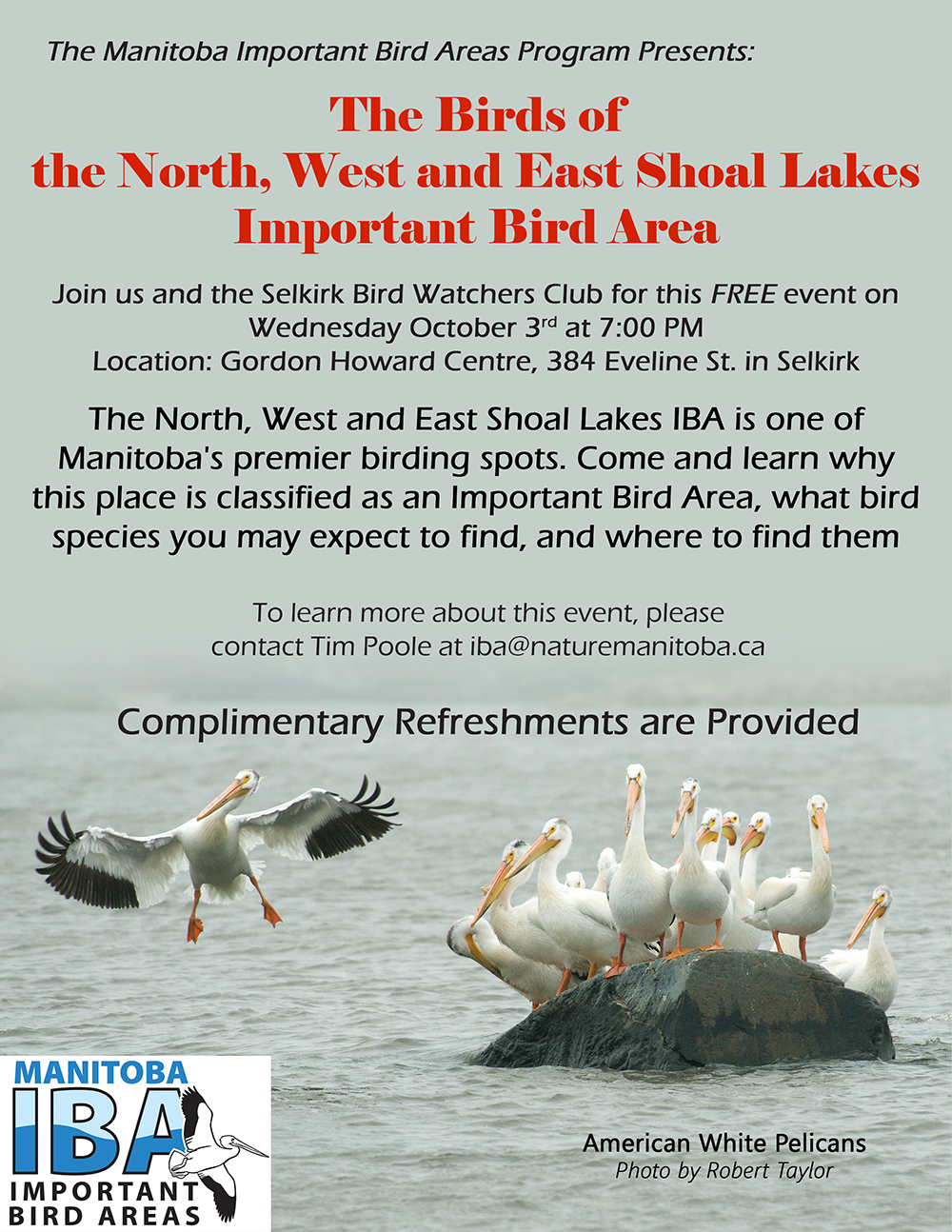
Announcement – Talk in Selkirk, October 3rd 2018
International Shorebird Survey – Round 3
2018 has seen the launch of the International Shorebird Survey (ISS) in Manitoba. Each month from July to September, volunteers from the Manitoba IBA Program, Bird Studies Canada, and NCC, have traveled to Whitewater Lake and Oak Lake and Plum Lakes Important Bird Areas to carry out these surveys. Our third and (in theory), final trips were completed earlier this week, and here is a summary of the results.
On September 17th, Gillian Richards, Christian Artuso, Josiah Van Egmond, and Ed Jenkins, completed the two monitoring transects at Whitewater Lake IBA. The results were, to say the least, quite spectacular.
The total of 38,861 birds, and 99 species was highly impressive, although a mere 20,764 were noted on the ISS surveys themselves, the remaining birds seen while driving from point to point. The most abundant bird was the Red-winged Blackbird, a colossal total of 8,960 being recorded.

Who scared the blackbirds? Photo copyright Christian Artuso
Ducks were also abundant, 4,046 Northern Pintail being the highest individual count, but with sizable counts of Green-winged Teal and Mallard as well. A single Greater White-fronted Goose was another standout, along with the usual totals of Snow and Canada Geese exceeding a thousand individuals.

Northern Pintail, Green-winged Teal and Snow Goose at Whitewater. Copyright Christian Artuso
Two Prairie Falcons and two Peregrines were also encountered, which segues nicely to the shorebirds (falcons are notoriously good at flushing shorebirds). The highlight was the Long-billed Dowitcher total of 3,217 individuals. An IBA trigger. This is fascinating. In ISS 1, we had a near trigger for this species, among several thousand dowitchers, but in ISS 2, dowitchers were almost absent. Therefore, large numbers of Long-billed Dowitchers migrated to Whitewater in July, moved on, and were replaced by large numbers in September. Dynamic populations or what! Of the other 21 species of shorebird, they counted a single Red Knot, 407 American Golden Plover, 562 Pectoral Sandpiper (a near trigger), and 542 Greater Yellowlegs.

Distant Long-billed Dowitcher flock. Copyright Christian Artuso
Here is the total birds for the day, with a column for those recorded on the ISS transect, and a column for the total Whitewater Lake birds.
| ISS Transects | Total for Day | |
| Snow Goose | 1,170 | 1,795 |
| Greater White-fronted Goose | 0 | 1 |
| Cackling Goose | 0 | 19 |
| Canada Goose | 654 | 2,679 |
| Wood Duck | 2 | 2 |
| Blue-winged Teal | 801 | 923 |
| Northern Shoveler | 365 | 450 |
| Gadwall | 265 | 572 |
| American Wigeon | 276 | 284 |
| Mallard | 1,591 | 2,456 |
| Northern Pintail | 4,043 | 4,046 |
| Green-winged Teal | 2,310 | 2,422 |
| Canvasback | 6 | 258 |
| Redhead | 12 | 222 |
| Lesser Scaup | 4 | 22 |
| Bufflehead | 4 | 13 |
| Common Goldeneye | 0 | 3 |
| Hooded Merganser | 2 | 2 |
| Ruddy Duck | 21 | 105 |
| Pied-billed Grebe | 3 | 7 |
| Eared Grebe | 9 | 11 |
| Western Grebe | 124 | 167 |
| Rock Pigeon | 9 | 9 |
| Mourning Dove | 12 | 42 |
| American Coot | 602 | 631 |
| Sandhill Crane | 338 | 629 |
| American Avocet | 16 | 16 |
| Black-bellied Plover | 10 | 10 |
| American Golden-Plover | 36 | 407 |
| Semipalmated Plover | 38 | 107 |
| Killdeer | 22 | 53 |
| Marbled Godwit | 2 | 2 |
| Red Knot | 1 | 1 |
| Stilt Sandpiper | 360 | 413 |
| Sanderling | 6 | 6 |
| Baird’s Sandpiper | 48 | 48 |
| Least Sandpiper | 191 | 256 |
| Buff-breasted Sandpiper | 1 | 1 |
| Pectoral Sandpiper | 62 | 562 |
| Semipalmated Sandpiper | 205 | 225 |
| peep sp. | 740 | 940 |
| Long-billed Dowitcher | 2,460 | 3,217 |
| Short-billed/Long-billed Dowitcher | 34 | 1,134 |
| Wilson’s Snipe | 4 | 15 |
| Red-necked Phalarope | 1 | 1 |
| Solitary Sandpiper | 1 | 1 |
| Greater Yellowlegs | 499 | 542 |
| Lesser Yellowlegs | 46 | 46 |
| Bonaparte’s Gull | 0 | 5 |
| Franklin’s Gull | 917 | 1,046 |
| Ring-billed Gull | 424 | 623 |
| Forster’s Tern | 0 | 8 |
| Double-crested Cormorant | 6 | 106 |
| American White Pelican | 72 | 90 |
| Great Blue Heron | 2 | 9 |
| Great Egret | 10 | 18 |
| Black-crowned Night-Heron | 8 | 8 |
| White-faced Ibis | 60 | 102 |
| Turkey Vulture | 1 | 1 |
| Northern Harrier | 12 | 22 |
| Cooper’s Hawk | 1 | 2 |
| Bald Eagle | 9 | 29 |
| Swainson’s Hawk | 0 | 2 |
| Red-tailed Hawk | 6 | 14 |
| Hairy Woodpecker | 0 | 1 |
| Northern Flicker | 1 | 4 |
| American Kestrel | 0 | 1 |
| Merlin | 1 | 2 |
| Peregrine Falcon | 2 | 2 |
| Prairie Falcon | 0 | 2 |
| Blue Jay | 0 | 1 |
| Black-billed Magpie | 4 | 1 |
| American Crow | 0 | 8 |
| Common Raven | 2 | 6 |
| Horned Lark | 1 | 2 |
| Bank Swallow | 59 | 59 |
| Barn Swallow | 23 | 79 |
| Sedge Wren | 3 | 4 |
| Marsh Wren | 6 | 9 |
| American Robin | 2 | 10 |
| American Pipit | 7 | 21 |
| American Goldfinch | 2 | 4 |
| Lapland Longspur | 0 | 10 |
| Clay-colored Sparrow | 0 | 1 |
| Vesper Sparrow | 1 | 2 |
| LeConte’s Sparrow | 0 | 2 |
| Savannah Sparrow | 23 | 114 |
| Song Sparrow | 6 | 11 |
| Swamp Sparrow | 7 | 7 |
| Yellow-headed Blackbird | 128 | 200 |
| Western Meadowlark | 4 | 10 |
| Red-winged Blackbird | 1,400 | 8,960 |
| Rusty Blackbird | 0 | 4 |
| Brewer’s Blackbird | 101 | 126 |
| Common Grackle | 43 | 333 |
| blackbird sp. | 0 | 1,000 |
| Common Yellowthroat | 1 | 1 |
| Palm Warbler | 0 | 2 |
| Yellow-rumped Warbler | 3 | 4 |
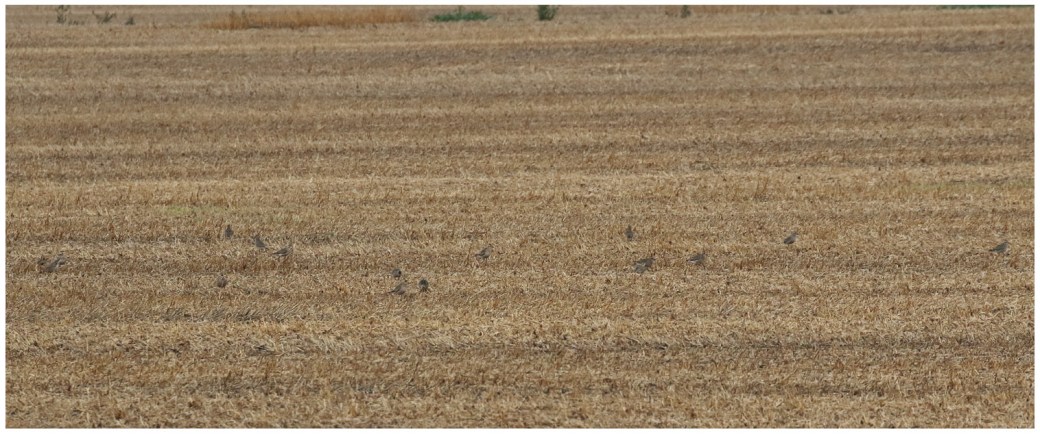
Spot the American Golden Plover. Copyright Christian Artuso
On September 18th, Ward Christianson and Linda Boys headed to Oak Lake and Plum Lakes IBA. The totals here were nothing like Whitewater Lake, with only 7 species of shorebird being encountered. Numbers of American Coot, Green-winged Teal, and other dabbling ducks were beginning to build up impressively as well. There were also good numbers of Franklin’s Gulls, and Sandhill Cranes and Tundra Swans were noticeably beginning to appear in the area. Long-billed Dowitcher were the most abundant shorebird, followed by Pectoral Sandpiper, and Lesser Yellowlegs.
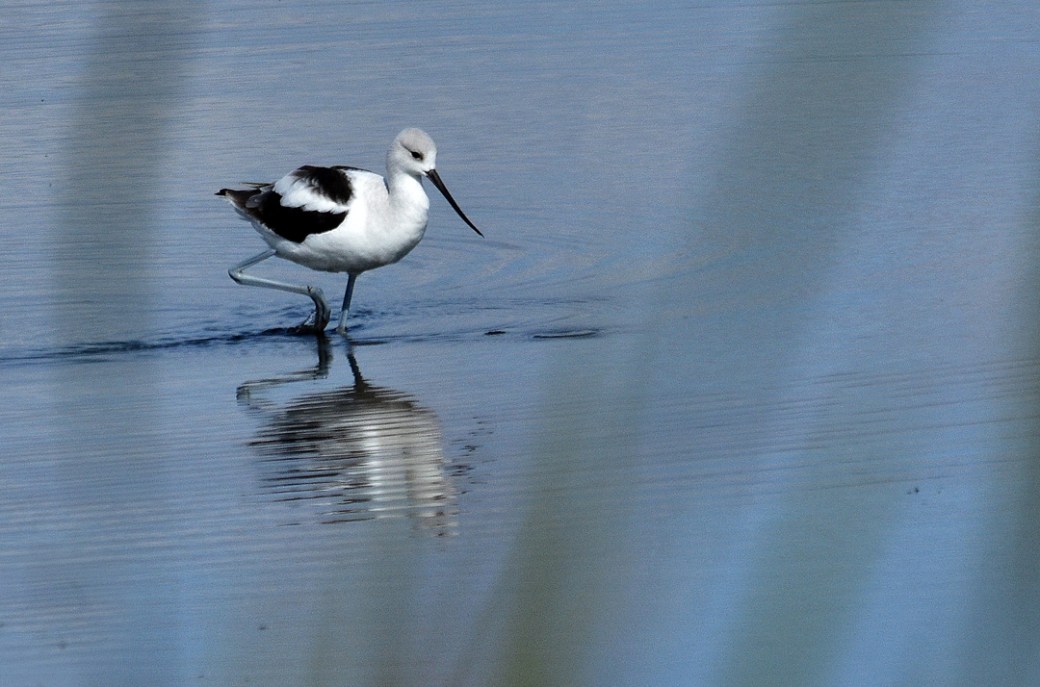
American Avocet in fall plumage at Oak Lake. Copyright Linda Boys
As the totals of non-shorebirds have not been added to eBird yet, we only include the shorebird totals below.
| American Avocet | 7 |
| Killdeer | 12 |
| Stilt Sandpiper | 11 |
| Pectoral Sandpiper | 32 |
| Long-billed Dowitcher | 39 |
| Short-billed/Long-billed Dowitcher | 1 |
| Greater Yellowlegs | 30 |
| Lesser Yellowlegs | 23 |


Photos above – another type of wading bird, the wonderful Great Egret. Copyright Linda Boys
Thanks Ward, Linda, Gillian, Josiah, Ed and Christian for all your excellent efforts this week!
For more information on ISS, and previous reports, please see:
Maps, basic instructions and Oak Lake and Whitewater Lake first trip reports
Shorebird Workshop Report – Day 1
Shorebird Workshop Report – Day 2
Whitewater Lake Second Trip Report
Story on NCC website
Story on Manomet website
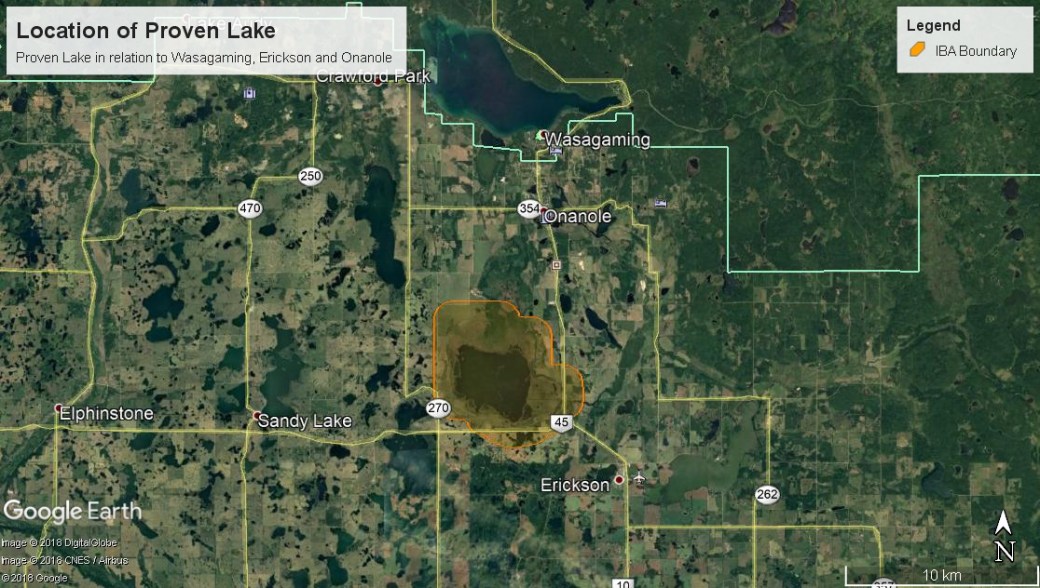
A Feature on Proven Lake IBA
Tucked in the shadow of Riding Mountain National Park, Proven Lake is the type of place which you might drive past on the road to and from the Park. But take a look, and you might find an interesting place, of Yellow Rails, Le Conte’s Sparrows, Bobolinks, and Alder Flycatchers. Beavers can be spotted here, and even the occasional River Otter. Proven Lake gives you an opportunity to find great birds from spring to fall, and even into winter.
It is fall and maybe not the best time to find some of the treasures named above, but then again, fall is often the time to get up early, visit wetlands, and watch (and count) the extraordinary numbers of waterfowl departing in search of a good meal. Others have commented that Proven Lake shelters hundreds, nee thousands, of waterfowl in fall, and we would encourage anyone staying in that area to get out, and take a look.
Manitoba Sustainable Development have in fact built a trail on Proven Lake. It is little used, and likely to be a bit overgrown, but in mid-summer, apart from the ticks, it provided a great birding walk.
Below, we share maps, and a bit of information about this little known IBA.
Proven Lake is reached by driving north on Highway 10 from Brandon. Turn to the west when Highway 10 meets number 45, and you are almost there! Rather than turn onto the 45 itself, immediately take the gravel road to the north, and head along here. The lake is to the north.
Soon the lake appears. You can see a possible Franklin’s Gull colony on the lake in this area. Of interst to most birders, the habitat here for Yellow Rail looks superb!
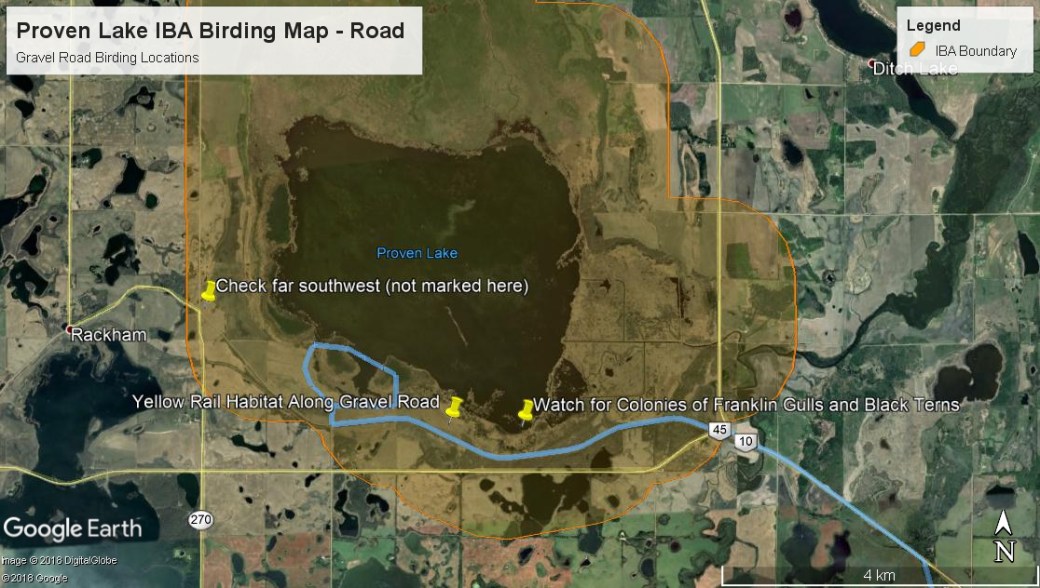

Sedge meadows beloved of Yellow Rail and Le Conte’s Sparrow, among others.
Continuing to head west, you come to the trail. This can be accessed on a road heading north, and you will be able to recognise it as it’s well signposted (see below).
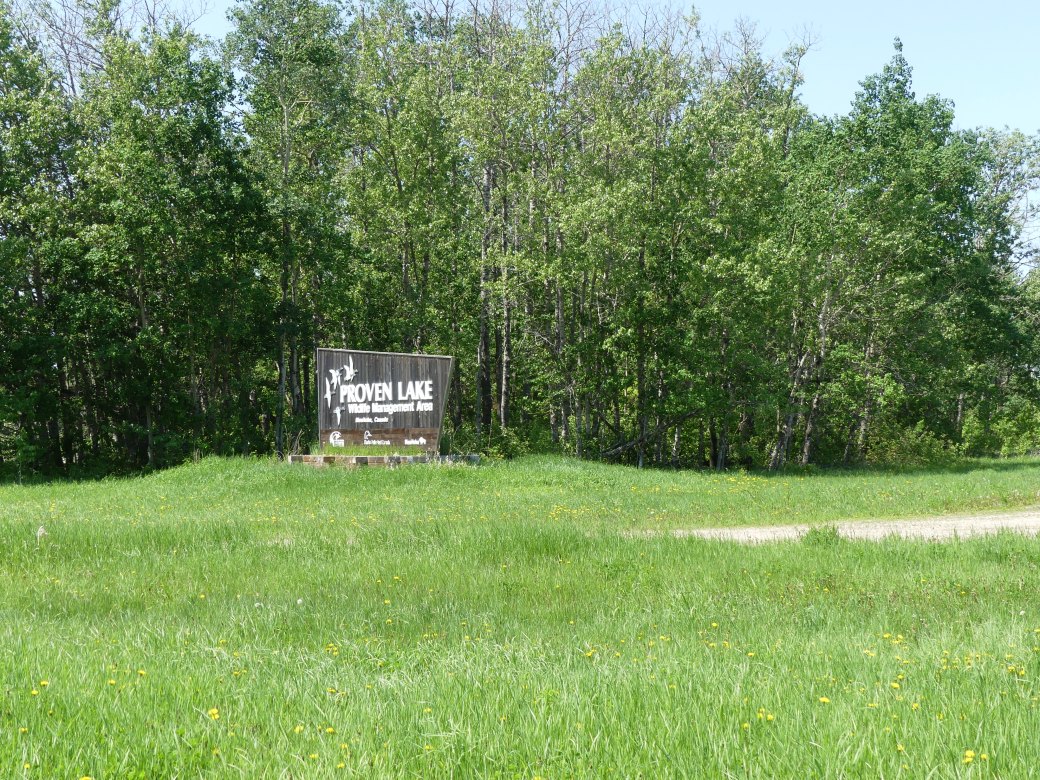
Pull into the parking lot, and you face an information sign with an image of the IBA-designate bird, the Black-crowned Night Heron. The original designation pertained to a huge colony of over 300 nests, counted in 1966. In 1995, there were still 200 nests. This represented around 4% of the estimated Canadian population of this species.
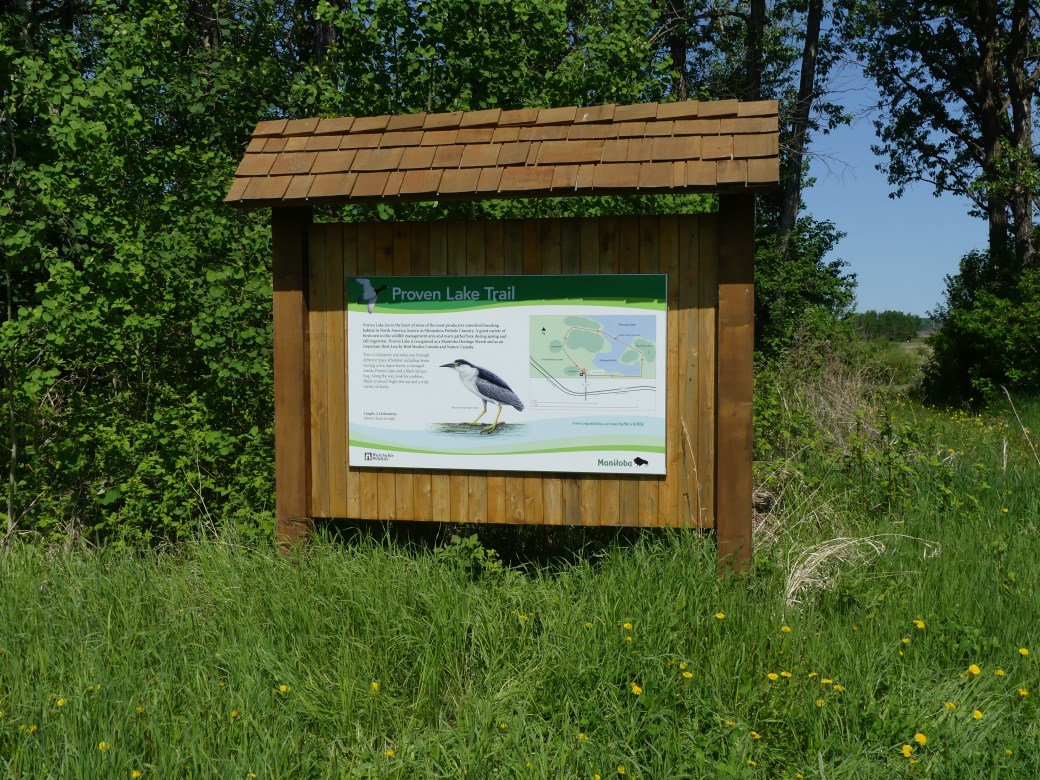
The information sign on the way into the trail. Copyright Tim Poole
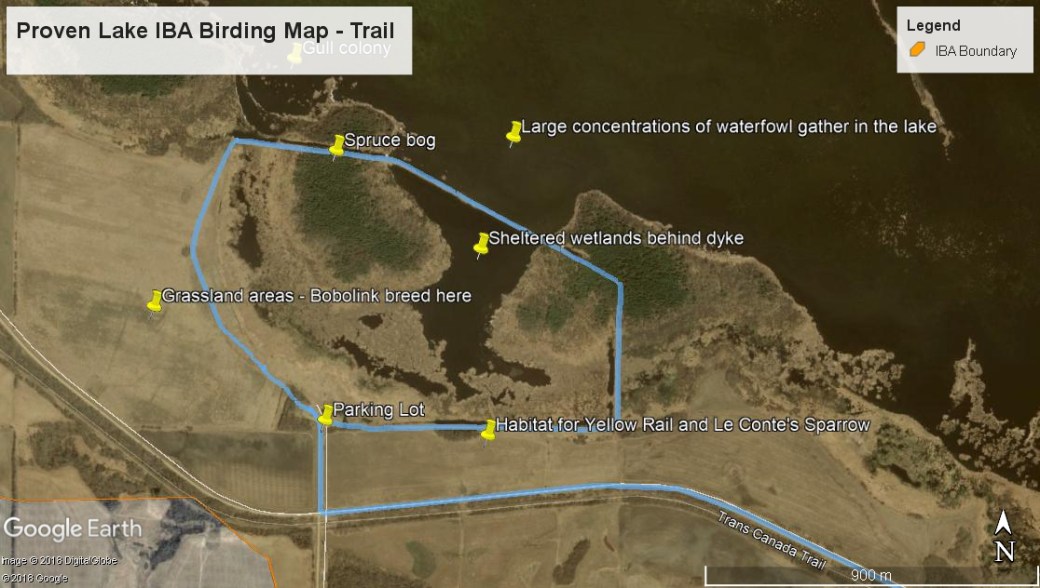
Close up of the trail track taken form a GPS.
Setting out along the trail, you come across a variety of habitats: broadleaf woodland; agricultural land, notably hay meadows; spruce bog and; wetlands including cattail marshes, sedge meadows and open water.


The hay meadows host Bobolinks, Brown Thrasher, and other generalist open ground bird species. These drop into sedge meadows closer to the lake, and this area was notable for its Yellow Rails during the Manitoba Breeding Bird Atlas. Le Conte’s Sparrow are also found here. The lake has hosted large colonies of Franklin’s Gull in the past, at least 800 nests (a modest 100 individuals were noted in summer 2018). Eared Grebe has bred here in significant numbers as well. Being so close to the National Park, a number of warblers can be spotted in migration, as well as some of the typical aspen parkland breeding species, such as Black-billed Cuckoo and Least Flycatcher. Areas of willow scrub, and dead conifer trees are ideal for flycatchers, Alder’s certainly breed here. The cattail marshes also host American Bitterns, and hide breeding dabbling ducks.
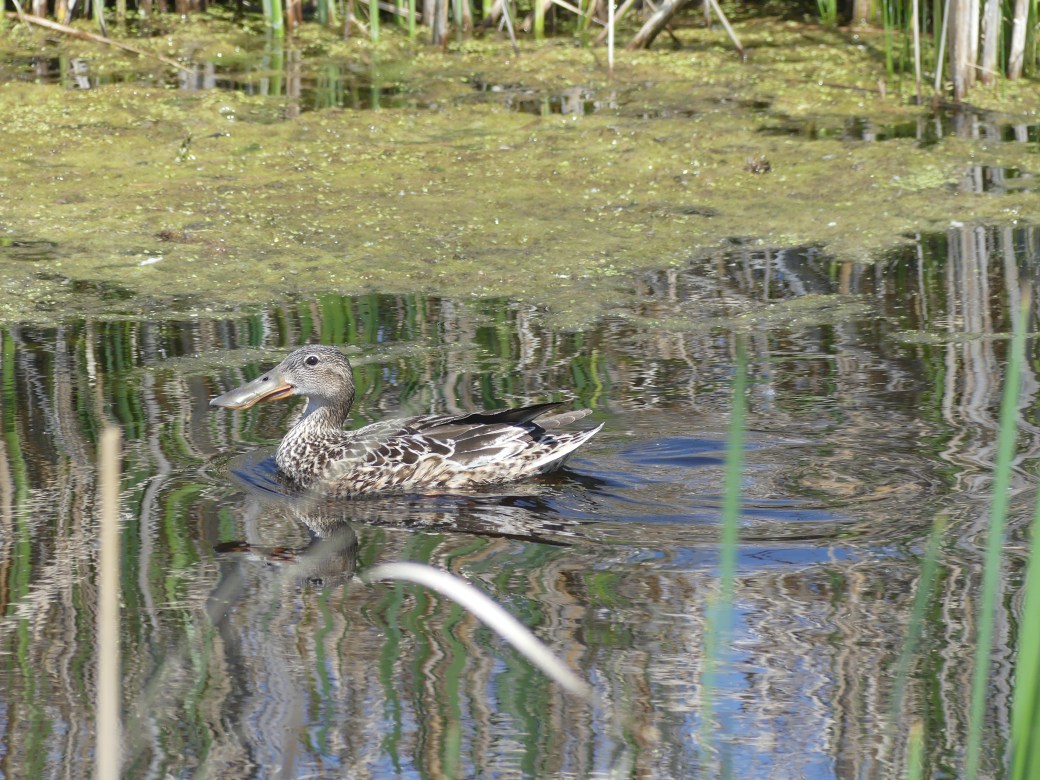
A female Northern Shoveler, just one of the species of duck using Proven Lake. Copyright Tim Poole
The varied habitat along the trail provides habitat for a host of species. Beaver lodges are noticeable along the channels, and muskrats are present in the cattails. The diverse habitats are also great for invertebrates (although in spring and summer, watch for ticks). Please though be Bear Smart – this is after all in the shadow of Riding Mountain, and this area is very much known for its bears.
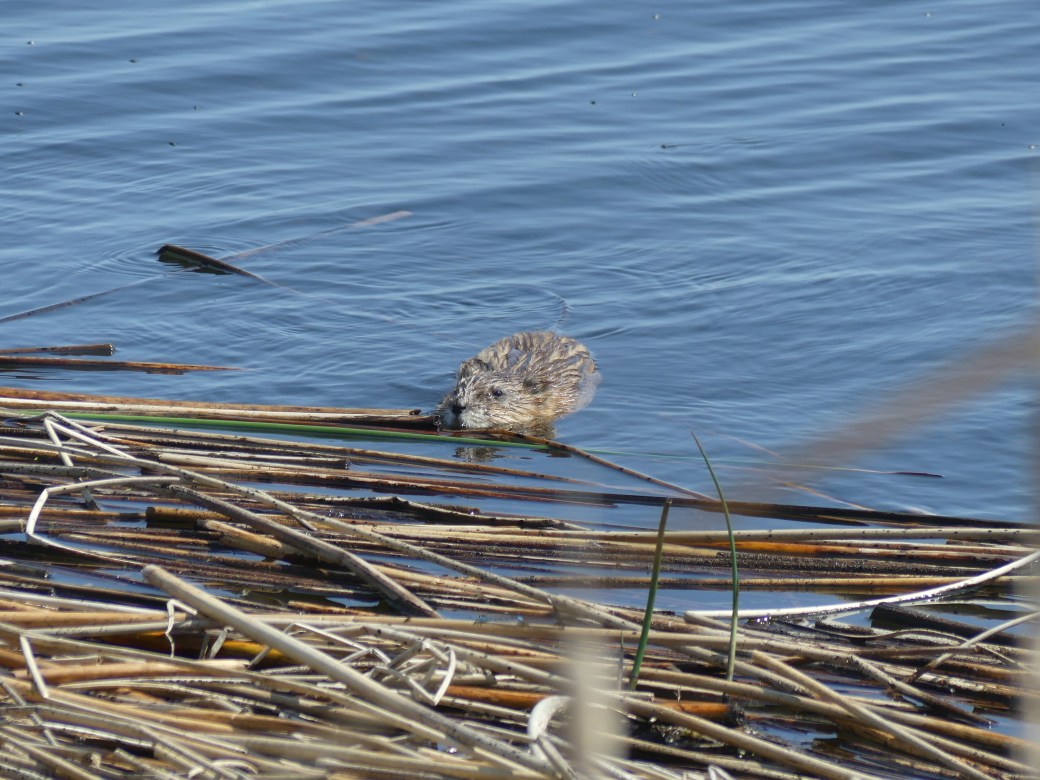
Muskrat in the lake. Copyright Tim Poole
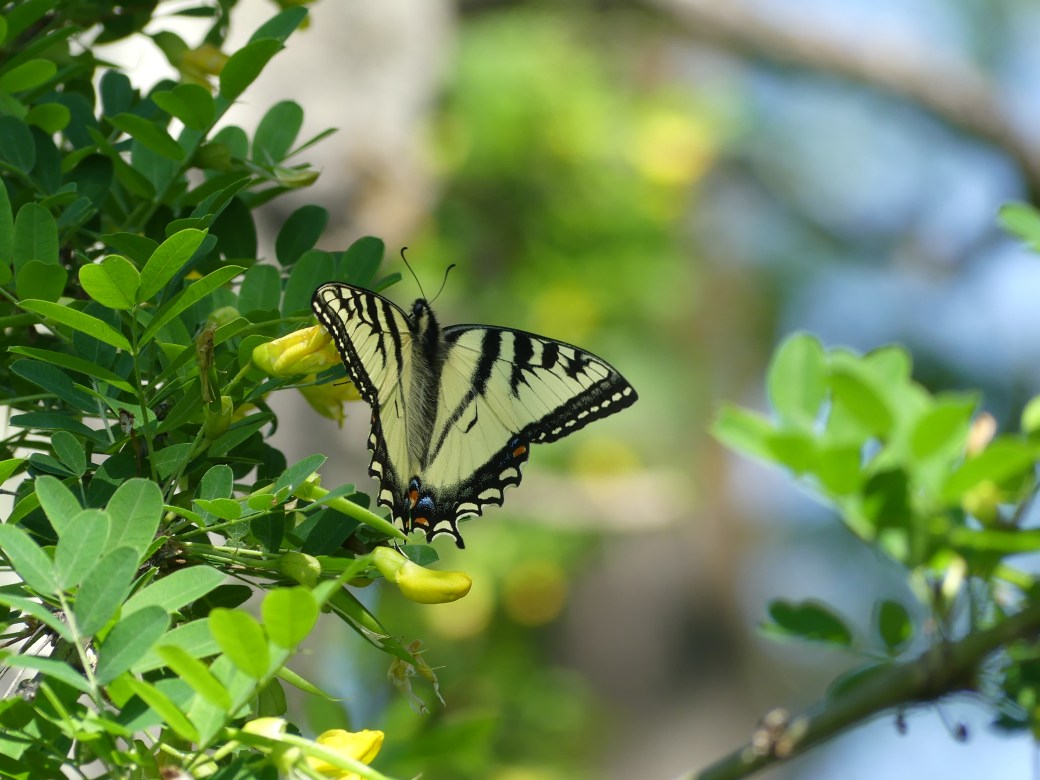
Canadian Swallowtail Butterfly, a species present along the woodland edge in late spring and early summer. Copyright Tim Poole
Monitoring Priorities
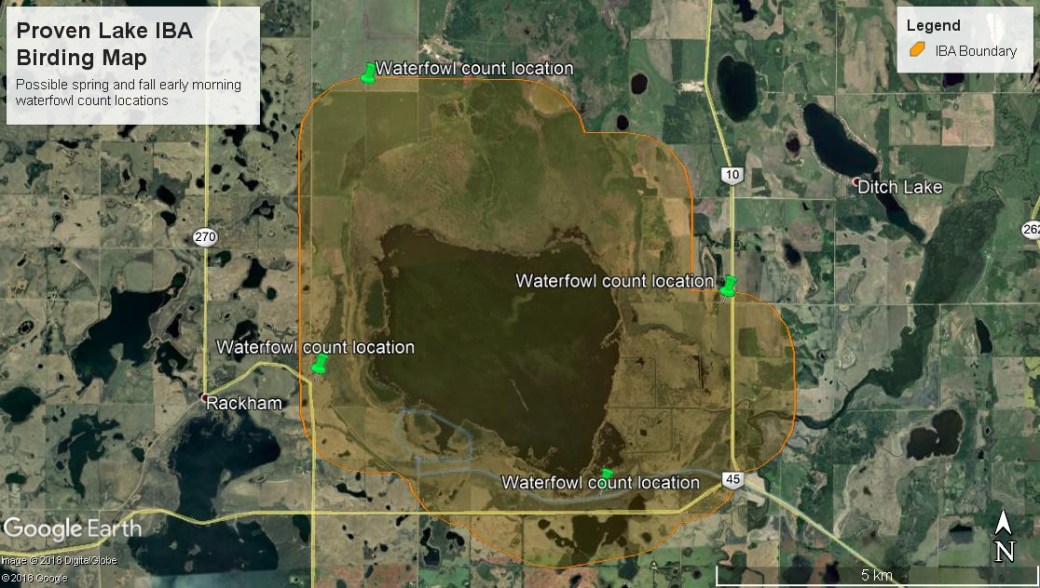
Although all the above were taken in June, there is a need to do more monitoring at Proven Lake. Many visiting birders drive straight by it, heading into the boreal treasure trove that is Riding Mountain National Park, and in a way, who could blame them! BUT, Proven Lake is certainly worth a look, and the area here is very much under-birded. You will find species such as Great Gray Owl in the conifer trees along the trail, and it is an ideal spot for the elusive Yellow Rail, so why not stop here next time you come by? In terms of fall priorities, if you are visiting the area, why not take an early morning trip to one of the points on the map below, and count the waterfowl as they leave the shelter of the lake and marshes, and go to feed for the day in the surrounding grain fields? If you are really adventurous, why not try to get a group of people out, and try to count from more than one spot? You might be surprised at the numbers you find!
Impressive Gull Totals During a Hawk Watch at MB001 Delta Marsh IBA
Garry Budyk, John Weier and John Hays have been committed volunteers, not just for the IBA Program, but also for many of Manitoba’s avian monitoring programs, including the Breeding Bird Atlas, Chimney Swift Initiative and Breeding Bird Surveys. A recent trip by all three to Delta Marsh has given us an excellent opportunity to highlight their amazing contributions to the Manitoba IBA Program, through good old fashioned bird monitoring, and the confirmation of an IBA trigger at one of Manitoba’s most well-known IBAs.
On Saturday September 8th, the three amigos made their way to Delta Marsh to count hawks, part of the annual Nature Manitoba Fall Hawk Watch. During the day of birding, they managed to encounter some high numbers of birds. Most impressively was a total of Franklin’s Gulls of 10,500. An IBA trigger, being more than 1% of the global breeding population of this species! This was almost half the total birds encountered, with there also being 7,120 Ring-billed Gulls. The vast majority of these birds were on open flats at Lynch’s Point in the northwest corner of the IBA. They also found two Red Knot, an excellent species to find in southern Manitoba at this time of year.

Thousands of birds gathering at Lynch’s Point, dominated by Franklin’s Gulls. Copyright Garry Budyk
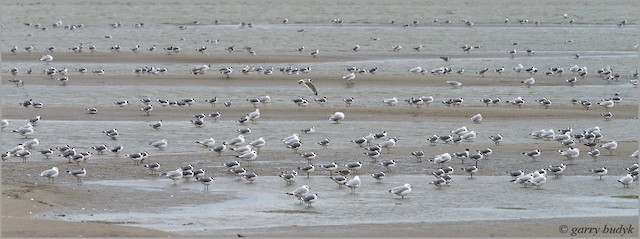
More gulls! Copyright Garry Budyk

Even more gulls! Copyright Garry Budyk

Pelicans and other waterbirds were also counted at Delta during the annual Hawk Watch. Copyright Garry Budyk
Here are the total birds for the day, within the IBA of course (the guys also have other lists outside the IBA).
| Snow Goose | 26 |
| Canada Goose | 2,570 |
| Blue-winged Teal | 160 |
| Northern Shoveler | 6 |
| Gadwall | 6 |
| American Wigeon | 3 |
| Mallard | 202 |
| Northern Pintail | 2 |
| Green-winged Teal | 17 |
| Bufflehead | 1 |
| Hooded Merganser | 2 |
| Ruddy Duck | 1 |
| Sharp-tailed Grouse | 8 |
| Pied-billed Grebe | 7 |
| Horned Grebe | 1 |
| Western Grebe | 4 |
| Rock Pigeon | 6 |
| Mourning Dove | 19 |
| Sandhill Crane | 145 |
| Black-bellied Plover | 1 |
| Semipalmated Plover | 4 |
| Marbled Godwit | 6 |
| Red Knot | 2 |
| Sanderling | 20 |
| Baird’s Sandpiper | 3 |
| Least Sandpiper | 5 |
| Pectoral Sandpiper | 5 |
| Semipalmated Sandpiper | 22 |
| Spotted Sandpiper | 3 |
| Greater Yellowlegs | 2 |
| Lesser Yellowlegs | 17 |
| Bonaparte’s Gull | 42 |
| Franklin’s Gull | 10,500 |
| Ring-billed Gull | 7,120 |
| California Gull | 1 |
| Herring Gull | 2 |
| Common Tern | 3 |
| Forster’s Tern | 44 |
| Double-crested Cormorant | 13 |
| American White Pelican | 80 |
| Great Blue Heron | 4 |
| Great Egret | 2 |
| Osprey | 1 |
| Northern Harrier | 5 |
| Sharp-shinned Hawk | 1 |
| Cooper’s Hawk | 1 |
| Bald Eagle | 1 |
| Red-tailed Hawk | 8 |
| Belted Kingfisher | 2 |
| Downy Woodpecker | 1 |
| Northern Flicker | 8 |
| Merlin | 3 |
| Peregrine Falcon | 1 |
| Eastern Phoebe | 1 |
| Blue Jay | 2 |
| Common Raven | 3 |
| Horned Lark | 2 |
| Barn Swallow | 36 |
| Black-capped Chickadee | 4 |
| Red-breasted Nuthatch | 1 |
| Marsh Wren | 3 |
| American Robin | 2 |
| European Starling | 61 |
| American Goldfinch | 12 |
| Clay-colored Sparrow | 1 |
| Vesper Sparrow | 1 |
| Savannah Sparrow | 1 |
| Swamp Sparrow | 2 |
| Yellow-headed Blackbird | 5 |
| Red-winged Blackbird | 324 |
| Rusty Blackbird | 12 |
| Brewer’s Blackbird | 100 |
| Common Grackle | 6 |
| blackbird sp. | 100 |
| American Redstart | 1 |
| Magnolia Warbler | 1 |
| Blackpoll Warbler | 1 |
| Yellow-rumped Warbler | 1 |
A Summary of Summer IBA Magic
2018 was an eventful summer for the Manitoba IBA program, which had a full itinerary of events which included numerous bird-blitz at different IBAs, workshops, community outreach events, habitat restoration, and attendance at summer fairs. This summer’s success was driven by a huge turnout of volunteers who dedicated their time (and gas money!) to helping monitor bird diversity and abundance across the province. It is obvious that the Manitoba IBA program is growing, and we wish to thank our generous financial donors and everyone who participated in events this summer. We are already looking forward to spring of 2019!
To really appreciate how much was accomplished this year, we have put together a detailed timeline of our events below:
May 5th – We headed out to Sandy Bay IBA near Langruth to engage the local community in bird watching and monitoring. We were expecting to find high counts of Western Grebes along the shoreline, but a late spring and ice cover foiled our expectations.
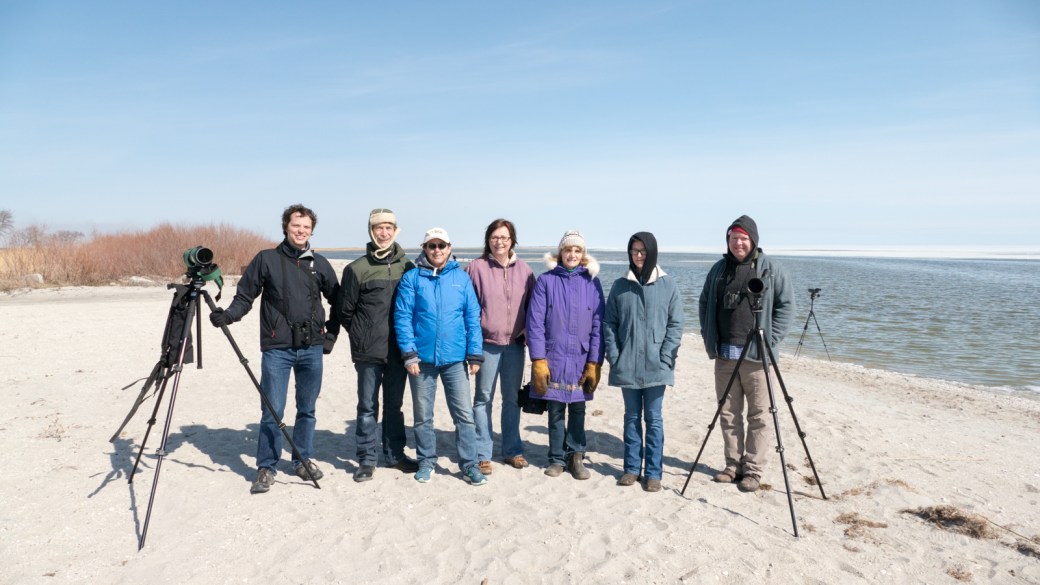
Grebewatch attendees. Copyright Lynnea Parker
May 6th – Kicking off events early, the IBA program brought a multitude of volunteers out to North, West, and East Shoal Lakes IBA to survey for Western Grebes and other waterbirds. It was a brisk morning with ice still on the lake, but that didn’t stop anyone from counting a total of 766 Western Grebes!
May 12th – We joined Oak Hammock Marsh in celebrating International Migratory Bird Day. Morning events took place at Oak Hammock Marsh with presentations by Christian Artuso and bird walk hosted by Tim, Lynnea, Paula, and Christian.
May 23rd and 24th – Nature Conservancy of Canada, Manomet Shorebird Recovery Program, and the Manitoba IBA program organized and hosted an International Shorebird workshop in southwestern Manitoba. It was a fantastic workshop which laid down the groundwork for initiating ISS surveys here in Manitoba. Never heard of ISS before? Read about it here for more details.
June – IBA intern Lynnea Parker accounts her adventures in the southwest surveying for grassland birds and species at risk. These survey efforts were apart of the SARPAL program, which is now in its second year.
June 3rd – The breeding season kicked off with an Oak Lake and Plum Lakes IBA Blitz. The day was full of great sighting and high counts of birds. Some noteworthy mentions include Cattle Egret, Upland Sandpiper, Red-headed Woodpecker, Loggerhead Shrike, Mountain Bluebird, Sprague’s Pipit, and Chestnut-collared Longspur. Read all about this successful start to the summer.
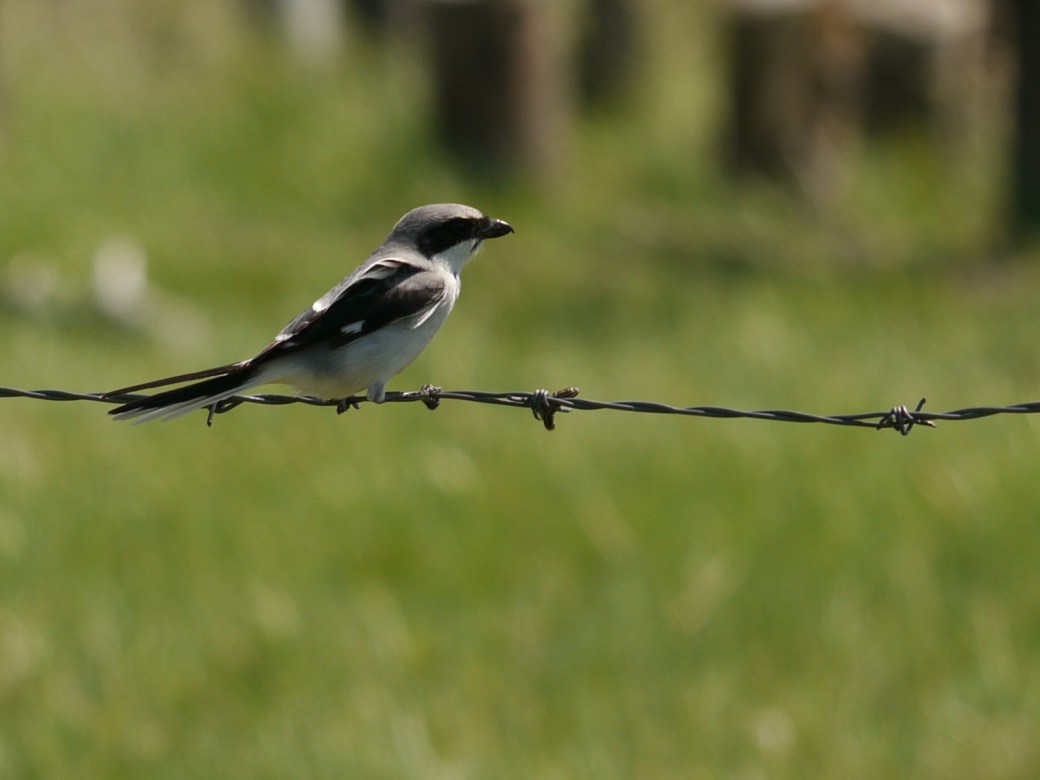
Loggerhead Shrike near Oak Lake. Copyright Katharine Schulz
June 9th – The program joined forces with the Nature Conservancy of Canada to look for species at risk on their properties near East Shoal Lake.
July 11th – Manitoba’s brand new Clear Your Gear program was supported by the Manitoba IBA program. We hosted a shoreline cleanup event at St. Ambroise Beach Provincial Park. Volunteers and event coordinators were equally surprised by the sheer quantity of commercial gill nets which were removed from 3km of shoreline (blog post Read more here
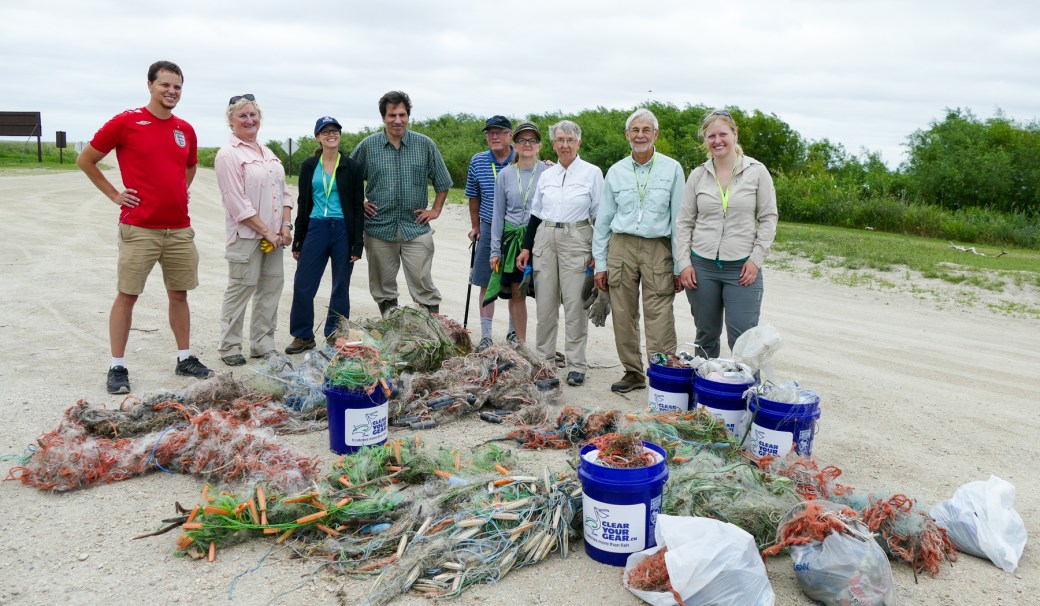
That is a lot of junk! Copyright Lynnea Parker
July 15th – The IBA program hosted its first ever species-specific blitz, which was for Red-headed Woodpeckers. This event took place at the Kinosota-Leifur IBA which great success. 51 individuals were found, and 34 breeding pairs were confirmed.
July 26th – Christian, Rebekah, Josh, and Ward conducted the first ever official International Shorebird Survey (ISS) in Manitoba at Oak Lake and Plum Lakes IBA! The survey revealed how important water levels are for shorebird habitat. Only 12 species of shorebirds were detected, with Lesser Yellowlegs, Killdeer, and Wilson’s Phalarope the most abundant.
July 29th – Christian, Colin, Gillian, and Tim conducted the first ever Whitewater Lake ISS survey. 21 species of shorebirds were detected. Special highlights included 1,440 Long-billed Dowitcher and 418 American Avocet. Continue reading about this great kickoff to the fall ISS season.
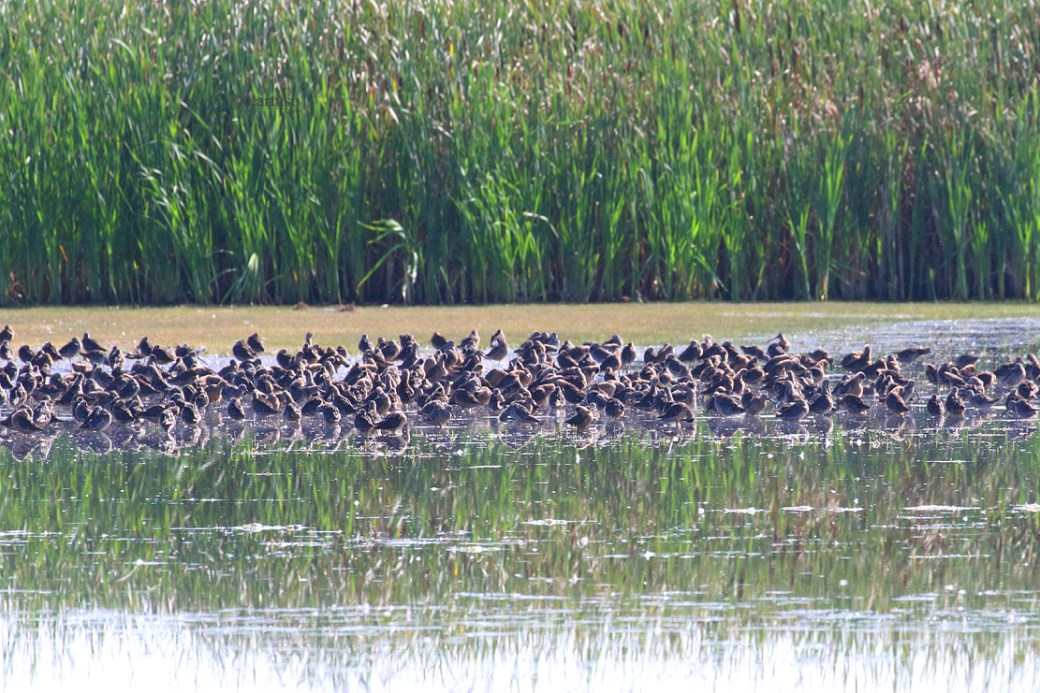
Shorebirds flocks. Copyright Christian Artuso
August 12th – The Delta Marsh IBA Blitz took place bright and early to beat the heat with a daytime high of 36 degrees Celsius. 5 groups covered the entire IBA area finding a total of 156 species and 19 shorebird species. Although a whopping 19,564 individual birds were counted, shorebirds were few and far between. The Least Sandpiper with 388 individuals was the most abundant shorebird species. Checkout what happened at Delta Marsh.
August 15th and 16th – Tim Poole flew to Gillam in northern Manitoba to introduce the IBA program to Fox Lake Cree Nation. The IBA program is excited to have the opportunity to work with the Fox Lake Cree Nation in establishing a monitoring program for the remote Nelson River Estuary and Marshy Point IBA.
August 16th – The annual Weed Pull for Plovers event took place with Joanne Smith (Sandy Bar IBA Caretaker). 24 volunteers turned out for this event and significant progress was made restoring habitat for shorebirds and waterbirds.
August 22nd – Tim and Lynnea conducted the 2nd fall season International Shorebird Survey (ISS) at Whitewater Lake. While most of the areas surveyed had low counts of shorebird, one particular spot along the route was a sight to behold – 6,000 to 8,000 thousand shorebirds of different species were found flocking together!
August 26th – 20 volunteers comprising 6 groups surveyed North, West and East Shoal Lakes IBA and surrounding areas. Although bird activity was in its seasonal decline, this IBA did not disappoint with 152 species and 7,868 individuals! 25 Red-headed Woodpeckers were found and 15 different species of shorebirds.
With so many events already concluded, let’s not forget about these upcoming opportunities to engage with bird conservation before the 2018 season ends.
September 21 – Riverton Sandy Bar Weed Pull Event (ROUND 2)
Please join the IBA program one more time this year to improve shorebird and waterbird habitat at the Sandy Bar IBA. Drinks and snacks will be provided at 8:30am and the group will depart for the sand bar with weed-whacking supplies at 9:00am. Expected end time is 12:30pm.
October 14 –Swans and Cranes… Oh My!
Oh my indeed! Come join us in southwestern Manitoba to help find, count, and record the anticipated arrival of hundreds (if not thousands!) of swans, geese, ducks, and cranes. The large gatherings of these congregational birds is a sight to behold every fall in Manitoba. We will need all the help we can get.
If you don’t believe us, check out this blog post: Blast from the past: Historical observations and fall birding in southern Manitoba (check it out here).
A Journey Down the Nelson River with Fox Lake Cree Nation
On August 15th and 16th, the Tim Poole, Manitoba IBA Program Coordinator, was invited to attend the Gathering of the Fox Lake Cree Nation. This was funded through the generous support of Nature Canada’s IBA Local Action Fund (LAF), and coordinated with the Centre for Indigenous Environmental Resources (CIER). Our intention was to reach out to members of the community in relation to the Nelson River Estuary and Marsh Point IBA, part of which is in Fox Lake’s territory. This is first part of the story of a fantastic journey in the north.
As a program, we have a strong interest in building relationships with communities living on the land, working on the land, and using the land in their local IBA. We are currently into the second year of a three year project to reach out to communities around the four Manitoba Hudson Bay coastline IBAs. Before moving on, it would be worth giving a summary description of these IBAs for readers unfamiliar with this area.
The most well known Manitoban IBA in Hudson Bay is the Churchill and Vicinity IBA. In year 1 of our grant, Bonnie Chartier and I delivered a number of outreach activities in the IBA (to read more about our trip, see blog 1, blog 2, blog 3, blog 4, blog 5). In 2018, Bonnie returned in early August, and a university professor from the USA, Kit Schnaars, was moving forward with setting up a local birding group for the summer months.
Churchill is a well known birding spot, and was designated IBA for a number of species, namely Ross’s Gull, Little Gull (Churchill hosts a large proportion of North America’s small breeding population of both these species), Snow Goose, Whimbrel and Ruddy Turnstone, among others.
North of Churchill and Vicinity IBA is the Seal River Estuary IBA. Bonnie actually managed to visit the Seal River this summer for a day, thanks to the generosity of Churchill Wild, and was able to promote the glories of this spectacular area for birds and birding. The Seal River Estuary was designated due to its large concentrations of Pectoral Sandpiper and Black Scoter, but is also a major stopover for other shorebirds. For more information on this area, see this piece by Dr Christian Artuso on the birds of this area.
Close to the Ontario border is the Kaskattama River Estuary IBA. This IBA is our remotest one, a tough achievement given the competition! There is a hunting lodge, but little else. In fact, it is so remote, no one during the Manitoba Breeding Bird Atlas made it here, even though there was attempts! It was designated for large migratory concentrations of Cackling Goose and Hudsonian Godwit.
Finally, we come to the Nelson River Estuary and Marsh Point IBA. This includes York Factory, the old fur trading post. The IBA was designated for incredible concentrations of Red Knot and Black Scoter, and takes in parts of Wapusk National Park, all the way across the Nelson and Hayes Estauries, almost as far as Cape Tatnum.
All these IBA’s are known for their high concentrations of birds. What many of us living in the south of Manitoba forget though, is that these IBAs are not just about birds. They are about people. Manitoba’s northern indigenous communities have lived here for longer than any reference can be found to an IBA, and long before any European touched down in North America. For thousands of years, people have lived in these IBAs, taking advantage of the bountiful natural resources to live and thrive. The IBAs are therefore not just special for birds, they are also part of the cultural and social traditions for Manitoba’s northern Cree First Nations, and not just part of tradition, but also part of these communities present lives.
Fox Lake is one of these communites. Their band office is in Gillam, their main reserve around 30 minutes north of the town, but their territory is in the vast boreal and coastal areas along the Nelson River up the estuary. Members of this community still use these lands, and for this reason, we are interested in talking with them, about the IBA.
Arriving in Gillam on the 14th August, I was driven from the airport by Joanne from Fox Lake, to Kettle Camp, a place used by contractors working on Hydro Projects. This was on the recommendation of Val from Fox Lake. Joanne also drove me in to Gillam next morning to meet my ride up to the launch on the Nelson River. As someone who needs to stretch his legs and go exploring, I found Kettle Camp somewhat claustrophobic. Why? Well, let’s just say that this is apparently also a favourite haunt of bears! A short walk around the grounds indicated that birds were already thin on the ground, a few Common Raven, Ring-billed Gulls and the occasional Bald Eagle being all I could find. Mid-August in the northern boreal is probably not the liveliest time to go I suppose!
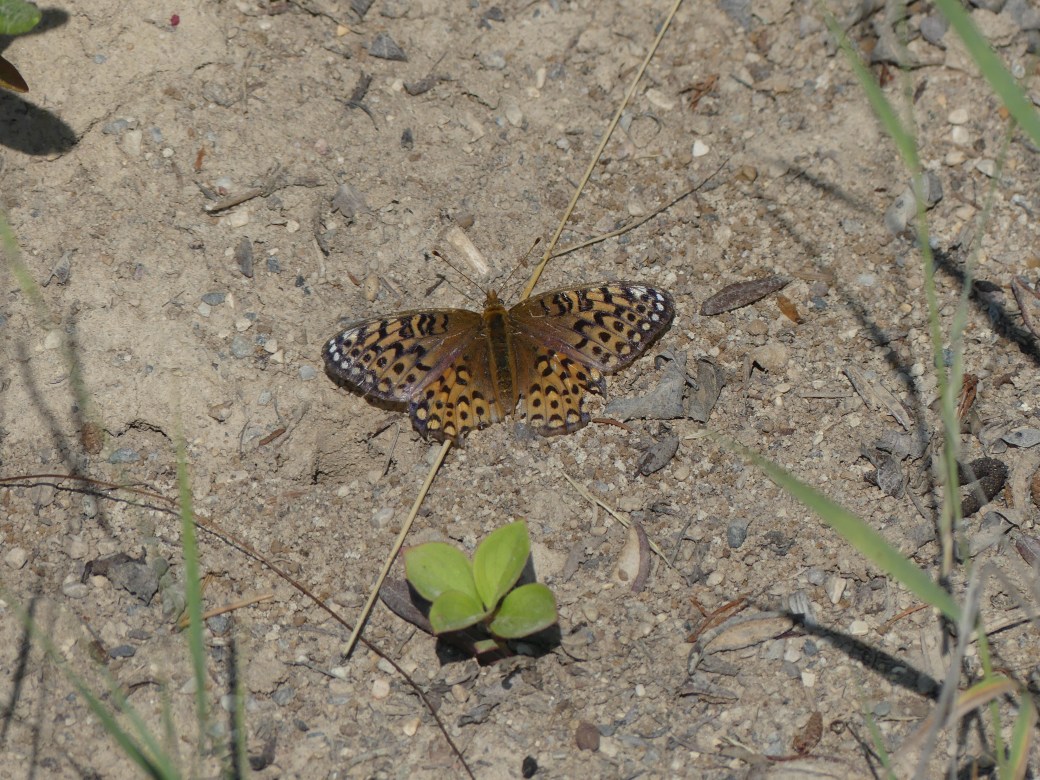
Signs of the wearing summer, and the early coming of fall? A very worn late summer fritillary (identification to follow). Copyright Tim Poole
I was to drive to the boat launch on the Nelson River with Gord Bluesky. I had come across Gord’s name previously as he was the Land and Resources Manager for Brokenhead Ojibway Nation. Brokenhead is on the edge of the Netley-Libau Marsh, so Gord has long lived in the shadow of an IBA! Although he is a band member of Brokenhead in Treaty 1, he is now based in Thompson with his young family doing a similar role for Fox Lake. This hour was an important learning experience for me. Gord explained about the history of Fox Lake, the relationship with the land, and many of the injustices that have been faced by this community, since colonialism, and more recently, the development of hydroelectric dams. Gord used the word ‘resilient’ to describe Manitoba’s northern First Nations in the face of what must have been overwhelming social and environmental change. Since my visit, this abuse was documented in a report from the Clean Environment Commission.
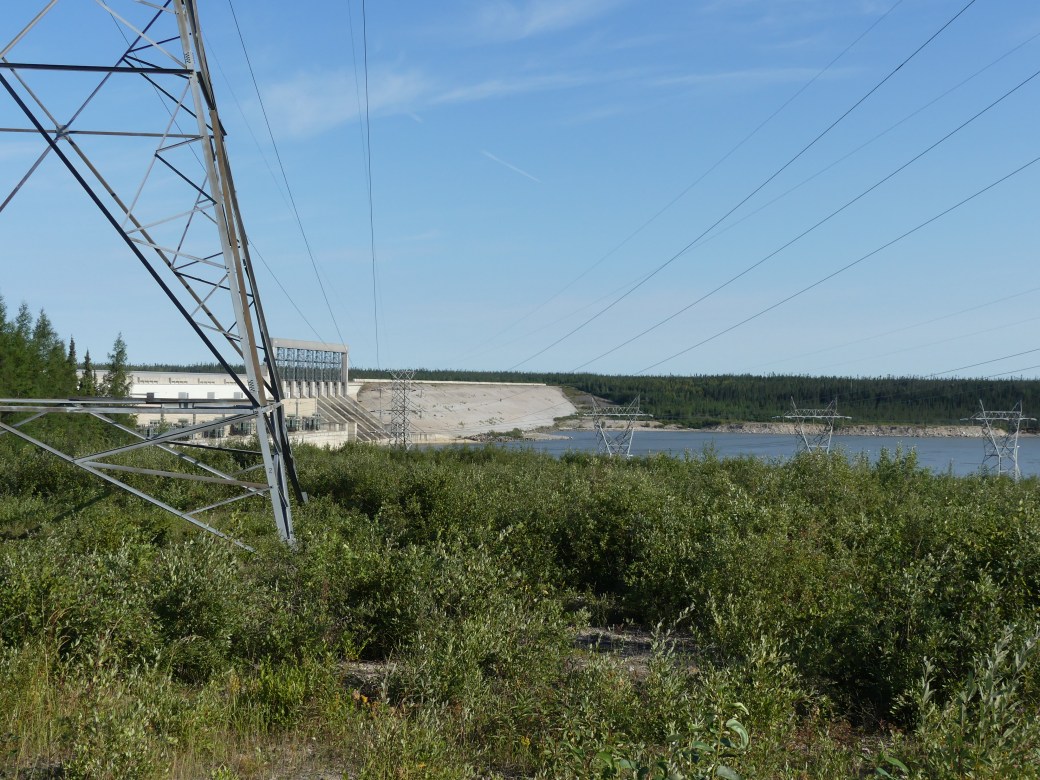
Kettle Dam just outside Gillam. Hydroelectric development dominates this northern landscape, leading to now well-documented environmental and social change. Copyright Tim Poole
The drive also gave us the opportunity to view some of the developments in this area, including the Longspruce Hydro Dam, where pelicans gathered to feed on fish, and Bald Eagles sat along the dykes, and even posed on the bridge, looking for a bite to eat.
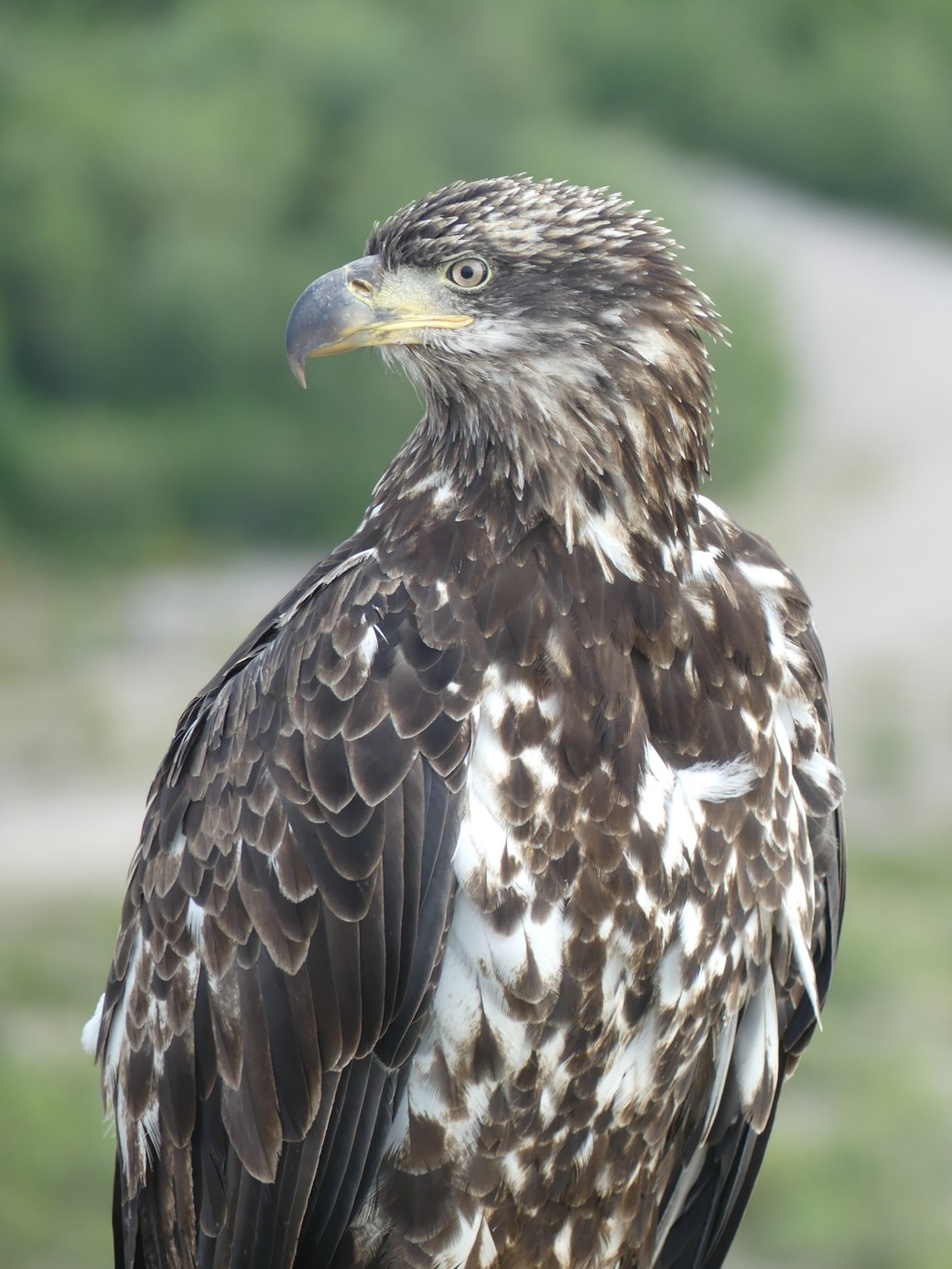
A young Bald Eagle which was sitting nonchalantly on the Longspruce Dam. Copyright Tim Poole
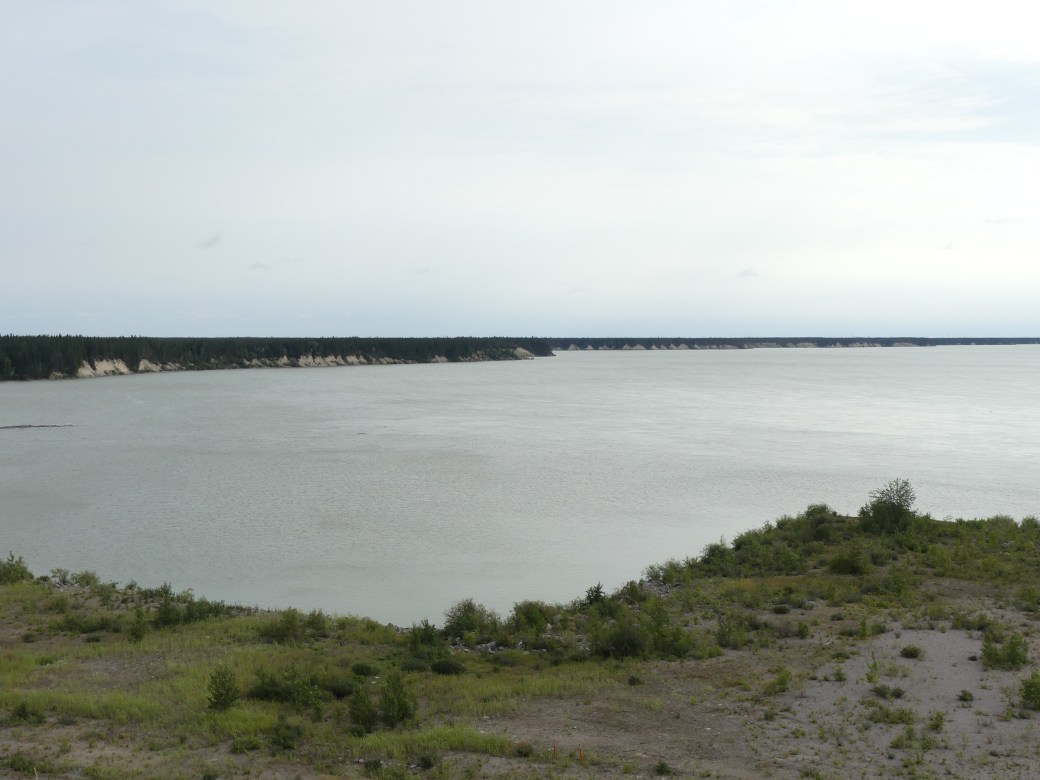
View north of Longspruce Hydroelectric Dam. Note how the water takes on the appearance of a resevoir rather than a flowing river. The pelicans and eagles seemed to like it, but as with all development, their are winners, and their are losers. Copyright Tim Poole
We arrived at the boat launch at 10:30 at Keewatinohk Converter Station. The boat drivers were already there, but there was a bit of a problem. Not enough water! Apparently, in summer, the water at the hydro dams is held back overnight, and released slowly throughout the day to feed air conditioners in Winnipeg (and no doubt elsewhere in the south, they just mentioned Winnipeg). Interestingly, the exposed rocks and gravel at this time was ideal habitat for foraging shorebirds, and about an hour later, it was pretty obvious, that these birds had been displaced – a number of shorebirds were seen flying along the river in small flocks. Although the initial foraging conditions were ideal for these migrating birds, the ever rising water levels must eventually displace them throughout the day.
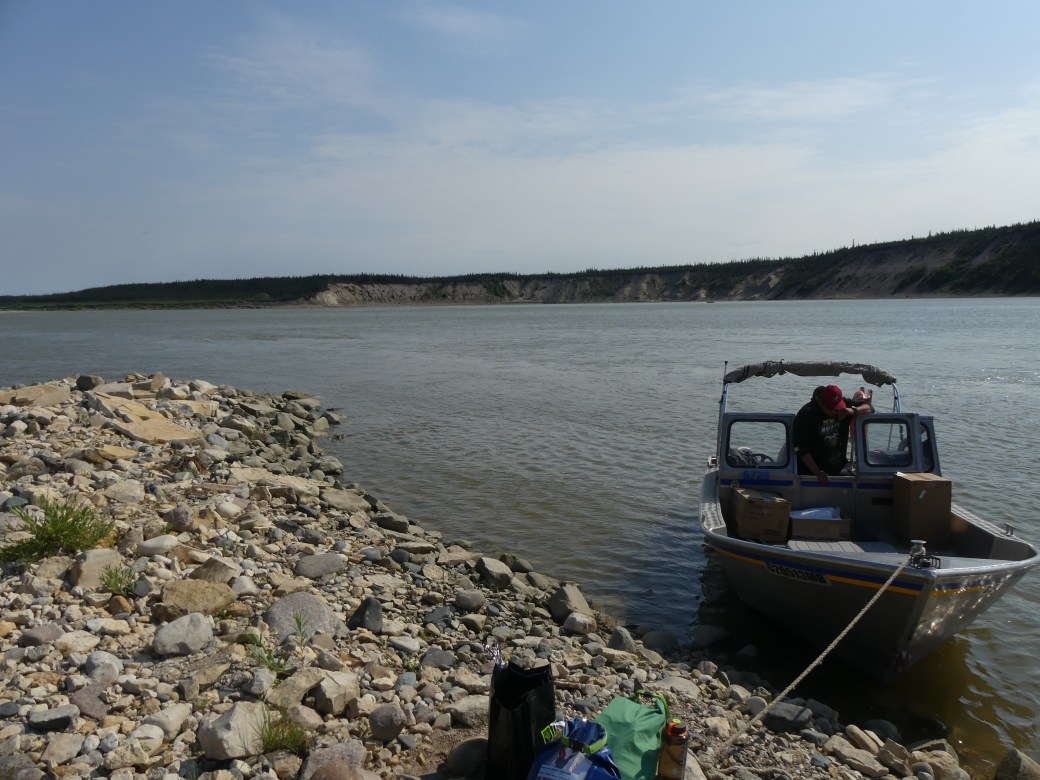
The boat launch on the Nelson. Copyright Tim Poole
The boat trip was uneventful – well, for our boat anyway! The guys from Fox Lake certainly seemed to know the river, and were able to pass through smoothly. Another boat carrying some other non-indigenous people unfortunately managed to knock its propeller on some rocks – more than once! Needless to say, the driver of this boat did not come from Fox Lake! There were good numbers of shorebirds, including Sanderling, Least Sandpiper, Semipalmated Plover and Greater Yellowlegs. I also picked out an Arctic Tern in among the Common Terns. I expected to see more ducks. There were a few small groups, but given the timing, I had hoped I might see some movement of mergansers and other northern and boreal ducks. Timing is everything when doing migration counts.
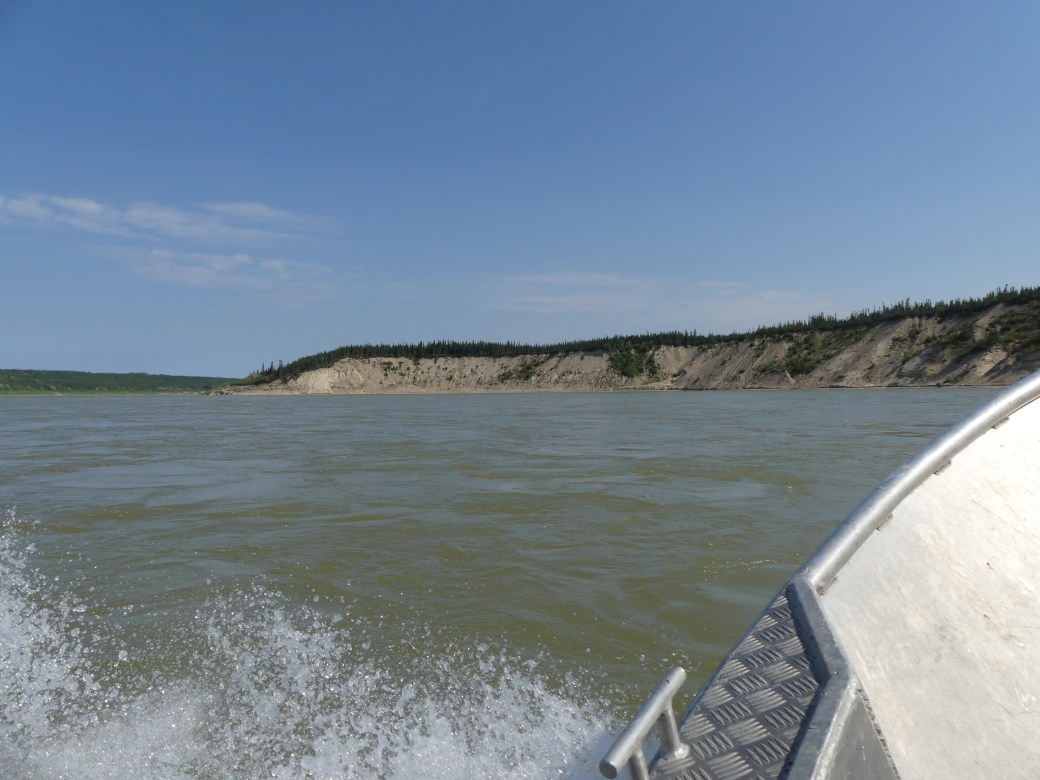
The banks of the mighty Nelson from the boat. The banks certainly showed signs of erosion in numerous places. Copyright Tim Poole
The boat trip to Deer Island lasted about one hour. The Nelson is a steep banked river, and not surprisingly for northern Manitoba, surrounded by boreal forest. The steep banks were showing signs of erosion, and in some places I was told that this was happening fast. For example, a trail along the edge of the Fox Lake Camp on Deer Island had completely fallen into the Nelson River since 2017. I am no expert on these matters, but I did wonder whether the unnatural hold back and release of water was having an impact. Certainly, it must be doing so behind the dams, and one area near the boat launch appeared to be hollowing out quickly.
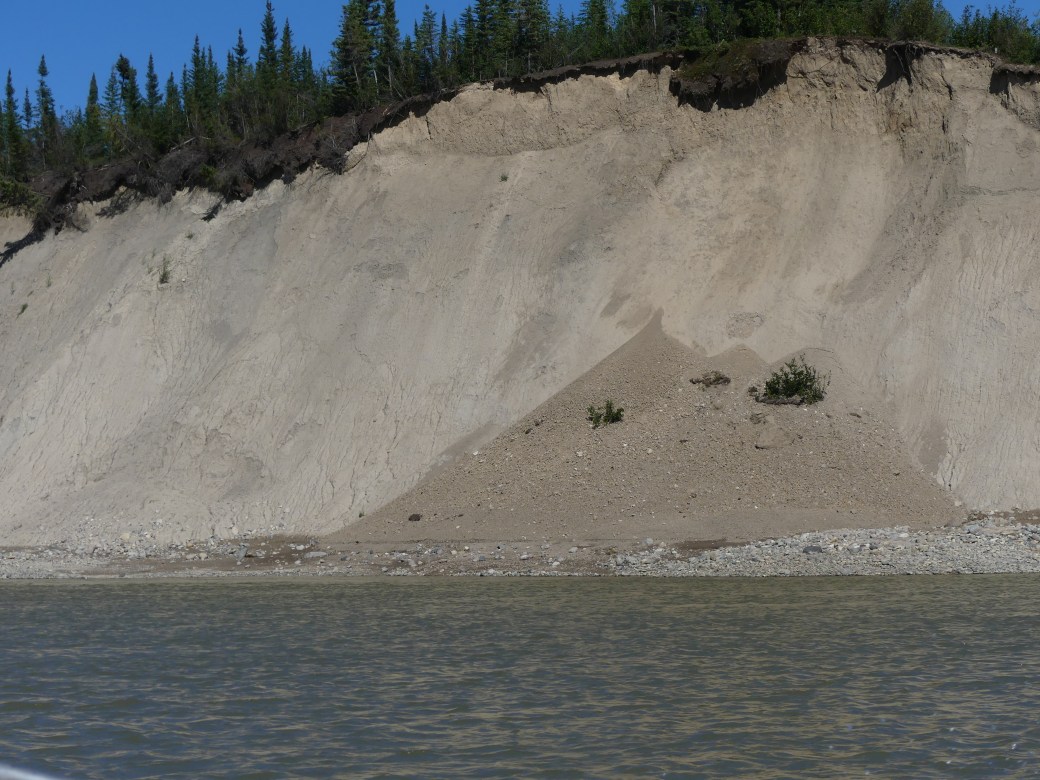
Signs of erosion on Deer Island. Copyright Tim Poole
Needless to say, this is not a conversation about the good and bad of energy policy, merely an eyewitness account of the current state of the river from a short journey.
Deer Island is located to the south and west of the Nelson River Estuary and Marsh Point IBA boundary, and in the middle of the Nelson River. It is a large rocky island covered in conifer trees, with a ground flora of blueberries, Labrador Tea, and other ericaceous shrubs. Just to the north is Wapusk National Park, and this area is full of wildlife. The bear watcher would spot caribou on the mainland coming down to drink from the river each morning. Black bear are present, and one was spotted near some blueberry pickers on the first afternoon of our visit. Moose are also present in this area.
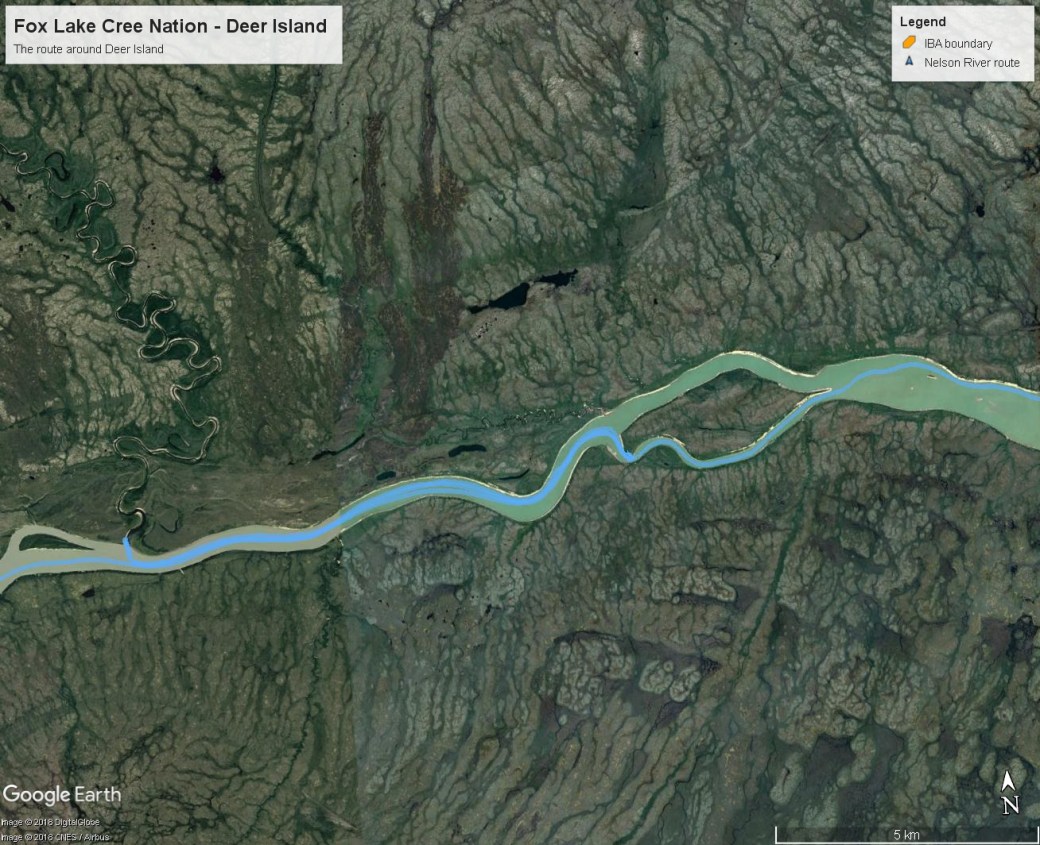
Deer Island is the large island to the right of centre, splitting the Nelson River to north and south.
Earlier in the summer, members of Fox Lake had demolished an old camp and built a new one. The rebuild took four days to complete. The camp was small, about enough for around thirty people to stay the night, and included a kitchen/eating cabin, a generator, and that all important outhouse. The first person that one would meet on entering the camp was the bear guard. The bear guard was to be on duty all night – no rest for this critical person!
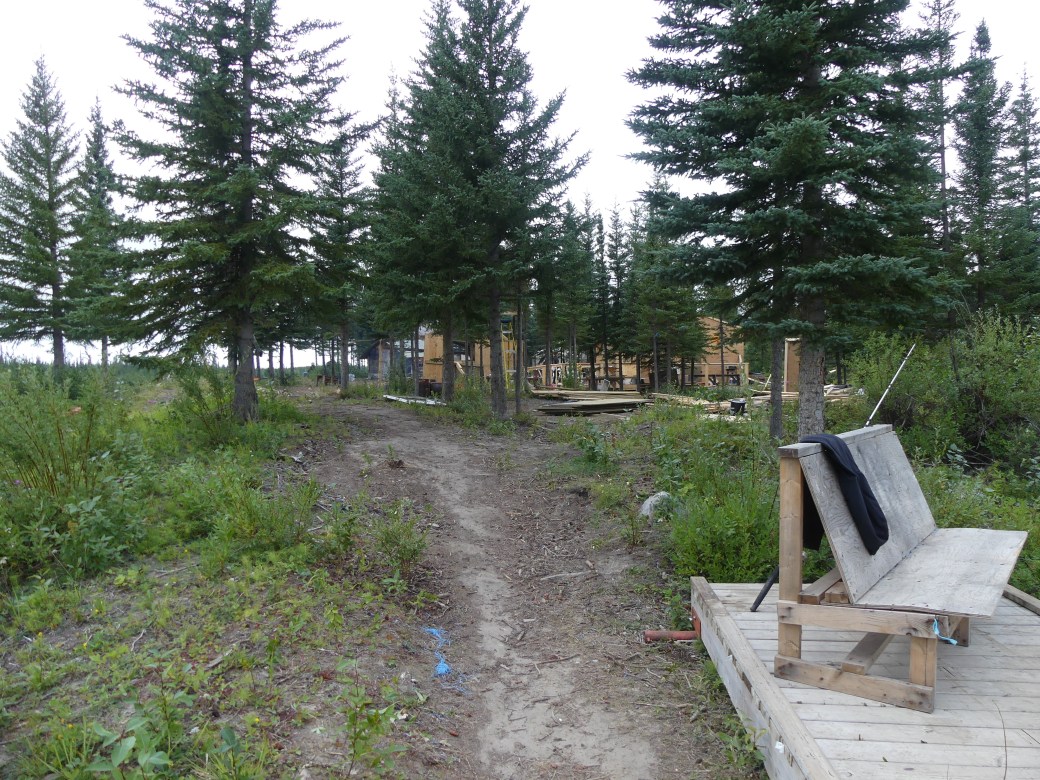
Bear guard spot to the right, camp to the rear. Copyright Tim Poole
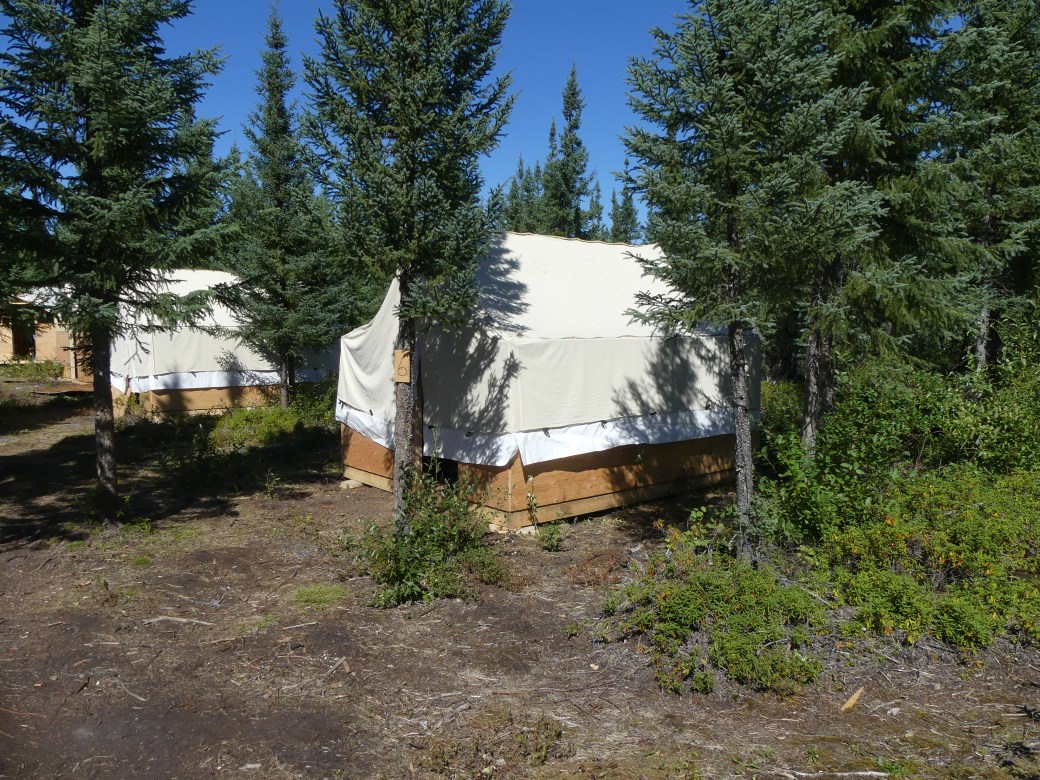
Cabins in the forest. Copyright Tim Poole
The organisation of this gathering was down to a number of people from within the Fox Lake Band. Initially, I was going to deliver a talk on that first afternoon, but we decided to delay it until the next morning. Instead, I made my way back up stream with Gord, Stephanie, part of the environmental team at Fox Lake, and her husband Jimmy. Jimmy is someone who has boated on the Nelson River for most of his life, and knew the river really well. He also knew his birds, having assisted with some Species at Risk monitoring with the Keeyask Hydro Project. We came to the spot where the Nelson River was joined by a smaller river – I cannot remeber which river, but I do remember everyone commenting on how the river conditions were much rougher when the Weir River joined the Nelson.
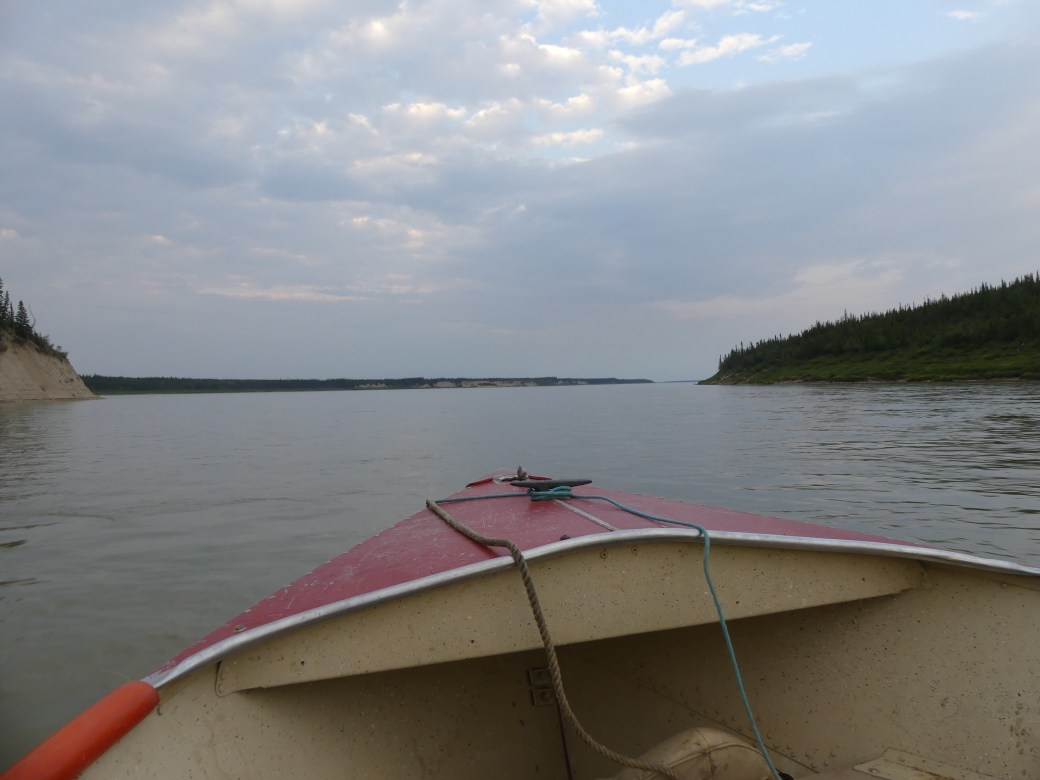
Back on a boat. Copyright Tim Poole
Jimmy and Gord fished, and Stephanie showed me one of the Fox Lake hunting cabins above the shore. I found Spruce Grouse poop – did I ever mention that I was a co-author on a study on the impacts of recreational disturbance on grouse – we used poop as a proxy for distribution of birds? I know my grouse poop! Red-breasted Merganser, Greater Scaup, Osprey and Least Sandpipers were noted in this area. The guys were failing to catch anything, so Stephanie showed them how it was done, catching a pike. The guys also caught walleye afterwards – but due to their small size, all fish were returned to the water.
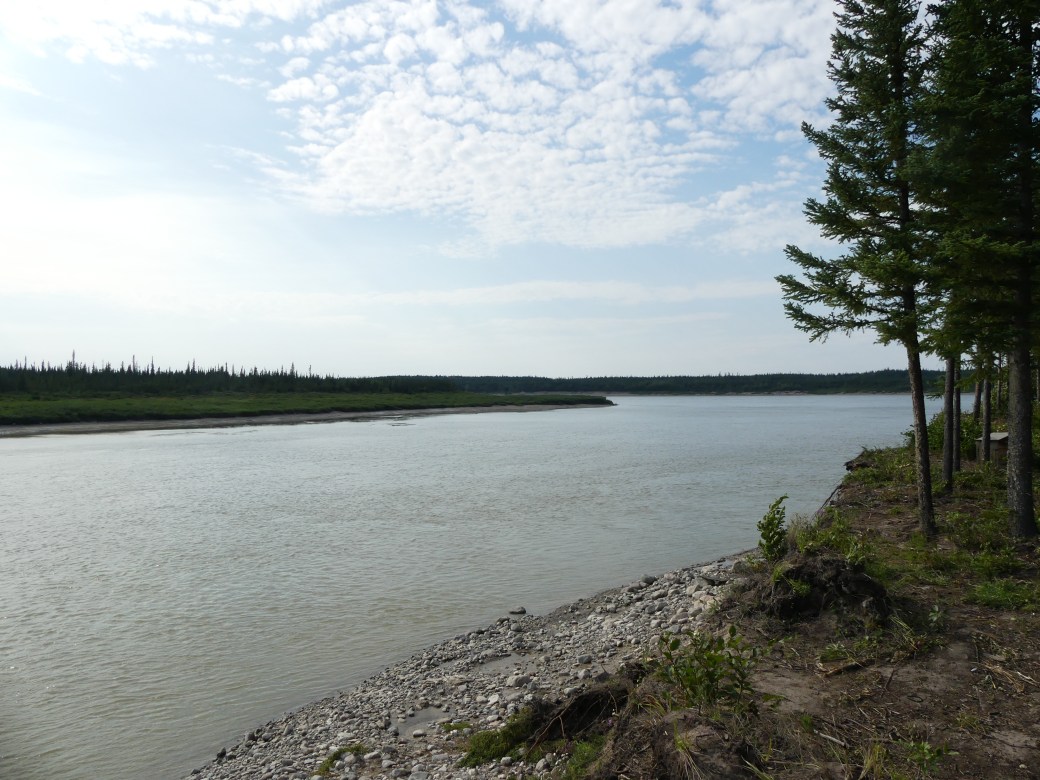
A view of the Nelson from the land, this time from Deer Island. Copyright Tim Poole
We headed back to camp once another boat made its way downriver – we had been waiting for this boat to return. On return to camp, and following an excellent supper, three boats headed up river. It was now 7:30, and we were leaving later than we hoped, mainly because we had to wait for the tide to move out at the estuary – this is after all a very large river! We were to travel downriver for an hour and then turn around – darkness was after all closing in. A Polar Bear had been spotted on Gillam Island well within the IBA boundary, and there was some hope we might almost get that far. Well, we could see Gillam Island by 8:30, and Hudson Bay, so we did get pretty close. But did we make it to the IBA? Jimmy thought maybe, just, but maybe not. I had my GPS on track, and later downloaded it, and here is the result (drum roll please).
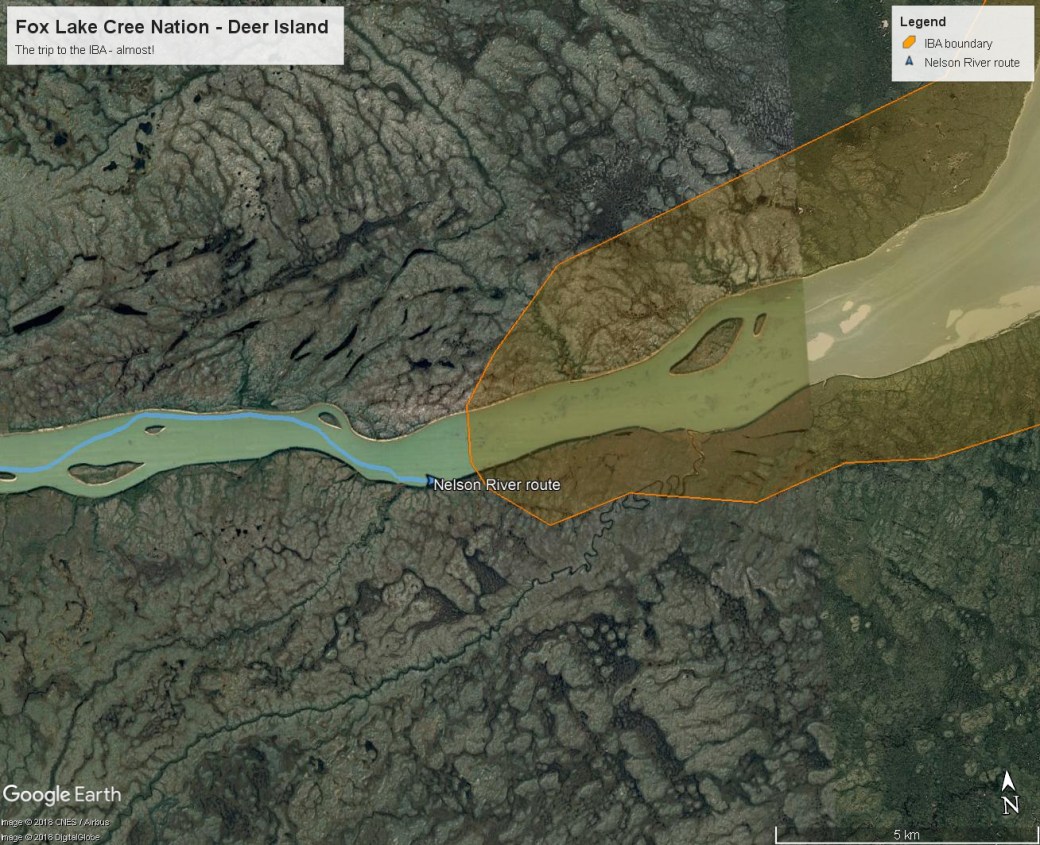
Blue line to the left, IBA to the right – so so close!
By my reckoning, we were within a few hundred metres of the IBA. Gutting! It was though a useful trip, and along with the rest of this visit, will hopefully will open up future opportunities for working together. We did get to point out some birds as the darkness closed in, including a small flock of Sanderling, no doubt looking for a spot to roost for the night. A Great Blue Heron flew overhead, and Semipalmated Sandpiper whipped around the shorelines. The Bald Eagle total for the day must, if I had included the birds seen on the morning drive, have tipped almost 50. Greater Yellowlegs and Ring-billed Gulls were also around, but the teasing prospect of the estuary left me wanting more! Maybe next year I will finally get to enter this special IBA!
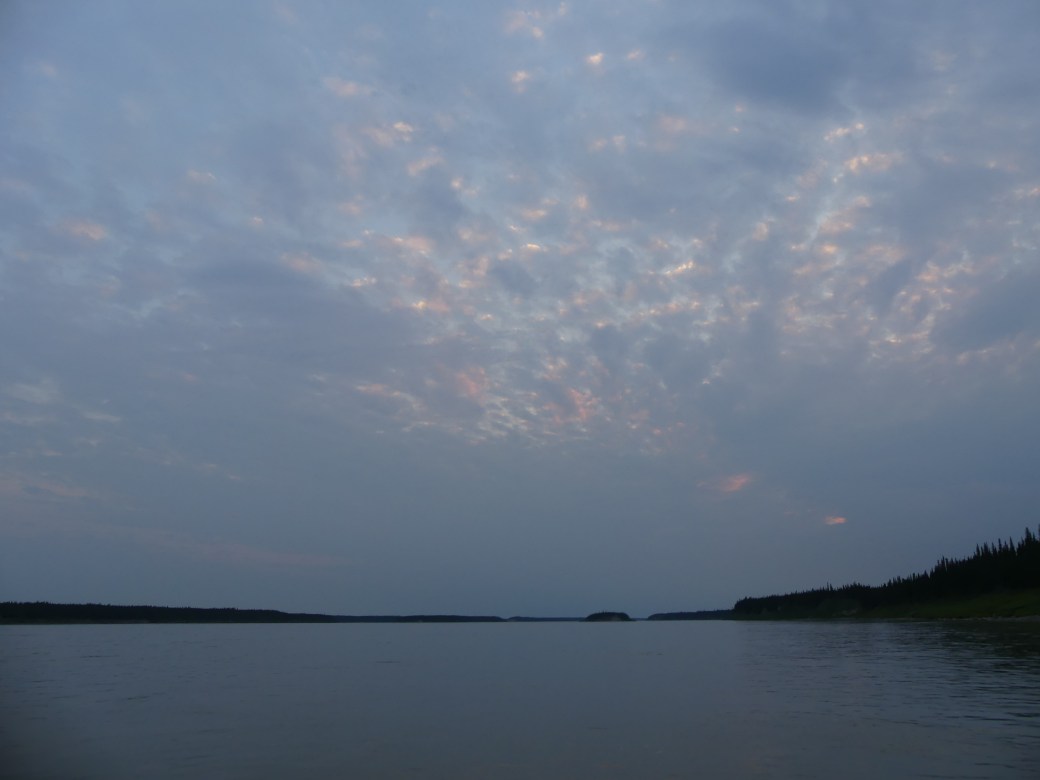
A look into the IBA as the sun sets. The large rock is Gillam Island. Copyright Tim Poole
Returning to camp, we slept in the new huts, made by members of the community specially for the gathering. The following morning, I awoke early wake-up to see if any wildlife was wandering along the shoreline. Alas, maybe due to the strong winds whipping up the river, there was little to be spotted. Later in the morning, I did spot a Peregrine Falcon swooping along the river, and a Northern Harrier swooping over, what I suspect was some open bog habitat to the east. The newly named Canada Jay, called Whisky Jack by the people at Fox Lake, started calling midway through the morning as well.
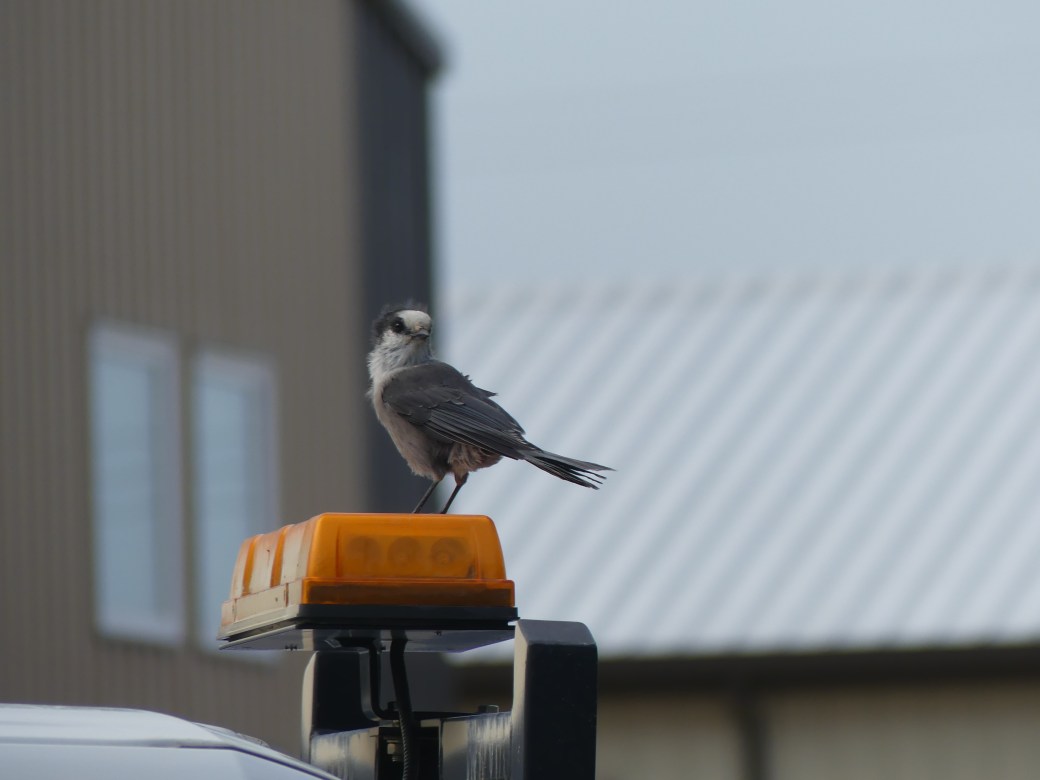
Call the alarm. A Gray Jay, er Whisky Jack, er Canada Jay, er who knows anymore! This bird was obviously not photographed on Deer Island but near the boat launch the previous day. Copyright Tim Poole
After breakfast, I gave a presentation about the IBA Program and the significance of the Nelson River Estuary for birds. I hope they enjoyed it! For certain, there is already a heap of knowledge within the community, and the community shared about some of the birds they recognised and had seen previously in good numbers in the estuary. As we had done the birding part of the workshop over the previous day, that was my official time over.
The remainder of the day was spent talking with people, birdwatching, and waiting for the boat to come back. There was an appearance by a Blackpoll Warbler and Yellow Warbler. I was also given a lesson in how to make a dream catcher by two wonderful sisters from out west, who had come to share their knowledge of medicines. A Golden Eagle was the highlight of the boat ride back, and then a great conversation with a member of the community on my way back to Gillam – did I mention the topnotch organisation, with shuttle vehicles taking members of the community from the Fox Lake Reserve and Gillam to the boat launch and back?
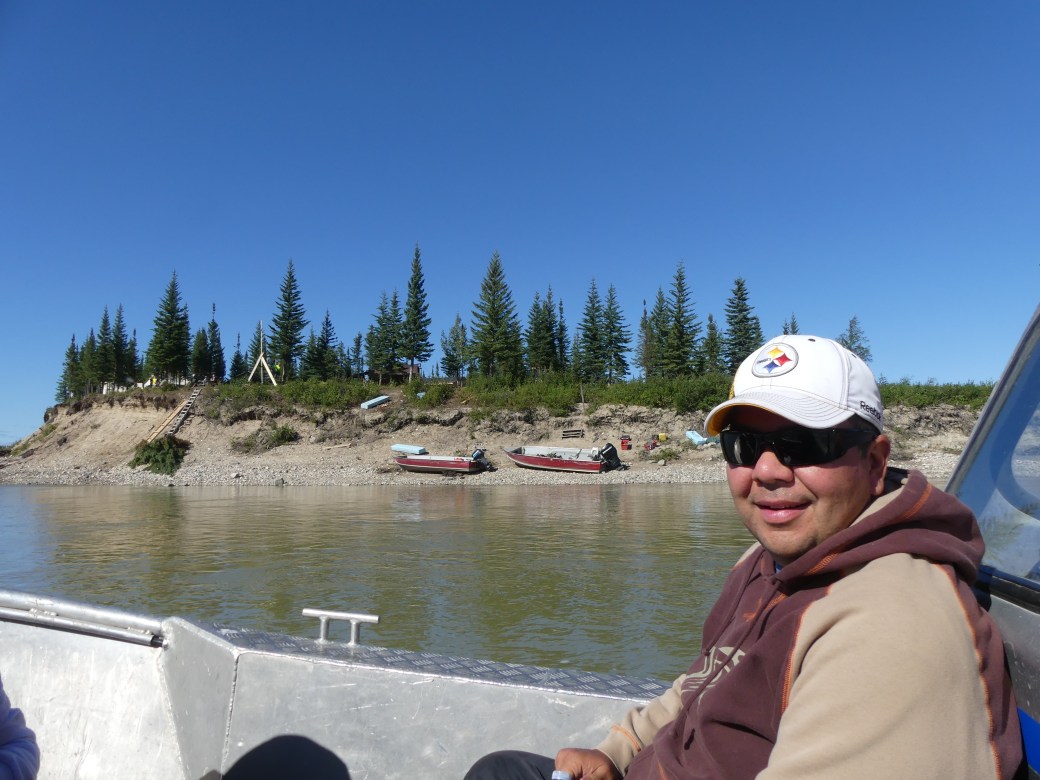
Gord, leaving the island on the boat. Copyright Tim Poole
Another night in Gillam was unadventurous – although I did achieve a unique experience riding to the airport in the local garbage truck! Before my flight out, I had time to head to Gillam Beach, and find Wilson’s Warbler, Sharp-shinned Hawk and a nice photogenic group of Greaterr Yellowlegs to finish off a successful trip.

Lesser Yellowlegs Copyright Tim Poole

Lesser Yellowlegs Copyright Tim Poole

A fen. Copyright Tim Poole

A bog. Copyright Tim Poole


A fen. Copyright Tim Poole

A bog. Copyright Tim Poole

Lesser Yellowlegs Copyright Tim Poole

Lesser Yellowlegs Copyright Tim Poole


As with any trip such as this, there are many people who worked hard to make it work. Special thanks to Shianne McKay from CIER for setting this up. Val was the primary organiser of our participation at Fox Lake, but also thank you to Conway, and Joanne for their help. Finally to Gord, Stephanie, Jimmy, Brandy, John, and everyone else involved in organising the gathering, and for Fox Lake for being so welcoming.
I hope that this will be the start of something, that we can work together to highlight the Nelson River Estuary, it’s unique place in Manitoba’s wildlife, and just maybe show Manitoban’s in the south, a flavour of the north, its rich natural treasures and its wonderful people.
Partner Media Release – Shorebird populations declining
The following release has been published by Nature Conservancy Canada, and relates to the International Shorebird Survey which we have partnered in launching in Manitoba this fall (full story found here). The release is timely following our initial surveys at Whitewater Lake and Oak Lake (survey report 1, survey report 2)
Nature Conservancy of Canada, partners and volunteers conducting surveys to learn more
Since late July, some of Canada’s most amazing travellers will have started their fall migration. Shorebirds are a diverse groups of migratory birds, a few species of which have some of the longest migration distances in the feathered world. But they are in trouble, and more needs to be done to help them.
The good news is that a number of local, national and international organizations are working together to learn how best to conserve them here in Manitoba.
Shorebirds come in various shapes and sizes, but this group of birds is strongly associated with shallow water habitats found on beaches or shorelines of lakes, shallow wetlands and in flooded fields or grasslands, where they forage for food in the mud and sand.
The migratory route that passes through the prairies is sometimes referred to as the central flyway. A handful of the species that move through Manitoba will stay and breed, raising their young, before returning south for the winter. Others only stop temporarily for food and rest on their way north or south. Whether for breeding or refuelling, Manitoba’s wetlands are incredibly important for these birds on their journeys.
Declining populations
This group of birds is declining quickly. A 2016 report on the State of the North American Birds indicated a 70 per cent decline in shorebird populations since the early 1970s. Causes of that decline range from habitat loss in breeding and wintering areas and along migratory pathways, changes in predation pressure, pollution, changes in food availability, changing climate conditions, and being repeatedly disturbed while resting and feeding.
Loss of habitat or stresses to birds during stopovers can have a significant impact on migrating birds. If the birds are not healthy and strong when they reach their breeding site, their ability to successfully raise their young falls significantly.
We need to learn more about shorebirds in Manitoba and other parts of the central flyway. How many are there? Where do they go? Which areas are the most important for them? Manitoba has a storied history of shorebird research in the Hudson Bay lowlands, but information on significant stopover sites in the midcontinent is more limited. Answering these questions will help ensure that efforts to conserve them will be as effective as possible. While a significant amount of work has been done on shorebirds on the East Coast, and more recently the West Coast, there is fewer data in the prairie regions.
Working together
Over a year ago, the Nature Conservancy of Canada (NCC) began discussions with partner organizations in both Canada and the U.S. to establish a monitoring system as part of the International Shorebird Survey (ISS). This spring, NCC, Manomet, the Manitoba Important Bird Areas Program (IBA), Bird Studies Canada and Environment and Climate Change Canada led an effort to establish a monitoring program in Manitoba. Over the past months, NCC and partners have identified sites to be surveyed and protocols for long-term surveying in ephemeral wetlands, complementing work by the IBA program and numerous volunteers. Survey data collected using ISS methods are used to calculate shorebird population trends, examine the distribution of shorebirds, the routes they use during migration and the locations of the most important stopover sites.
Key information about shorebird conservation was shared at a spring workshop held near Oak Lake. Participants were trained in shorebird identification and survey methods. These methods are currently being piloted in southwestern Manitoba. If successful, the program will eventually expand to other parts of the province and the prairies.
In late July, staff from Bird Studies Canada and the Manitoba Important Bird Area Program trained staff from NCC and volunteers from the IBA Program on Manitoba’s first shorebird surveys at Whitewater Lake near Deloraine, and Oak Lake.
What you can do
Simple, everyday things like cleaning up garbage along wetlands, beaches and shorelines and not allowing your pets to disturb birds while they are resting and foraging can help. If you are a birding enthusiast, consider submitting your data to databases such as eBird so it is available to researchers and conservation organizations. Donating to non-profit organizations working on shorebird conservation is also great way to contribute.
If you are interested in volunteering for future shorebird surveys, contact the Nature Conservancy of Canada or the Manitoba IBA Program.
Learn more
To learn more about shorebirds and the work that is being done in Manitoba, check out these blogs by the Manitoba IBA:
https://importantbirdareasmb.ca/2018/05/31/manitoba-shorebird-conservation-management-and-monitoring-workshop-day-1/
https://importantbirdareasmb.ca/2018/06/07/manitoba-shorebird-conservation-management-and-monitoring-workshop-day-2/
https://importantbirdareasmb.ca/2018/07/31/the-international-shorebird-survey-iss-in-manitoba-an-encouraging-start
this post by Manomet:
https://www.manomet.org/publication/shorebird-conservation-management-and-monitoring-workshop-in-manitoba/
and this link to the International Shorebird Survey
https://www.manomet.org/project/international-shorebird-survey/
About
The Nature Conservancy of Canada is Canada’s leading not-for-profit, private land conservation organization, working to protect our most important natural areas and the species they sustain. Since 1962, NCC and its partners have helped protect 2.8 million acres (more than 1.1 million hectares), coast to coast. We have conserved and protected over 65,000 acres (26,305 hectares) across nine natural areas critical to Manitoba’s biodiversity. To learn more, visit natureconservancy.ca.
The shorebird workshop was funded in part by the Government of Canada’s Natural Areas Program (NACP), a unique public-private partnership led by the Nature Conservancy of Canada, Manomet, and Environment and Climate Change Canada.
Learn More
Follow us on Twitter: twitter.com/NCC_CNC | twitter.com/NCC_CNCMedia
Find us on Facebook
Volunteer Trip List – Whitewater Lake IBA
Randy and Odette Mooi visited Whitewater Lake on August 4th and 5th 2018. Randy sent us his trip list, and some photos, so we thought we would post the pics on this blog for your enjoyment, with the trip list of course.
If you have any birding lists, or individual sightings from any of Manitoba’s IBAs which you have not entered on eBird, we would love to enter them for you. Please email any records to us at iba@naturemanitoba.ca.

American Coots and foraging shorebirds at Whitewater Lake. Copyright Randy Mooi
| Species | Count |
| Canada Goose | X |
| Blue-winged Teal | 200 |
| Northern Shoveler | 25 |
| Gadwall | 7 |
| Mallard | 200 |
| Northern Pintail | 12 |
| Green-winged Teal | 12 |
| Redhead | 5 |
| Ruddy Duck | 12 |
| Pied-billed Grebe | 4 |
| Red-necked Grebe | 4 |
| Eared Grebe | 15 |

Eared Grebe juvenile having a stretch. Copyright Randy Mooi
| Eurasian Collared-Dove | 2 |
| Mourning Dove | 24 |
| American Coot | 1000 |
| American Avocet | 360 |
| Killdeer | 25 |
| Upland Sandpiper | 1 |
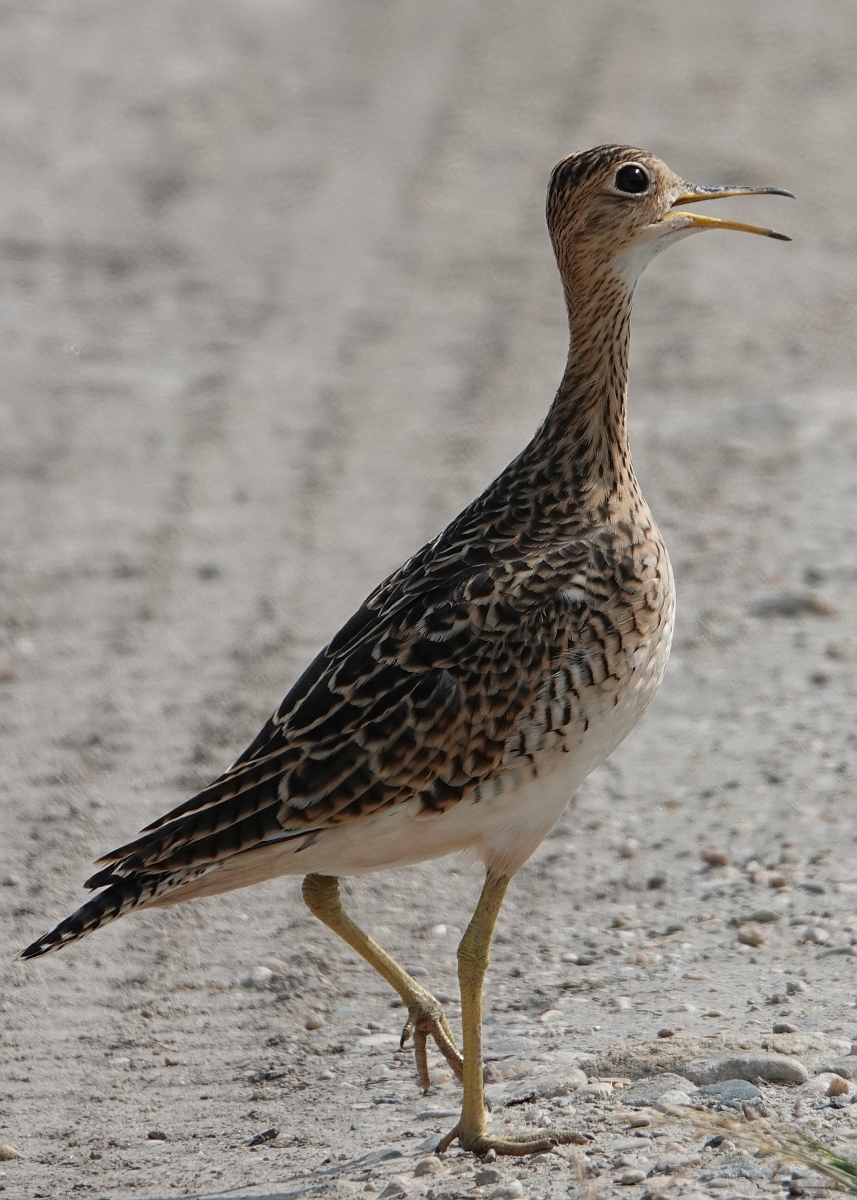
Upland Sandpiper, one of the most striking looking shorebirds. Copyright Randy Mooi
| Marbled Godwit | 20 |
| Ruddy Turnstone | 10 |
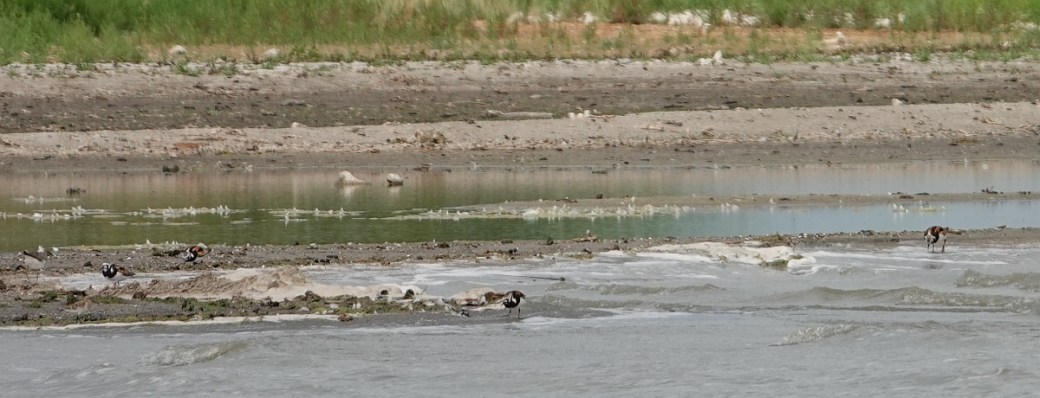
Some distant Ruddy Turnstones. Copyright Randy Mooi
| Stilt Sandpiper | 5 |
| Baird’s Sandpiper | 10 |

Baird’s Sandpipers. Copyright Randy Mooi
| Least Sandpiper | 1 |
| Pectoral Sandpiper | 10 |
| Short-billed Dowitcher | 500 |
| Long-billed Dowitcher | X |
| Wilson’s Phalarope | 5 |
| Greater Yellowlegs | 100 |
| Willet | 5 |
| Lesser Yellowlegs | 50 |
| Franklin’s Gull | 1000 |
| Ring-billed Gull | 24 |
| Black Tern | 50 |
| Common Tern | 1 |
| Double-crested Cormorant | 1 |
| American White Pelican | 24 |
| American Bittern | 2 |

Juvenile American Bittern. Copyright Randy Mooi

Parent and juvenile American Bittern. Copyright Randy Mooi
| Great Blue Heron | 3 |
| Great Egret | 20 |
| Black-crowned Night-Heron | 3 |
| White-faced Ibis | 100 |
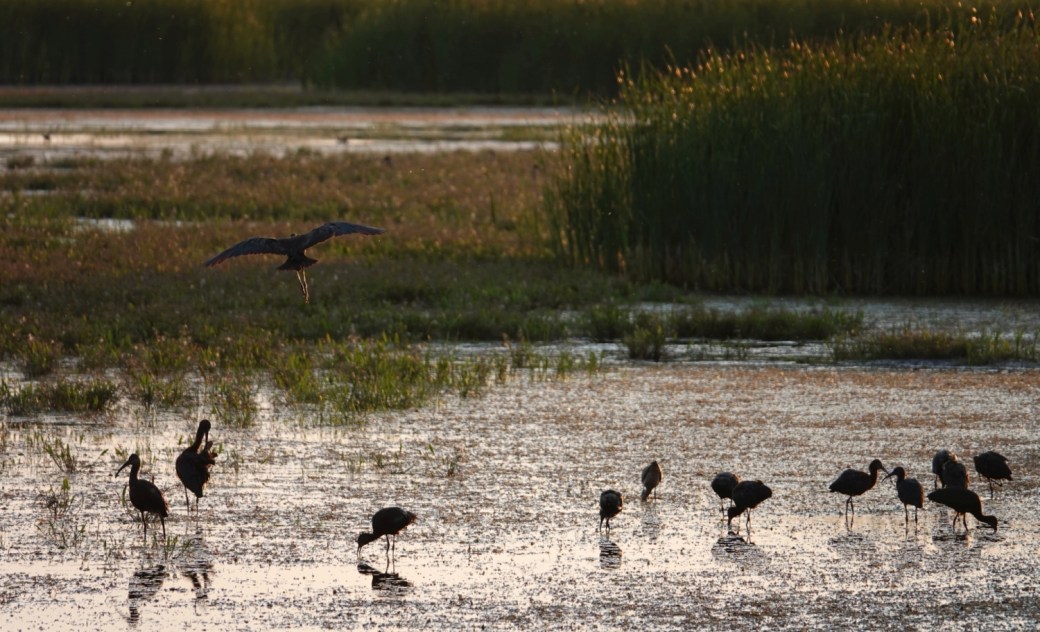
White-faced Ibis at sunset. Copyright Randy Mooi
| Turkey Vulture | 5 |
| Northern Harrier | 4 |
| Bald Eagle | 4 |
| Swainson’s Hawk | 2 |
| Red-tailed Hawk | 10 |
| Ferruginous Hawk | 1 |
| Northern Flicker | 1 |
| American Kestrel | 5 |
| Peregrine Falcon | 1 |
| Western Kingbird | 15 |
| Eastern Kingbird | 30 |
| American Crow | X |
| Common Raven | X |
| Horned Lark | 10 |
| Purple Martin | 100 |
| Tree Swallow | 200 |
| Bank Swallow | 1000 |
| Black-capped Chickadee | X |
| Sedge Wren | X |
| Marsh Wren | X |
| American Robin | X |
| European Starling | X |
| American Goldfinch | 20 |
| Chipping Sparrow | X |
| Vesper Sparrow | 5 |
| Savannah Sparrow | 24 |
| Song Sparrow | X |
| Yellow-headed Blackbird | 20 |
| Bobolink | 5 |
| Western Meadowlark | X |
| Red-winged Blackbird | 1000 |

A swarm of blackbirds…Copyright Randy Mooi
| Common Grackle | 50 |
| House Sparrow | X |
 Manitoba Important Bird Areas Program