Uncategorized
Nature Manitoba’s New Avian Stewardship Program Assistant

Lynnea Parker presenting her research poster, 2016
My name is Lynnea Parker and I am very thrilled to be joining Nature Manitoba for the next year as a full-time internship student. This intern position was made possible through co-funding provided by EcoCanada and Nature Manitoba. I will be working directly with the Manitoba’s Breeding Bird Atlas, Nocturnal Owl Survey, Important Bird Areas (IBA) program and the Chimney Swift Initiative.
I moved to Winnipeg from Nanaimo, BC in the fall of 2015 to pursue a master’s degree at the University of Manitoba. My thesis is on bear smart messaging and black bear conflicts near Riding Mountain National Park. This project was a perfect fit for me, as I have always held a passion for understanding human-wildlife interactions and finding non-lethal ways to reduce conflict. I plan to defend my thesis and graduate this summer.
Aside from my educational goals, I have held an interest in birding since 2013 when I received my first field job as a Grassland Songbird Research Technician in Brooks, AB. This is the same project that was the focus of ex-IBA Summer Assistant, Patricia Rosa’s PhD. I learned how to identify grassland songbirds and conduct various bird and plant survey methods for the first time. Since that summer, birding has become a dedicated hobby. The wonderful bird diversity and variety of conservation-oriented initiatives in Manitoba have prompted me to stay in the province after the completion of my master’s degree.

Chestnut-collared Longspur chicks

Long-billed Curlew

Marbled Godwit

Prairie Rattlesnake
Left: Chestnut-collared Longspur chicks, Right Upper: Long-billed Curlew, Right Middle: Marbled Godwit, Right Lower: Prairie Rattlesnake. Photos by Lynnea Parker.
Riding Mountain National Park was a fantastic setting to conduct research and go bird watching. A little known, but highly diverse IBA is located at Proven Lake, just 20 minutes south of Wasagaming. It was at this IBA I encountered my first Great Gray Owl at dusk. Other highlights of this IBA included being startled by a Short-eared Owl in the spooky black spruce bog, watching Bobolink glide across open fields, and stumbling across many nests alongside the 1.5 km trail.

Great Gray Owl at dusk, Proven Lake IBA, Photo by Lynnea Parker
A Year in Review At MB091, Riverton Sandy Bar by Joanne Smith
Joanne Smith, our caretaker for MB091 Riverton Sandy Bar gives us an overview of comings and goings during another successful 2017 in the IBA. All photos unless stated otherwise were taken by and copyright to Joanne Smith.
The year 2017 began as most years do at Important Bird And Biodiversity Area MB091 Riverton Sandy Bar. From January to March, ice fishing shacks dotted the ice on Lake Winnipeg, just south of the IBA’s Riverton Sandy Bar and Hecla Bar. This area is well known to both local and visiting recreational fishermen. 2017 also proved to be special because of local and visiting volunteers who came out to help pull invasive sweet clover with the goal of improving the habitat for possible future Piping Plover. With recent breeding success in other parts of the province, the possibility of having this nationally Endangered species return to Sandy Bar is quite real. The last record of nesting Piping Plover at Sandy Bar was in 2004.
From the arrival of Herring gulls in late March and first signs of nesting Canada Geese in early April, to the last fall migrants in late October, Sandy Bar can definitively be a hot spot for many species of birds ranging from the more common Mallard to the endangered Red Knot rufa subspecies. Fishermen, birders, volunteers and the birds all flock to Sandy Bar!
By the third week of April Herring Gulls had already begun to settle in and prepare nests. Approximately 65 gulls and 18 nests (without eggs) could be seen at the far end of Sandy Bar. American White Pelicans and Double Crested Cormorants had also made their arrival at this point.
Along with the arrival of new species, massive chunks of ice littered the shoreline as a wind/ rain/snow storm had battered the area in mid-April. Willows were bent over along the shoreline and the old wooden building which is used by nesting Barn Swallows (COSEWIC Threatened) received damage to many of its boards. The destruction left by the storm was a sharp contrast to the tranquility of seeing three Common Loons diving on the calm Lake Winnipeg waters just north of Sandy Bar. Hawk species Northern Harrier and Bald Eagle as well as the migrating song bird American Tree Sparrow were also regulars at this point. The huge Bald Eagle nest just west of the IBA boundary had already been occupied for several weeks at this point.
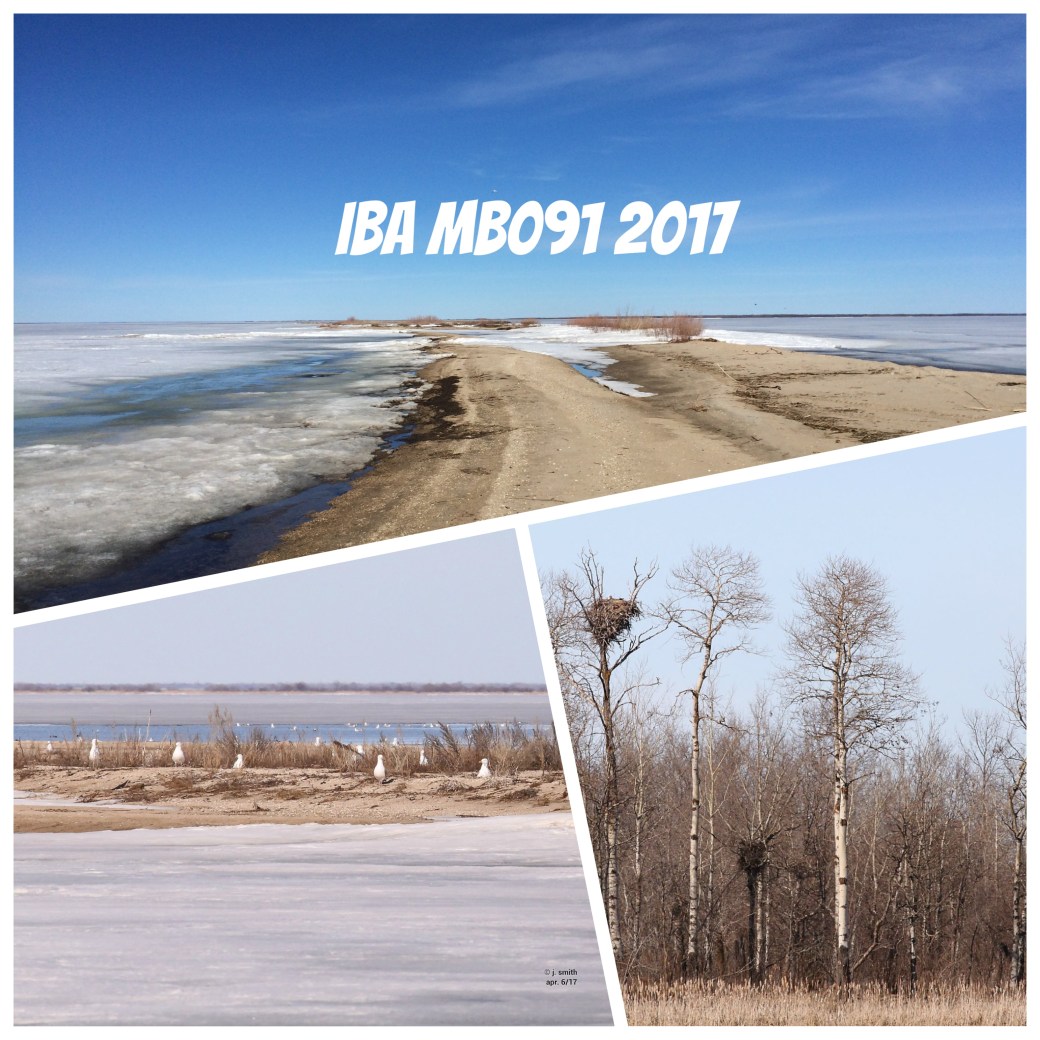
- April images, clockwise from top: Sandy Bar; occupied Bald eagle nest; Herring Gulls checking out nest sites
By early May other waterfowl species such as American Wigeon, Northern Pintail, Lesser Scaup and Gadwall were visiting the waters off Sandy Bar. Migrants Yellow-rumped and Palm Warblers could be seen along the shoreline and the Song Sparrows had already begun to check out the vegetation on the edge of the marsh that would make ideal spots to nest. One lone Snow Bunting lingered further out on the sand bar and one Barn Swallow had arrived to check out the building that would serve as home to its young in the coming weeks. At this point, a few shorebirds and marsh birds had also made an appearance. Two Marbled Godwits and one Sora (local breeder) were seen by mid-May. Towards the end of May sightings of migrating Sanderlings, Ruddy Turnstone, Whimbrel and Red Knot were also added to the shorebird visitor list.
-
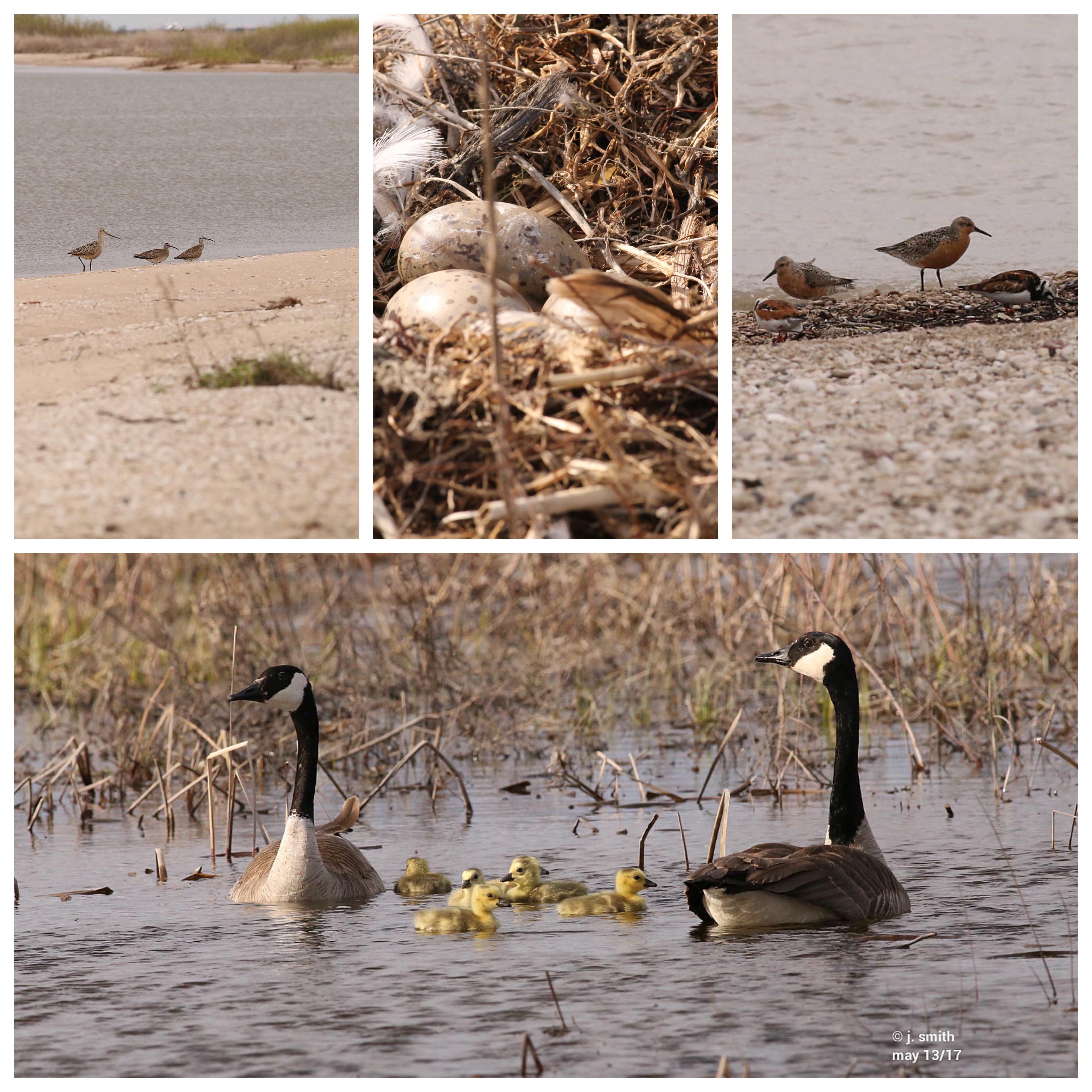
May images, clockwise from top left: Marbled godwit and Whimbrels; Herring Gull nest; Red Knot and Ruddy Turnstone; Canada Goose Family
The month of June included a few more shorebird species including Dunlin (seen by Jock McCracken), Semipalmated Sandpipers, Semipalmated Plover, Black-bellied Plover, White- rumped Sandpiper and local breeding species Killdeer and Spotted Sandpiper. By June 8th one Killdeer pair had already chosen an area of the shoreline to nest on. Unfortunately they had chosen an area close to human foot and ATV traffic and it didn’t appear in later weeks as if they had been successful in this particular spot. But then again, much goes on that our human eyes never see. June was definitely a successful month for Canada Geese. Numerous families could be seen on the lake consisting of little fluffy goslings bouncing on the waves between protective parents. A view of Hecla Bar with binoculars showed American White-Pelican and Double-crested Cormorants taking it easy on the distant sand bar.
-
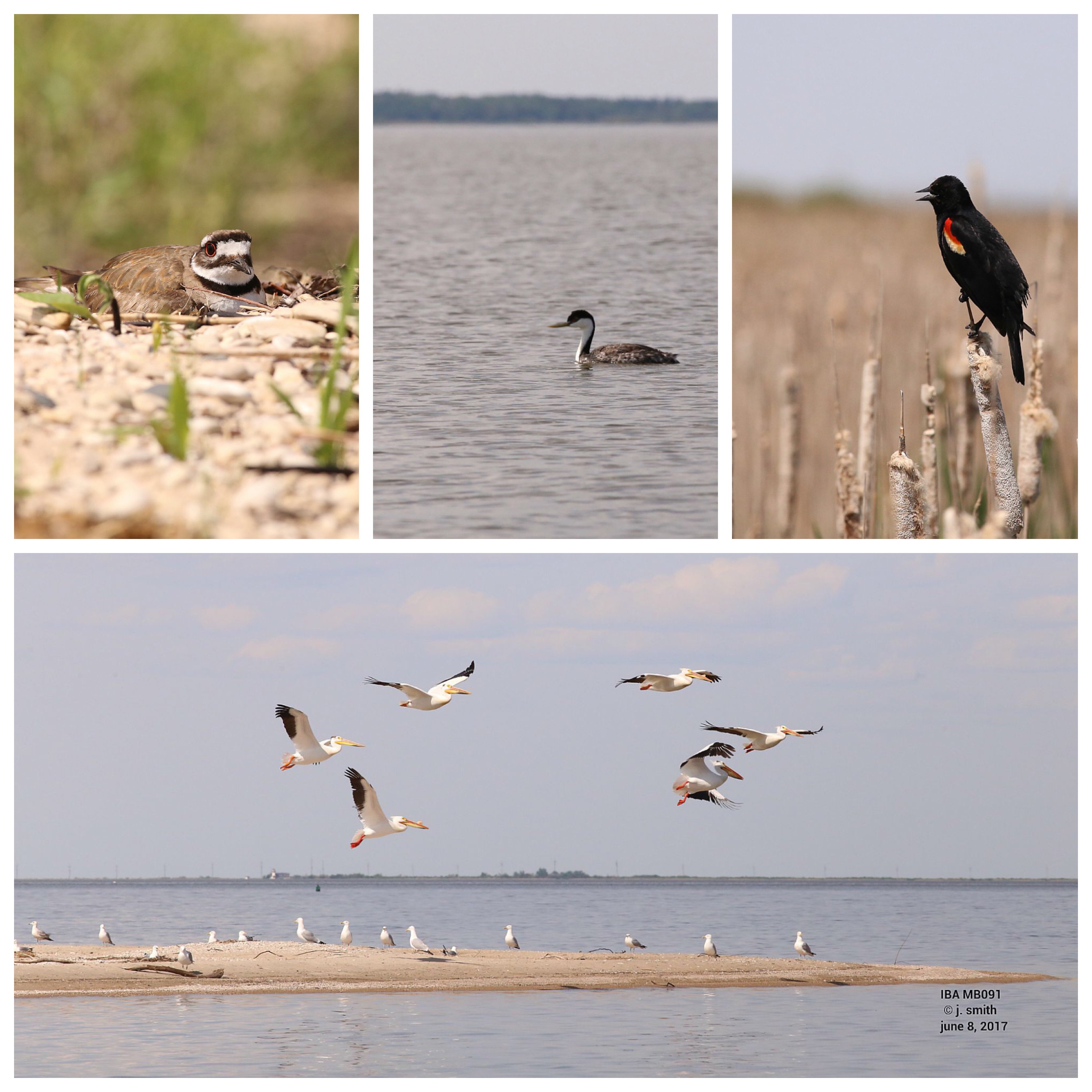
June images, clockwise from top left: Killdeer on nest; Western Grebe; Red-winged Blackbird staking out territory at Marsh; Herring Gulls And American White Pelican
In July, 75 Herring Gull adults could be seen at the far end of Sandy Bar with at least 5 juveniles. Close to 300 Franklin’s Gulls were sunning themselves on the shoreline some distance from the Herring Gulls. Marsh Wrens were numerous along the road that winds through the marsh area of the IBA. Even though we humans think of July as a summer month, some shorebirds had already begun their fall migration south. By July 10th, two Greater Yellowlegs made a stop at Sandy Bar before continuing their journey south.
-
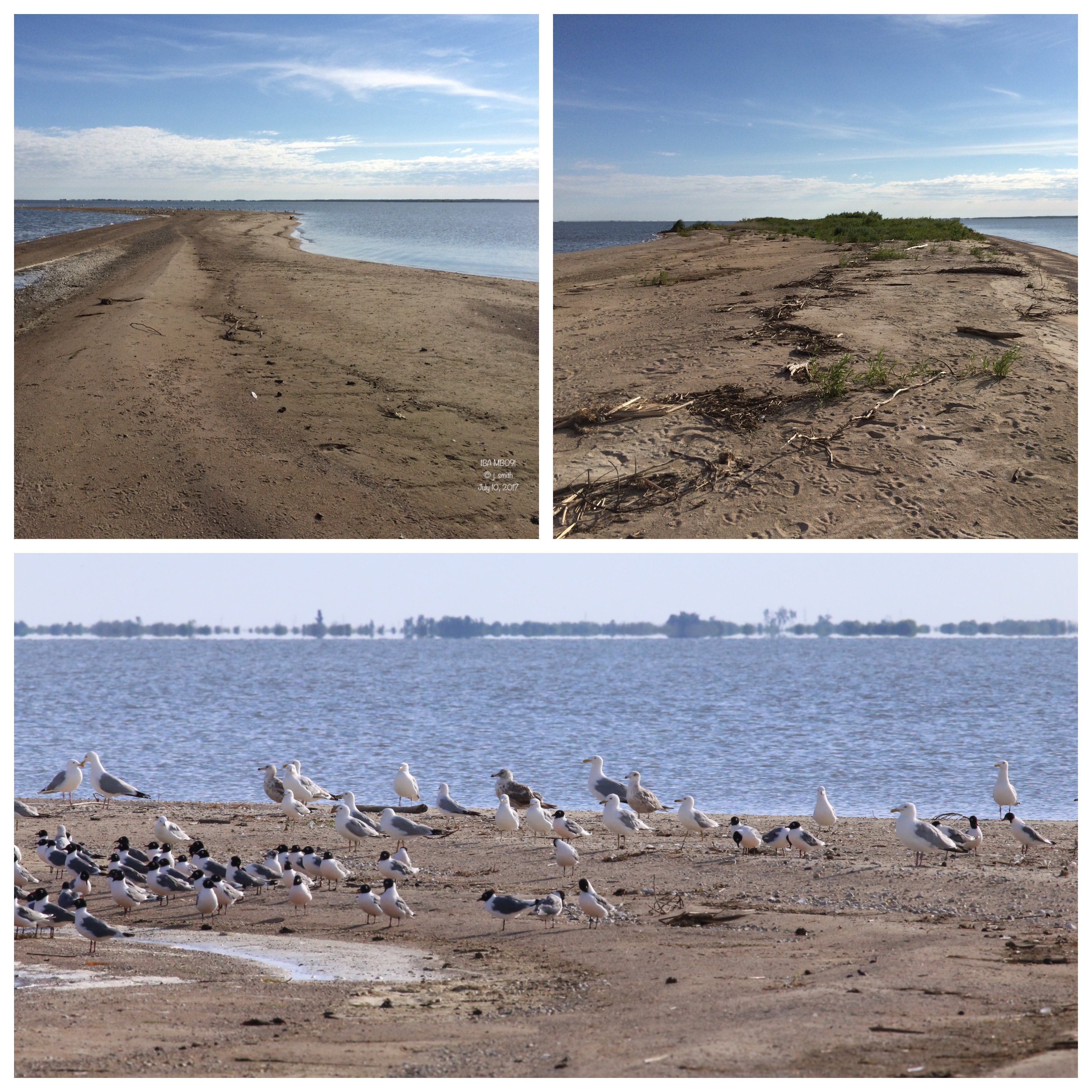
July images, clockwise from top left: looking out towards the tip of the bar; vegetation at the tip; Franklin’s Gulls, Ring-billed Gulls and Herring Gulls
By the first week of August more shorebirds were using Sandy Bar as a refueling station before continuing their fall migration. Many shorebird species nest in northern Canada and the Arctic and then fly back to South America for the winter months. Baird’s Sandpiper, Least Sandpiper, Semipalmated Sandpipers, Black-bellied Plovers, Ruddy Turnstone, one lone Sanderling and one Red Knot had made appearances in early August.
-
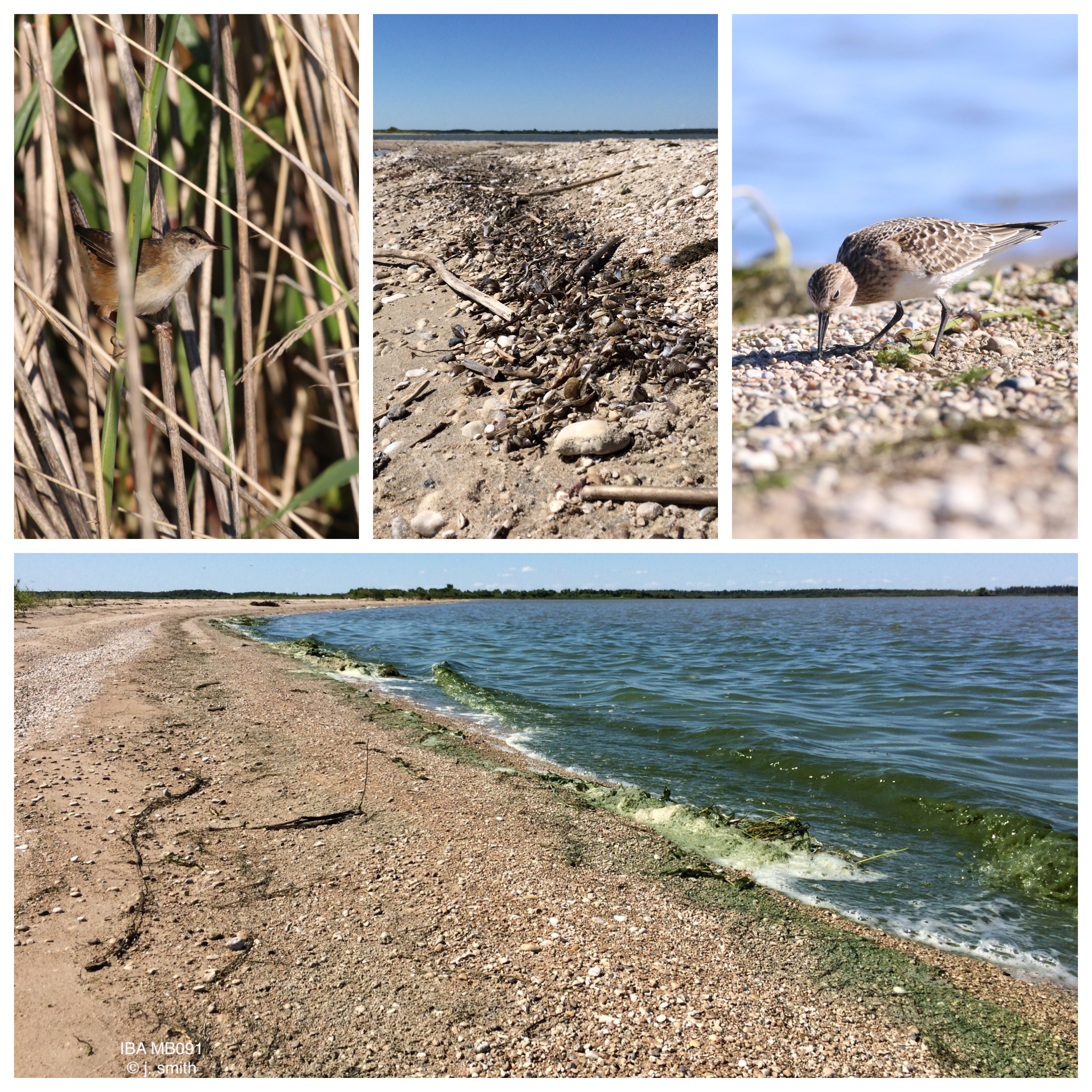
Early August images. Clockwise from top left: Marsh Wren; Zebra Mussels; Baird’s Sandpiper; Blue-green algae
On August 17th, thirty-six volunteers from the Riverton, Interlake and Winnipeg areas, came together to pull weeds at Sandy Bar. Riverton resident, Thor Johannson was instrumental in recruiting local volunteers and both the East Interlake Conservation District and Manitoba Sustainable Development were on board to pull weeds. After a brief introduction and coffee and donuts, volunteers headed out onto the sand bar to begin the weed pull. The day started with a pleasant 16 degrees but soon rose to 26. Despite the heat, volunteers sweated their way to filling sixty-six bags of weeds! Not too shabby! Along with the humans, there were three additional shorebird species using the sand bar as a stopover refueling station. Lesser Yellowlegs, Pectoral Sandpiper and the super long distance migrant American Golden Plover (can fly up to 20,000 miles per year, including a nonstop flight of over 3000 miles over the Atlantic Ocean) put in an appearance. An extra bonus was when Linda Curtis spotted and photographed two Trumpeter Swans just north of the Sandy Bar marsh area.
-
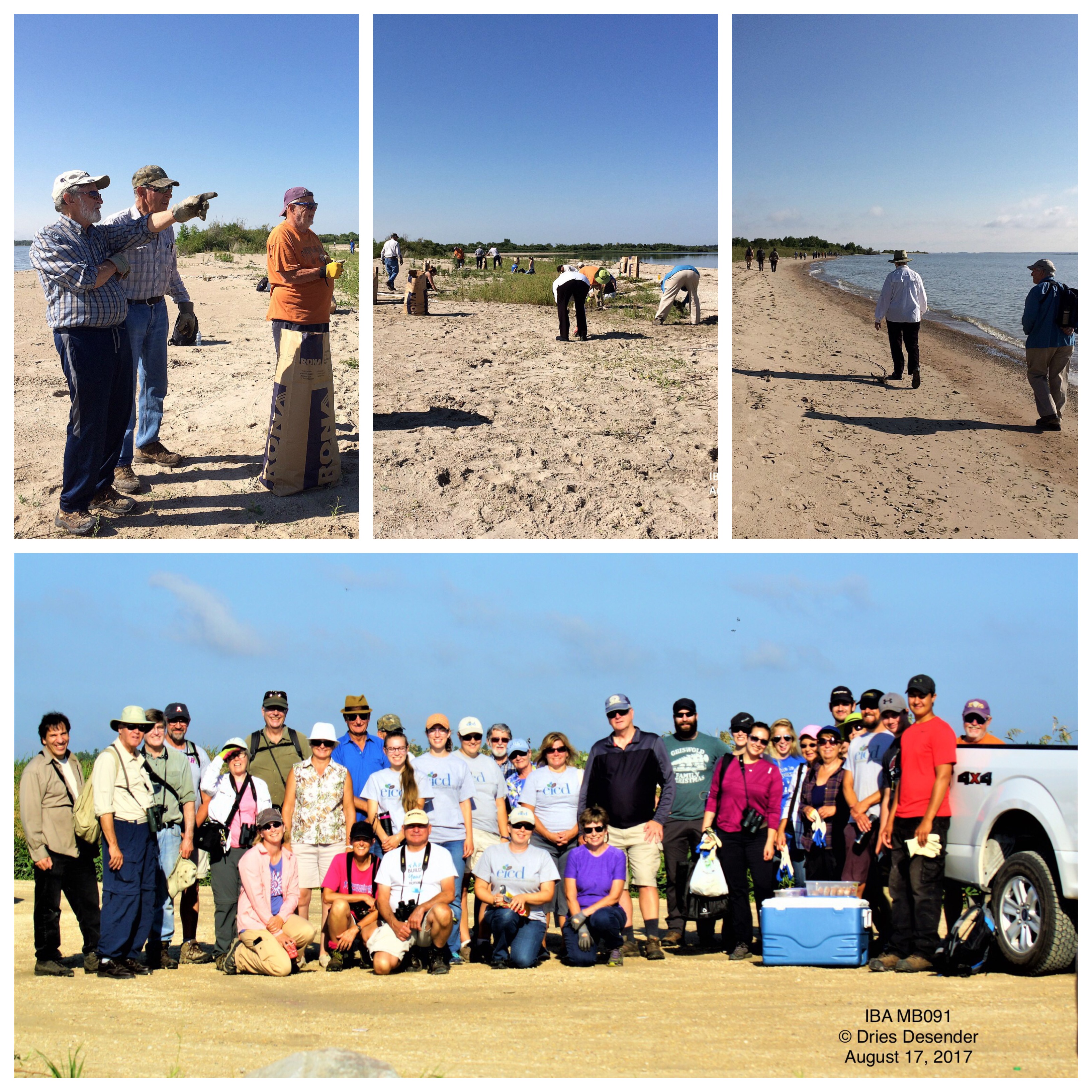
Weed pickers at work (top); the weed team, photo by Dries Desender (bottom)
Late August provided sightings of five Buff-breasted Sandpipers and four Red Knots. Buff- breasted Sandpipers are sometimes seen during migration in plowed fields or the sod farms near Oak Hammock Marsh. Having them show up at IBA Riverton Sandy Bar was an extra special bonus. A week later, both species were seen by a group of nine individuals. For some, this was the first time seeing them in 2017 and for a few others, they were lifers (a birder’s term used when they see a species for the very first time).
-
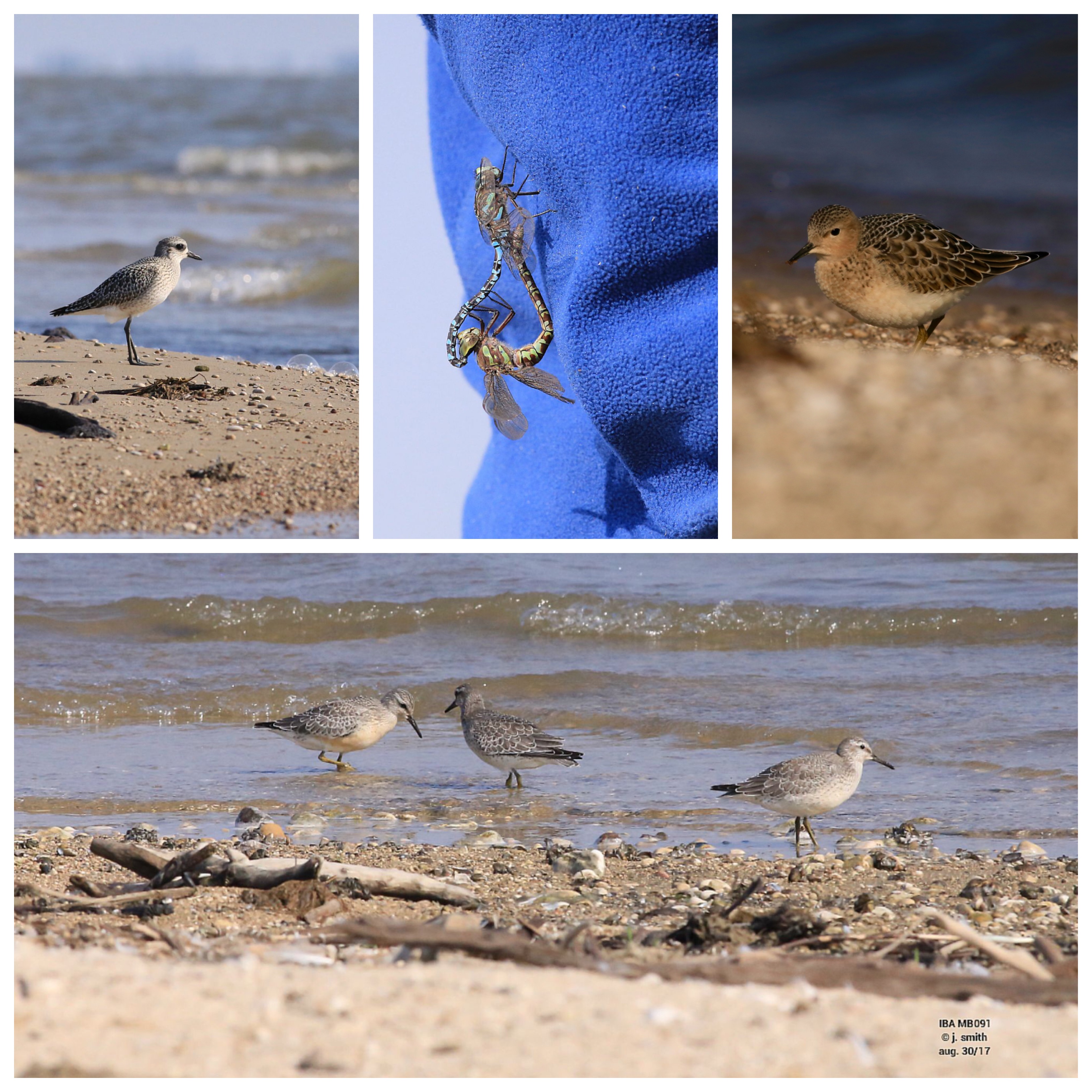
Late August images. Clockwise from top left: Black-Bellied Plover; Canada Darner (thanks to Deanna Dodgson for the id); Buff-breasted Sandpiper; Red Knots
-
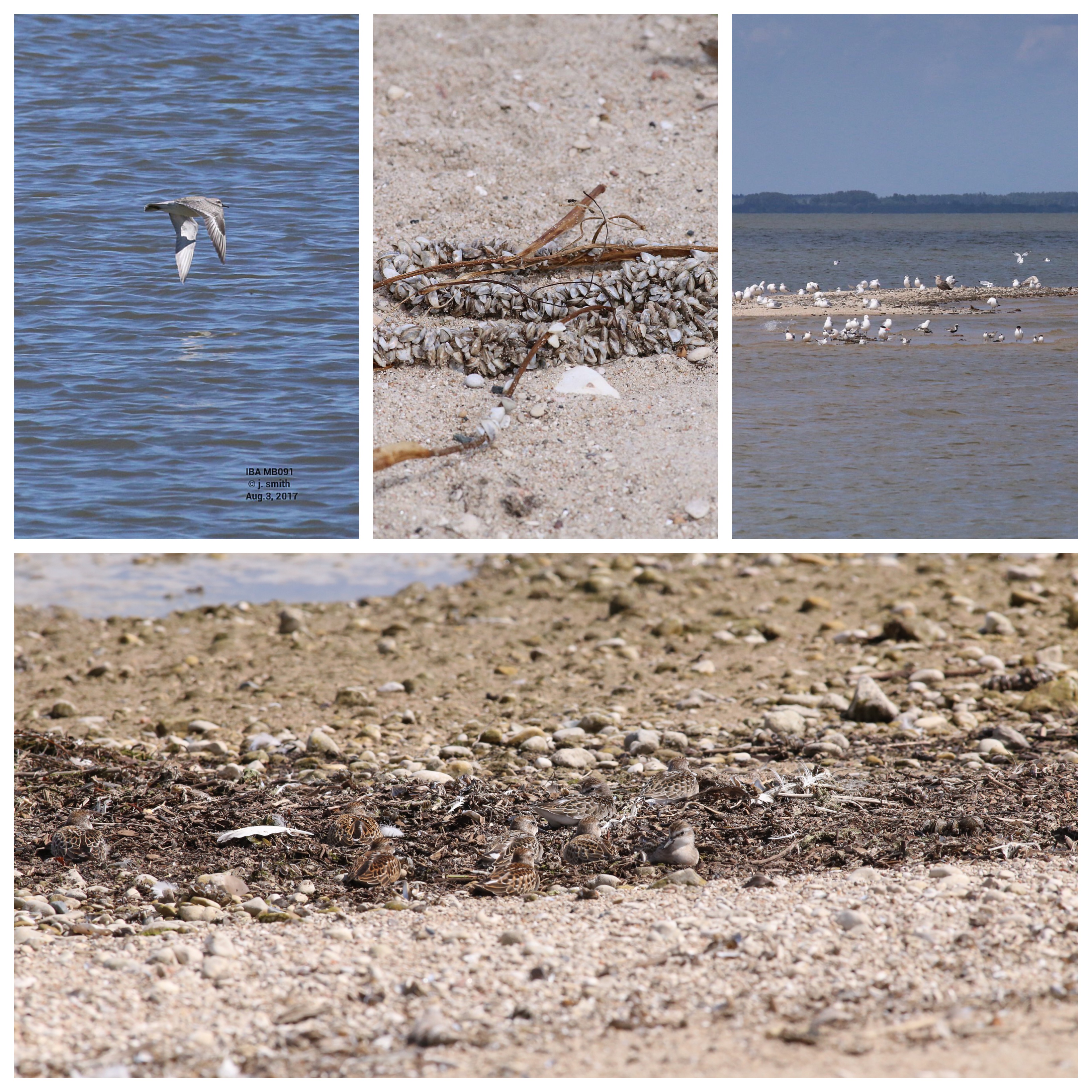
Late August images. Clockwise from top left: Red Knot; zebra mussel necklace; Herring, Ring-billed Gulls, Caspian, Common, Forster’s terns, Black-bellied Plovers, 2 hard to find Red Knots in far back; Sandpipers in camouflage (guess the numbers and species)
By September 8th, real signs of the upcoming fall season were noticed at Sandy Bar as Horned Lark and Lapland Longspur dropped by to refuel. On September 14th two American Black Ducks were noticed by Bonnie Chartier. American Pipits also put in an appearance. Earlier that day, Ryan and Irene Porteous were fortunate enough to see twenty-five White-winged Scoters on the lake. Another sure sign of the changing seasons.
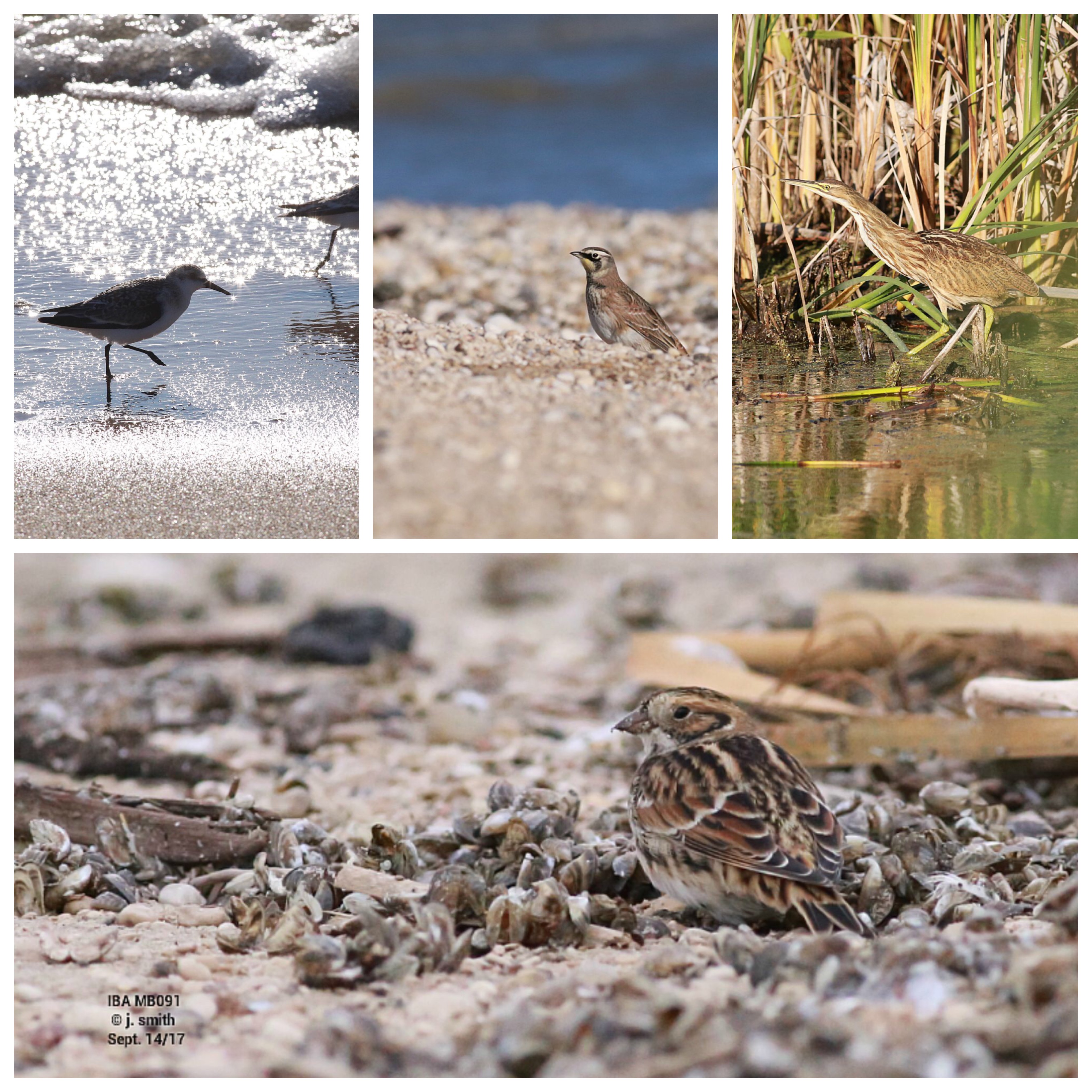
September highlights, clockwise from top left: Sanderlings; Horned Lark; American Bittern; Lapland Longspur
Late summer also brought its regular waves of algae rolling onto shore. While it can look rather interesting, it’s probably not a good sign for Lake Winnipeg. Zebra mussels are now so common on the shoreline at Sandy Bar that one almost forgets to mention them.
On September 29th, another weed pull was carried out by volunteers. Thirty-five volunteers spent the morning pulling fifty bags of invasive sweet clover including a good number of people from the Riverton Friendship Centre. Riverton High School Science teacher Don Bodnarus brought his grade 9/10 class out to experience the event as part of their science and outdoor education program. And dare we use the word “snow” in the month of September, but one lone Snow Bunting was seen amongst the sixty-five Lapland Longspurs. A nice sighting of two more American Golden Plover and numerous Snow Geese also added to this successful event.
-
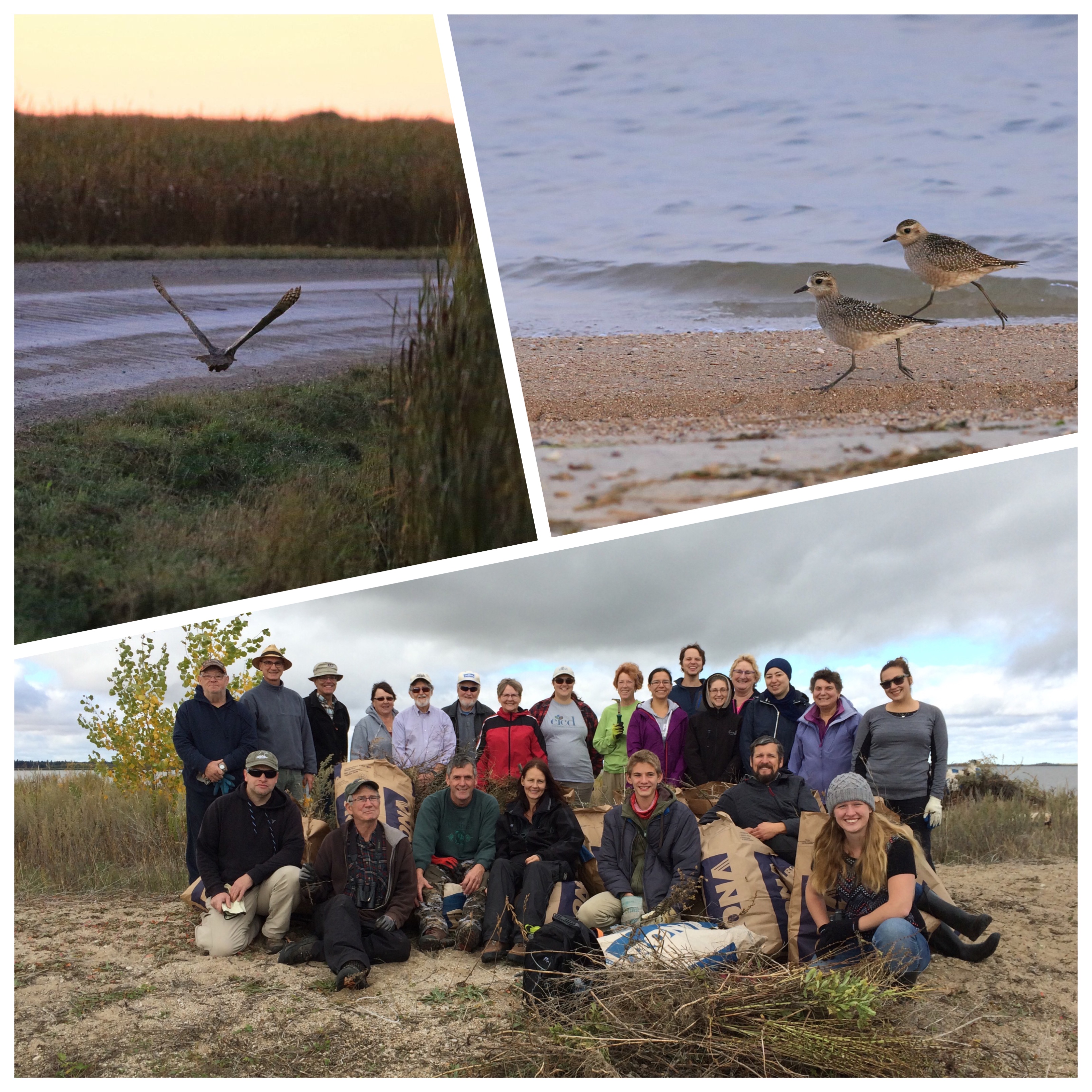
Final weed pull, clockwise from top left: Great-Horned Owl; American Golden Plover; Sept 29 weed pullers
Earlier in September, John Weier spotted a Peregrine Falcon flying past the tip of Sandy Bar and by mid-October, the northern shore of the IBA was occupied by hundreds of migrating Canada and Cackling Geese. Later that month, Common Redpolls were also added to the 2017 fall bird list at Sandy Bar. Another sign that fall had definitely arrived.
-
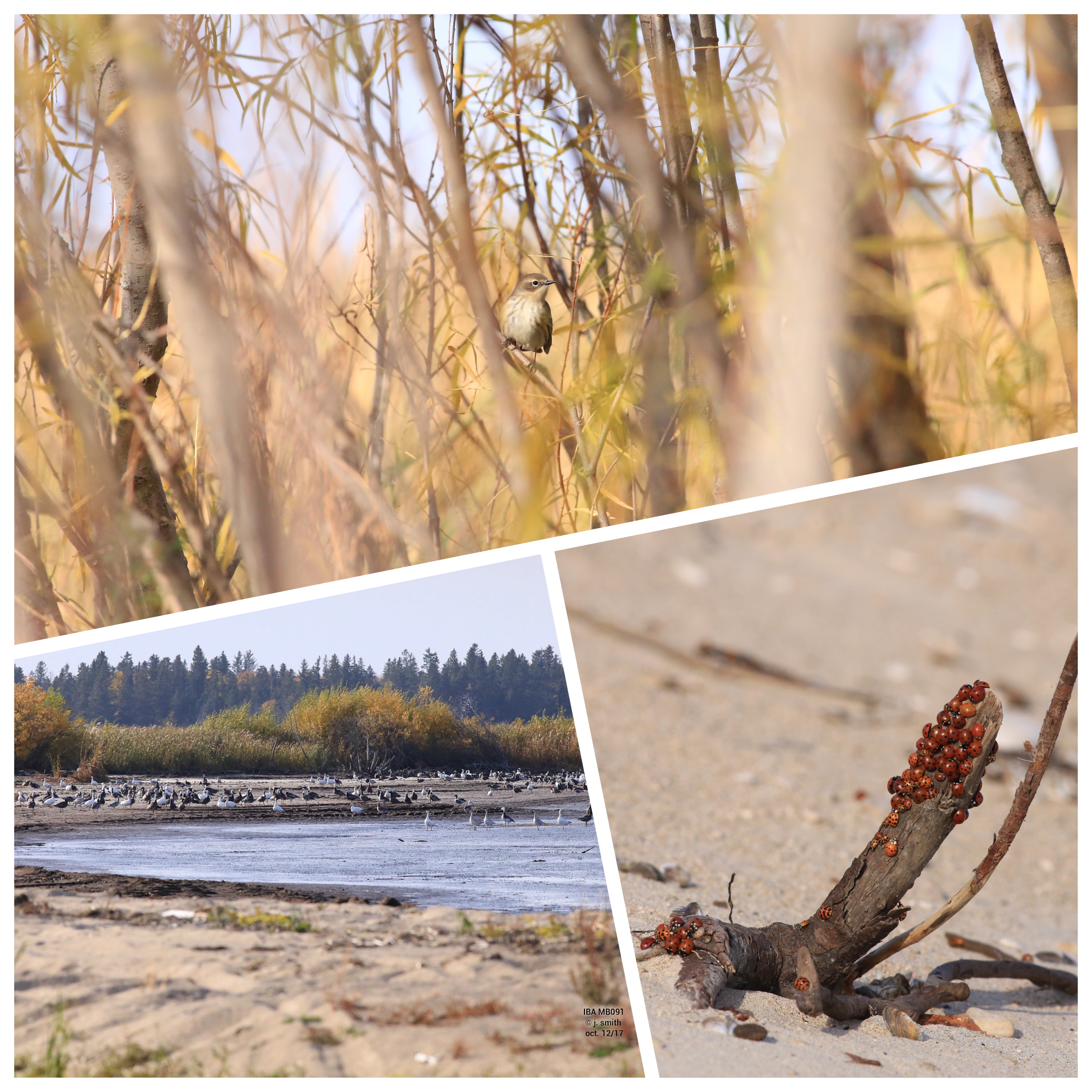
Flavours of fall, clockwise from top: Yellow-rumped Warbler; invasive Asian lady beetles; Snow Geese
The final chapter in the 2017 weed pulling weedathons was completed as Sustainable Development made their way out to Sandy Bar in October to burn the 100+ bags of invasive sweet clover.
-
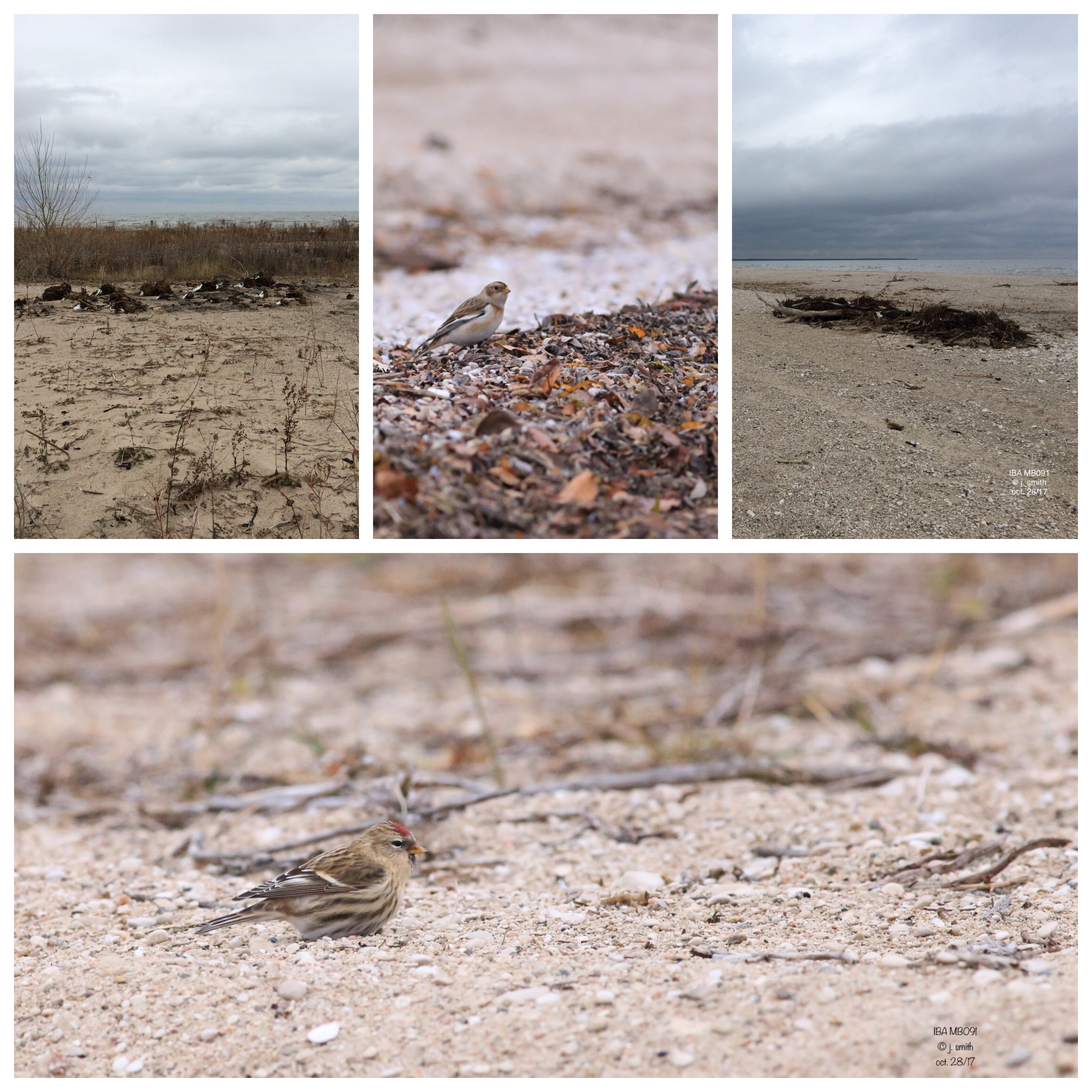
Final fall images, clockwise from top left: burnt weed bags; Snow Bunting; weeds gone up in smoke; Common Redpoll
The lake levels were lower in 2017 than the previous 4 years since IBA Riverton Sandy Bar monitoring had begun. Despite this, one cannot help but think that it was the combined effort of many volunteers who cleared the area of weeds along with the lower lake levels that made Sandy Bar more appealing as a stopover for important migrating shorebirds such as the Buff- breasted Sandpiper and the endangered Red Knot. With more weed pulling events and continued lower lake levels, maybe we’ll eventually see another pair of nationally Endangered Piping Plover stake out Riverton Sandy Bar as their place to successfully raise young.
-
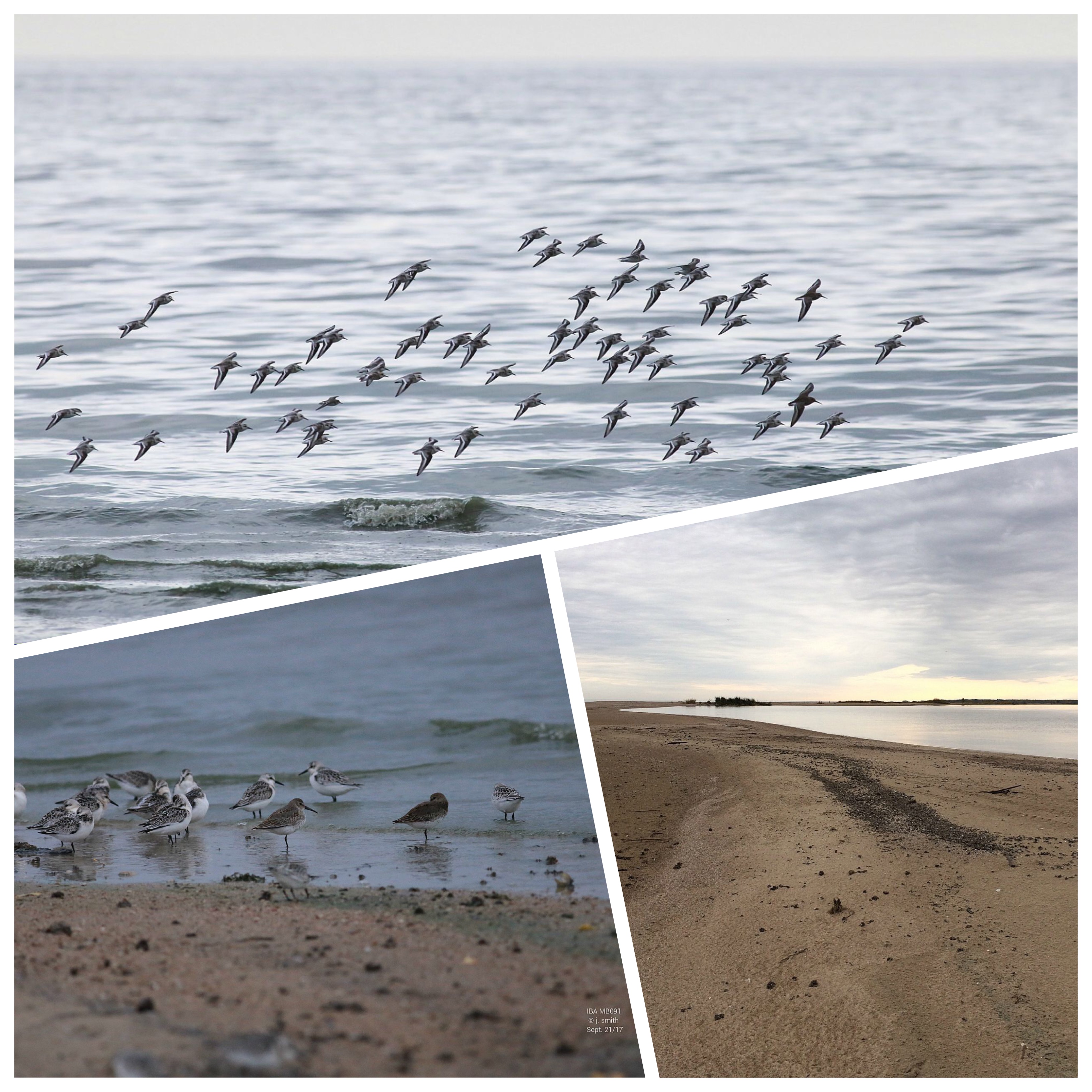
Fall shorebird migration on the sandbar was the most successful in terms of species richness in a number of years – maybe a sign of early weeding success? Clockwise from top: Sanderlings and two Dunlin in flight, the sandy bar, more Sanderlins and Dunlin
Many thanks to all weed pullers, weed burners, bird monitors, Rona in Gimli for a donation of bags and gloves, those who made eBird entries and all who simply showed an interest in learning more about Important Bird And Biodiversity Area MB091 Riverton Sandy Bar.
May 2018 be as productive as 2017!
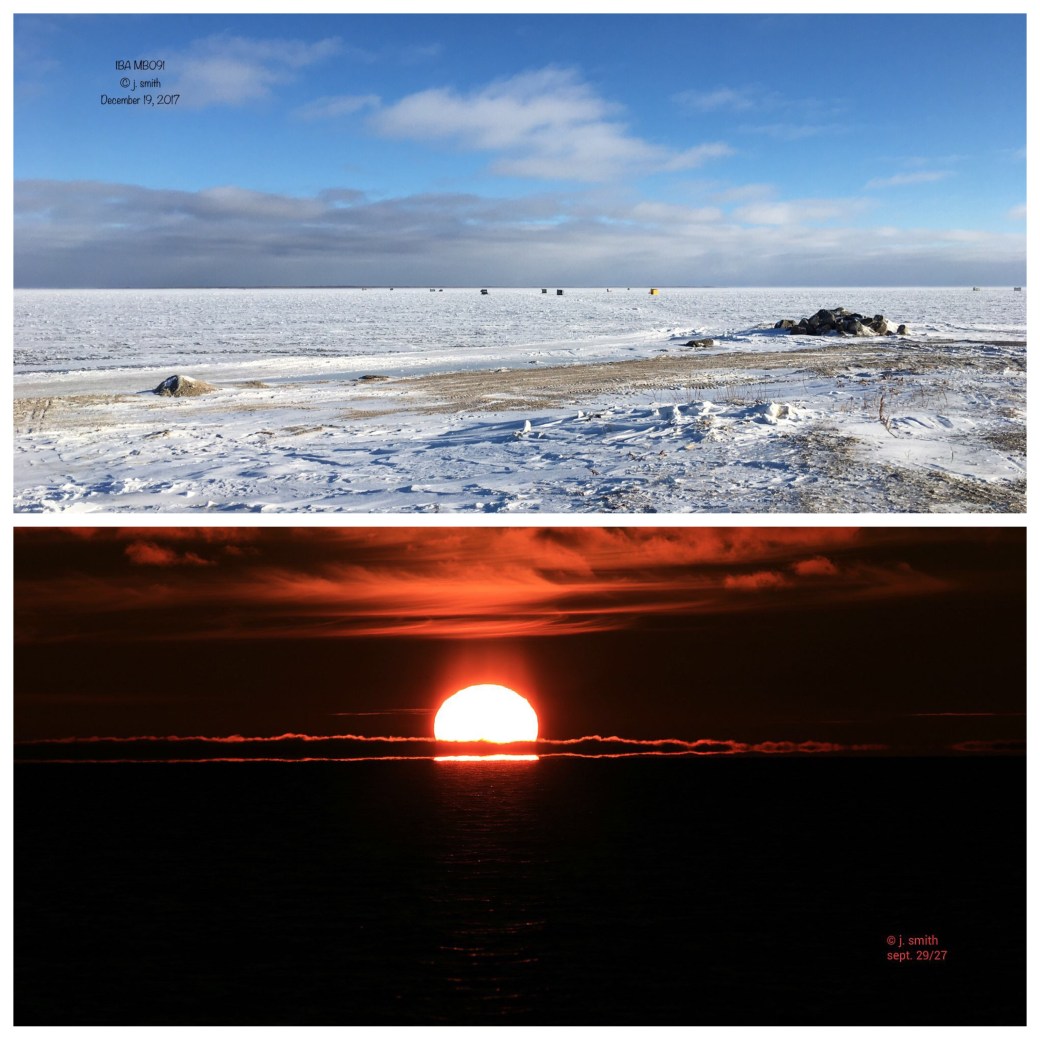
Top: Fishing Ice shacks Bottom: Sunrise taken morning of weed pull Sept 29
Footnote: 2017 has been a wonderful year in the life of Riverton Sandy Bar, no doubt almost 100% due to one person. Joanne has been a fabulous caretaker and a real asset to the program. Thanks Joanne!
Happy Holidays From the Manitoba IBA Program
Thank you to everyone who has counted birds, pulled weeds, led public bird walks, been an advocate for globally important habitats for biodiversity and the many other critical activities which make this program what it is. 2017 has been a fantastic year for the Manitoba IBA Program and we would be nothing without our brilliant volunteers.
A few notable highlights from 2017 included:
- counted some ridiculously good concentrations of birds;
- monitored bird populations in at least 19 IBAs in Manitoba;
- organised two weed pulls at Riverton Sandy Bar (see Riverton pull number 1 and Riverton pull number 2);
- organised a bioblitz at Oak Lake and Plum Lakes IBA with Nature Conservancy Canada
- set forth on 3 blitzes at Whitewater Lake (blitz 1, blitz 2 and blitz 3);
- searched for Red-headed Woodpeckers on the western side of Lake Manitoba;
- had a bird blitz at Oak Lake and Plum Lakes IBA;
- counted geese in Netley-Libau;
- provided outreach activities in Churchill;
- got overwhelmed by cranes;
- began some exciting outreach projects with Manitoba’s indigenous communities;
- continued to build on early successes working with our SARPAL partners in southwestern Manitoba and;
- much, much more!
Have a wonderful holiday season and see you in 2018!
Netley-Libau Goose Count and Marsh Day Tour on the Red River
Geese are some of the most recognisable and numerous birds found in IBAs across Canada. Perusing the on the IBA Canada website, you will notice that geese are significant trigger species for a number of Manitoba’s IBAs – I make it 12, so around one third. It is likely that the Canada Goose makes an appearance in every one of Manitoba’s IBAs each year, with the possible exception of one or two of the rockiest and more remote islands on Lake Winnipeg.
Given all of the above, one may come to the conclusion that counting geese is not important. In fact, we could argue that there is little purpose to giving geese any attention. BUT these large concentrations of geese are among the highest concentrations in North America. Geese are also likely to be a good indicator of some wider environmental issues (pollution, wetland loss, habitat changes and overexploitation for example – ok little chance on the last one right now). Collecting accurate information on goose concentrations in our IBAs not only contributes to our long-term understanding of their populations but also helps us to identify issues within individual IBAs.
It is with this in mind that 6 people gathered at 4 different points around the Netley-Libau Marsh IBA in October to count the geese as they left their roost in the morning. The Netley-Libau Marsh was historically considered to be one of the most important resting areas for migratory geese, primarily Canada and Snow, in the central flyway. In recent years attention has shifted understandably to the showstopper scenes at Oak Hammock Marsh and it appeared to be a good time to see what was happening at Netley-Libau.
This was very much a trial – but we hope to expand this principal to other IBAs in future years. The objective was simple: to test the methodology at Netley-Libau and identify ways to improve the approach for future years. These experiences will hopefully be transferred to counting other sites in 2018.
Netley-Libau Marsh is the largest inland coastal marsh in North America. The flow of the Red River through the centre and into Lake Winnipeg effectively splits the marsh into two distinct areas: Netley Marsh and; Libau Marsh.
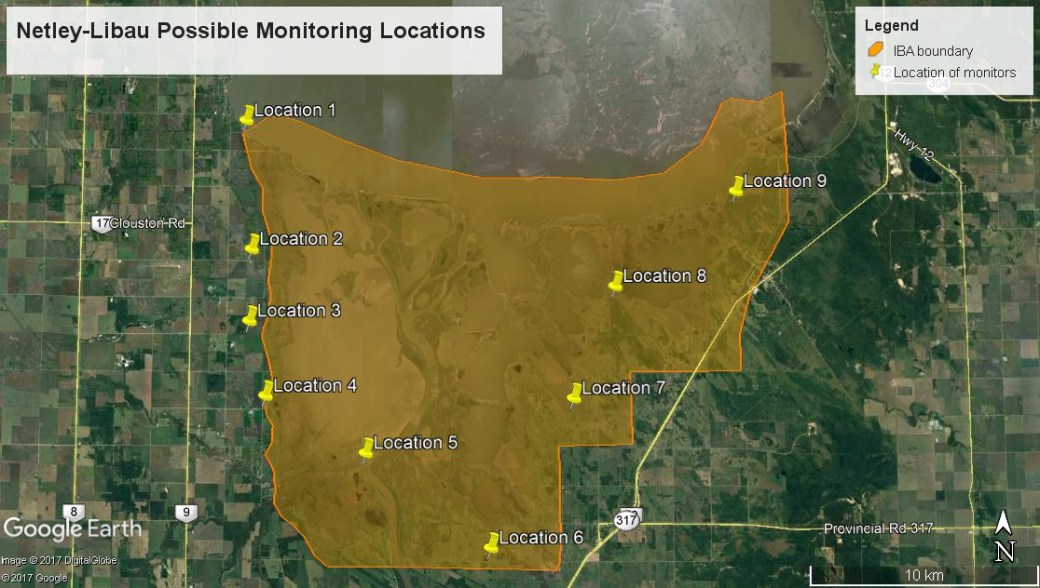
Such a large area is hard to cover with few people – we had three groups on the Netley side and one on the Libau side.

A glorious morning with calm bright conditions made it perfect for waterfowl counting. Eric Smith and Louise Buelow-Smith counted the geese as they headed northwest over Chalet Beach. They counted 1,100 Canada Geese in total.
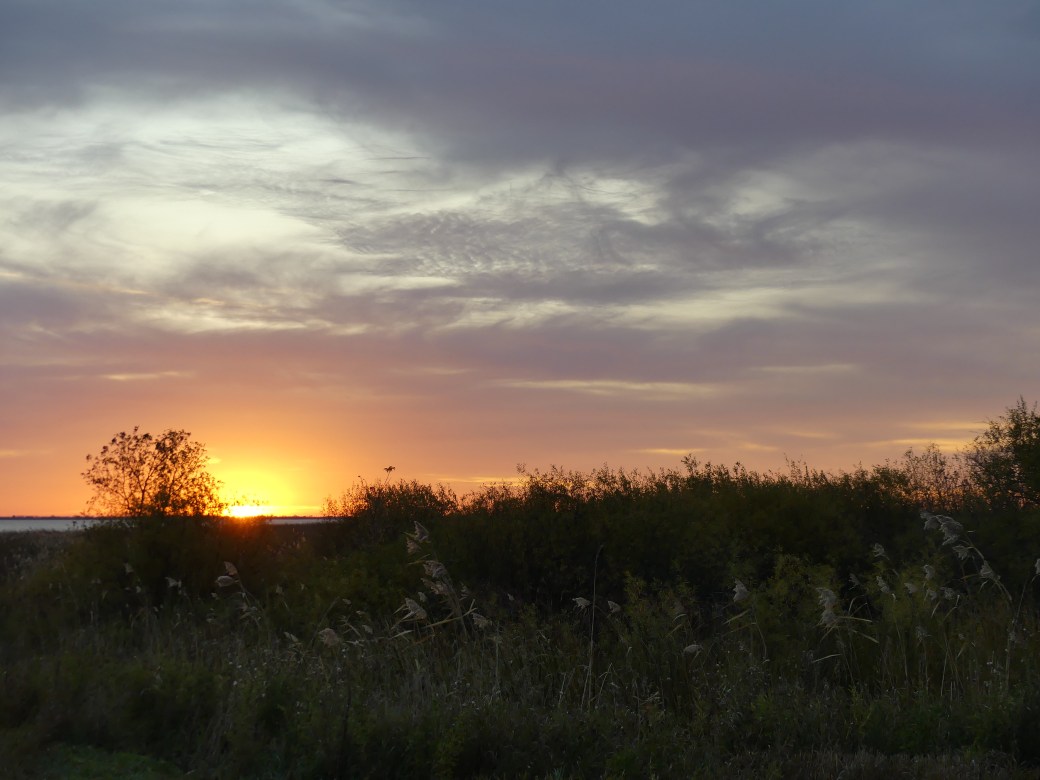
A beautiful sunrise over Netley Marsh. Copyright Tim Poole
A few miles south of Eric and Louise, Tim Poole stood at the end of Henry Road. This area had the largest counts of the morning with Snow Geese, Cackling Geese and Canada Geese present. This is one of the few spots with good views of the water. However, views were impeded by trees and bushes. Total counts included 1,115 Snow Geese, 289 Cackling Geese, 2758 Canada Geese and 1,565 Ring-billed Gulls.
A third group, Pat and Dave Wally took up a location south of the marsh and west of the Red River. They saw fewer birds leaving from here, perhaps as they were further from grain fields. This was a good future lesson: position your volunteers in areas between the marsh and good feeding. They did however see 1,240 Canada Geese, 540 leaving the marsh and a further 700 in fields as they left the area. This is interesting as it suggests that a combination of standing observation followed by checking a few blind spots afterwards might be important.
Due to a lack of volunteers, we were unable to check the Libau side as thoroughly as we would like. We did however have high hopes that there might be good numbers of geese. The actual marsh here is more functional than the Netley side, and Christian Artuso had counted 1,975 Canada and 4,128 Snow Goose on the northeastern corner the previous weekend. Surely it would turn up something good! John Hays turned up full of hope and was left standing almost alone – only 26 Canada Geese flew over for company – bizarre! Still, there were several hundred Canada Geese by Patricia Beach later in the morning. What would have caused such a large fall from Sunday to Thursday? Maybe a change in the wind direction? Maybe a shift in foraging area from east to west? Maybe the geese migrated? Whatever it was, it goes to demonstrate how dynamic migration can be.
Before moving on, another lesson learned was that it probably doesn’t pay to be too close to the action as birds leave a marsh. A panoramic view across grain fields on the west side of the IBA will probably in all likelihood provide a wider field of vision than a closeup but restricted view. The grid system of roads in this area might lend itself to positioning a counter at every second mile road giving a very large view across the area. Here is a possible ideal scenario monitoring map for future years. Preferably with 2 volunteers at each point – a caller and a counter – but if necessary with a single monitor.
Louise had found out that the Red River Basin Commission were going to lead boat trips to Netley-Libau Marsh, an area which has become degraded over decades. Louise, Eric, Pat, Dave and Tim attended following the goose count. The event was led by Dr Gord Goldsborough, Associate Professor in the Department of Biology at the University of Manitoba, Dr Richard Grosshans from the International Institute of Sustainable Development, and Steve Strang, Manitoba Director for the Red River Basin Commission. This was a fascinating opportunity to see the state of the marsh and hear firsthand from about the various influences which have led to the current state of the marsh.
From the boats – a flotilla of local boat owners had been hired for to take us out – our first point of call was the Netley cut. This is a small cut which was created in the 1920’s to allow access from the river to Big Netley Lake. Unfortunately a narrow cut has grown to become a very wide opening effectively flooding the marsh at this point with river water. A cursory glance (past the pelicans and gulls on the sandbar) demonstrated the issues succinctly: a lack of emergent vegetation (e.g. cattails, phragmites, bulrushes and sedges) and some very choppy water.
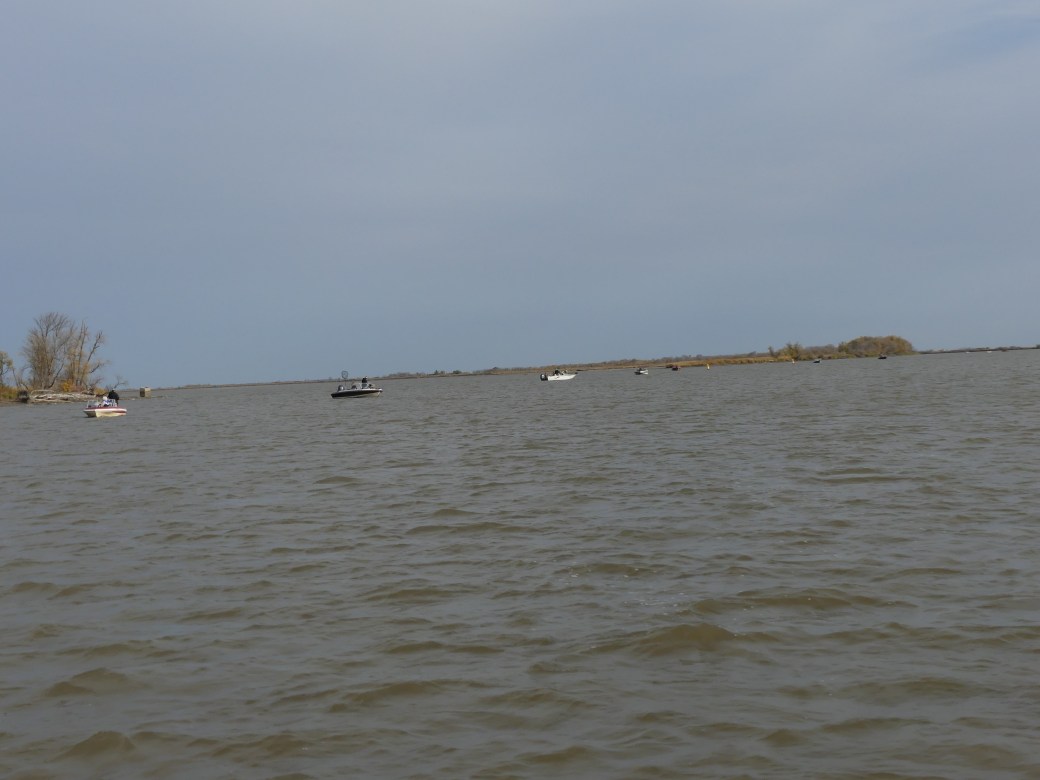
A view of the Netley Cut. Note how open it is, Copyright Tim Poole
Continuing north we learned that the issues affecting the marsh were complicated: Lake Winnipeg Regulation creating elevated water levels and preventing drawdown; the cut; nutrient load; weather and climate impacts and; isotonic rebound (glacial melt in the north is causing the lake to ’tilt’ towards the south). These issues add up to a marsh which is deteriorating and at risk of losing the functionality which makes marshes so important for communities and wildlife. Wetlands after all provide us with a high number of ecosystem services. Loss of these functions in an already struggling watershed will impact on everyone and everything in the area. For example, consider the issues with phosphorous loading in Lake Winnipeg. Functioning wetlands act like kidneys, absorbing these excess nutrients before they reach Lake Winnipeg. Netley-Libau should be part of the solution to the many issues in this area – but only if it the marsh regenerates.
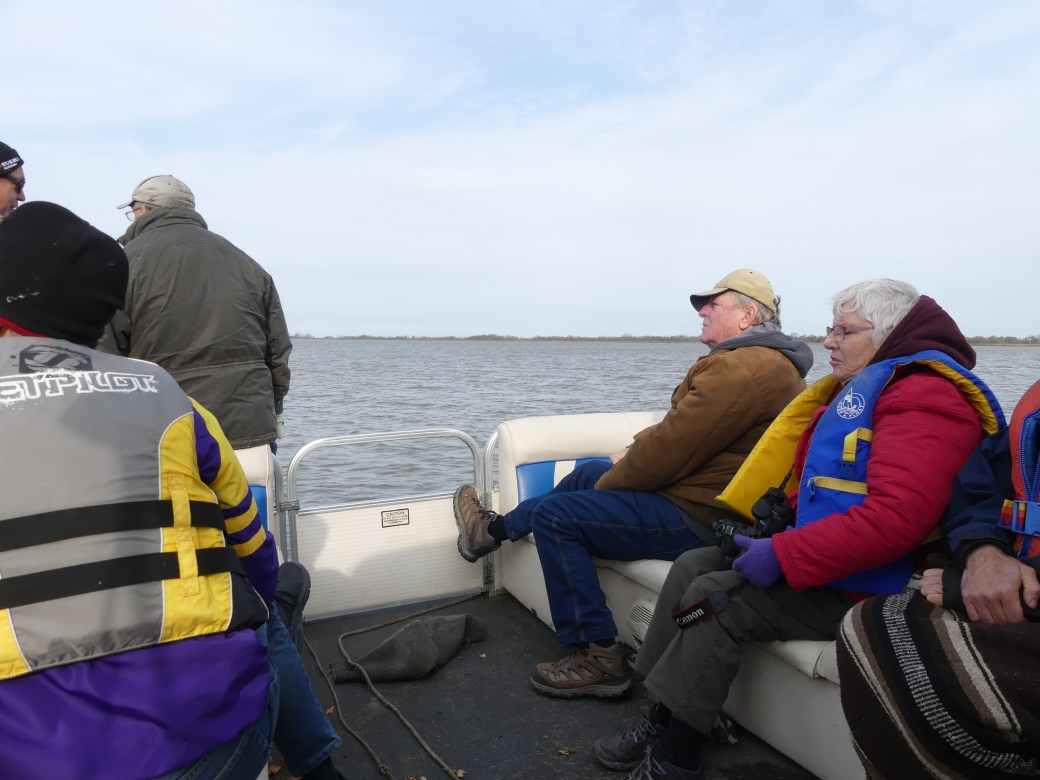
It was pretty cold out on the boat! Copyright Tim Poole
We finally ended up at the north end of the marsh near where the river opens into Lake Winnipeg. We were told about the historic use of dredging to keep the channels open for boats (there are 3 channels entering Lake Winnipeg). Dredging is controversial when used in some locations, and it is certainly not our intention here to get into a debate about the good, the bad and the ugly of this management. However, we are also facing a critical situation in this watershed. Silt is building up in the channels, some natural but much due to human-induced erosion.
The plan here is dredge, remove the silt from the channels and try to create artificial reefs in the marsh on which emergent vegetation can begin to grow. If this could be made to work then the marsh might begin to regenerate in places. It certainly would not deal with all the issues at Netley-Libau but it might begin to mitigate for some of the impacts. This idea is certainly creative and worth exploring – something needs to happen in this marsh before it is too late. So best of luck to everyone involved!
For more information on this please take a look at the Red River Basin Commission website.
Finally, the following is the Red River Basin Commission conclusions from the day:
- The Netley-Libau Marsh is in danger: vegetation is being lost and the riverbanks are being eroded: the marsh is disappearing
- The wetlands act as the kidneys of the lake: they have the capacity to absorb nutrients and harmful toxins in water before it enters Lake Winnipeg, hence reducing the toxic algae blooms
- Wetlands are also capable of sequestering carbon and providing important habitat for wildlife and fish
- Since dredging ending in 1999,the bottle-neck caused by siltation at the mouth of the Red River has been consistently contributing to flooding of the marsh
- The time to act is NOW!
Updates to the IBA Canada Tables
There has been a recent upload from eBird to the IBA Canada website. In turn, there have been a number of Manitoba IBAs which now have updated in their respective tables. Below are links to the relevant tables. If the writing is in bold, it means that a species trigger has been met (usually either 1% of a global, continental or national (for COSEWIC species) breeding population). If the writing is not in bold type, it means that the total number of birds listed is 75% below the trigger.
If you notice any other changes from 2016 and 2017 which are not highlighted below, please let us know.
MB001 – Delta Marsh IBA, Semipalmated Plover, Rusty Blackbird
- The above Semipalmated Plover trigger came from our 2016 summer blitz
MB003 – Churchill & Vicinity IBA, Little Gull, Rusty Blackbird
- Little Gulls trigger each year given the small North American breeding population. For example, our 2017 trip to Churchill located 6.
- Rusty Blackbirds were triggered numerous times by visitors to Churchill.
MB010 – Oak Hammock Marsh, Buff-breasted Sandpiper, Rusty Blackbird
- One of the 2016 Rusty Blackbird triggers came from our fall blitz.
- Buff-breasted Sandpiper was from summer 2017 from an eBird user.
- American White Pelican, Pectoral Sandpiper, Short-billed Dowitcher and Western Grebe were all triggered in our August 2016 blitz.
- Franklin’s Gull received a trigger in our May 2017 blitz.
- Short-billed Dowitcher and Western Grebe were triggered in our early August 2017 blitz
- Long-billed Dowitcher and Western Grebe were triggered in our late August 2017 blitz.
- A total of 2,500 Pectoral Sandpipers has appeared from fall 2014, recorded by Christian Artuso and the late Liis Veelma, indicating that the new boundaries have now been uploaded by Cornell. Thanks to Andrew Couturier and his team at BSC for facilitating this process.
- Loggerhead Shrike is a regular trigger in this IBA
- The triggers for pipits and longspurs from 2016 were from our July blitz.
MB038 – North, West and East Shoal Lake, American White Pelican
- The above total shows the IBA Protocol on eBird in action, being a total of 3 different checklists from a single day within the IBA. These were recorded by Christian Artuso and Josiah Van Egmond (checklist 1, checklist 2, checklist 3).
MB055 – Saskatchewan River Delta, Tundra Swan
- The large numbers of Tundra Swans were counted on a single day in the Carrot Valley by Joel Kayer.
MB091 – Riverton Sandy Bar, Rusty Blackbird
- This 2016 trigger came from the late September workparty.
MB100 – Kinosota-Leifur, Red-headed Woodpecker
- The above trigger does not include the total for the IBA blitz in July 2017. This will be updated in the next upload.
We do know of some significant totals at Oak Lake and Plum Lakes IBA which will be added in the next data upload in the table (a certain gathering of cranes and some large totals of Tundra Swans).
Thank you to the many people contributing this critical information on eBird. There is a strong possibility that one day your totals might end up on these tables. If you have any high numbers of birds from IBAs, historic or recent, and they are not entered on eBird, then please don’t hesitate to contact us at iba@naturemanitoba.ca. We would be delighted to enter your bird monitoring information on your behalf!
Tundra Swan Counts in the Oak Lake and Plum Lakes IBA
Keeping up on events around Manitoba has been a challenge. We still need to update on our goose count at Netley-Libau Marsh and catch up on a few other volunteer based activities. For today, it is to Oak Lake and Plum Lakes IBA and a recent visit with volunteer Glennis Lewis.
Glennis is certainly very knowledgable about some of the unique biodiversity of the sandhills and other habitats around Oak Lake and Plum Lakes IBA. Having worked in the IBA (before it was an IBA) as a student (close to the former large Franklin’s Gull colony) or completing a contract looking for western spiderwort, Glennis has spent many days in the Oak Lake area and knows it very well.
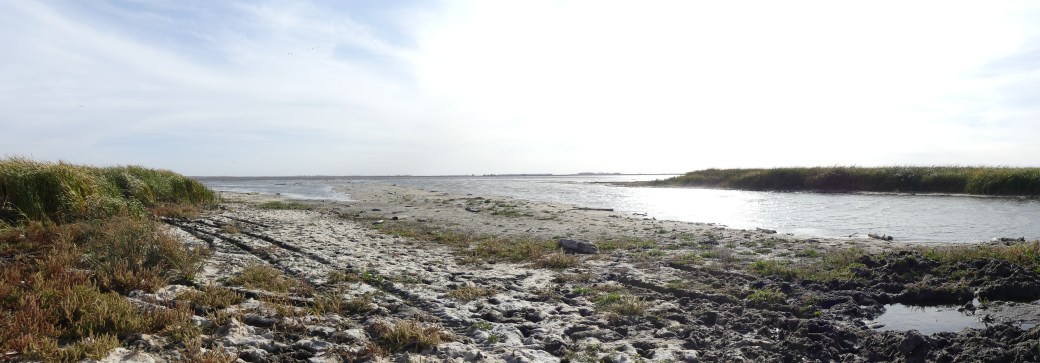
A panoramic view from the weir near Oak Lake Resort. Copyright Tim Poole
On Wednesday October 11th, Glennis and Manitoba IBA Coordinator met up early morning in Brandon and travelled the 45 minutes down the road to Oak Lake. The primary objective was to take a look at a few areas of the IBA which Tim had not visited previously and maybe also get a count of any large concentrations of fall migrants.
The northern area of the IBA is covered by pasture, hay meadows and the dominant feature, the Assiniboine River Valley. Within this area is part of the Upper Assiniboine Wildlife Management Area. An old wetland project is also to be found in this area – but alas there were few waterfowl to be found here on a warm Wednesday morning in October. The groups of Eastern Bluebird were worth the trip at least.
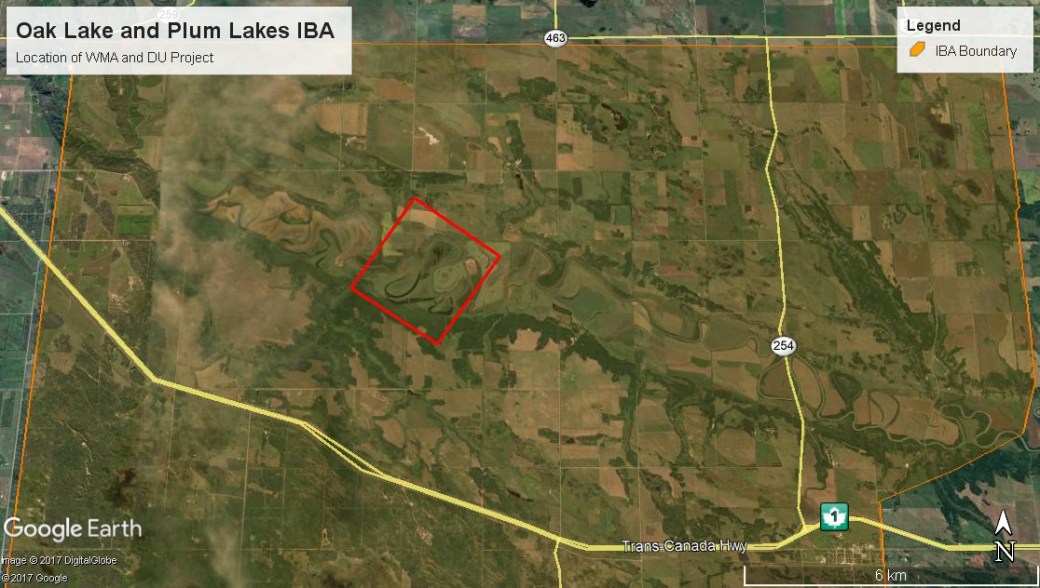
The highlight of the day were the large concentrations of waterfowl, especially Tundra Swan. These northern breeders can be abundant in large concentrations during passage in some of Manitoba’s IBAs (see Saskatchewan River Delta, Whitewater and Churchill and Vicinity). From the southwest corner of Plum Lakes to the wetlands just to the north of Oak Lake we were able to count a minimum of 1765 Tundra Swans, just 135 short of the 1% North American breeding population. See below for a map of where the larger concentrations were encountered.
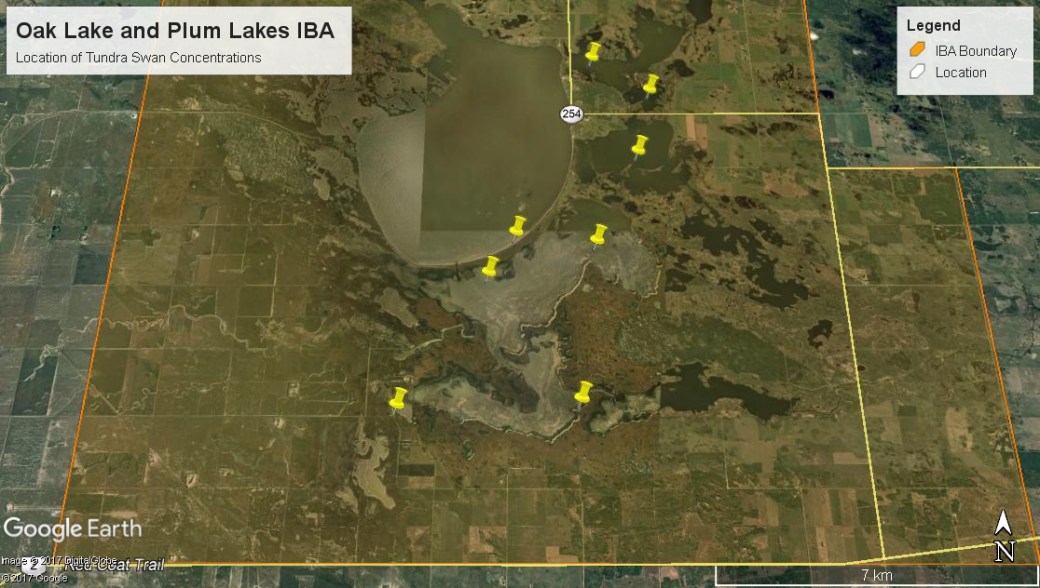
These large concentrations suggest that some concerted, targeted counts during fall by a group of volunteers should be able to identify significant concentrations of migratory waterfowl in the Oak Lake and Plum Lakes IBA boundary.
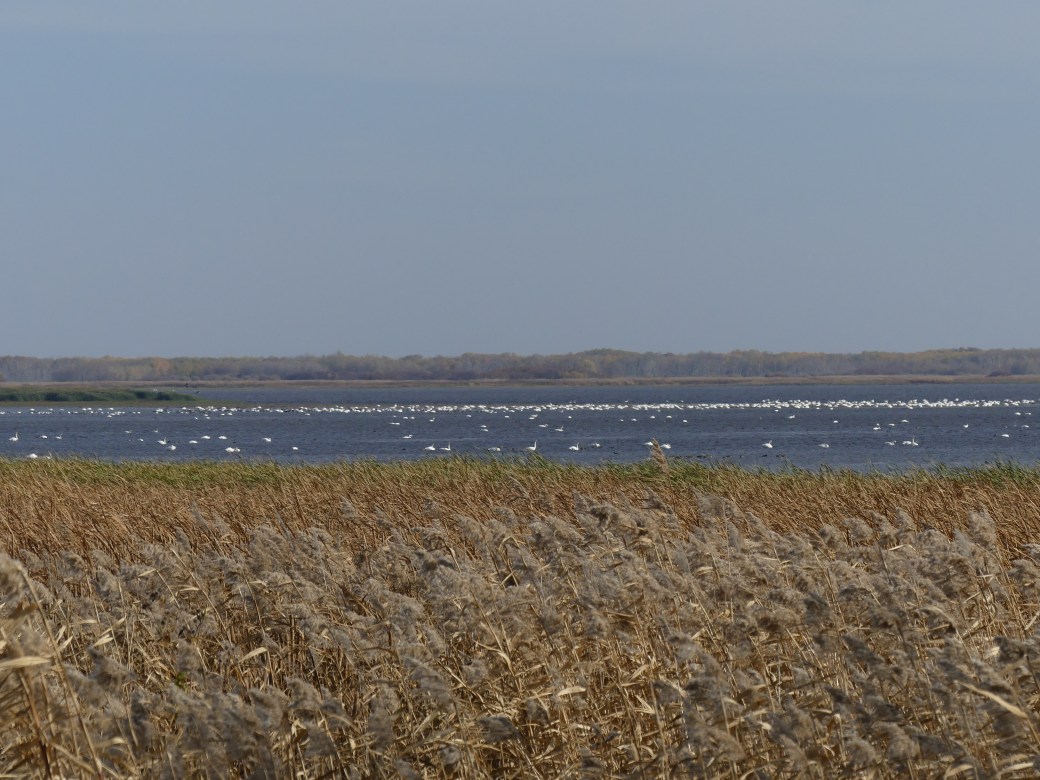
An example of several hundred Tundra Swans at Oak Lake near the weir. Copyright Tim Poole
There were also thousands of Snow Geese in the area, their presence made public thanks to a passing Bald Eagle. Snow Geese tend to be more abundant in southwestern Manitoba at this time – a count of 22,000 was made by Colin Blyth and Gillian Richards on October 22nd at Whitewater Lake. In addition thousands of ducks were feeding along the weir, too many to stop and count at times. Anyway below are a couple of (not the best) videos just to demonstrate the sheer scale of Snow Geese encountered.
In terms of shorebirds, there were still a few around – and Plum Lakes remains in a state of drawdown. Long-billed Dowitcher and both species of yellowlegs were most abundant, with a single Black-bellied Plover flying overhead adding a bit of diversity. Raptors were also present in low numbers including a glimpse of a Northern Goshawk in forest on the Grande Clariere Road and a lovely view of a Great Horned Owl.
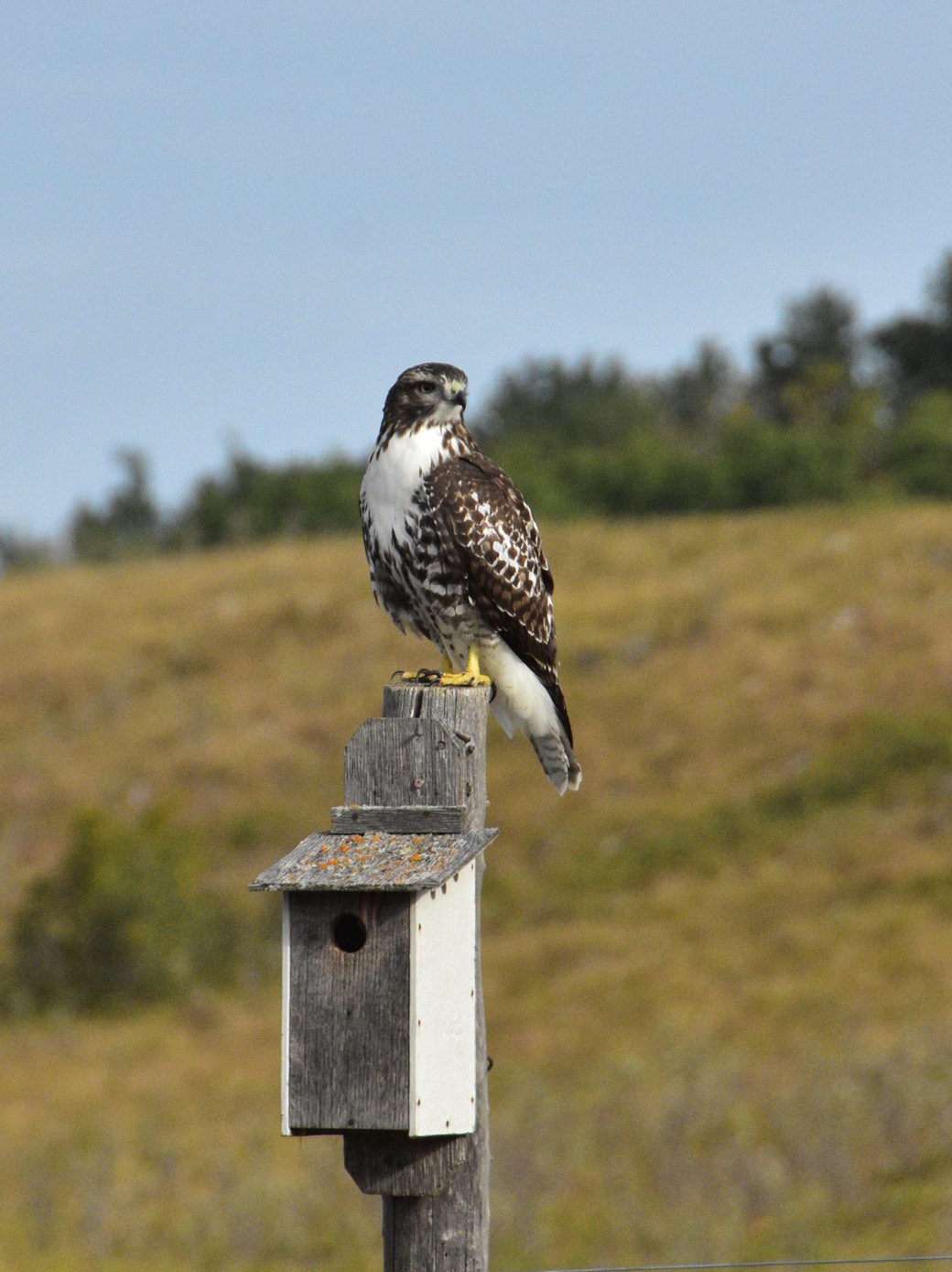
Red-tailed Hawks were among the raptors encountered. Copyright Linda Boys
10 days later and this time Glennis was joined by Linda Boys another one of our IBA volunteers based out of Minnedosa. A focused Tundra Swan count was the aim of the day this time, avoiding the north which lacks good waterfowl habitat. In the intervening period it was apparent that although the numbers of waterfowl were still very high, there had been a certain amount of drop-off from the 11th. A very good total of 1133 Tundra Swans were present in the same areas, a drop of 600 from the high count. No trigger, but at least we now know that with some planning it would be possible to do target counts of swans and other waterfowl during fall.
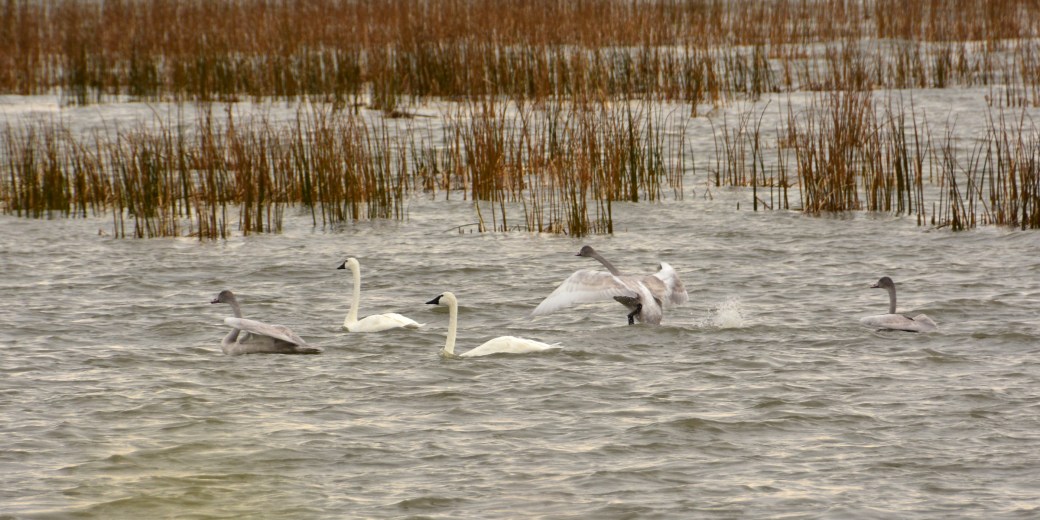
Gorgeous Tundra Swans feeding in the shallow waters around Oak Lake. Copyright Linda Boys
Another major highlight of this trip was a surprisingly large concentration of Sandhill Cranes (for this late in the fall that is). These cranes were all concentrated in a single field in the west of the IBA. Sandhill Cranes are certainly a species to look out for in large concentrations in IBAs with open hay meadows and pastures. In 2016 around 2000 were counted in early October in fields in the Southwestern Manitoba Mixed-grass Prairie IBA and the adjacent Maple Lakes area and the Langruth-RM of Lakeview IBA has historically been a critical staging area for this species. Another species to look out and get more people reporting!

Another stunner from Linda, this time a small snapshot of the huge numbers of Sandhill Cranes present in the western part of the IBA. Copyright Linda Boys
Other late season birds included Turkey Vulture:
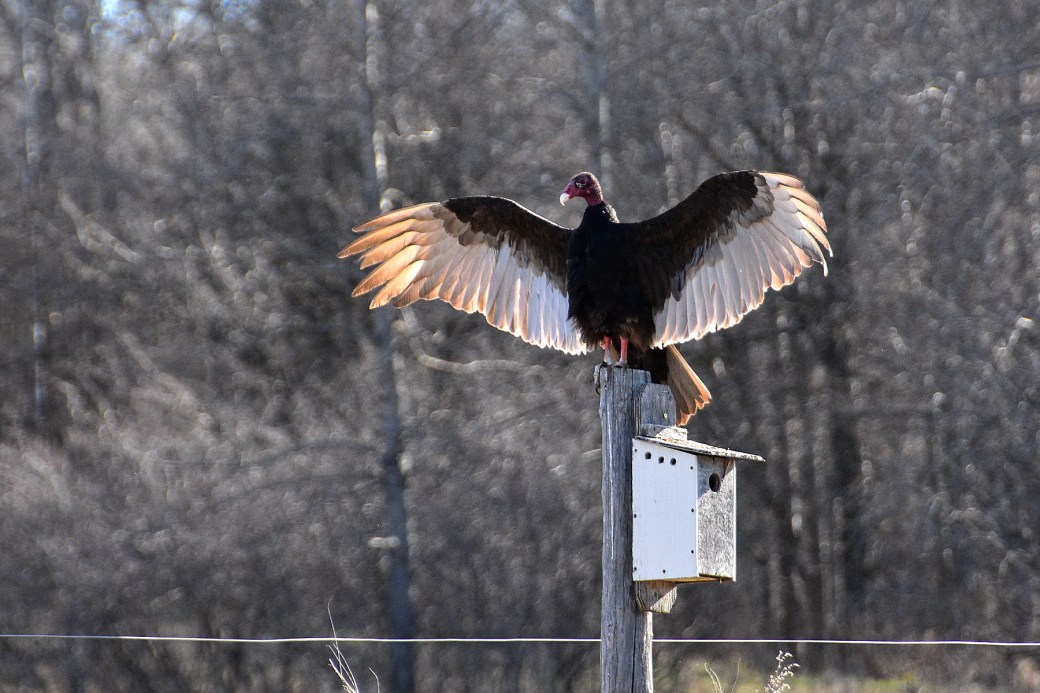
Not strictly taken on the 21st but Linda had previously sent us this stunning image of a Turkey Vulture, well worth sharing. Copyright Linda Boys
The combined bird lists of these trips is outlined below. Thanks Glennis and Linda for your time!
| October 11th | October 21st | |
| Snow Goose | 5941 | 913 |
| Canada Goose | 81 | 105 |
| Tundra Swan | 1765 | 1133 |
| Blue-winged Teal | 18 | 3 |
| Northern Shoveler | 80 | 1 |
| Gadwall | 485 | 1 |
| American Wigeon | 8 | 0 |
| Mallard | 417 | 203 |
| Northern Pintail | 14 | 0 |
| Green-winged Teal | 10 | 2 |
| Canvasback | 598 | 2 |
| Redhead | 79 | 1 |
| Ring-necked Duck | 50 | 1 |
| Lesser Scaup | 65 | 0 |
| Greater/Lesser Scaup | 20 | 0 |
| Bufflehead | 66 | 21 |
| Common Goldeneye | 15 | 0 |
| Hooded Merganser | 3 | 0 |
| Ruddy Duck | 1 | 2 |
| duck sp. | 1000 | 0 |
| Pied-billed Grebe | 3 | 0 |
| Double-crested Cormorant | 0 | 2 |
| American White Pelican | 0 | 1 |
| Great Blue Heron | 2 | 1 |
| Turkey Vulture | 1 | 0 |
| Northern Harrier | 5 | 3 |
| Northern Goshawk | 1 | 0 |
| Accipiter sp. | 1 | 0 |
| Bald Eagle | 2 | 4 |
| Red-tailed Hawk | 5 | 0 |
| American Coot | 562 | 5 |
| Sandhill Crane | 24 | 1200 |
| Black-bellied Plover | 1 | 0 |
| Long-billed Dowitcher | 56 | 0 |
| Wilson’s Snipe | 1 | 0 |
| Greater Yellowlegs | 24 | 0 |
| Lesser Yellowlegs | 40 | 2 |
| Greater/Lesser Yellowlegs | 23 | 0 |
| Ring-billed Gull | 20 | 1 |
| gull sp. | 50 | 0 |
| Rock Pigeon (Feral Pigeon) | 2 | 8 |
| Mourning Dove | 1 | 0 |
| Short-eared Owl | 0 | 1 |
| Great Horned Owl | 1 | 0 |
| Hairy Woodpecker | 1 | 0 |
| American Kestrel | 1 | 0 |
| Blue Jay | 2 | 0 |
| Black-billed Magpie | 22 | 3 |
| American Crow | 3 | 2 |
| Common Raven | 10 | 2 |
| Horned Lark | 1 | 0 |
| Black-capped Chickadee | 1 | 0 |
| Eastern Bluebird | 86 | 0 |
| American Robin | 21 | 7 |
| European Starling | 12 | 0 |
| Lapland Longspur | 200 | 0 |
| American Tree Sparrow | 4 | 28 |
| Dark-eyed Junco | 8 | 18 |
| Harris’s Sparrow | 1 | 2 |
| Vesper Sparrow | 1 | 0 |
| Savannah Sparrow | 5 | 0 |
| Song Sparrow | 1 | 0 |
| sparrow sp. | 20 | 0 |
| Western Meadowlark | 6 | 0 |
| Red-winged Blackbird | 9 | 200 |
| Rusty Blackbird | 24 | 0 |
A Day of Champions at the Riverton Sandy Bar IBA
Tim Poole gives an overview of the second weed pull at Sandy Bar in 2017
Absolutely amazing turnout again – that was my first reaction as I drove along the track towards the parking lot at Sandy Bar on Friday September 29th. There were vehicles parked up on both sides of the track as the parking lot overflowed. I was a few minutes late having been delayed in Gimli collecting some snacks and coffee – and with Ward Christianson, showing young Josiah Van Egmond his lifer Ross’s Goose near the Icelandic Museum. An early success for the morning.
Following out first previous weed pull there has been a multitude of shorebird sightings on Sandy Bar. Maybe the work is already beginning to bear fruit?

American Golden Plovers on the waters edge. This is one of a number of shorebird species which have been using Sandy Bar in the month and a half since the previous weed pull. Copyright Joanne Smith
Joanne gave a briefing in the parking lot -while distributing her excellent array of baking. Anyone who knows Joanne will know that she has a wicked sense of humour. On this occasion she added in
‘I will now pass across to Tim for some more sophisticated words’.
Eek! I stumbled through a few garbled, unsophisticated sentences and then sending everyone on their way to the bar. Thanks Joanne!
We had around 32 volunteers join us this time, not bad for a morning in late September. Not only did we have some IBA regulars and Nature Manitoba stalwarts, to representatives of the East Interlake Conservation District and a mass of Riverton locals.
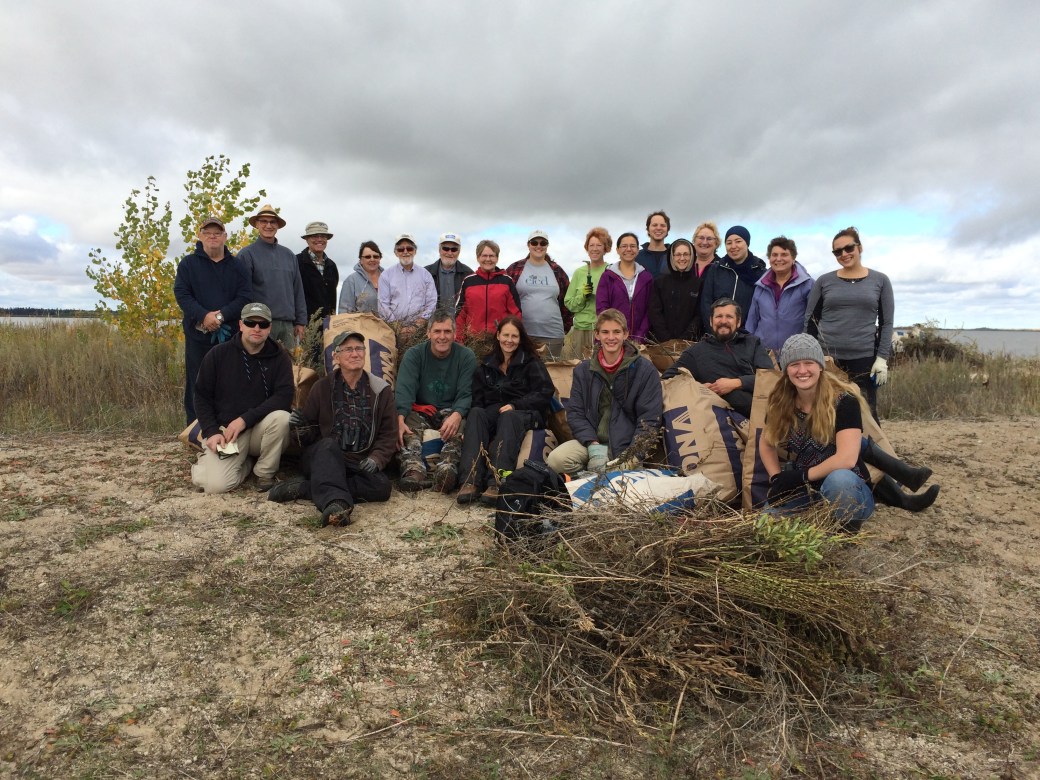
Team photo taken during the weed pull. Copyright Joanne Smith
Reaching the weed pulling area took varying amounts of time depending on peoples personal interests. What this means is that in general the birders took a lot longer than everyone else!
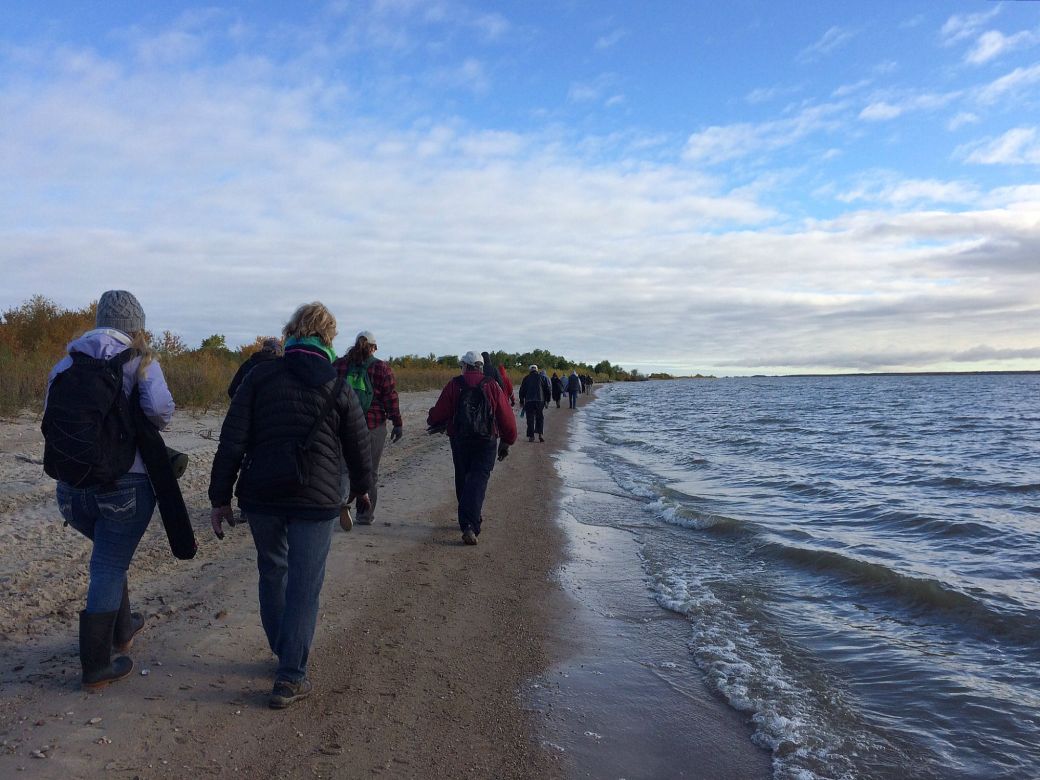
Customary shot of a stream of people making their way to the end of Sandy Bar. Copyright Joanne Smith
Our first task was to show everyone the primary target species, the invasive white sweet clover. This provided an opportunity to describe the ongoing conservation situation with Sandy Bar and the need to continue to attack the weeds on the bar to create more habitat for breeding and migrating birds. While pulling conversation inevitably turned to how we could make things easier for ourselves. Suggestions included using round-up (not on a Special Conservation Area out in the lake), a propane tank with a flame thrower attached (could be fun but there may be some possible issues with setting fire to an entire sandbar) and using goats. The favourite among pretty much all present was using a goat with a flame thrower fitted to its back. Back on Planet Earth, it was explained to people that due to various environmental, health and safety issues, the only realistic way to remove the weeds was good old fashioned people power.
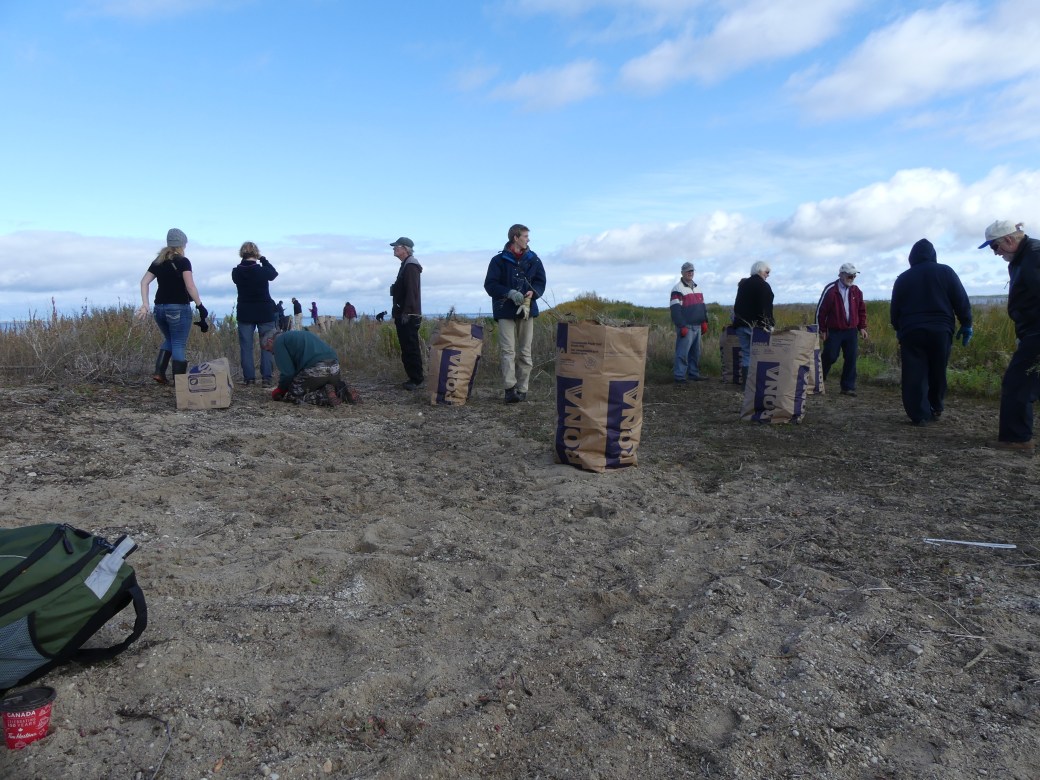
Goat, flamethrower or hand pulling? Volunteers get ready to vote. Copyright Tim Poole
Joanne had also set up a visit from the local Riverton High School students led by teacher Don Bodnarus. Midway through the morning she met the first group off the bus at the parking lot and took them on a short walk, explaining to everyone about the importance of Sandy Bar and the weed pull. In total 25 students and 3 adults came from the school and each picked at least a few weeds as time was short. Maybe next year we can have them out for a longer period of time!

Students making their way onto Sandy Bar. Copyright Joanne Smith
As the title suggests though, this piece is really about a few conservation champions who helped to make this day possible. Firstly all the volunteers who turned out on both weed pulls. Thank you everyone.

Busy finding that final weed…..another one of our terrific volunteers. Copyright Tim Poole
Second, to Louise Buelow-Smith and Eric Smith. Earlier in the week they visited Rona and Gimli and persuaded the manager to part with 10 pairs of workers gloves and 50 yard waste bags. Thank you both and thank you Rona in Gimli!
Third, to local resident Thor Johannson. Thor has been absolutely incredible recruiting local volunteer help leading to huge support in both 2017 workparties. He also contacted other local groups including the local Friendship Centre and even a local Don Balinski to potentially remove the bags by boat or ATV. Thanks Thor!
Finally, to Joanne Smith, Caretaker for Riverton Sandy Bar, who is doing an amazing job organising these weed pulls and raising awareness of the area across the local community. Joanne is a tremendous asset to the Manitoba IBA Program!

In total over 50 bags were filled. Joanne filled this many herself. Copyright Tim Poole
Thank you everyone!

The only photo I could find where Bonnie Chartier is not birdwatching! Copyright Tim Poole
As ever, we finish with a bird list. Joanne shared the following on eBird:
| Snow Goose | 67 |
| Canada Goose | 273 |
| Mallard | 10 |
| White-winged Scoter | 7 |
| Double-crested Cormorant | 6 |
| Great Blue Heron | 1 |
| Northern Harrier | 2 |
| Bald Eagle | 1 |
| Black-bellied Plover | 10 |
| American Golden-Plover | 2 |
| Ruddy Turnstone | 3 |
| Sanderling | 64 |
| Dunlin | 2 |
| Greater Yellowlegs | 1 |
| Bonaparte’s Gull | 6 |
| Ring-billed Gull | 137 |
| Herring Gull | 2 |
| Great Horned Owl | 1 |
| Belted Kingfisher | 1 |
| Hairy Woodpecker | 2 |
| Merlin | 1 |
| Common Raven | 20 |
| Horned Lark | 6 |
| Black-capped Chickadee | 2 |
| American Pipit | 9 |
| Lapland Longspur | 65 |
| Snow Bunting | 1 |
| Yellow-rumped Warbler | 1 |
| Dark-eyed Junco | 2 |
| Swamp Sparrow | 4 |
| Rusty Blackbird | 19 |
| American Goldfinch | 3 |
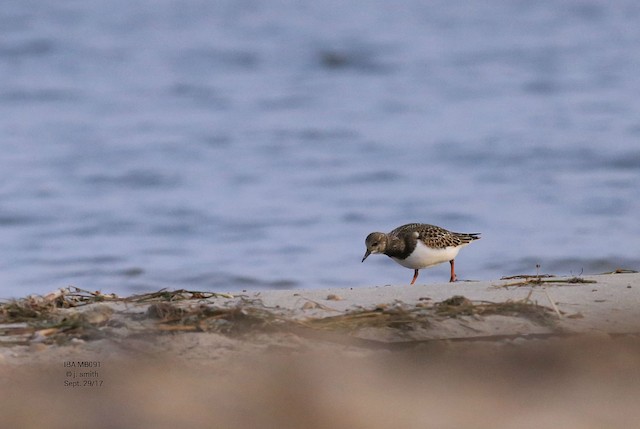
Another of the shorebirds on Sandy Bar. This time a Ruddy Turnstone. Copyright Joanne Smith
Quick Report From Weekend Bird Walk at Delta Marsh
Thanks to the folk at the Fort La Reine Museum we had a great morning out at Delta Marsh on Saturday. We had 5 people join us including the former Delta Marsh Manager, Dr Bob Jones, a huge reservoir of knowledge of the history and biology of this area.
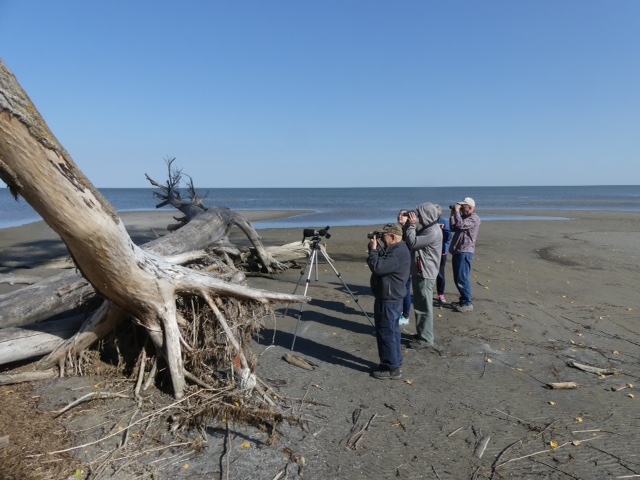
Birding on Delta Beach. Photo copyright Tim Poole
We started off checking for shorebirds at a creek west of the diversion, the site of several thousand migrating shorebirds last August. On this occasion we were limited to a few dozen Lesser and Greater Yellowlegs and large numbers of ducks.
Onwards we headed towards Delta Beach, checking around the diversion but seeing very little of note from the road. Along the road north towards the beach John Hays spotted some movement and eventually we had brief glimpses of 3 Black-bellied Plover flying away. At the Delta Marsh welcome sign there were good numbers of Western Grebe, over 100 in total, and several species of duck. We moved on towards the beach. Following reports of water surges raising the lake levels by up to 5m earlier in the week, it was apparent that there was limited beach available for birds. The advantage of this however was that the shorebirds and miscellaneous gulls were restricted to fingers of beach close to the shore. A mixed flock of Semipalmated Plover (30), Sanderling (12) and Least Sandpiper (2) were certainly the highlight. Behind on the ridge Eastern Phoebe, Yellow-rumped Warbler and Palm Warbler foraged on the dead wood for bugs and swallows battled strong winds seeking the final tasty morsels available before they embark on their long migration.
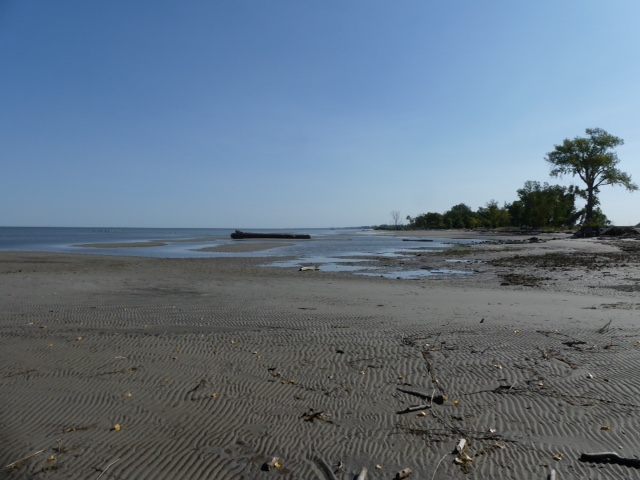
Delta Beach. Copyright Tim Poole
Finally we headed to the Delta Waterfowl Trail on the south of the beach ridge. Here again were large numbers of ducks, mainly Mallards, Northern Pintail, American Widgeon and Blue-winged Teal. Bob Jones shared some of the history of the marsh and the different groups involved. The final highlight were flocks of Sandhill Cranes flying south, their wonderful sights and sounds, a clear sign that fall is well and truly upon us.


All Sandhill Crane images copyright Tim Poole
Thanks to the small but knowledgeable group who joined us on Saturday and to Fort La Reine Museum. Delta Marsh is a great area to explore with many wonderful birds to find. We will return here again in 2018!
Sandy Bar Weed Pull #2 Sept. 29th, 2017
On Friday September 29th we are planning another weed pull at Important Bird and Biodiversity Area MB091 Riverton Sandy Bar.
We had an excellent turnout on Aug. 17th with 36 volunteers filling 66 bags of invasive sweet clover, burdock and willow. Because the sweet clover requires regular removal we plan to meet at 9:00 am on September the 29th to pull more bags of the stuff. Looking far into the future, we also hope to do another pull in late April or early May 2018.
We are looking forward to having Don Bodnarus’s high school class from Riverton Collegiate join us on the 29th as well. It’ll be great to get youth from the community involved.
We’ll also be doing a bit of Birding and recording the species we see and hear while we’re pulling weeds. It would be ideal if we could pull weeds for 2-3 hours and then walk to the end of the sand bar with binos and scopes to show birders and nonbirders some of the bird species that stop over at Sandy Bar as they continue their fall migration south to areas as far away South America. On September 30th 2016 we saw such species as Rusty Blackbird, Smith Longspur, Lapland Longspur, American Pipit, Horned Lark and American Golden Plover.
There is also a possibility that we may be able to show the volunteers how to enter our bird sightings into eBird under the IBA Protocol.
It would be great to have you join us again on the 29th. Please feel free to forward this email to others who may be interested in pulling weeds, meeting others and learning about the fall migrating birds at Sandy Bar.
More details will be emailed out as we get closer to the date.
Thanks!
Joanne Smith

Photo copyright Dries Desender
Footnote – please email Tim Poole, iba@naturemanitoba.ca for more details
 Manitoba Important Bird Areas Program