Lynnea surveying for shorebirds at the end of ISS Route West 3 at Whitewater Lake. Photo by A. Shave.
The International Shorebird Survey is an international monitoring program started by Manomet. In spring 2018 members of the Manitoba IBA program, Westman Naturalists and others participated in a workshop with Manomet to enable us to start this monitoring program in Manitoba.
Our two surveys sites are Whitewater Lake (3 routes on the west side of the IBA and 4 routes on the east side), and Oak Lake/ Plum Lakes (5 routes). Normally the monitoring includes each route being surveyed 3 times in the spring and 3 times in the fall each year. However, this year with COVID-19, normal monitoring efforts were not possible.
However, we did still want to gather some data on these ISS routes, and so surveys were done when safe, and when possible according to provincial and federal health guidelines. While this year’s data as a whole is not able to be directly compared to survey efforts in the past (due to difference in sampling effort), below are our results from our spring and fall ISS surveys in 2020. Although all species seen are recorded under the ISS protocol, only shorebird species are reported below.
A big thank you to Glennis, Gillian, Lynnea and Christian, our volunteers who helped with ISS this year! Also thank you to Nate and Alyssa, our summer assistants who learned fall shorebird ID on the fly.
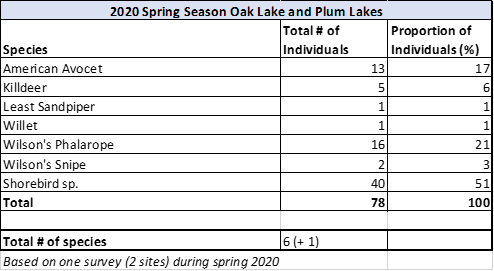
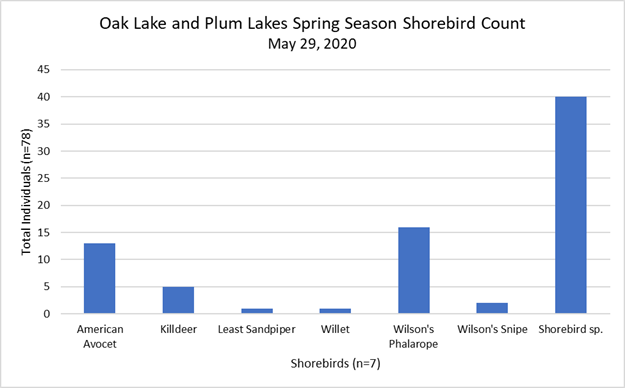
Spring 2020 Oak Lake/ Plum Lakes IBA
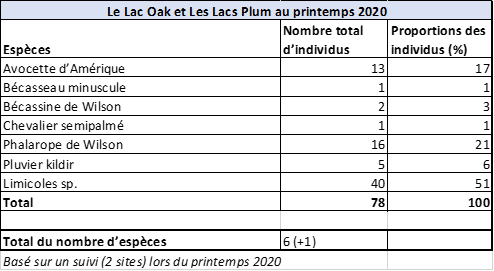
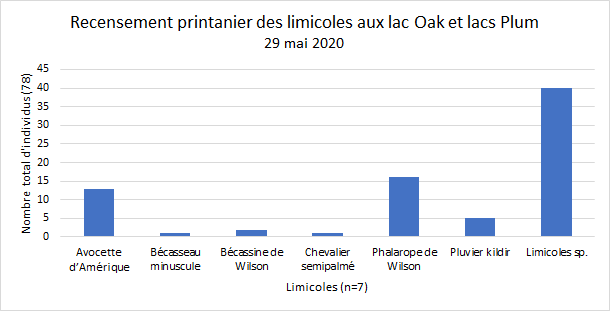
We were only able to get out once to monitor 2 of the 5 routes at Oak Lake/ Plum Lakes this spring due to uncertainty about COVID-19 and travel advisories. A total of 6 species were seen (plus some unidentified shorebird species seen in the distance).
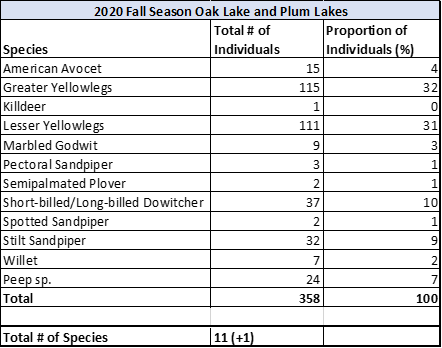
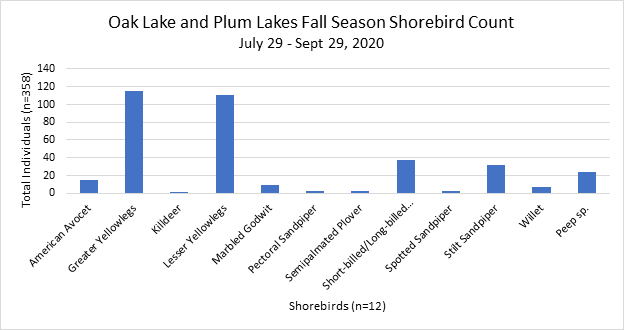
Fall 2020 Oak Lake/ Plum Lakes
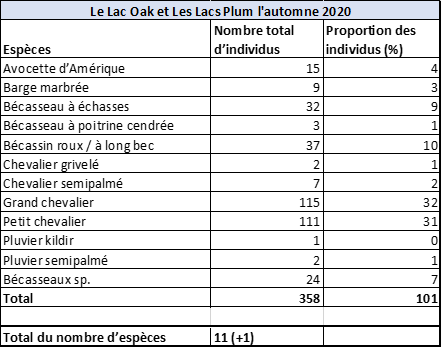
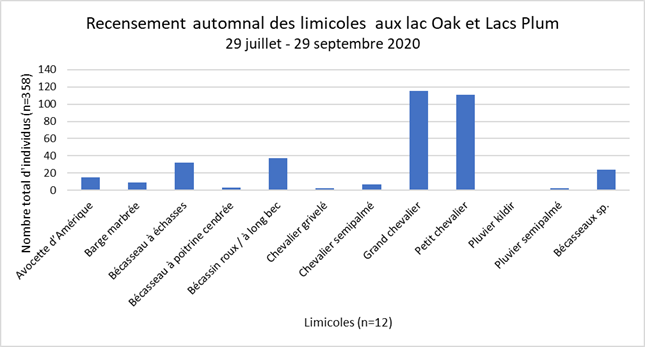
All ISS routes at Oak Lake/ Plum Lakes were visited at least once (1-3 visits per site) over the course of 3 trips by the IBA program and volunteers. A total of 11 species were seen (in addition to some unidentified “peeps”).
Spring 2020 Whitewater Lake Results
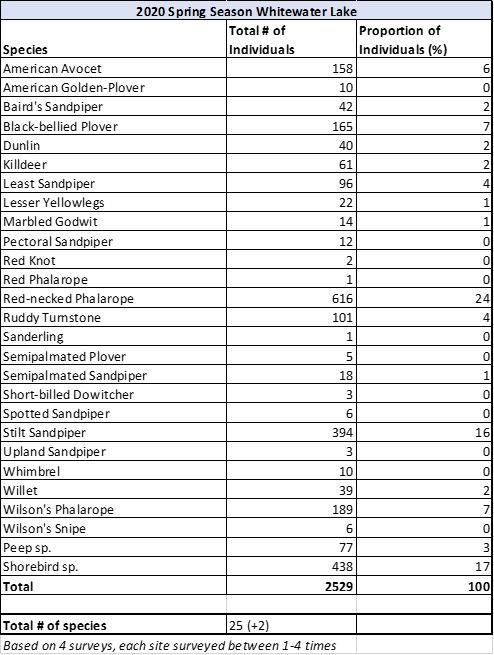
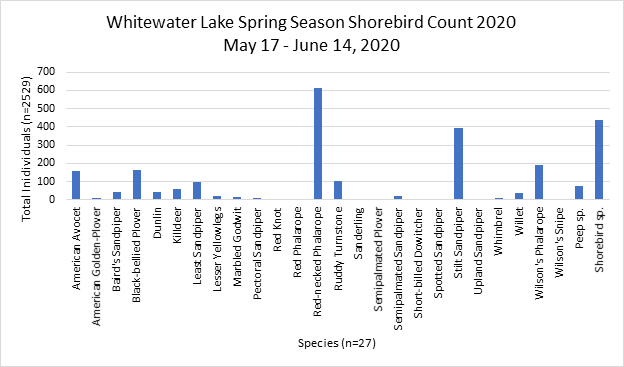
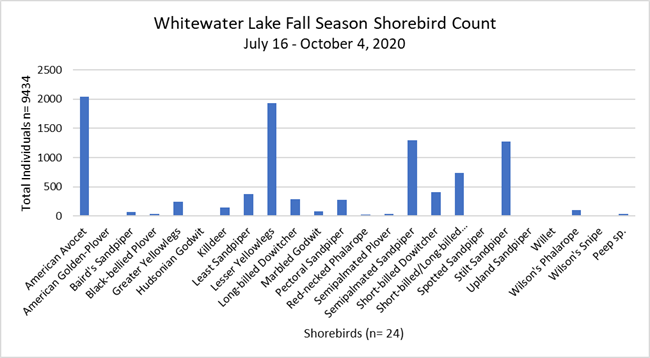
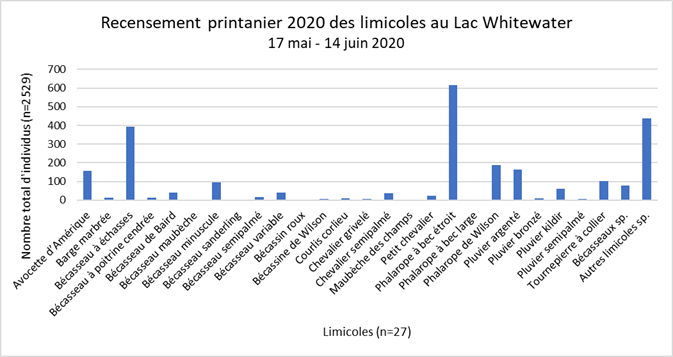
We were able to visit Whitewater Lake 4 times this spring, although each route was run a different number of times. Some routes we were able to run according to ISS protocol (3 or more surveys), others that are harder to access were only surveyed once. A total of 25 shorebird species were seen during spring surveys, with a few unidentified shorebird species and “peep” species mixed in.
A highlight of the Whitewater Lake spring surveys for myself was a nice view of some Whimbrels landing in a field while Lynnea and I were surveying on the east side of Whitewater Lake. If we had not seen them fly in, I don’t think we would have noticed them, they were so camouflaged with the habitat, and at quite a distance. On the flip side, on the same trip but on the west side of the lake Lynnea and I encountered a large number of tiny parachuting spiders which was not nearly so nice.
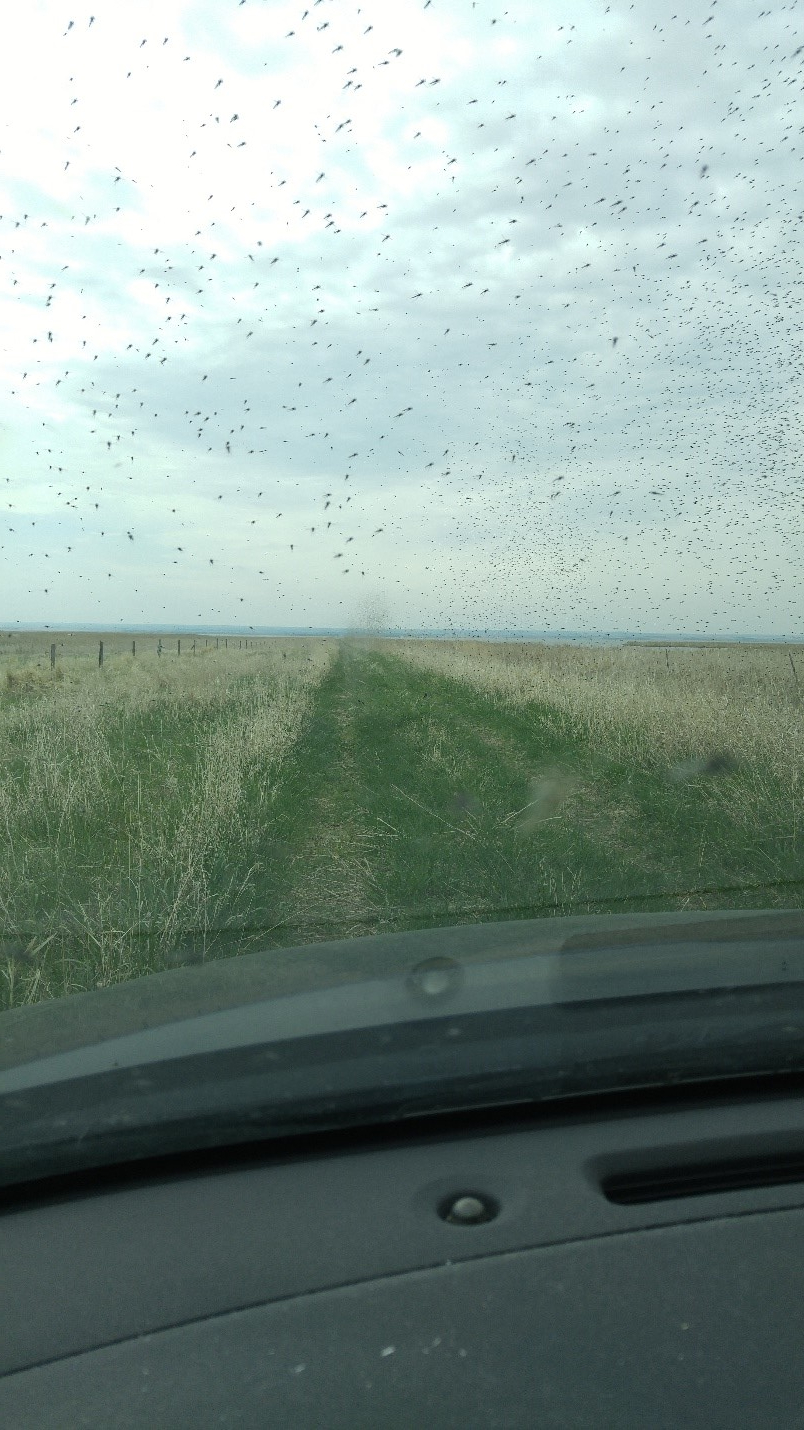
You can see why Whitewater Lake is a great place for birds that eat insects! So many midges in late May. Photo by A. Shave.
Fall 2020 Whitewater Lake
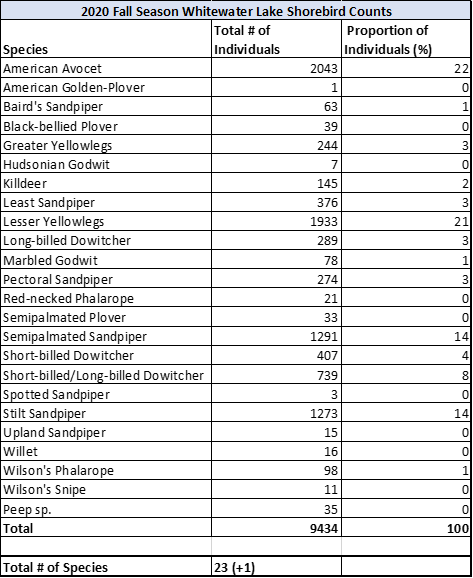
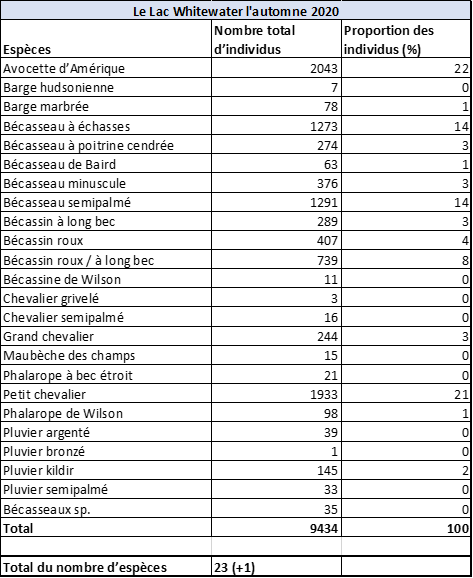
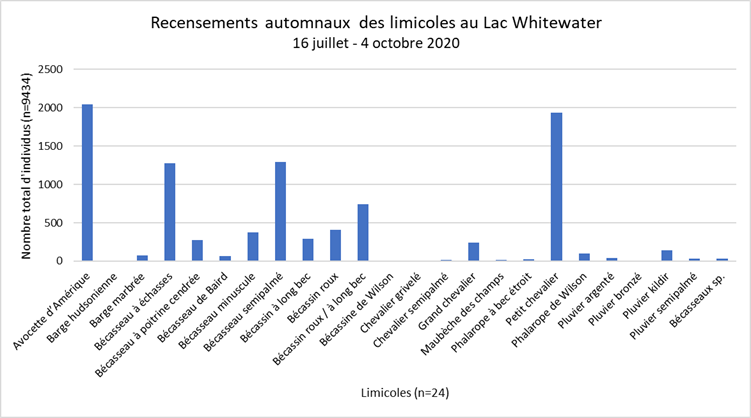
Whitewater Lake sites were visited between 1-5 times each over a course of 8 trips by the IBA program and volunteers. A total of 23 species were identified (with additional unidentified shorebird species and “peep” species).
Future International Shorebird Surveys
During the periods where the Manitoba IBA program could not travel to western Manitoba, we stayed closer to home to explore some new opportunities for shorebird surveys in central/eastern Manitoba. Stay tuned for more information on this!
If you are interested in learning more about shorebird Identification or about volunteering to be part of the International Shorebird Survey, please contact Amanda at iba@naturemanitoba.ca. Volunteering as part of the shorebird survey can be as easy as running a route while out birding in the area, and we are happy to provide personalized, hands-on training in the field!
Résumé du Recensement international des oiseaux limicoles 2020
Lynnea recensant des oiseaux de rivages à la fin de la route 3 Ouest du RIOL au Lac Whitewater. Photo d’A. Shave.
Le recensement international des oiseaux limicoles est un programme de suivi international initié par Manomet. Au printemps 2018, les membres du programme de ZICO Manitoba, des naturalistes de Westman et d’autres personnes ont participé à un atelier offert par Manomet afin de pouvoir commencer ce programme de dénombrement au Manitoba.
Nos deux sites de suivi sont le Lac Whitewater (3 routes du côté ouest de la ZICO et 4 routes du côté est), et aux Lac Oak / Lacs PLum (5 routes). En temps normal, le suivi annuel de chaque route est fait 3 fois au printemps et 3 fois à l’automne. Toutefois, en raison de la COVID-19, nos activités normales de dénombrement n’ont pas été possibles cette année.
Cependant, nous voulions toujours recueillir certaines données sur ces routes du RIOL, donc les recensements ont été faits lorsqu’il était sécuritaire et possible de le faire selon les recommandations fédérales et provinciales de la santé. Même si les données de cette année ne peuvent pas être directement comparées aux efforts des suivis des années précédentes (dû à la différence de l’échantillonnage), les résultats des suivis du RIOL du printemps et de l’automne 2020 sont présentés ci-bas. Bien que toutes les espèces observées soient consignées dans le protocole du RIOL, seules les espèces limicoles font l’objet de ce rapport.
Un grand merci à Glennis, Gillian, Lynnea et Christian, nos bénévoles aux RICO de cette année, ainsi qu’à Nate et Alyssa, nos assistants d’été qui ont appris à identifier les limicoles à la volée.
Lac Oak/ Lacs Plum au printemps 2020
Nous n’avons pu recenser que 2 des 5 routes aux Lac Oak / Lacs Plum ce printemps suite aux restrictions de voyage. En tout, 6 espèces ont été observées (plus quelques autres espèces limicoles non-identifiées au loin).
Lac Oak / Lacs Plum à l’automne 2020
Toutes les routes de la ZICO des Oak Lake/ Plum Lakesont été recensées au moins une fois (1-3 visites par site) lors de trois visites par le programme ZICO et les bénévoles. En tout, 11 espèces ont été observées (en plus de quelques bécasseaux non-identifiés).
Résultats au Lac Whitewater au printemps 2020
Nous avons pu visiter le Lac Whitewater quatre fois ce printemps, quoique chaque route a été visitée un différent nombre de fois. Le protocole du RIOL (3 recensements ou plus) a été respecté pour certaines routes, mais celles étant difficiles d’accès n’ont été visitées qu’une seule fois. En tout, 25 espèces limicoles ont été observées lors de ces recensements, en plus de quelques espèces limicoles non-identifiées.
À mon avis, le point saillant des recensements printaniers du Lac Whitewater a été la découverte de quelques courlis corlieux alors que Lynnea et moi recensions la rive est du Lac Whitewater. S’ils n’étaient pas arrivés en volant, je ne crois pas que nous les aurions remarqués tant ils se camouflaient bien dans leur habitat, en plus d’être éloignés. En revanche, lors de la même excursion mais sur la rive ouest du lac, Lynnea et moi avons croisé un nombre incroyable de minuscules araignées se laissant porter par le vent, ce qui était moins agréable.
Comme vous pouvez le voir, le Lac Whitewater est un très bon endroit pour les oiseaux se nourrissant d’insectes! Il y a énormément de moucherons à la fin mai. Photo d’A. Shave.
Lac Whitewater à l’automne 2020
Les sites du Lac Whitewater ont été visités de 1 à 5 fois chacun lors de 8 voyages faits par les bénévoles du programme ZICO. 23 espèces ont été identifiées en tout (en plus des espèces limicoles non-identifiées).
Les prochains Recensements internationaux des oiseaux limicoles
Lorsque le programme des ZICO Manitoba ne pouvaient pas se rendre dans l’ouest du Manitoba, nous nous restions en région afin d’explorer de nouveaux sites pour les recensements de limicoles dans le centre et l’est du Manitoba. Nous vous ferons parvenir plus d’information à ce sujet!
Si vous voulez en apprendre davantage au sujet de l’identification des limicoles ou pour devenir bénévole du Recensement international des oiseaux limicoles, veuillez contacter Amanda à iba@naturemanitoba.ca. Être bénévole pour un recensement de limicoles est aussi simple que de suivre un itinéraire tout en observant les oiseaux dans la région, et il nous fera plaisir de vous offrir une formation personnalisée sur le terrain!
February 2nd may be known more widely as Groundhog Day in Canada, but did you know it is also World Wetland Day? As so many of our Important Bird Areas in Manitoba contain wetland habitat, it is only fitting that we have a blog post to celebrate all that wetlands do for us and the birds!
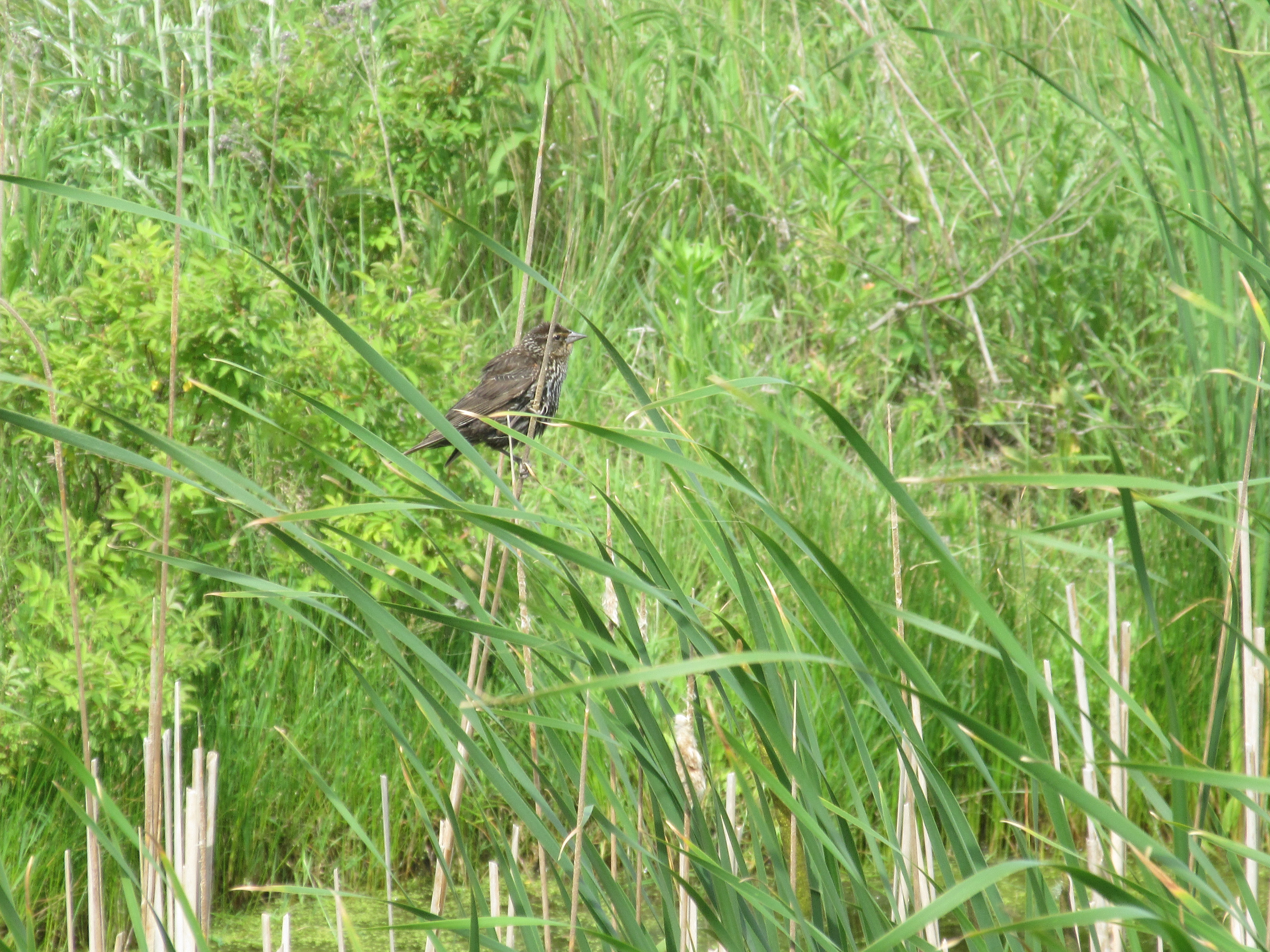
A Red-winged Blackbird at Oak Hammock Marsh. Photo by A. Shave
What makes wetlands such good habitat?
Shallow water in wetlands means that light penetrates to the bottom of the water column, which promotes plant growth and provides habitat for many small insects and crustaceans. Some of these insects will spend all their lives in water, while others will leave the water as adults. All this insect life is an excellent food source for birds from warblers to ducks.
Additionally, wetlands provide excellent habitat for birds that are adapted to live there. Plants often grow thick and tall in wetlands (such as cattail and bulrush) that provide good places to hide nests from predators. Nesting in areas higher ground surrounded by water, or floating nests also means that also provides safety from predators looking to snack on eggs or young birds.
What services do wetlands provide to people?
Wetlands provide many services to people, that we often don’t consider in our day to day lives:
Water storage – Wetlands store water in times of excess precipitation, and provide a reservoir of water in times of less precipitation.
Flood control – Related to water storage, wetlands as natural flood control measures is key in southern Manitoba. Wetlands are able to store both water from winter snow melt, and spring precipitation. Without wetlands this water would drain fast off the landscape, leading to more flooding.
Shoreline stabilization – Wetlands protect against erosion caused by wave action and storms. We see this in action at Delta Marsh (south end of Lake Manitoba) and Netley-Libau Marsh (south end of Lake Winnipeg), which protect the shoreline against wave action caused by northerly winds.
Water purification – As water moves very slowly through wetlands, they can trap excess nutrients (like phosphorus), sediments and heavy metals that get taken up by plant roots or are trapped in the wetland bottoms.
And more!
Manitoba Wetland IBAs
Manitoba has many wetland IBAs. Here are a couple of highlights:
Oak Hammock Marsh – An easy drive from Winnipeg, Oak Hammock Marsh is a RAMSAR wetland. It is constructed through a series of human-made dikes. These dikes allow water levels in different areas of the marsh to be artificially raised and lowered to provide a variety of water levels and habitats. Oak Hammock Marsh is also where you will find the shorebird scrape – a first-of-its-kind habitat constructed in Manitoba for shorebirds in summer 2020.
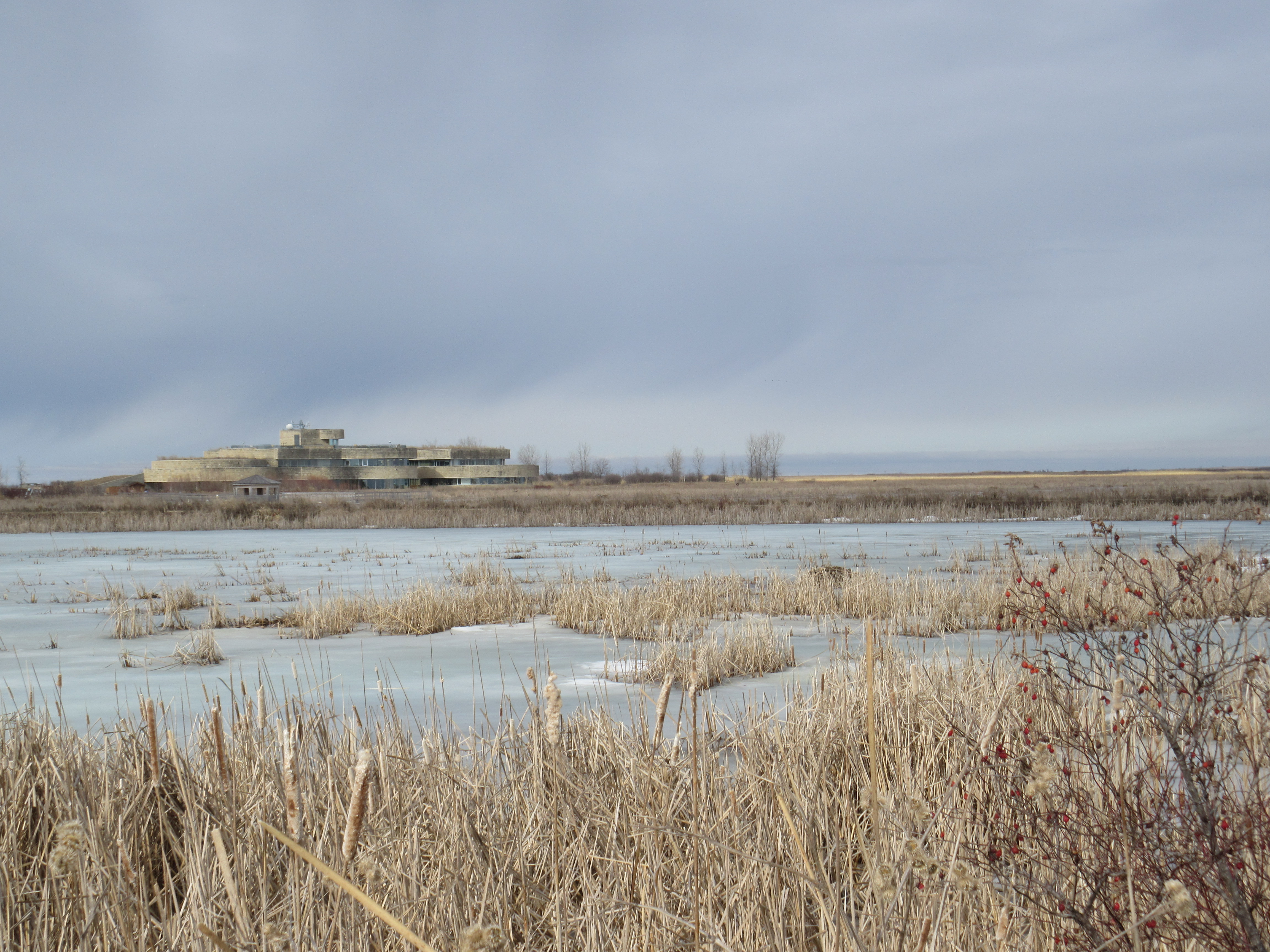
While Oak Hammock Marsh looks frozen over in February for World Wetlands Day – it is still key habitat for our resident birds. Photo by A. Shave
Delta Marsh – Just 15 minutes north of Portage la Prairie, Delta Marsh is also a RAMSAR wetland. Delta marsh hosts many different species of birds due to the combination of marsh, lake and a treed sand ridge habitat. High counts of birds using the marsh in recent years include Bonaparte’s Gull (6,710 in 2018), Franklin’s Gull (15,000 in 2020) and Semipalmated Plover (1,905 in 2016).
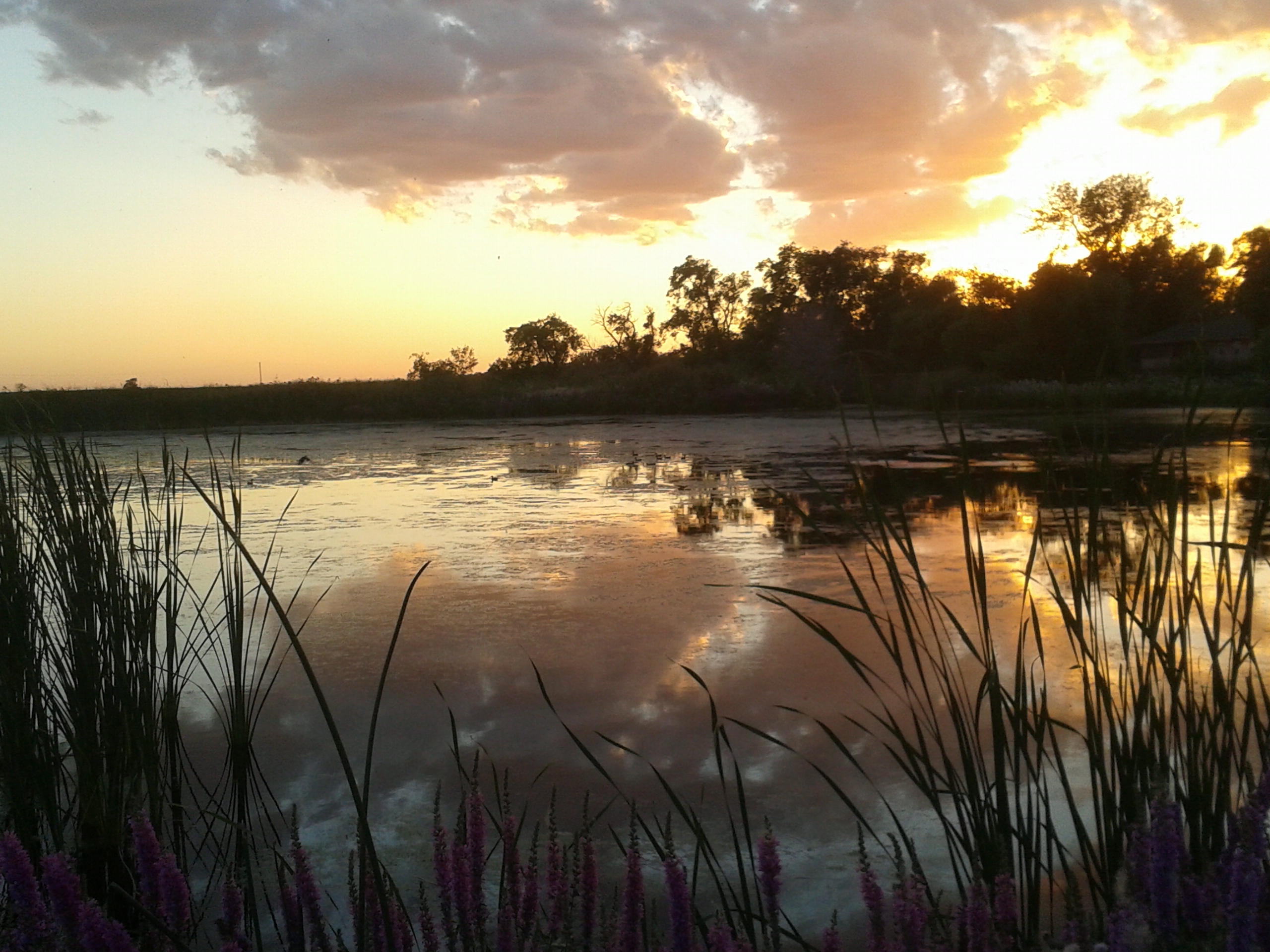
Delta Marsh at sunset. Photo A. Shave
Douglas Marsh – near to Brandon, Douglas marsh is actually a type of wetland called a fen. Fens are wetlands that have a lot of organic material (peat), as well as a continuous flow of surface and/or groundwater. They are usually dominated by grasses and sedges. Douglas Marsh IBA is best known for its population of Yellow Rails. They are a secretive species that are more often heard than seen. Listen after dark for a sound like rocks clacking together to identify the Yellow Rail.
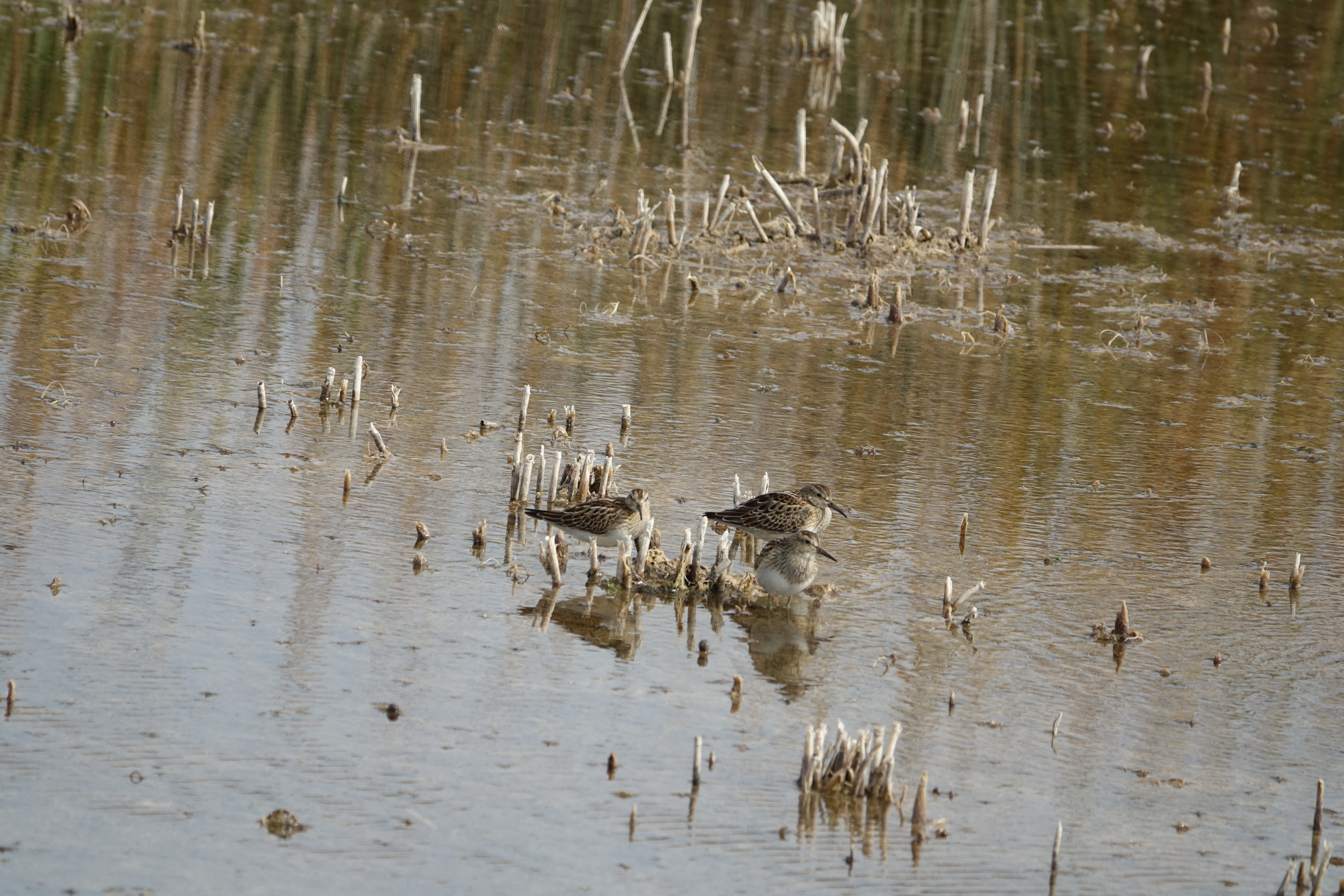
Pectoral Sandpipers using wetland habitat at Shoals Lakes during a 2020 bird blitz. Photo by A. Shave
Manitoba has many, many more IBAs that are key breeding and/or migratory stopover habitat for our birds. If you are interested in exploring Manitoba’s wetland IBAs stay tuned for volunteer opportunities with bird blitzes and the International Shorebird Survey coming this spring with Manitoba IBA.
Journée mondiale des zones humides
Le 2 février est peut-être plus largement connu comme la Journée de la marmotte au Canada, mais saviez-vous que c’est aussi la Journée mondiale des zones humides ? Comme un grand nombre de nos zones primordiales pour les oiseaux au Manitoba contiennent des habitats de zones humides, il est tout à fait approprié que nous postions un article de blog pour célébrer tout ce que les zones humides font pour nous et les oiseaux !
Un carouge à épaulettes à marais de Oak Hammock. Photo d’A. Shave.
Qu’est-ce qui fait des zones humides un si bon habitat ?
Les eaux peu profondes des zones humides signifient que la lumière pénètre jusqu’au fond de la colonne d’eau, ce qui favorise la croissance des plantes et fournit un habitat à de nombreux petits insectes et crustacés. Certains de ces insectes passeront toute leur vie dans l’eau, tandis que d’autres la quitteront à l’âge adulte. Toute cette vie d’insectes est une excellente source de nourriture pour les oiseaux, des parulines aux canards.
De plus, les zones humides offrent un excellent habitat aux oiseaux qui sont adaptés pour y vivre. Les plantes poussent souvent en hauteur et en épaisseur dans les zones humides (comme les quenouilles et les joncs) qui offrent de bons endroits pour cacher les nids des prédateurs. Le fait de nicher dans des zones plus élevées entourées d’eau ou dans des nids flottants permet également de se mettre à l’abri des prédateurs qui cherchent à picorer les œufs ou dévorer les jeunes oiseaux.
Quels services les zones humides fournissent-elles aux personnes ?
Les zones humides fournissent de nombreux services aux personnes, dont nous ne tenons souvent pas compte dans notre vie quotidienne :
Stockage de l’eau – Les zones humides stockent l’eau en cas de précipitations excessives et constituent un réservoir d’eau lorsque les précipitations sont plus faibles.
Contrôle des inondations – En ce qui concerne le stockage de l’eau, les zones humides comme mesures naturelles de contrôle des inondations sont essentielles dans le sud du Manitoba. Les zones humides sont capables de stocker à la fois l’eau de la fonte des neiges en hiver et les précipitations du printemps. Sans les zones humides, cette eau s’écoulerait rapidement hors du paysage, ce qui entraînerait davantage d’inondations.
Stabilisation du littoral – Les zones humides protègent contre l’érosion causée par l’action des vagues et des tempêtes. On le voit en action au marais Delta (extrémité sud du lac Manitoba) et au marais Netley-Libau (extrémité sud du lac Winnipeg), qui protègent le littoral contre l’action des vagues causées par les vents du nord.
Purification de l’eau – Comme l’eau se déplace très lentement dans les zones humides, elle peut piéger l’excès de nutriments (comme le phosphore), les sédiments et les métaux lourds qui sont absorbés par les racines des plantes ou sont piégés dans le fond des zones humides…
Et plus encore !
ZICO des zones humides du Manitoba
Le Manitoba compte de nombreuses ZICO de zones humides. En voici quelques exemples :
Marais de Oak Hammock – A quelques minutes de route de Winnipeg, le marais de Oak Hammock est une zone humide RAMSAR. Il est construit grâce à une série de digues construites par l’homme. Ces digues permettent d’élever et d’abaisser artificiellement le niveau de l’eau dans différentes zones du marais afin d’offrir une variété de niveaux d’eau et d’habitats. Le marais Oak Hammock est également l’endroit où vous trouverez le grattage des oiseaux de rivage – un habitat unique en son genre construit au Manitoba pour les oiseaux de rivage à l’été 2020.
Alors que le marais de Oak Hammock semble gelé en février pour la Journée mondiale des zones humides, il reste un habitat important pour nos oiseaux d’hiver. Photo d’A. Shave.
Marais du Delta – A 15 minutes au nord de Portage la Prairie, le marais du Delta est également une zone humide RAMSAR. Le marais du Delta abrite de nombreuses espèces d’oiseaux différentes en raison de la combinaison du marais et d’une crête de sable couverte d’arbres. Parmi les oiseaux qui ont fréquenté le marais ces dernières années, on compte la mouette de Bonaparte (6,710 en 2018), la mouette de Franklin (15,000 en 2020) et le Pluvier semipalmé (1,905 en 2016).
Marais du Delta au coucher du soleil. Photo d’A. Shave.
Marais de Douglas – près de Brandon, le marais de Douglas est en fait un type de zone humide appelée marécage. Les marécages sont des zones humides qui contiennent beaucoup de matière organique (tourbe), ainsi qu’un flux continu de surface et/ou d’eau souterraine. Ils sont généralement dominés par des herbes et des carex. La ZICO du marais Douglas est surtout connue pour sa population de râles jaunes. Il s’agit d’une espèce secrète qui est plus souvent entendue que vue. La nuit, écoutez le bruit de pierres qui s’entrechoquent pour identifier le râle jaune.
Bécasseau à poitrine cendrée utilisant l’habitat des terres humides des lacs Shoals. Photo d’A. Shave
Si vous êtes intéressé par l’exploration des ZICO du Manitoba, restez à l’écoute pour connaître les possibilités de bénévolat dans le cadre des campagnes de chasse aux oiseaux et de l’International Shorebird Survey qui aura lieu ce printemps dans les ZICO du Manitoba.
‘Tis the time of year again – not the holiday season – instead the annual COSEWIC meeting. COSEWIC (Committee on the Status of Endangered Wildlife in Canada) is an independent advisory panel that provides information to the Minister of Environment and Climate Change in Canada. They are responsible for identifying and assessing the conservation status of wildlife species in Canada.
At COSEWIC meetings Species Specialist Subcommittees (say that three times fast!) meet to determine changes to COSEWIC wildlife rankings and determine the urgency for wildlife species to receive COSEWIC assessments. These rankings sort wildlife candidates into different risk categories (special concern, threatened, endangered, extirpated) after an assessment and different priority categories (high, mid and low priority) prior to a COSEWIC assessment.
Changes to Species at Risk Status:
Lesser Yellowlegs
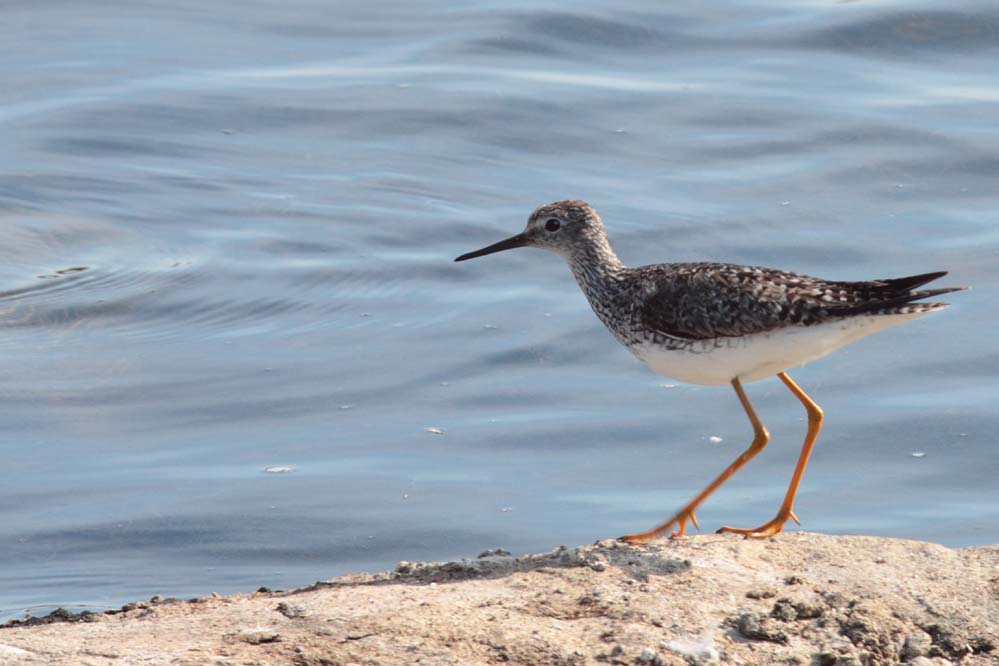
Lesser Yellowlegs was assessed by COSEWIC as Threatened. Previously Lesser Yellowlegs was a Priority for assessment by COSEWIC. Lesser Yellowlegs can be found in many of our IBAs such as Whitewater, Oak Lake/ Plum Lake, Shoal Lakes and Oak Hammock Marsh IBA, just to name a few.
Lesser Yellowlegs. Photo by Christian Artuso.
Canada Warbler
Some good news here! Previously ranked as Threatened by COSEWIC, now re-assessed as Special Concern. While we don’t have an IBA specifically triggered by the Canada Warbler, we do sometimes get a glimpse of them during migration season. Otherwise look for them in the Boreal Forest during breeding season.
Canada Warbler. Photo by Dale Bonk/Audubon Photography Awards
Bird Species up for Assessment in 2021:
Horned Lark– High Priority
Seven of the eight subspecies are listed as priorities for COSEWIC assessment. The eighth subspecies is already listed as endangered. Subspecies of Horned Lark listed as occurring in Manitoba are the Saskatchewan Horned Lark, Hoyt’s Horned Lark and the Desert Horned Lark. Long term declines of these subspecies range from 52%-89% (1970-2018) and short-term declines range from 15%-42% (2008-2018) from sources such as the Breeding Bird Survey and Christmas Bird Count.
Horned Lark. Photo by Christoph Moning/ Cornell All About Birds
Snowy Owl – High Priority
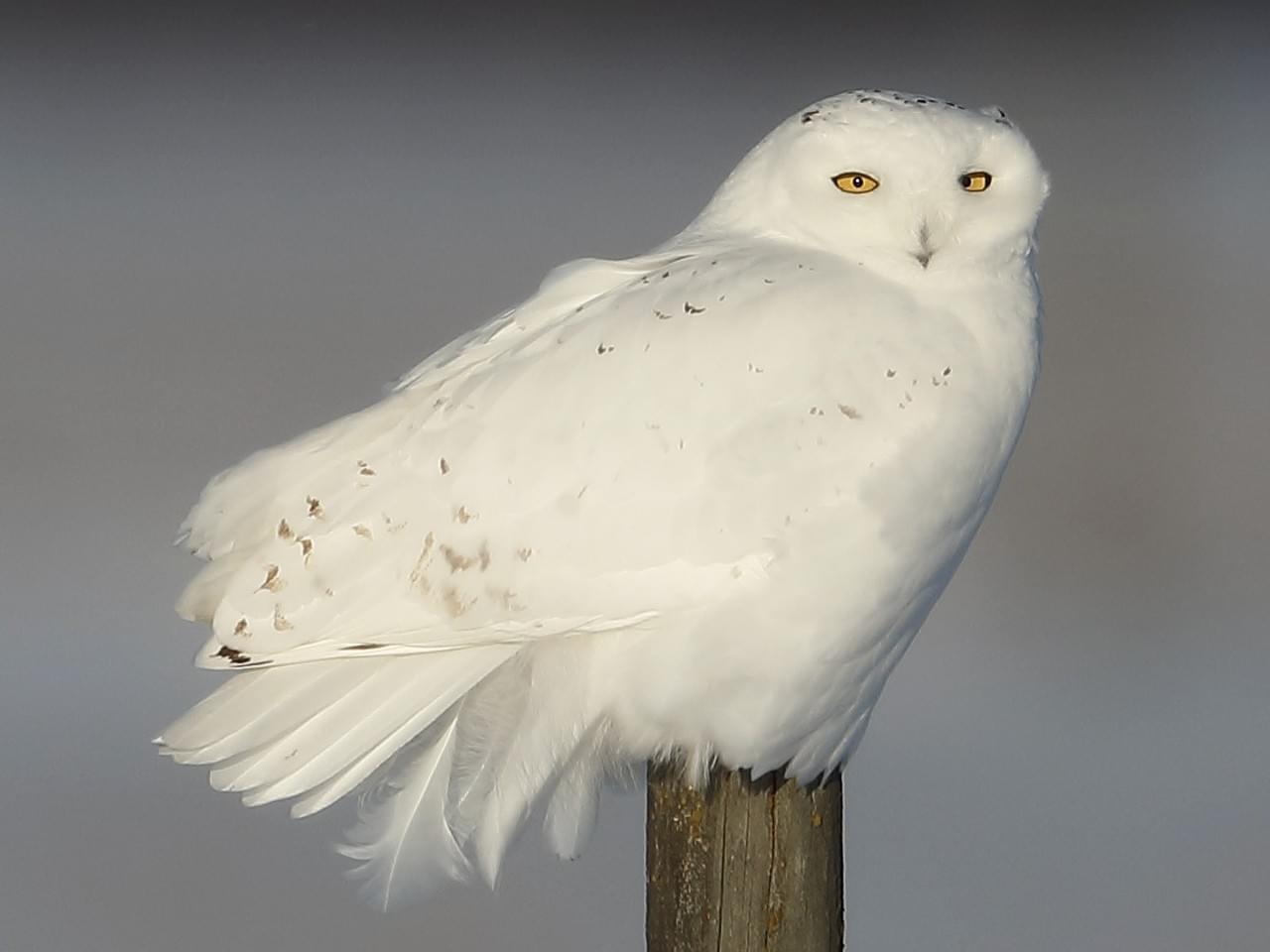
Snowy Owl populations are thought to have declined to approximately 15% of their historical numbers worldwide. The Snowy Owl breeds on the northern edges of Manitoba and northward on the arctic tundra. We more often see Snowy Owls in Manitoba during the winter season. Threats contributing to this decline are mostly unknown, but the rapid pace of climate change is likely a key driver on the breeding grounds.
Snowy Owl. Photo by Mark Benavides/ Cornell All About Birds.
Other species still on candidate list from prior to 2020:
Sanderling – High Priority
Pectoral Sandpiper – High Priority
Stilt Sandpiper – High Priority
Dunlin – High Priority
Semipalmated Sandpiper – High Priority
Killdeer – High Priority
Whimbrel – High Priority
Connecticut Warbler – High Priority
Le Conte’s Sparrow – Mid Priority
Upland Sandpiper – Mid Priority
Long-billed Dowitcher – Mid Priority
American Golden Plover – Mid priority
Purple Martin – Mid Priority
Blackpoll Warbler – Mid Priority
Arctic Tern – Mid Priority
Black Tern – Low Priority
Western Wood-Pewee – Low Priority
Brewer’s Blackbird – Low Priority
American Kestrel – Low Priority
Pine Siskin – Low Priority
If you are interested in other types of wildlife discussed in recent COSEWIC meetings check out the links below:
Piping Plover have been seen on the west side of Whitewater Lake multiple times in past years. We are excited to report that there were multiple Piping Plover sightings this year at Whitewater Lake. The first sighting this year was by three Manitoba birders on May 15th, 2020, and the second Piping Plover happened at on July 13th. There were multiple sightings of a pair of plovers and it was assumed that a breeding attempt failed. Regardless, still exciting observations for Manitoba and we will keep our fingers crossed for next breeding season!
The Piping Plover is listed as an endangered species in both Canada and Manitoba.
Whooping Cranes at Whitewater Lake IBA
Another set of exciting sightings from Whitewater Lake this year!
A single Whooping Crane was spotted at Whitewater Lake on April 21, 2020, likely on spring migration.
Next, a Whooping Crane was seen by a birder on July 26, 2020. This bird was not banded, so likely a Whooping Crane that came from the Wood Buffalo National Park breeding population. On August 20-22 several birders once again saw what was likely the same crane on the west side of Whitewater Lake near to where the July sighting took place. This sighting definitely would have needed a spotting scope as the crane was very far off in the distance, in the middle of a farmer’s wheatfield.
Whooping Cranes are listed as an endangered species in Canada and Manitoba.
Tundra Swans at Saskatchewan River Delta IBA
Joel Kayer’s springtime count of (mostly) Tundra Swans in the Carrot Valley (near The Pas), netted the Saskatchewan River Delta IBA an IBA trigger for a large congregation of species. He counted 26,111 individuals over approximately two hours on May 7, 2020. This count surpassed the global and regional IBA thresholds (3000 and 1900 individuals respectively).
It seemed like the habitat and weather created the “perfect storm” for swans, as Joel observed “Perfect conditions with all swamps and lakes frozen to the north. Lots of sheet water over ample crop residue and crops still in swath”. Lots of local food, and the inability of swans to move further north, likely created a bottle neck in the Carrot Valley.
Sabine’s Gull at Delta Marsh IBA and Saskatchewan River Delta IBA
Sabine’s Gull. Photo by C. Nikkel.
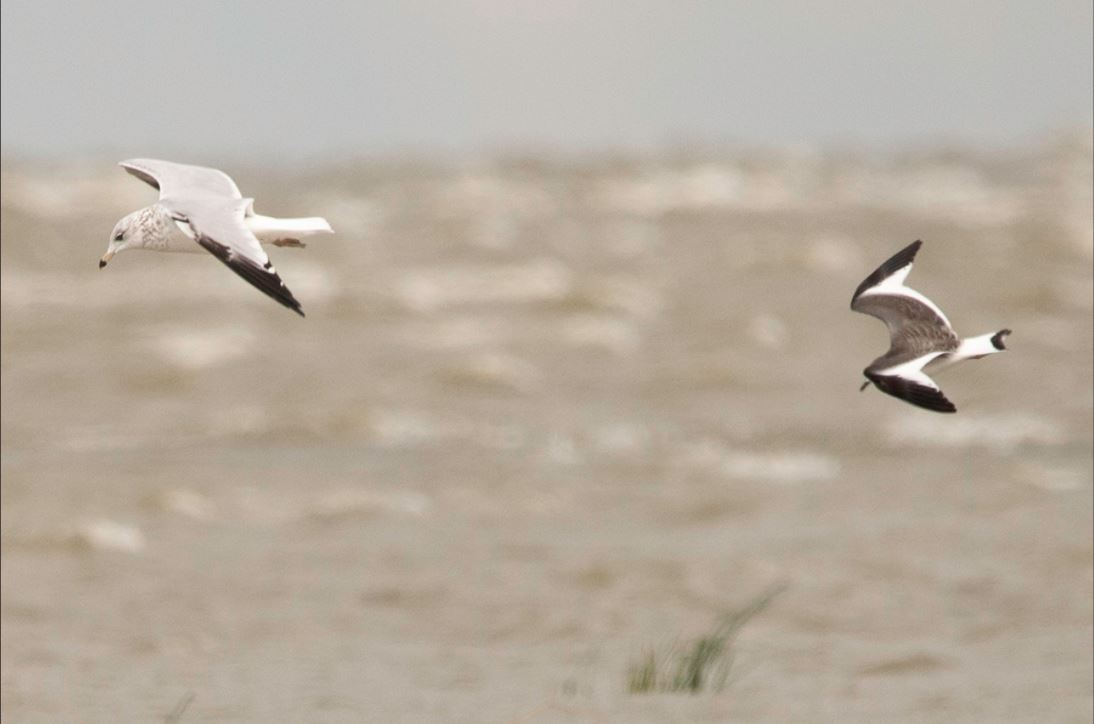
An immature Sabine’s Gull was spotted and photographed at the Delta Beach area of Delta Marsh IBA by Cam Nikkel on September 7th. Sabine’s Gulls are small gulls with forked tails and unique colouration, that is a standout from other gull species. They breed in the high arctic and overwinter in coastal central America. However, despite the migration flight path you might expect (as the crow flies), instead most individuals migrate along the west coast, and thus they are not commonly seen on migration in central Canada.
Sabine’s Gull (right) with Ring-billed Gull. Photo by C. Nikkel.
David Raitt also saw a Sabine’s Gull this year; his record was at Sunset Beach on Clearwater Lake (Saskatchewan River Delta IBA). This sighting took place on June 11th.
Franklin’s Gulls at Delta Marsh IBA
Cal Cuthbert hit an IBA trigger with his count of Franklin’s Gulls at Delta Marsh. He counted 15,000 gulls on September 5, 2020. The IBA trigger was for a large congregation of a single species, with the global and regional IBA thresholds for Franklin’s gulls at 9,800 individuals for both triggers. This has not been a one-time occurrence for Cal, he also mentioned “From my experiences over the years out here (mainly pre eBird) many FRGU [Franklin’s Gull] concentrations have typically numbered into the thousands, occasionally tens of thousands, especially pre fall migration”.
Lesser Black-backed Gulls at Delta Marsh IBA
There have been multiple sightings of Lesser Black-backed Gulls this year at Delta Marsh IBA. The first sighting was during spring migration on May 5th at Delta Beach by Cal. It was first seen on Provincial Road 227 near the landfill, and then seen on a sandbar on the east side of the eastern most beach on May 24th. Sightings continued periodically on and near the Road 227 landfill until September 17th. The number of Lesser Black-backed Gulls ranged from 1-3 individuals seen at one time during the season; however, photos permitting a comparison of markings show that at least four were present, although only one was an adult.
Harlequin Ducks at Delta Marsh IBA and Willow Island
A female or immature Harlequin Duck was spotted at Delta Marsh IBA by Rob Parsons and Jo Swartz on October 24th. It was difficult to spot due to wave action in the water off Delta Beach. This is not the first Harlequin Duck spotted at the IBA. One was seen in 2016 during an IBA blitz by Matt Gasner near St Ambroise at the end of August.
Another Harlequin Duck was also spotted this fall near Gimli (Willow Island Road) by Jan Bradley on November 8th.
Late Season Virginia Rail at Netley-Libau Marsh IBA
While not a rare species, a late season Virginia Rail was found (deceased) in a yard site in Netley-Libau Marsh IBA on November 4th. The bird was found by Dan and Allison, and news was passed along by IBA caretakers Ryon and Hazel Blenderhassett. Other eBird records for Virginia Rails in the area are primarily for June and July, with one seen in September.
Burrowing Owl in Southwestern Mixed Grass Prairie IBA
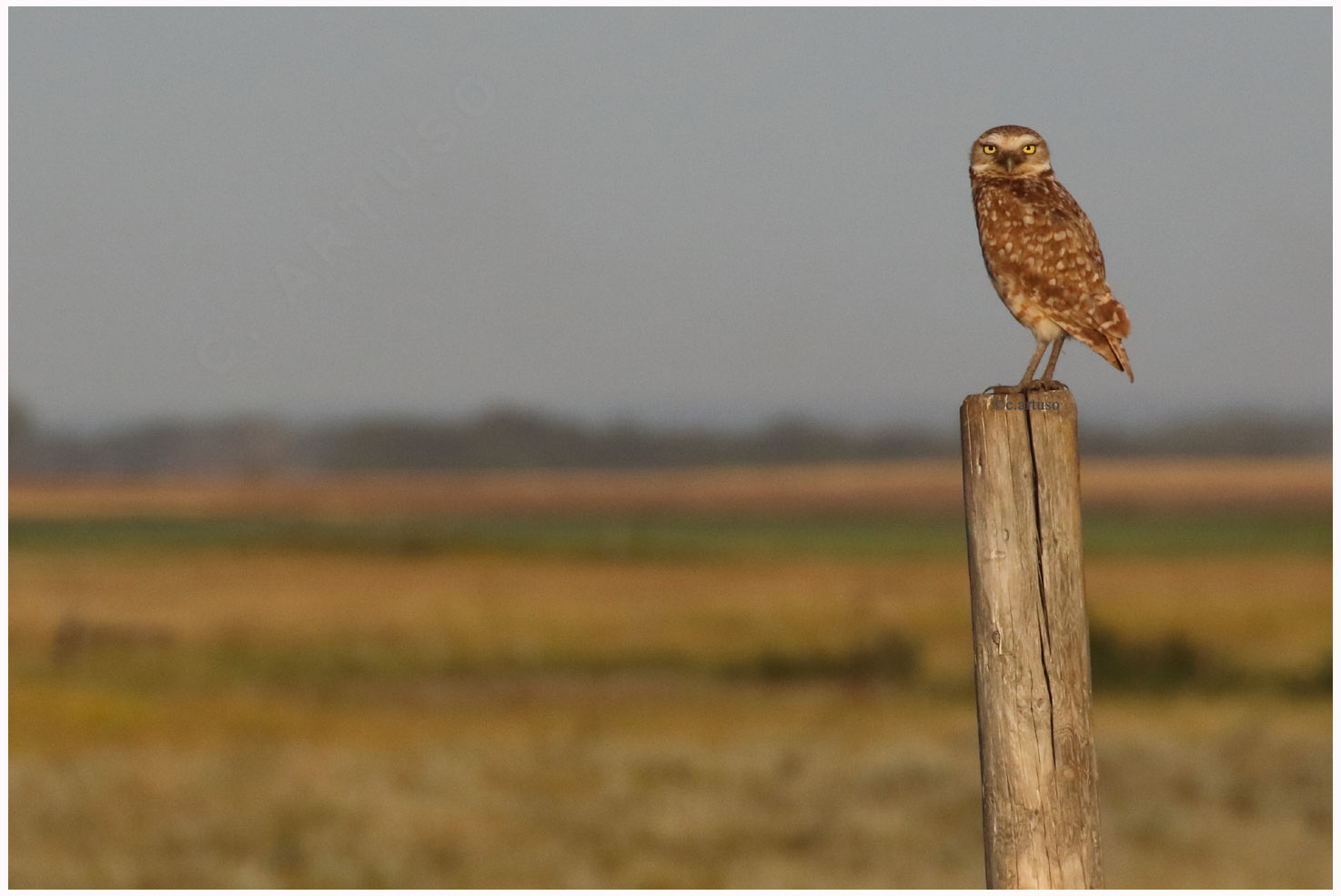
Wild Burrowing Owl seen at one of the nest sites in southwestern Manitoba. Photo by C. Artuso.
Two wild Burrowing Owl nests were reported in southwestern Manitoba this year by the Manitoba Burrowing Owl Recovery Program (MBORP). MBORP runs captive-release and monitoring of burrowing owls in the region, so they keep track of where nests and owls are location – as thus know when a wild owl is reported (as opposed to a captive-release individual). So not only were there wild burrowing owls at these sites, there were also two successful nests by two wild owl pairs. These records are the first records of wild Burrowing Owls breeding in Manitoba since 2011.
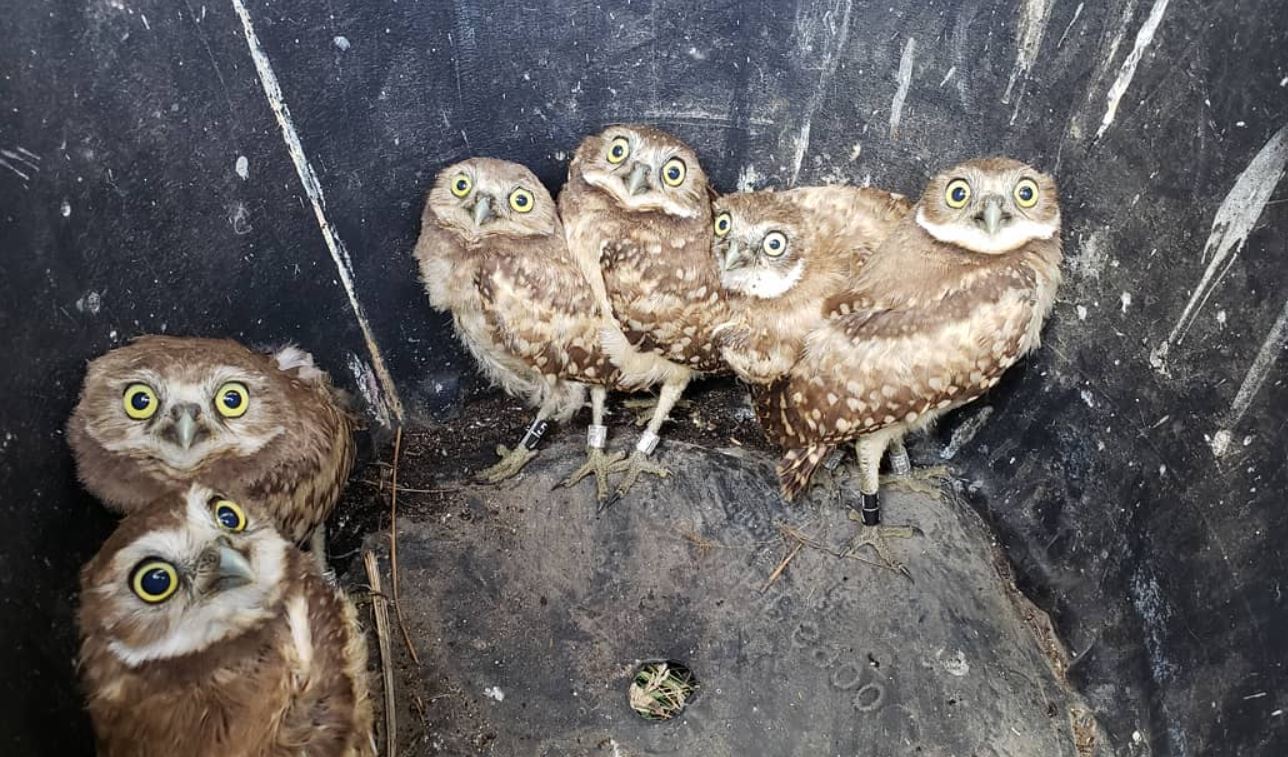
One pair nested in the Southwestern Mixed-Grass Prairie IBA. This pair was reported by the landowner who saw the male standing on a fence post. This The landowner then contacted MBORP, who assessed that the site had a nest. This pair of owls used an artificial nest burrow that was installed by MBORP in 2017. The owls at this site fledged six young.
Burrowing Owl Young from the nest in the Southwestern Mixed-Grass Prairie IBA banded by MBORP. Photo from MBORP.
The second pair nested near Whitewater Lake IBA was spotted by Alex of MBORP while driving around the southwest. She said “The other nest I found while driving around in southwestern MB. I spotted a male owl fly to a burrow. I observed from a distance for quite some time and then spotted the female.” This pair nested in a naturally occurring badger burrow. The owls at this site fledged five young.
If you would like to know more about the Manitoba Burrowing Owl Recovery Program (and read the stories of these owls as they unfolded this past summer) check out MBORP’s Facebook or Twitter pages.
Burrowing Owls are listed as endangered at both a federal and provincial level.
Chestnut-collared Longspurs at Ellice-Archie Spyhill IBA
This sighting comes to us courtesy of Tim Poole, who was conducting bird counts at the Ellice-Archie Community Pasture. He recorded a checklist of 67 Chestnut-collared Longspurs in one day during a survey on June 23, 2020. This is an IBA trigger for the number of pairs. The next day Tim saw another 28 Longspurs in a different portion of the IBA.
Chestnut-collared Longspurs are listed as threated at a federal and provincial level.
Smith’s Longspur at Riverton Sandy Bar IBA
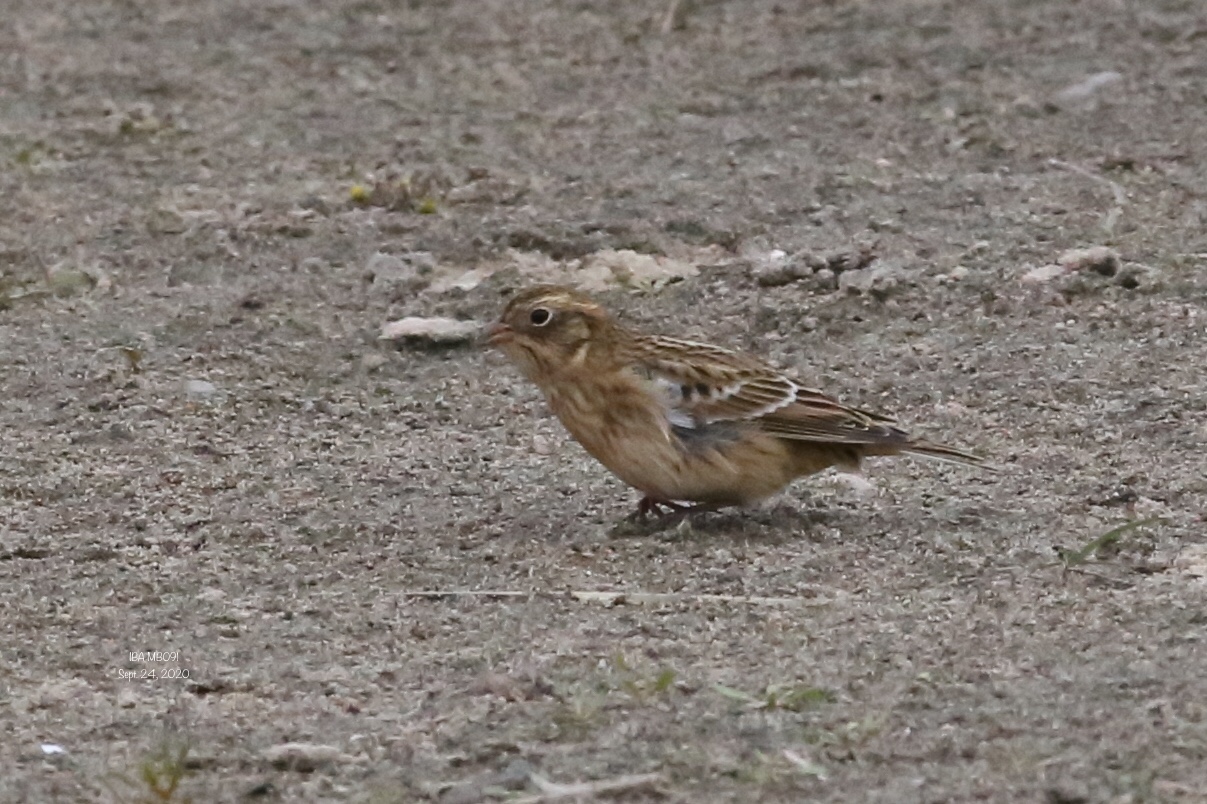
The Smith’s Longspur(s) seen at Riverton Sandy Bar IBA also deserves a mention on this list. They were first spotted on fall migration on September 24th by Joanne, caretaker of the IBA, on the sandspit. eBird.org checklists also list the Longspur on September 26th and 27th both on the sandspit and near the Sandy Bar parking lot. While Longspurs migrate through Riverton Sandy Bar their small size, cryptic colouration (similar between species) and tendency to be inflight (rather than still) makes identification of the Smith’s Longspur certainly tricky! On one previous occasion, we recorded this seldom seen species during one of our weed pulls on the sandbar.
Smith’s Longspur. Photo by J. Smith
Other sightings of Smith’s Longspurs this year have been near Altona (spring migration), Fort Whyte Alive in Winnipeg (fall migration), and Grand Beach/Grand Marais (fall migration).
Purple Sandpiper at Churchill and Vicinity IBA
With increased caution about travel this season, there have been fewer birding reports coming out of northern Manitoba. One interesting report we did hear about was the presence of a Purple Sandpiper this fall in Churchill and Vicinity IBA. The Purple Sandpiper was reported by James Barber on October 23rd, 2020. It was spotted approximately halfway between the town of Churchill and the airport.
Purple Sandpipers breed in the high arctic (further north than Churchill) and spend the winter along coastlines bordering the north Atlantic Ocean. They migrate regularly along the Hudson Bay coast but are difficult to see.
Which birds have you seen this year?
If you have any other interesting sightings, or large congregations of birds seen this season seen in Manitoba’s IBAs we would love to hear about it at iba@naturemanitoba.ca.
Les espèces notables des ZICO 2020
Pluviers siffleurs à la ZICO du Whitewater Lake / Plum Lake
Les pluviers siffleurs ont été observés plusieurs fois sur la rive ouest du lac Whitewater ces dernières années. Nous sommes ravis d’annoncer qu’il y eu de multiples observations de pluviers siffleurs cette année au lac Whitewater. La première observation de l’année a été rapportée par trois ornithologues le 15 mai 2020, et celle d’un deuxième pluvier siffleur s’est faite le 13 juillet. Par la suite, il y a eu plusieurs observations d’une paire de pluviers et il est fort probable que leur tentative de nidification ait échoué. Quoi qu’il en soit, ce sont des observations prometteuses pour le Manitoba et nous nous croisons les doigts pour la prochaine saison de nidification!
Le pluvier siffleur est inscrit sur la liste des espèces en danger de disparition au Canada et au Manitoba.
Grue blanche d’Amérique à la ZICO du Whitewater Lake / Plum Lake
Une autre série d’observations notables du lac Whitewater cette année!
Une grue blanche d’Amérique a été aperçue au lac Whitewater le 21 avril 2020, sans aucun doute en migration printanière.
Une autre grue blanche d’Amérique a été vue par un observateur le 26 juillet 2020. Cet oiseau n’étant pas bagué, il s’agissait probablement d’un individu provenant de la population nicheuse du Parc national Wood Buffalo. Du 20 au 22 août, plusieurs ornithologues ont revu ce qui était probablement la même grue sur la rive ouest du lac Whitewater à proximité du site de l’observation de juillet. La grue étant au milieu d’un champ de blé, une lunette d’observation aurait facilité l’observation car l’oiseau était très éloigné.
Les grues blanches d’Amérique sont inscrites sur la liste des espèces en danger de disparition au Canada et au Manitoba.
Cygnes siffleurs à la ZICO du Saskatchewan River Delta
Joel Kayer, avec son décompte printanier de cygnes siffleurs à Carrot Valley (Près de Le Pas), a déclenché une alerte (trigger) de surnombre d’une espèce dans la base de données à la ZICO du Saskatchewan River Delta. Il a compté 26 111 individus lors d’une période d’environ deux heures le 7 mai 2020. Ce décompte a surpassé les seuils maximaux des ZICO global et régional de 3000 et 1900 individus respectivement.
Comme Joel l’a observé, il l semble que l’habitat et la météo aient réuni les « Conditions parfaites avec les marécages et les lacs gelés au nord. Beaucoup de plans d’eau recouvraient les abondants résidus de culture et des récoltes étaient toujours en andains ». L’abondance de nourriture disponible et l’incapacité des cygnes à migrer vers le nord ont ainsi provoqué un engorgement dans la région de la Carrot Valley.
Mouette de Sabine à la ZICO du Delta Marsh et à la ZICO du Saskatchewan River Delta
Mouette de Sabine. Photo de C. Nikkel.
Une mouette de Sabine immature a été observée et photographiée dans la région de Delta Beach de la ZICO du Delta Marsh par Cam Nikkel le 7 septembre. Les mouettes de Sabine sont de petites mouettes à la queue fourchue et à la coloration unique, ce qui les différencie aisément des autres espèces de mouettes. Elles nichent dans l’extrême Arctique et hivernent dans les régions côtières de l’Amérique Centrale. Toutefois, elles ne migrent pas en ligne droite, comme on pourrait s’y attendre : la majorité des individus migrent le long de la côte Ouest; elles sont donc rarement observées en migration dans le centre du Canada.
Mouette de Sabine en compagnie d’un goéland à bec cerclé. Photo de C. Nikkel.
David Raitt a aussi observé une mouette de Sabine cette année; il l’a trouvée à Sunset Beach au lac Clearwater (ZICO du Saskatchewan River Delta) le 11 juin.
Mouettes de Franklin à la ZICO du Delta Marsh
Cal Cuthbert a déclenché une alerte (trigger) de surnombre avec son décompte de mouettes de Franklin à Delta Marsh. Il a compté 15 000 mouettes le 5 septembre 2020. L’alerte a détecté un surnombre de cette espèce, les seuils maximaux des ZICO global et régional pour les mouettes de Franklin étant les deux de 9 800 individus. Ce n’était pas une première pour Cal, qui a aussi mentionné que « de son expérience au fil des années (surtout avant eBird), plusieurs congrégations de FRGU (mouettes de Franklin) se chiffraient typiquement dans les milliers et, à l’occasion, dans les dizaines de milliers, surtout avant la migration d’automne ».
Goélands bruns à la ZICO du Delta Marsh
Il y a eu plusieurs observations de goélands bruns cette année à la ZICO du Delta Marsh. La première observation était lors de la migration printanière le 5 mai à Delta Beach par Cal Cuthbert. Il a été trouvé en premier sur la Route provinciale 227 près du site d’enfouissement, puis sur un banc de sable du côté est de la plage la plus à l’est le 24 mai. Les observations se sont poursuivies régulièrement au site d’enfouissement de la Route 227 ou à proximité jusqu’au 17 septembre. Le nombre de goéland bruns variait de 1 à 3 individus à la fois au cours de la saison; cependant, des photos permettant de comparer les caractéristiques de chaque oiseau montrent qu’il y avait au moins quatre individus présents, dont seulement un adulte.
Arlequins plongeurs à la ZICO du Delta Marsh et à Willow Island
Un arlequin plongeur femelle ou immature a été trouvé à la ZICO du Delta Marsh par Rob Parsons et Jo Swartz le 24 octobre. Il était difficile à observer à cause de l’action des vagues au large de Delta Beach. Ce n’est pas le premier arlequin plongeur observé à la ZICO; un autre avait été observé en 2016 lors d’un blitz de la ZICO par Matt Gasner près de St. Ambroise à la fin août.
Un autre arlequin plongeur a été observé cet automne près de Gimli (Route Willow Island) par Jan Bradley le 8 novembre.
Râle de Virginie tardif à la ZICO du Netley-Libau Marsh
Même si ce n’est pas une espèce rare, un râle de Virginie a été trouvé (décédé) dans une cour de la ZICO du Netley-Libau Marsh le 4 novembre. L’oiseau a été découvert par Dan et Allison, et la nouvelle a été communiquée par les gardiens de la ZICO, Ryon et Hazel Blenderhassett. Les données eBird concernant la présence du râle de Virginie dans la région sont surtout en juin et juillet, avec une mention en septembre.
Chevêche des terriers à la ZICA de la Southwestern Mixed Grass Prairie
Chevêche des terriers sauvage observée à l’un des sites de nidifications dans le sud-ouest du Manitoba. Photo de C. Artuso.
Deux nids de chevêches des terriers sauvages ont été découverts dans le sud-ouest du Manitoba cette année par le Programme de rétablissement de la chevêche des terriers du Manitoba (PRCTM, ou Manitoba Burrowing Owl Recovery Program, MBORP). Le PRCTM gère un programme d’élevage en captivité, de mise en liberté et de surveillance de chevêches des terriers dans la région, et fait un suivi de l’emplacement de ses chevêches et leurs nids, ce qui permet de savoir quand une chevêche sauvage est découverte (et non un individu élevé en captivité puis relâché). Il y avait non seulement des chevêches des terriers sauvages à ces sites, mais aussi deux nichées réussies par deux couples de chevêches sauvages. Ce sont les premières présences de chevêches des terriers sauvages nichant au Manitoba depuis 2011.
Le premier couple a niché dans la ZICA de la Southwestern Mixed-Grass Prairie. Le couple a été rapporté par le propriétaire terrien qui a vu le mâle perché sur un poteau de clôture, qui a ensuite contacté le PRCTM. Un nid artificiel avait été installé par le PRCTM en 2017, et le couple de chevêches l’a utilisé. Quatre jeunes chevêches ont quitté le nid.
Une jeune chevêche des terriers du nid la ZICA de la Southwestern Mixed-Grass Prairie bagué par le PRCTM. Photo du PRCTM.
Le deuxième couple a niché près de la ZICA du Whitewater Lake et a été découvert par Alex du PRCTM alors qu’il se conduisait dans la région sud-ouest du Manitoba. Elle a dit : « J’ai trouvé l’autre nid alors que je conduisais dans la région sud-ouest du Manitoba. J’ai aperçu la chevêche mâle voler à son nid. Je l’ai observé de loin pendant un certain temps puis j’ai aperçu la femelle ». Le couple a niché dans un terrier de blaireau. Cinq jeunes chevêches ont quitté le nid.
Si vous voulez en savoir plus au sujet du Programme de rétablissement de la chevêche des terriers du Manitoba (et lire les histoires de ces chevêches et leur dénouement l’été passé), consultez les pages Facebook ou Twitter de MBORP (en anglais seulement).
Les chevêches des terriers sont inscrites sur la liste des espèces en danger de disparition au Canada et au Manitoba.
Plectrophanes à ventre noir à la ZICO de la Ellice-Archie Spy Hill
Cette observation nous est offerte par Tim Poole, qui effectuait des recensements d’oiseaux dans le Pâturage communautaire Ellice-Archie. Il a observé 67 plectrophanes à ventre noir lors de la journée du 23 juin 2020. C’était une alerte de détection pour un surnombre de couples. La journée suivante, Tim a observé 28 autres plectrophanes dans un autre secteur de la ZICO.
Les plectrophanes à ventre noir sont inscrits sur la liste des espèces menacées au Canada et au Manitoba.
Plectrophane de Smith à la ZICO du Riverton Sandy Bar
Le plectrophane (ou les plectrophanes) de Smith aperçu à la ZICO de Riverton Sandy Bar vaut aussi la peine d’être mentionné dans cette liste. Il a été aperçu en migration automnale le 24 septembre par Joanne Smith, gardienne de la ZICO, sur la langue de sable. Les listes de eBird indiquent aussi la présence de ce plectrophane les 26 et 27 septembre, toutes deux sur la langue de sable and près du stationnement de Sandy Bar. Même si les plectrophanes migrent en passant par Riverton Sandy bar, leur petite taille, leur couleur cryptique (semblable aux autres espèces) et leur tendance à s’envoler (au lieu de rester au sol) rend l’identification du plectrophane de Smith difficile! Dans le passé, cette espèce rare y a déjà été observée lors d’une visite de désherbage du banc de sable.
D’autres plectrophanes de Smith ont été observés près d’Altona (migration printanière), Fort Whyte Alive à Winnipeg (migration automnale), et Grand Beach/Grand Marais (migration automnale).
Bécasseau violet à la ZICO de Churchill and Vicinity
Avec les précautions de voyage accrues cette saison, il y a eu moins d’observations d’oiseaux provenant du nord du Manitoba. Une observation intéressante qui s’est rendue à nos oreilles était la présence d’un bécasseau violet cet automne dans la ZICO de Churchill and Vicinity. Le bécasseau violet a été observé par James Barber le 23 octobre 2020. Il a été vu à mi-chemin entre le village de Churchill et l’aéroport.
Les bécasseaux violets nichent dans l’Extrême Arctique (plus au nord que Churchill) et passent l’hiver le long des côtes de l’Atlantique Nord. Ils migrent régulièrement le long de la côte de la Baie d’Hudson mais sont difficile à apercevoir.
Quels oiseaux avez-vous observés cette année?
Si vous avez des observations intéressantes, ou si vous avez vu de grandes concentrations d’oiseaux dans les ZICO du Manitoba, nous serions ravis de l’apprendre! Vous pouvez nous contacter à iba@naturemanitoba.ca.
Manitoba’s mixed-grass prairie is a habitat that is under threat. Native prairie habitats are some of the most endangered ecosystems in Canada. While this habitat may be dismissed as “just grass” on a quick pass through on the highway, it is a complex, diverse and beautiful ecosystem. This habitat is under threats such as conversion to crop agriculture and segmentation by linear features (roads, train tracks, etc.).
Threats to the habitat, also mean threats to the species who call this habitat home. There are many bird species that specialize in a variety of habitats in the mixed-grass prairie that are listed as Species at Risk in Manitoba and Canada. These include species like the Burrowing Owl, Sprague’s Pipit, Chestnut-collard Longspur, Ferruginous Hawk, Baird’s Sparrow and Loggerhead Shrike. It also includes birds that specialize in grasslands that are not currently classified as at risk, but who still have declining populations, such as the Upland Sandpiper and Grasshopper Sparrow. The sights and sounds of these species are ubiquitous to those who live on the prairies. Unfortunately, sometimes we only know how dear to us the sights and sounds of these birds are when they are gone.
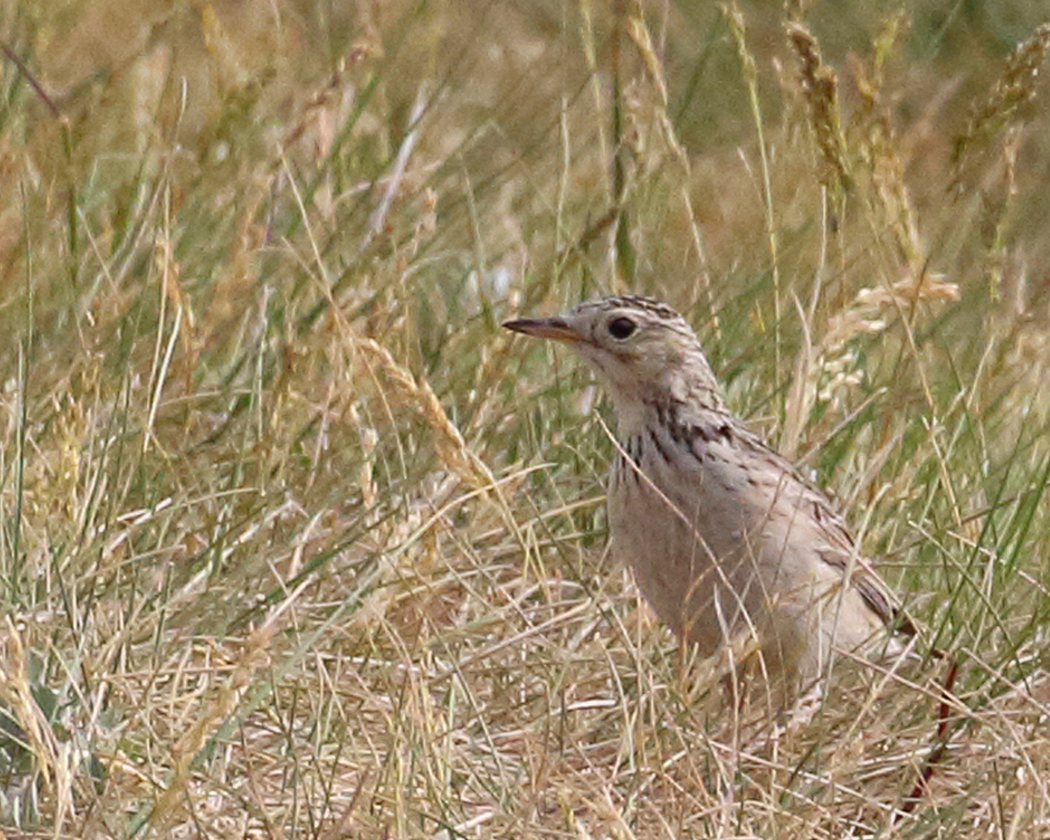
Sprague’s Pipit. This species is known for hovering high in the air while singing a musical, downward swirling song. Photo by Christian Artuso.
Almost all of the remaining native mixed-grass prairie habitat left in Manitoba is privately owned land. Nature Manitoba is one of many conservation groups working with cattle producers and landowners in Manitoba’s southwestern corner to keep this land in grass. Supporting cattle producers and other landowners who have a strong connection to, and depend on healthy mixed-grass prairie for their livelihoods is key to continuing to hold on to this threatened habitat, and the species that call it home.
Nature Manitoba is working with Birds Canada to engage landowners with grassland habitat that would like to keep or restore native mixed-grass prairie on their land. We are especially interested in working with landowners or groups of landowners wish to work together to conserve continuous portions of habitat on working landscapes.
Native mixed-grass prairie habitat in a cattle pasture near Broomhill, MB. Photo by A. Shave.
If you are interested in learning more about opportunities for incentives to keep or improving your grassland please contact Amanda at iba@naturemanitoba.ca or Ian Cook at icook@birdscanada.ca.
Manitoba IBA and Birds Canada have produced several publications to help landowners, cattle producers and conservation groups who are interested in working together to keep land in grass. You can find the links below:
We are so lucky to be right in the middle of the migration path for so many birds! It certainly makes migration season an exciting time of year. I thought we could take a quick fall migration journey with a few of the species that have triggered areas of Manitoba to become IBAs. I have picked just a few examples from different habitats and types of birds, but there are so many others that also go on amazing migratory journeys each year.
You can use eBird.ca to track bird movements as they are sighted by citizen scientists throughout the year. Here I focused on the large picture of fall migration, but you can also zoom in to see specific locations and habitats that birds are using through satellite imagery (assuming the location entered by the observer is precise). You can make you own maps on eBird’s Explore Species Maps. Each image can be clicked to make them full screen for easier viewing.
Chestnut-collard Longspur – Grassland habitat
IBAs: Southwestern Mix-Grass Prairie and Ellis-Archie/ Spyhill
The Chestnut-collard Longspur is a medium distance migrant. The individuals that spend their summers on Manitoba’s southwestern prairie region overwinter in the short-grass prairie and desert grasslands of the southern U.S.A. and northern Mexico. While in the breeding season they nest in pairs, during fall migration and in the nonbreeding season large numbers of individuals will flock together.
Sightings of Chestnut-collared Longspurs in August 2020. eBird.orgSightings of Chestnut-collared Longspurs in September 2020. eBird.orgSightings of Chestnut-collared Longspurs in October 2020. eBird.org
Hudsonian Godwit – Northern Manitoba
IBAs: Nelson River Estuary and Marsh Point and Kaskattama River Mouth
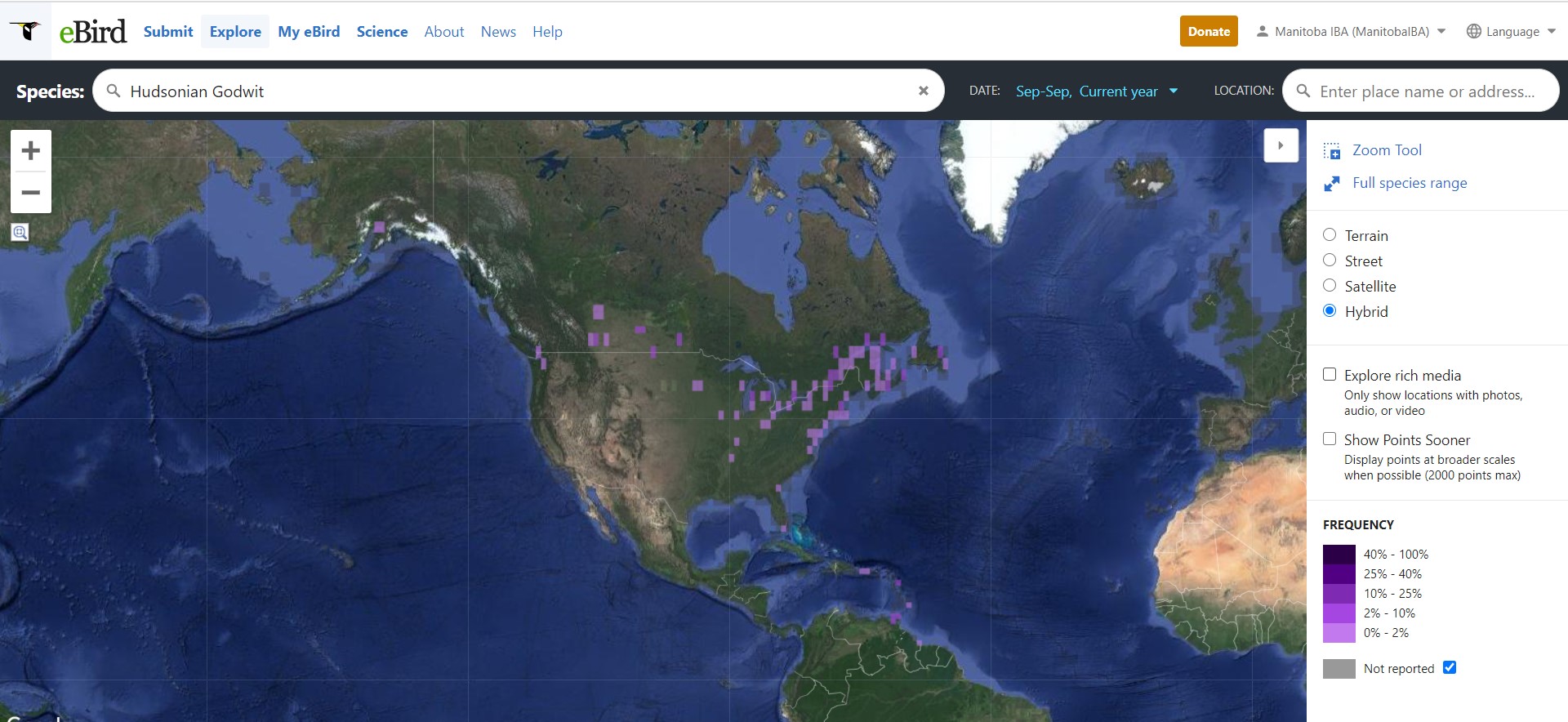
In southern and central Manitoba we generally only see the Hudsonian Godwit as it migrates to its breeding grounds each spring. This makes sense as this Godwit is a long-distance migrant – heading from southern South America to the Arctic breeding grounds each year. We tend not to see Hudsonian Godwits on fall migration because they follow a circular migration route. In the spring they follow a more westerly migration route which can take them over Manitoba, while in the fall they go to eastern North America before heading south. Many shorebirds in the Americas have a similar migration pattern. I spent some time in 2015 volunteering as a bird monitor in the Patagonia region of Argentina, and was lucky enough to see a couple Hudsonian Godwits. It was neat to see a bird that might have migrated over Manitoba so far from home.
Sightings of Hudsonian Godwits in August 2020. eBird.orgSightings of Hudsonian Godwits in September 2020. More sightings occurred in South America as well. eBird.orgSightings of Hudsonian Godwits in October 2020. More sightings occurred in South America as well. eBird.org
Rusty Blackbird
IBAs: Netley-Libau Marsh; Nelson River Estuary and Marsh Point; Churchill and Vicinity; Oak Lake/ Plum Lake; Whitewater Lake; Southwestern Mix-Grass Prairie; Delta Marsh; North, West and East Shoal Lakes; Oak Hammock Marsh, and Riverton Sandy Bar The Rusty Blackbird breeds throughout the boreal region in Canada and Alaska and migrates to spend the winter in the east-central and southeastern U.S.A. In the fall Rusty Blackbirds can be seen mixing with migrants of other blackbird species, as well as American Robins and Blue Jays.
Sightings of Rusty Blackbirds in August 2020. eBird.orgSightings of Rusty Blackbirds in September 2020. eBird.orgSightings of Rusty Blackbirds in October 2020. eBird.org
Red-headed Woodpecker
IBAs: Kinosota/ Leifur and North, West and East Shoal Lakes
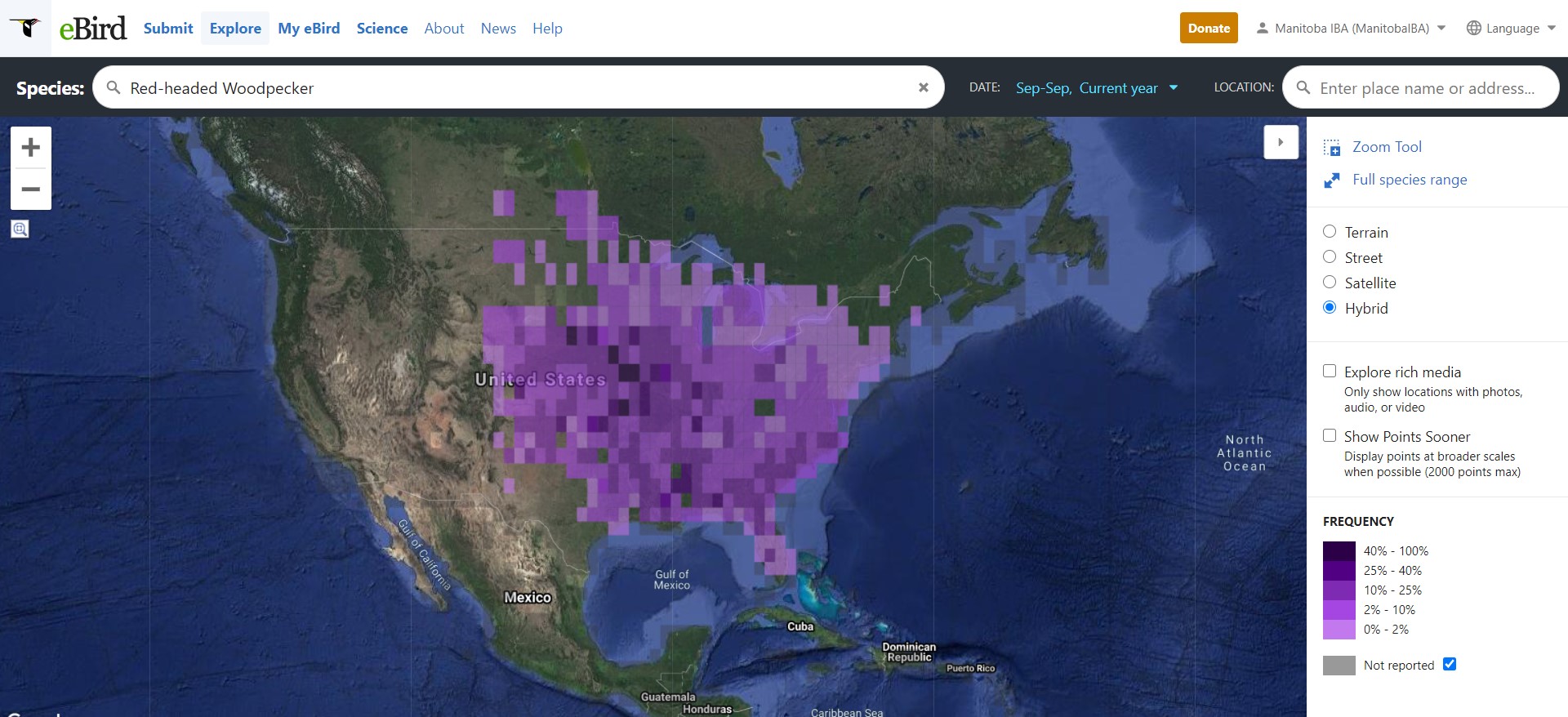
The Red-headed Woodpecker is a short distance migrant. Manitoba is on the northern edge of its breeding range, and we see Red-headed Woodpeckers in the south and central parts of the province. In the winter they make the (comparatively) short journey to central and southeastern U.S.A. The yearly dynamics of the location and timing of fall migration are impacted by the abundance of hard mast (seeds of hardwoods – like Oak with acorns).
Sightings of Red-headed Woodpeckers in August 2020. eBird.orgSightings of Red-headed Woodpeckers in September 2020. eBird.orgSightings of Red-headed Woodpeckers in October 2020. eBird.org
You may have noticed that the four species I’ve chosen to highlight above are federally listed as Species at Risk, and two of them are provincially listed under the Endangered Species and Ecosystems Act. Seeing how ranges shift during, before and after migration really brings home that threats these species face can vary widely. This means cooperation on conservation measures is also imperative between regions, countries and continents that are lucky enough to share these birds.
Amanda, Alyssa and Tim from Manitoba IBA attended Oak Hammock Marsh’s Migration Festival on September 26th, 2020. Despite a wide variety of weather conditions throughout the day, we were happy to lead a couple of shorebird walks and show off the new shorebird scrape.
The day started with Tim Poole (now the chair of the Manitoba IBA Steering Committee) leading a shorebird walk at 8:00am. We had lovely weather for the start – sunny and just a little cool, but perhaps because mother nature knew Tim had to head off at 9:00am, the skies ended our birding walk with a chilly drizzle. Despite the change in weather, we saw good numbers and a good variety of shorebirds. Shorebirds were seen at the front pond, the Coot cell (off of Muskrat Trail), the Teal cell (on the east side the Teal trail) and the shorebird scrape. We had approximately 15 participants on this walk.
For the next shorebird walk at 11:00am I (Amanda) took over as the walk leader. Unfortunately, we had a number of participants cancel due to the poor weather earlier in the morning. However, as the start time came around, there was nothing but blue skies and warming temperatures. A family of four keen birders ended up with a private tour of shorebirds around Oak Hammock!
Alyssa looking at Greater Yellowlegs at the Shorebird Scrape. Copyright A. Shave.
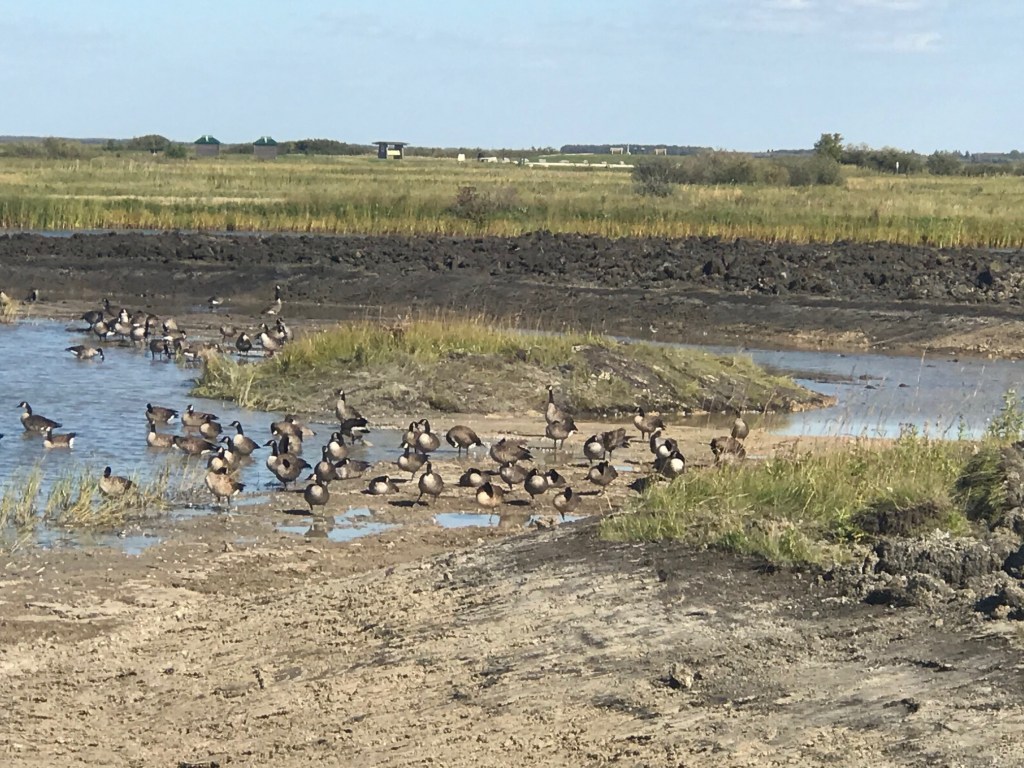
After the bird walks, myself and Alyssa headed out to the shorebird scrape to be Station 6 on Oak Hammock Marsh Interpretive Centre’s Migration Station activity. A variety of groups came to learn more about the scrape throughout the day and take a close up look at the variety of shorebirds, geese and ducks using the scrape and pond. By far the most numerous birds throughout most of the day were Canada Geese and Cackling Geese (hanging out nicely side-by-side for easy comparison), with Greater Yellowlegs being the most numerous shorebird. An interesting part of our time at the scrape was watching several Greater Yellowlegs being harassed by Canada Geese. However, the Yellowlegs were not quite concerned enough to un-tuck their feet so they hopped over on one leg to move away (rather than running or flying – behaviour I have not seen before).
Our bird list for the shorebird scrape around 1:00pm:
Species Name
Count
Snow Goose
3
Cackling Goose
320
Canada Goose
840
Blue-winged Teal
2
Mallard
6
Greater Scaup
1
Bufflehead
1
Common Goldeneye
1
Pied-billed Grebe
1
Pectoral Sandpiper
4
Wilson’s Snipe
1
Greater Yellowlegs
16
Lesser Yellowlegs
5
Franklin’s Gull
15
ZICO Manitoba au Festival des oiseaux migrateurs du Marais Oak Hammock
Amanda, Alyssa et Tim de ZICO Manitoba ont assisté au Festival des oiseaux migrateurs du Marais Oak Hammock le 26 septembre 2020. Malgré les conditions météos changeantes tout au long de la journée, nous avons eu le plaisir d’animer deux promenades d’observation d’oiseaux de rivage et de montrer le nouvel étrépage de limicoles.
La journée a commencé avec Tim Poole (maintenant le président du Comité directeur de ZICO Manitoba) qui a animé une promenade d’observation d’oiseaux de rivage à 8h00. Le temps était beau au début – ensoleillé et frais; mais on aurait dit que Dame Nature savait que Tim devait quitter à 9h00 car la promenade s’est terminée avec une bruine froide. Malgré la météo changeante, nous avons vu un bon nombre et une bonne variété d’oiseaux de rivage. Des limicoles ont été observés à l’étang avant, à la cellule Coot (près du sentier Muskrat), à la cellule Teal (du côté est du sentier Teal) et à l’étrépage de limicoles. Environ 15 personnes ont participé à cette promenade.
Lors de la seconde promenade d’observation d’oiseaux de rivage à 11h00, j’ai pris la relève en tant que guide (Amanda). Malheureusement, plusieurs participants s’étaient désistés suite à la piètre météo plus tôt dans la matinée. À l’heure du départ cependant, le ciel bleu était de retour avec une température à la hausse. Une famille de quatre observateurs d’oiseaux passionnés a donc eu droit à une visite privée des oiseaux de rivage autour d’Oak Hammock!
Alyssa observant un grand chevalier à l’étrépage de limicoles. Droit d’auteur d’A. Shave
Après les promenades, Alyssa et moi-même nous sommes dirigés à l’étrépage de limicoles pour animer l’activité de la 6e des stations des migrations d’oiseaux du Centre d’interprétation du marais Oak Hammock. Des groupes variés sont venus tout au long de la journée pour en apprendre plus au sujet de l’étrépage et pour observer la diversité de limicoles et de la sauvagine fréquentant l’étrépage et l’étang. Les espèces les plus nombreuses pendant la journée étaient de loin les bernaches du Canada et de Hutchins (elles se tenaient gentiment côte à côte pour une comparaison aisée); le grand chevalier était l’espèce limicole la plus nombreuse. Un fait intéressant lors de notre présence à l’étrépage était de voir plusieurs grands chevaliers se faire harceler par des bernaches du Canada. Cependant, les chevaliers ne semblaient pas être suffisamment importunés pour déplier la patte et s’éloignaient en sautillant sur un pied (au lieu de courir ou de s’envoler – un comportement que je n’avais jamais observé auparavant).
Notre liste d’observation d’oiseaux à l’étrépage de limicoles vers 13h00 :
On September 19th volunteers headed to Riverton Sandy Bar IBA for a morning of beautiful fall weather, birding, and weed pulling. Here is a report of the successful day from Alyssa.
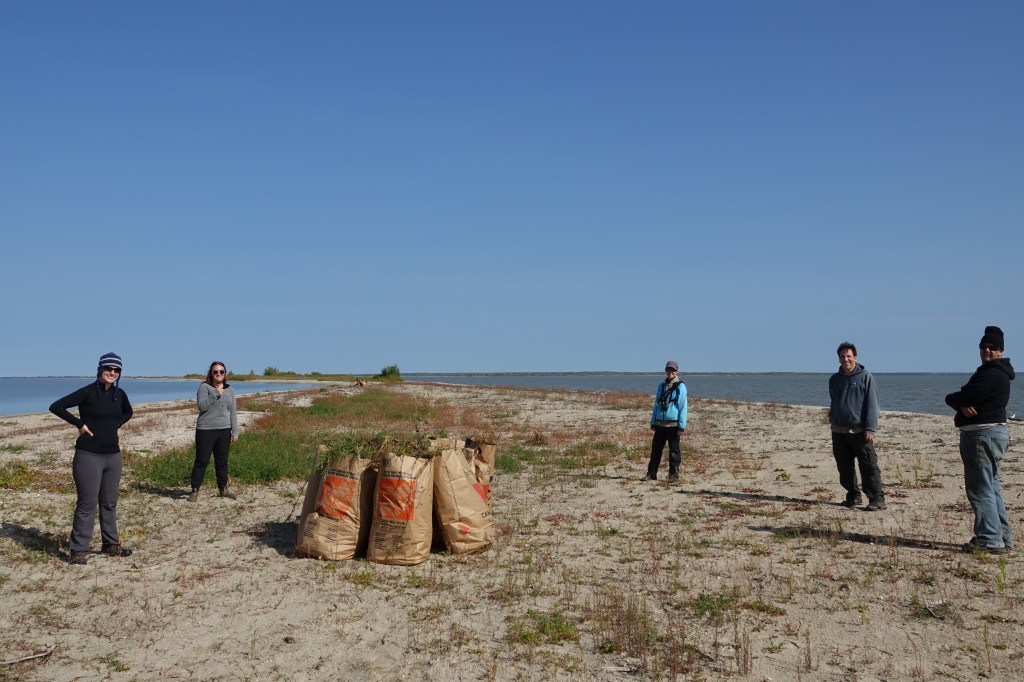
Our socially distanced volunteers with some of our weed pulling bags (other bags off in the distance) at the end of the day. Missing Ann, Jock, Peter and Jessica. Thank you everyone!
The morning started off by sharing coffee and snacks in the parking lot as we waited for everyone to arrive. Amanda, assuming the morning would be chilly, brought more than enough coffee for 10 people. Perhaps it was a ploy to energize the group into weed-pulling machines?!?
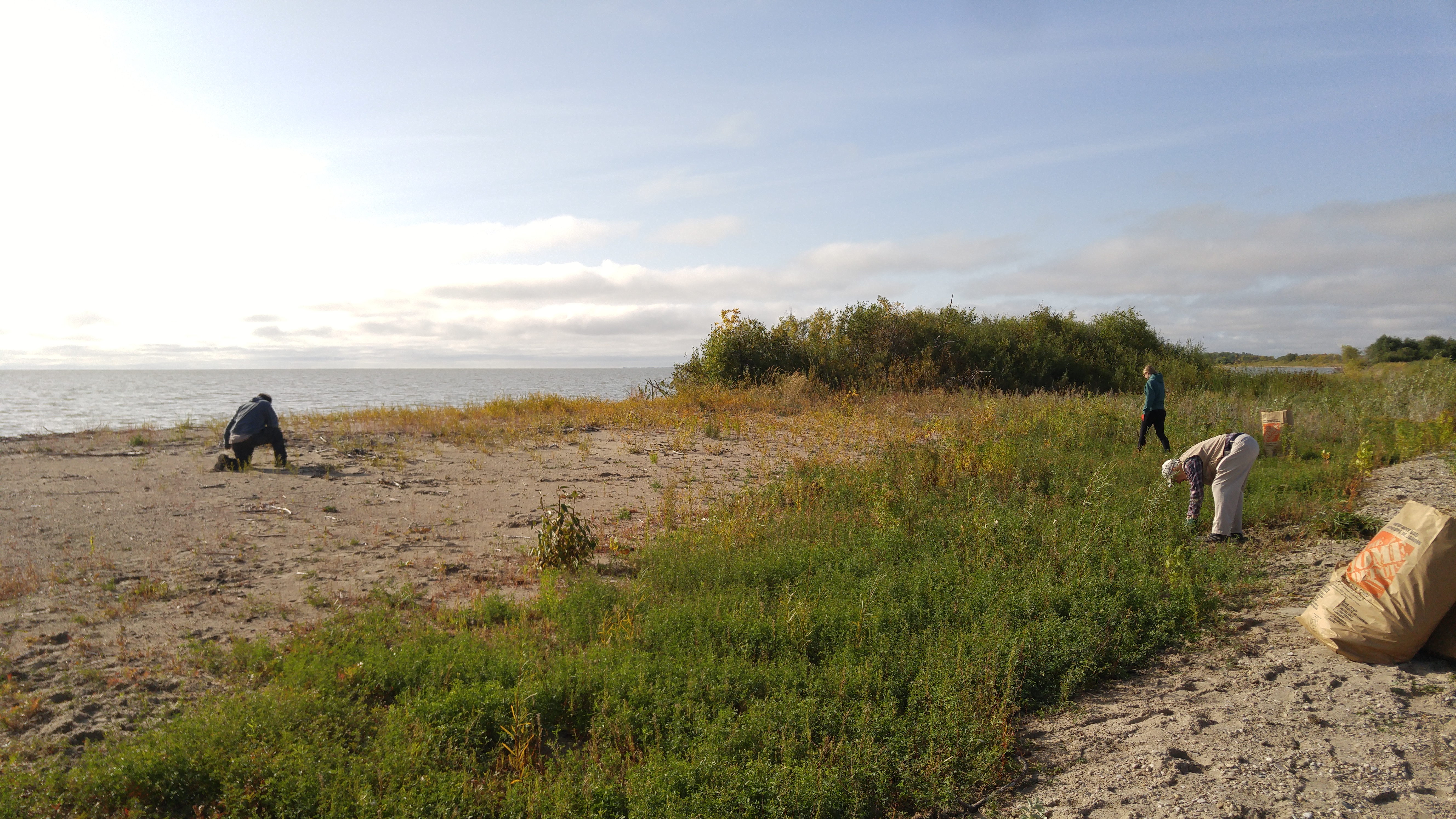
After mingling, we hiked the roughly 1.5km stretch to our destination. The weeds looked green and healthy as ever, even with several days of fall weather already past. The group got to work tackling areas that would be most desirable for nesting shorebird habitat. Clover, Burdock, and silverweed were quite abundant when we arrived (but not when we left!). It is not often that habitat restoration involves removing vegetation from the area, but by removing weeds we hope to improve the habitat to the sandy-beach qualities desired by some species of shorebirds and terns. The Piping Plover, for example, is a species at risk that has historically nested in this IBA. Although this species has not been seen at Sandy Bar since 2004, they nested at an undisclosed location in Manitoba in 2016. Perhaps our continued efforts will aid in its return.
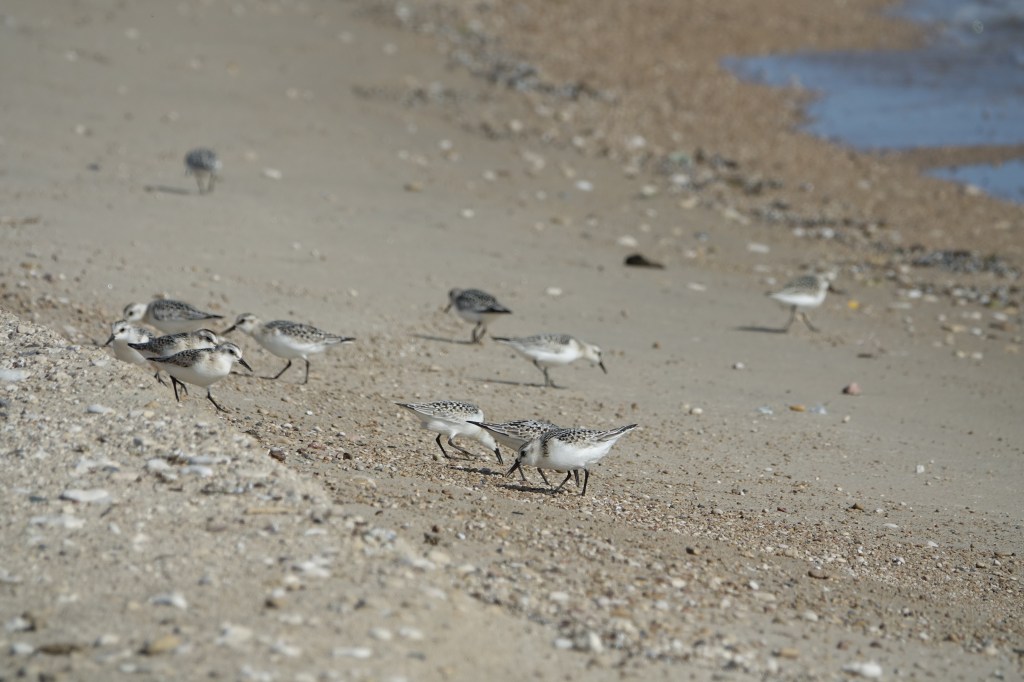
Around noon the team took a well-deserved break and hiked down the spit in search of shorebirds. We saw a variety of shorebirds, waterfowl, and a few other migrants. Yellow-rumped Warblers have clearly started their migration down south, as they were one of the most abundant species recorded for the day (second to over 600 Canada Geese spotted). Some other highlights were a Ross’s Goose and a Greater White-fronted Goose. We were also lucky enough to have about 15 Sanderlings come very close to our group. They were clearly distracted by all the good grub.
As many of you may know, identifying fall shorebirds can be a bit of a challenge. Some birds, however, were quite cooperative and stood side-by-side with other species so we could have a direct comparison. By seeing them side-by side we could see the daintier qualities of a Golden Plover when compared directly with a chunkier Black-bellied Plover, as well as the black “armpit” of the Black-bellied Plover.
Joanne, Christian, Jock and Peter taking in the shorebirds, while on a birding break from weedpulling. Copyright A. Shave
A few folks popped in at different times throughout the day, but overall we had a total of 10 of us pulling weeds. Together we filled just over 20 bags to the brim with tightly packed weeds, which is about two bags a person!
Peter, Christian and Jessica pulling weeds.Lynnea and Adam pulling weeds. Copyright A. Shave.
We would like to give a big thank you to Ann, Jessica, Peter, Jock, Lynnea, Adam, Joanne and Christian for joining us in our weed pull event this year! We are looking forward to holding future weedpull events in 2021, so stay tuned.
Thank you to Christian for providing our species list for the day.
Species Name
Count
Snow Goose
40
Ross’s Goose
1
Greater White-fronted Goose
1
Cackling Goose
2
Canada Goose
650
Mallard
55
Green-winged Teal
4
Ring-necked Duck
2
Horned Grebe
2
Black-bellied Plover
6
American Golden-Plover
12
Semipalmated Plover
2
Sanderling
43
Dunlin
1
Pectoral Sandpiper
2
Greater Yellowlegs
15
Bonaparte’s Gull
16
Ring-billed Gull
50
Herring Gull
50
Double-crested Cormorant
25
American White Pelican
9
American Bittern
1
Bald Eagle
2
Merlin
1
Common Raven
3
Black-capped Chickadee
3
Marsh Wren
1
American Robin
3
American Pipit
30
Lapland Longspur
20
Fox Sparrow
1
Dark-eyed Junco
5
White-crowned Sparrow
2
Harris’s Sparrow
1
White-throated Sparrow
3
Savannah Sparrow
5
Common Grackle
3
Northern Waterthrush
1
Common Yellowthroat
2
Palm Warbler
3
Yellow-rumped Warbler
90
Dans les mauvaises herbes
Le 19 septembre dernier, des bénévoles se sont rendus à la ZICO de Riverton Sandy Bar pour y passer une belle matinée d’automne à observer les oiseaux et à arracher des plantes invasives. Voici le compte rendu d’Alyssa de cette journée bien réussie.
Les bénévoles éloignés socialement avec quelques sacs de mauvaises herbes arrachées (les autres sacs sont en arrière-plan) à la fin de la journée. Il manque Ann, Jock, Peter et Jessica à la photo. Merci à tous!
Le matin a débuté en partageant du café et des collations dans le stationnement pendant que nous attendions que tout le monde arrive. Amanda, supposant que la matinée serait froide, avait amené suffisamment de café pour dix personnes. C’était peut-être une ruse afin d’encourager tout le monde à devenir des machines désherbeuses?!?
Par la suite, nous avons marché les quelques 1,5 km qui nous séparaient de notre destination. Même avec l’automne déjà bien avancé, les plantes invasives semblaient tout aussi vertes et en santé que d’habitude. Le groupe s’est attaqué aux zones qui seraient les plus favorables pour la nidification des limicoles. Les plants de trèfles, de bardanes et de potentilles étaient très abondants à notre arrivée (mais elles ne l’étaient plus à notre départ!). Ce n’est pas à tous les jours que la restauration d’habitat passe par le désherbage d’une région, mais en arrachant ces plantes invasives, nous espérons recréer les plages sablonneuses tant désirées par certaines espèces de limicoles et de sternes. Le pluvier siffleur, par exemple, est une espèce en péril qui nichait historiquement dans cette ZICO. Malgré le fait que cette espèce n’aie pas été vue à Sandy Bar depuis 2004, elle a niché dans un endroit tenu secret au Manitoba en 2016. Nos efforts continus contribueront peut-être à son retour.
Vers midi, l’équipe a pris une pause bien méritée et s’est dirigée vers la langue de sable à la recherche d’oiseaux de rivage. Nous avons observé une grande variété de limicoles, de sauvagine et quelques oiseaux migrateurs. Les parulines à croupion jaune avaient de toute évidence commencé leur migration vers le sud car elles étaient l’une des espèces les plus abondantes de la journée (surpassées seulement par plus de 600 bernaches du Canada). D’autres observations notables étaient celles d’une oie de Ross et d’une oie rieuse. Nous avons eu la chance de voir une quinzaine de bécasseaux sanderling s’aventurer tout près de notre groupe. Ils étaient bien distraits par la bonne bouffe.
Les bécasseaux sanderling étaient trop occupés à chercher de la nourriture pour remarquer notre présence. Droit d’auteur d’A. Shave.
Comme vous le savez, l’identification des limicoles en automne peut être tout un défi. Toutefois, certains oiseaux étaient très coopératifs et se tenaient côte à côte avec d’autres espèces, ce qui nous permettait une comparaison directe. En les voyant ensemble, nous pouvions comparer les traits délicats du pluvier doré avec les traits trapus et les aisselles noires du pluvier argenté.
Joanne, Christian, Jock et Peter profitant des limicoles lors d’une pause du désherbage. Droit d’auteur d’A. Shave
Des personnes sont arrivées à différents temps tout au long de la journée, pour un total de 10 désherbeurs. Ensemble nous avons bien rempli un peu plus de 20 sacs de mauvaises herbes, soit environ deux sacs par personne!
Peter, Christian et Jessica arrachant des plantes invasives. Droit d’auteur d’A. ShaveLynnea et Adam arrachant des plantes invasives. Droit d’auteur d’A. Shave
Nous aimerions remercier Anne, Jessica, Peter, Jock, Lynnea, Adam, Joanne et Christian pour s’être joints à notre événement de désherbage annuel! Nous avons hâte à nos futurs événements de désherbage en 2021, donc restez à l’écoute.
Merci à Christian pour la liste des espèces de la journée.
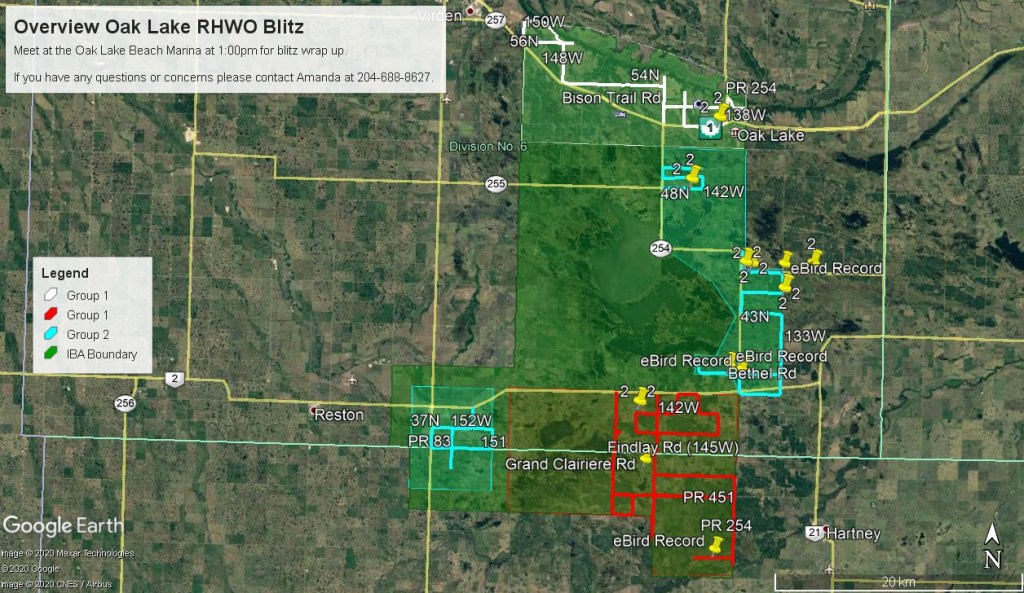
On August 15th we had our second IBA Blitz of the year. Volunteers travelled out to the Oak Lake/ Plum Lakes IBA in search of Red-headed Wooodpeckers.
The day started off early for several volunteers making the trip from Winnipeg to Virden area! We also had a couple of volunteers from the Brandon area join us in surveying a large section of the IBA. The weather started out wonderful for birding – we avoided the early morning rain as well as the strong afternoon winds! Our volunteers split into 3 groups for the day so that we could cover the largest area possible.
Group 1 comprised of the IBA staff (Amanda, Nate and Alyssa). We had a blackbird-happy day and our species with the highest counts were Red-winged Blackbirds, Common Grackles, Brown-headed Cowbirds, and Yellow-headed Blackbirds. We also saw 9 Eastern Wood-Pewees throughout the day.
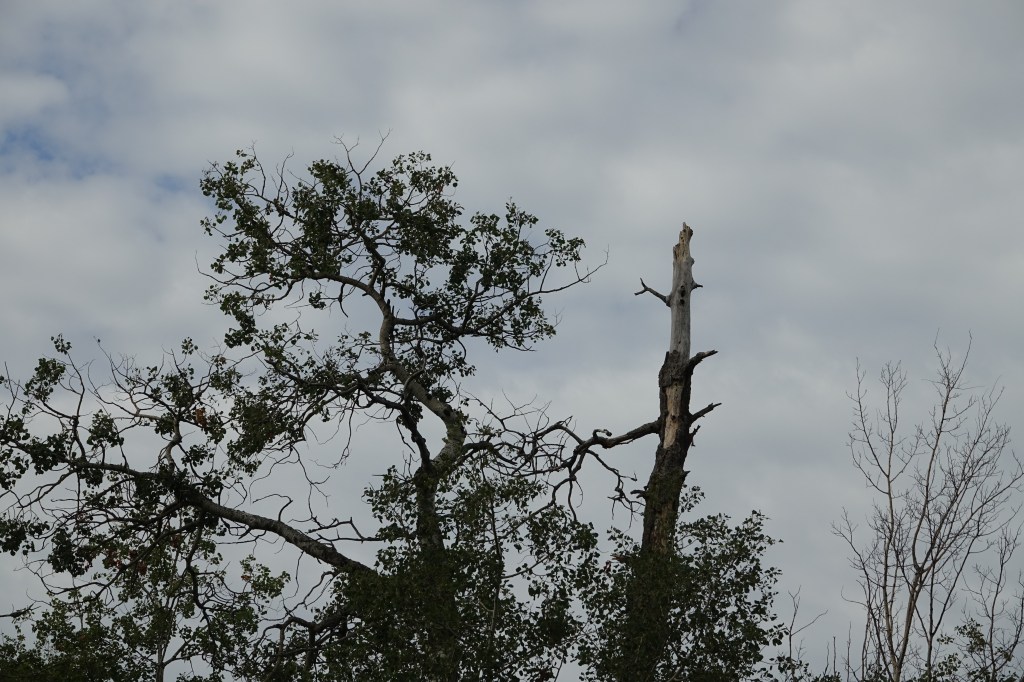
There was a Red-headed Woodpecker here a minute ago! Habitat where Group 1 saw an adult and juvenile Red-headed Woodpecker. Copyright A. Shave.
Group 2 included Gillian, Roger and Heather. Group 2 became our most successful “shorebirders” of the day and saw many Lesser Yellowlegs, Red-necked Grebes, Marbled Godwits, and Stilt Sandpipers. They were also lucky enough to see several White-faced Ibises. They saw our most abundant species of the day - Franklin’s Gulls – with a count of around 2000 individuals!
Group 3 included Glennis, Cam, Paul and Lynn. Group 3 saw a large flock of nearly 30 Cedar Waxwings. Other exciting finds were a Broad-winged Hawk, Purple Martins, and a pair of Lark Sparrows.
And now on to the the Red-headed Woodpeckers! Group 2 saw the largest number of Red-headed Woodpeckers by far, with a total of nine seen, all in or around sites that were identified by blitz volunteers last year. Group 1 saw two Red-header Woodpeckers (an adult and a juvenile) together, also hanging out in an area where they had been previously seen. Despite driving through what we would expect to be good Red-headed Woodpecker habitat, Group 3 did not see any of the species. The area Group 3 was surveying was new to our Red-headed Woodpecker Blitz this year, and we now have valuable ground truthing of the possible habitat north of the Trans-Canada Highway in the Oak Lake IBA. All together we found Red-headed Woodpeckers at 6 points within the IBA and possible breeding pairs were detected at 4 points. We had a total count of 10 adults and 1 juvenile for the day.
To everyone who came out thanks for the great day and all your hard work! Collectively we saw 73 species and 3182 individual birds! Our full species list is below.
Exciting news came out of Oak Hammock Marsh last week with the construction finishing on Manitoba’s first shorebird scrape at the Wildlife Management Area.
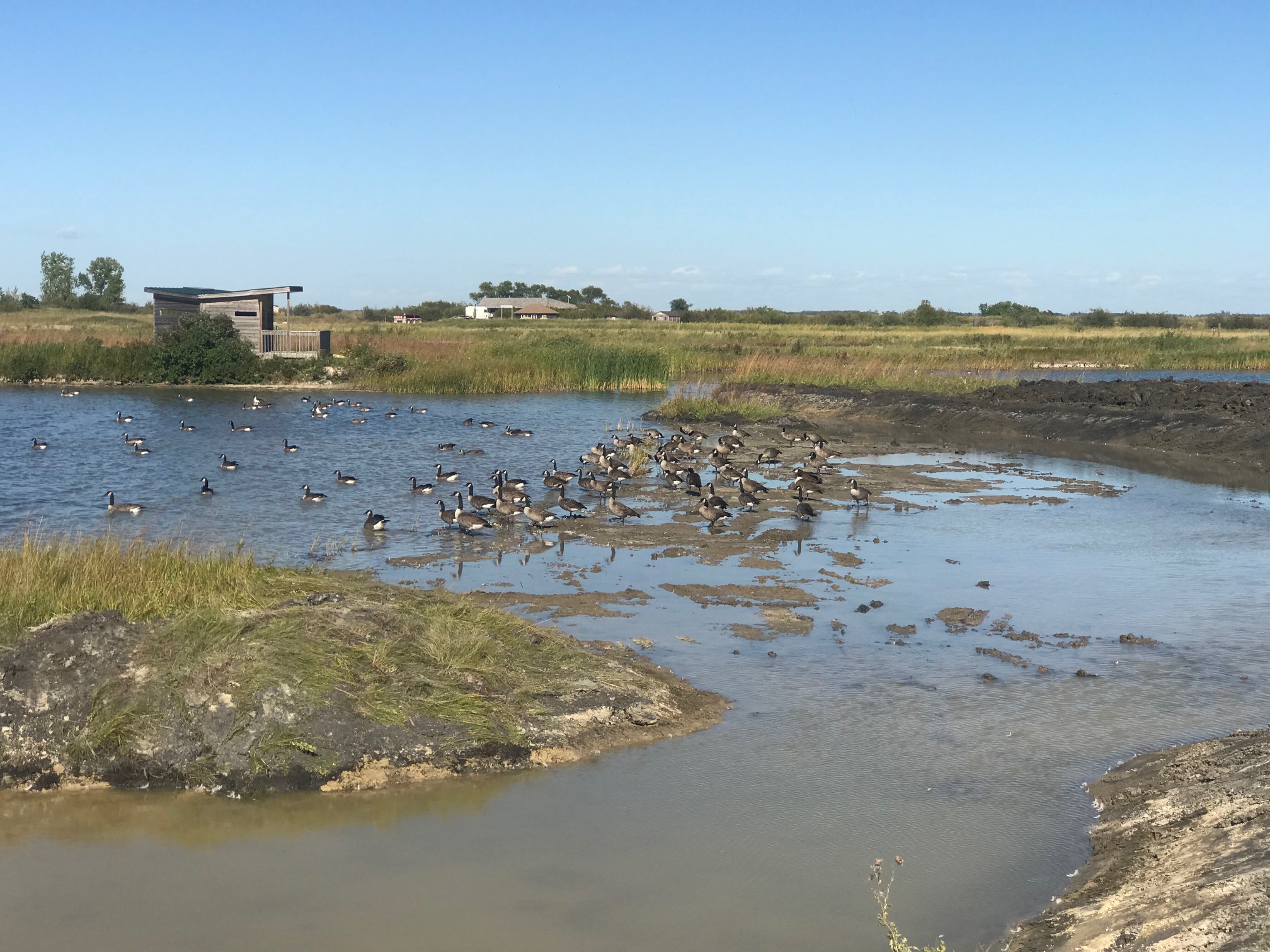
The new shorebird scrape as seen from PR 220. Copyright C. Heald.
What is a scrape you might ask? It is a conservation tool that benefits many species, including shorebirds. A shallow depression is dug into the ground, and this depression is seasonally fed with water. Generally the scrape is wetter in the spring, due to spring rains and drier in the autumn. The shallow depression leads to shallow water, providing good habitat for aquatic invertebrates, and the various animals that feed on them (such as ducks, geese, shorebirds, and amphibians).
Canada Geese enjoying the shorebird scrape. Copyright C. Heald.
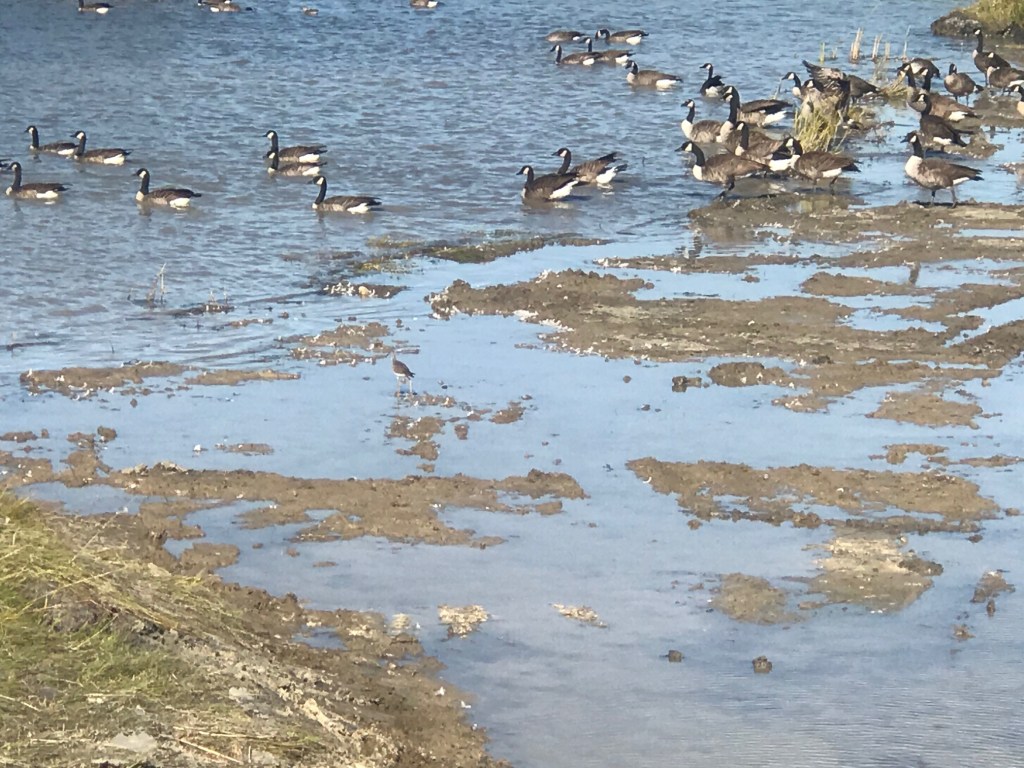
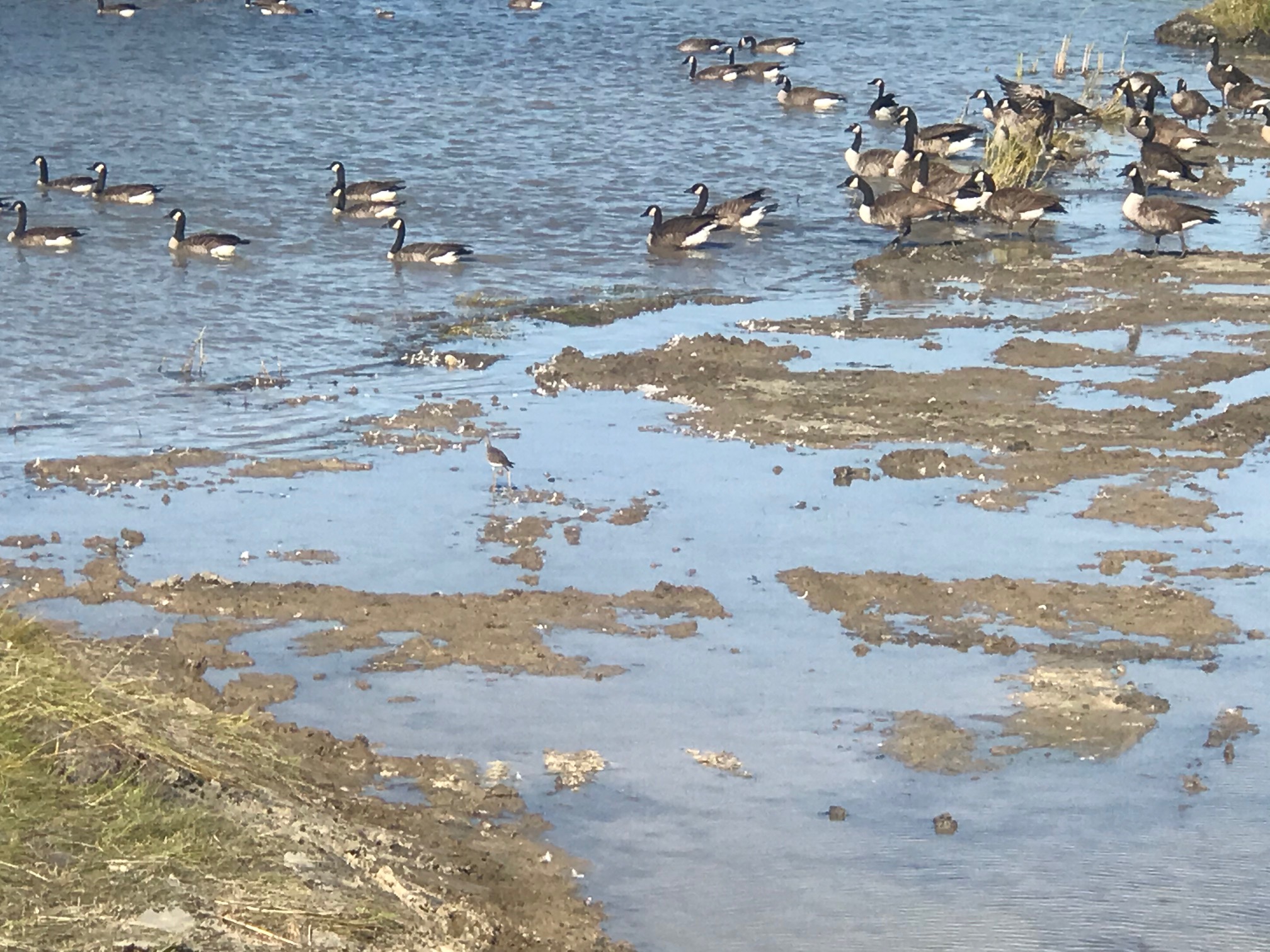
Scrapes are a common conservation tool in Europe, but less commonly employed in North America. Luckily, so far we seem to have a successful scrape, with a Lesser Yellowlegs spotted in a photo only two hours of the scrape being completed.
Can you spot the first shorebird visitor to to shorebird scrape? Copyright C. Heald.
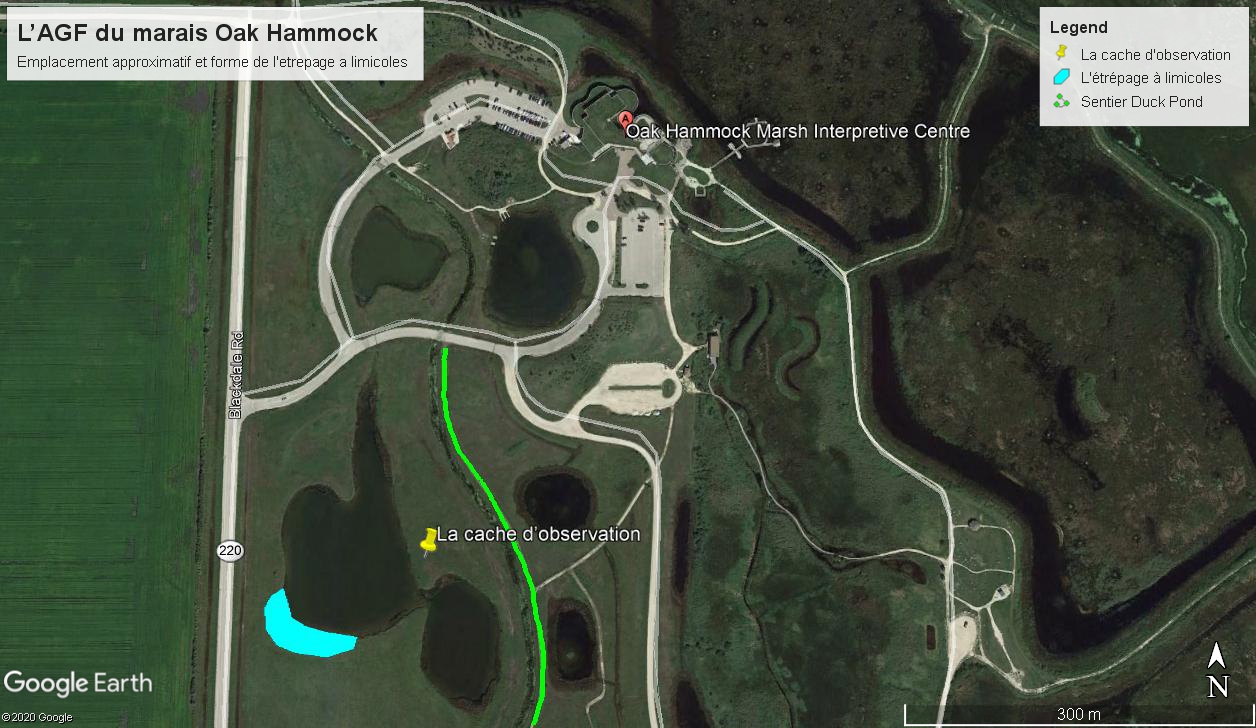
If you are interested in visiting the shorebird scrape, you can find it on the southern edge of the pond closest to Provincial Road 220. It is visible from PR 220 or from Duck Pond Trail (with a viewing blind). Manitoba IBA will be at Oak Hammock Marsh Interpretive Centre’s Migration Festival on September 26th with spotting scopes, if you are interested in seeing what is out on the scrape. Manitoba IBA would also love to feature photos and bird lists of shorebirds (and other birds!) using the scrape, you can send them to iba@naturemanitoba.ca. There is also a new hotspot set up for the Oak Hammock Marsh – Shorebird Scrape on eBird to help us keep track of species using the scrape (versus the marsh as a whole).
Location of the shorebird scrape at Oak Hammock Marsh WMA
The Shorebird Scrape would not have been possible without funding and support from The Conservation Trust, Nature Manitoba, Province of Manitoba and Oak Hammock Marsh Interpretive Centre.
Le premier étrépage de limicoles du Manitoba
La semaine passée, le marais Oak Hammock était heureux d’annoncer la fin de la construction du premier étrépage de limicoles sur son Aire de gestion de la faune au Manitoba.
Le nouvel étrépage de limicoles, vu de la Route provinciale 220. Droit d’auteur de C. Heald
Vous vous demandez peut-être ce qu’est un étrépage? C’est un outil de conservation qui profite à plusieurs espèces, limicoles inclus. Une dépression peu profonde et creusée dans le sol, et cette dépression est alimentée en eau selon les saisons. Règle générale, l’étrépage est plus humide au printemps, à cause des pluies printanières, et plus sec à l’automne. La faible dépression contient une eau peu profonde, et fournit un bon habitat aux invertébrés aquatiques, puis aux divers animaux s’en nourrissant (tels les limicoles et les amphibiens).
Des bernaches du Canada profitent de l’étrépage de limicole. Droit d’auteur de C. Heald.
Les étrépages sont un outil de conservation commun en Europe, mais ils sont utilisés moins fréquemment en Amérique du Nord. Heureusement, notre étrépage semble déjà porter fruit, avec l’observation d’un petit chevalier deux heures seulement après la complétion de l’étrépage.
Pouvez-vous repérer le premier oiseau de rivage à l’étrépage de limicoles? Droit d’auteur de C. Heald.
Si vous voulez visiter l’étrépage à limicoles, vous pouvez le trouver au sud de l’étang le plus près de la route provinciale 220. Il est visible depuis la RP 220 ou du sentier Duck Pond (depuis la cache d’observation). ZICO Manitoba sera présent à la Journée des oiseaux migrateurs du Centre d’interprétation du marais Oak Hammock du 26 septembre et aura des lunettes d’observation disponibles pour les personnes intéressées à découvrir les secrets de l’étrépage. ZICO Manitoba aimerait aussi publier des photos et des listes d’observation de limicoles (et des oiseaux en général) qui fréquente l’étrépage; vous pouvez les envoyer par courriel à iba@naturemanitoba.ca. Il y a également un nouveau site public d’observation de l’étrépage avec eBird, « Oak Hammock Marsh – Shorebird Scrape », qui nous permettra de faire le suivi des espèces utilisant l’étrépage (versus le marais dans son entier).
Site de l’étrépage de limicoles de l’AGF du marais Oak Hammock
L’étrépage de limicoles n’aurait pu être réalisé sans l’aide financière et l’appui de The Conservation Trust, de Nature Manitoba, de la Province du Manitoba et du Centre d’interprétation du marais Oak Hammock.




















 Manitoba Important Bird Areas Program