Boundary Changes

If anyone out there is interested in the trifling small details of IBA boundaries, you will surely enjoy our new boundary for the Southwestern Mixed-grass Prairie IBA.

SW Mixed-grass IBA boundary change

Spot the difference. The green areas on the maps refer to areas of grassland. As you can see, there is a large section of grassland missing from the IBA in the southeast corner. This is the area known as the Blind Souris.

The changes were made to include the native prairies around the Blind Souris in the IBA boundary which were omitted originally. The Blind Souris has excellent habitat for grassland specialist birds including Ferruginous Hawk, Chestnut-collared Longspur and Sprague’s Pipit. This is not just a place for threatened birds, it also provides habitat for endangered plants, including some of the best remaining areas of Buffalograss in Manitoba (More info here).

We do not take boundary changes lightly and will only change them when there is a clear biological justification – we’re not politicians looking for electoral advantage after all!

This may not be the last word on this topic but for the meantime thanks to Andrew and Mike from Bird Studies Canada for acting on this.

Shoal Lakes IBA Blitz halftime scores

As we have a 2nd blitz on the 3rd October at the North, West and East Shoal Lakes IBA it is effectively halftime. Now everyone has been able to submit their complete checklists for the day I thought it would be fun to post the numbers of birds counted on August 29th. So here goes:

SPECIES TOTAL
Canada Goose 535
Cackling/Canada Goose 5
Trumpeter Swan 2
Wood Duck 8
Gadwall 52
American Wigeon 24
American Black Duck 2
Mallard 866
Blue-winged Teal 1024
Northern Shoveler 107
Northern Pintail 94
Green-winged Teal 57
teal sp. (Anas sp. (teal sp.)) 44
dabbling duck sp. (Anas sp.) 7
Canvasback 114
Redhead 97
Ring-necked Duck 73
Lesser Scaup 6
White-winged Scoter 8
Scoter sp 6
Bufflehead 12
Common Goldeneye 90
Hooded Merganser 26
Ruddy Duck 45
duck sp. (Anatinae sp.) 153
Pied-billed Grebe 183
Red-necked Grebe 53
Double-crested Cormorant 105
American White Pelican 183
Least Bittern 1
American Bittern 11
Great Blue Heron 23
Great Egret 96
Black-crowned Night-Heron 2
Turkey Vulture 1
Northern Harrier 29
Sharp-shinned Hawk 2
Cooper’s Hawk 2
Bald Eagle 55
Red-tailed Hawk 10
Yellow Rail 1
Virginia Rail 25
Sora 94
American Coot 1282
Sandhill Crane 41
Semipalmated Plover 43
Killdeer 91
Spotted Sandpiper 2
Solitary Sandpiper 3
Greater Yellowlegs 227
Willet 3
Lesser Yellowlegs 124
Greater/Lesser Yellowlegs 2
Marbled Godwit 4
Stilt Sandpiper 10
Baird’s Sandpiper 9
Least Sandpiper 9
Pectoral Sandpiper 5
Semipalmated Sandpiper 14
peep sp. (Calidris sp. (peep sp.) 5
Long-billed Dowitcher 1
Wilson’s Snipe 51
Red-necked Phalarope 2
shorebird sp. (Charadriiformes sp.) 15
Bonaparte’s Gull 227
Franklin’s Gull 1
Ring-billed Gull 155
Herring Gull 5
gull sp. (Larinae sp.) 10
Caspian Tern 18
Black Tern 57
Common Tern 105
Forster’s Tern 266
tern sp. (Sterninae sp.) 5
Mourning Dove 5
Ruby-throated Hummingbird 3
Belted Kingfisher 15
Red-headed Woodpecker 3
Yellow-bellied Sapsucker 2
Downy Woodpecker 7
Hairy Woodpecker 4
Northern Flicker 34
Pileated Woodpecker 3
American Kestrel 7
Merlin 10
Eastern Wood-Pewee 3
Yellow-bellied Flycatcher 1
Least Flycatcher 11
Eastern Phoebe 7
Great Crested Flycatcher 3
Eastern kingbird 6
Yellow-throated Vireo 4
Warbling Vireo 5
Red-eyed Vireo 9
Philadelphia Vireo 1
Blue Jay 11
Black-billed Magpie 12
American Crow 17
Common Raven 35
Tree Swallow 23
Barn Swallow 258
Black-capped Chickadee 27
White-breasted Nuthatch 4
House Wren 3
Sedge Wren 6
Marsh Wren 125
Eastern Bluebird 7
American Robin 14
Gray Catbird 16
European Starling 127
American Pipit 1
Cedar Waxwing 59
Bohemian/Cedar Waxwing 1
Northern Waterthrush 56
Black-and-white Warbler 3
Tennessee Warbler 13
Nashville Warbler 2
Common Yellowthroat 111
American Redstart 8
Magnolia Warbler 1
Yellow Warbler 16
Chestnut-sided Warbler 1
Palm Warbler 1
Yellow-rumped Warbler 3
Wilson’s Warbler 1
Chipping Sparrow 4
Clay-colored Sparrow 17
Vesper Sparrow 5
White-throated Sparrow 5
Savannah Sparrow 35
Le Conte’s Sparrow 4
Song Sparrow 48
Swamp Sparrow 36
Rose-breasted Grosbeak 2
Red-winged Blackbird 168
Yellow-headed Blackbird 236
Common Grackle 25
Blackbird sp. 10
Baltimore Oriole 2
Purple Finch 2
American Goldfinch 47
TOTAL 8876

So there we go, after the 1st blitz, the most numerous species is the American Coot at 1282 individuals followed by Blue-winged Teal and the trusty Mallards and a total of 132 species. It will be interesting to see how numbers change next month. We would probably expect fewer species but with more sparrows and very few, if any warblers still around. Canada Goose might possibly be expected to be the most abundant species and the numbers of shorebirds will also likely have fallen. All will be revealed on this site after the blitz and we can compare the changes in species types and abundance then.

All in all something to look forward to on October 3rd!

Misty beginnings to the Shoal Lakes IBA Bird Blitz

Saturday 29th August 2015 was our first bird migration blitz at the North, West and East Shoal Lakes IBA. 14 people made their way from WInnipeg, Gimli and further afield to take part. Tim Poole shares some memories and photos from the mornings birding. 

A perfect morning for counting birds. Photo copyright Garry Budyk

Mist. Oh dear! Not the most auspicious start to the mornings birding activities. Surely things will improve soon?

Driving along West Shoal Lake, the mist hovering over the water, a Belted Kingfisher flies across the front and as the organizer, I am getting a wee bit concerned. Soon Garry Budyk and John Weier will be here to start counting and I haven’t got a didgeridoo (clue) how things are going to go. Apparently it took about an hour after our 7am start for Garry and John to get going. But things did improve (as evidenced below).

IBA6583_webj2

John Weier thinking of lunch? Photo copyright Garry Budyk

John and Garry would eventually be able to count good numbers or birds. in fact they managed to record 78 species and almost 1600 individuals. The section of West Shoal Lakes is a fantastic place for seeing ducks and shorebirds, even more-so in spring than fall.

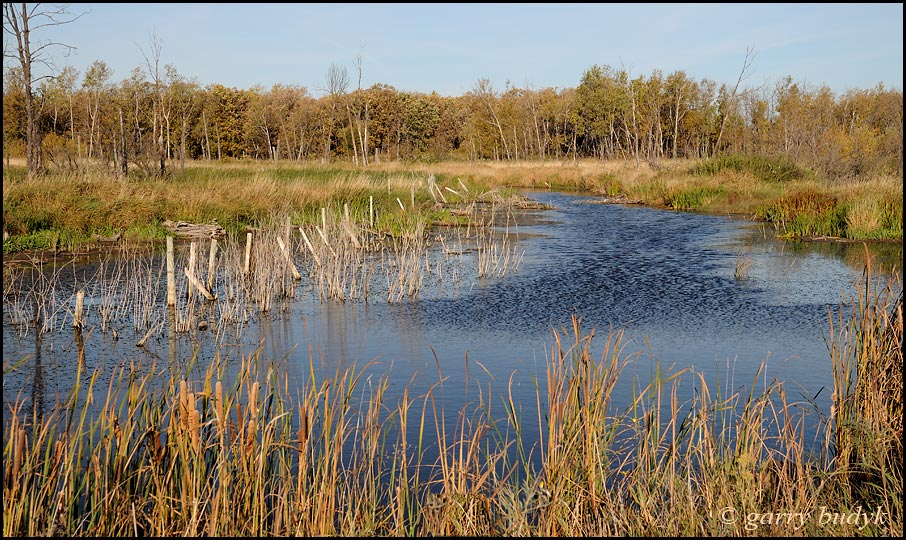
Good duck habitat. Note the trees at the back of the photo. This is the boundary of the lake when water levels were a wee bit lower. Photo copyright Garry Budyk.

Good duck habitat. Note the trees at the back of the photo. This is the boundary of the lake when water levels were a wee bit lower. Photo copyright Garry Budyk.

The IBA was split into 7 survey sections, 4 to be accessed by vehicle, 1 by boat and 2 on foot.

The IBA was split into 7 survey sections, 4 to be accessed by vehicle, 1 by boat and 2 on foot.

14 people scattered in cars, foot, even a boat across the area. Optics galore and (from the evidence of the photos here), some rather good photographic gear. For anyone unfamiliar with the area, the Shoal Lakes IBA is in the Interlake area near Inwood. Originally this was a great place for Piping Plover but high water levels make it currently unsuitable for these rare birds. instead there are waterfowl aplenty, blackbirds, shorebirds and even the occasional Least Bittern (see here). Donna Martin is caretaker for this IBA and was also responsible for gaining the two donations which are funding these fall blitzes. Beforehand the big job was to recruit volunteers and provide maps of the survey sections which you can see to the left.

Donna was teamed up with Ray Methot and covered the north and west sides of North Shoal Lake. There were a fair few shorebirds in the area and another Least Bittern darted away.

I dropped Matt Gasner in rubber boots to walk across the washed out parts of Provincial Road 415, where he would meet Christian Artuso halfway. The following photos and captions are all from Christian and along with the captions tell the story of their birding highlights and endeavors along the flooded highway.

Common Yellowthroat_9566_artuso

Common Yellowthroat: There were many migratory warblers counted, presumably some migrants mixed with local-born Common Yellowthroats in the 54 I counted (before I joined up with Matt and there were many more after that).

Greater Yellowlegs_9667_Artuso

Greater Yellowlegs: we are deeply grateful to team yellowlegs for assisting in assessing the depth of water over the flooded road! No incidents occurred, other than a few wet pairs of socks.

Virginia Rail_9426_juv_Artuso

One of 18 Virginia rails seen or heard, including many juveniles

Sora_9766_juv_artuso

One of 51 Soras seen or heard, including many juveniles trotting about in the open (plus more after I joined up with Matt)

Northern Waterthrush_9600_artuso

The marsh seemed to be teeming with Northern Waterthrushes (this is one of 38 I counted by myself plus more again after I joined up with Matt)

Matt Gasner surveying IBA_9758

Matt Gasner counting egrets, waterfowl and shorebirds along the flooded PR 415

While Christian and Matt were wading across an old highway, I was exploring another nearby road which might disappear at any moment. Needless to say, the mist reappeared before the road disappeared! I did manage one major achievemnet; that of getting the wettest feet of the day while trying to wade across a flooded section of road. I still managed to find 419 American Coots and 400+ ducks in the surrounding wetlands. Unbelievably, even though I eventually waded to the lake shore, I failed to enter the IBA! Later I would meet up with Christian and Matt counting another section with Semipalmated Plovers (37), Semipalmated Sandpiper (3), Least Sandpiper (2) and a single calling Long-billed Dowitcher.

While all this was going on, we had Bonnie Chartier roaming East Shoal Lake with Cam Meuckon from Manitoba Conservation on a boat. Special thanks to Cam for offering his time and the boat for the morning. Birding highlight? Scoters, ’nuff’ said!

Map of Cam's and Bonnie's route. Note how they seemed to spend most of their 'boat trip' on land especially to the north and east! This goes to show how much greater the water levels are now compared to where they were in the past.

Map of Cam’s and Bonnie’s route. Note how they seemed to spend most of their ‘boat trip’ on land especially to the north and east! This goes to show how much greater the water levels are now compared to where they were in the past.

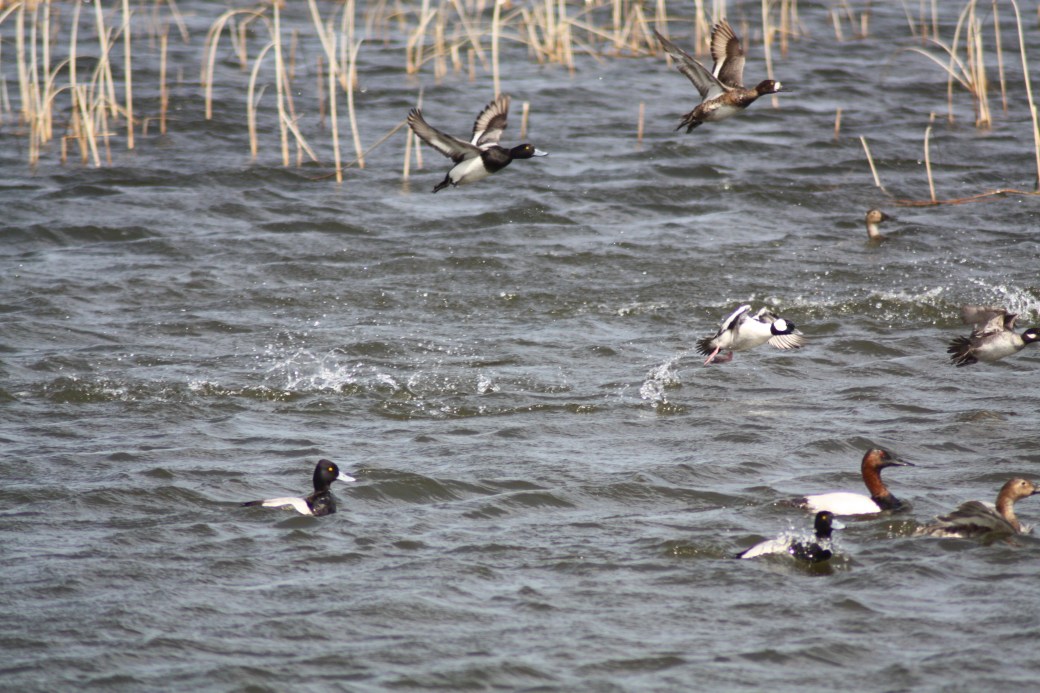
Joanne Smith, Bill Rideout and Peter Douglas surveyed the eastern side of North Shoal Lake. They had the distinction of seeing a rather special couple of waterbirds….

Yes, that's right Trumpeter Swans. No, er, Tundra Swans, er, Tumpeter or is Trundra Swans? Ok, final they were Trumpeter Swans. Note the size difference with the adjacent Canada Geese, the long straight beak and lack of yellow on the lores below the eye. Photo copyright Bill Rideout

Yes, that’s right Trumpeter Swans. No, er, Tundra Swans, er, Tumpeter or is it Trundra Swans? Ok, they were Trumpeter Swans. Note the size difference with the adjacent Canada Geese, the long straight beak and lack of yellow on the lores below the eye. Photo copyright Bill Rideout

Apparently these guys must have started really early judging by this photo of the moon.

Bit ate for Yellow Rail surveys? Photo copyright Bill Rideout

August is not known as a good time to do nocturnal owl surveys but that didn’t stop our intrepid surveyors from trying. Photo copyright Bill Rideout

One nameless member of the group spotted a Big Black Bear (new acronym BBB). Stoooooooooooooooooooop’ he/she yelled, ‘I see a bear’. The other group members turn to look but only see a field of cows. Admit it, we’ve all managed to confuse a cow and a bear!

BBB doesn’t just mean big black bear according to this group. It also means, big black blob (whatever that is) and big black bird (presumably the one below).
Big black bird aka Common Raven. Photo copyright Bill Rideout

Big black bird aka Common Raven. Photo copyright Bill Rideout

Again there were hosts of birds and much confusion to be found; yellowlegs, terns, ravens and warblers among a host of others.

Bill claims that he would have 'bet the farm' on his identification of this Cooper's Hawk. Er, it's a Merlin. Photo copyright Bill Rideout

Bill claims that he would have ‘bet the farm’ on his identification of this Cooper’s Hawk. Er, it’s a Merlin. Photo copyright Bill Rideout

Yellow Warbler hiding in the bushes. Photo copyright Bill Rideout.

A Yellow Warbler with half a face. Photo copyright Bill Rideout.

Greater Yellowlegs

Greater Yellowlegs and the close resembling Lesser Yellowlegs were the most abundant shorebird on the day. Photo copyright Bill Rideout.

Forester's Tern

Unfortunately this Forster’s Tern is displaying winter plumage. Is it trying to tell us something? Photo copyright Bill Rideout

Bonaparte's Gull

Bonaparte’s Gull were the more numerous gull species on the day. The prairie breeding Franklin’s Gulls have long left leaving more northern breeding gulls in their stead. Photo copyright Bill Rideout.

Belted Kingfisher

Everyone loves a kingfisher! Photo copyright Bill Rideout

Another fantastic shot showing the eerie damp, misty start to the day. Photo copyright Jo Swartz

Another fantastic shot showing the eerie damp, misty start to the day. Photo copyright Jo Swartz

Jo Swartz, Liis Veelma and Betsy Thorsteinson were our East Shoal Lake road team. They managed to achieve another birding highlight by hearing the secretive Yellow Rail calling very early on. Other birding highlights were Pectoral Sandpiper and American Pipit, the only group to locate these species on the blitz. I should apologise for sending this group up some pretty ropey roads looking for access points to the southern end of the lakes. Sorry!

Just before 1pm, a trail of us began to turn up at Rosie’s Cafe in Inwood for a late breakfast/brunch/lunch to share experiences and locations for a couple of species (the Trumpeter Swans were certainly revisited).

Thanks to everyone mentioned above for giving up your weekend to help out. The next blitz is on Saturday October 3rd. If you are interested in coming along for the ride please let me know at iba@naturemanitoba.ca.

Southwestern Manitoba IBA blitz, the last article I promise

We were obviously very happy with our efforts in Southwestern Manitoba earlier this summer. After a bountiful number of blogs, Facebook and forum posts we have also managed to make the front cover of the latest newsletter from Nature Manitoba. So click here to read the last article from the summers adventure. I promise.

Of course, after Saturday we will turn our attention to bountiful articles and blogs describing our Shoal Lake Bird Blitz.

Post Banana Split IBA visits

Tim Poole, Manitoba IBA Coordinator, gives us the rundown on happenings post Melita Banana Day.

Once the banana split had been consumed, the table put away, what else could we do but find some birds! There are 2 IBA’s in this part of southwestern Manitoba, one being the grassland IBA which includes the town of Melita and the other is the famous birding hotspot at Whitewater Lake.

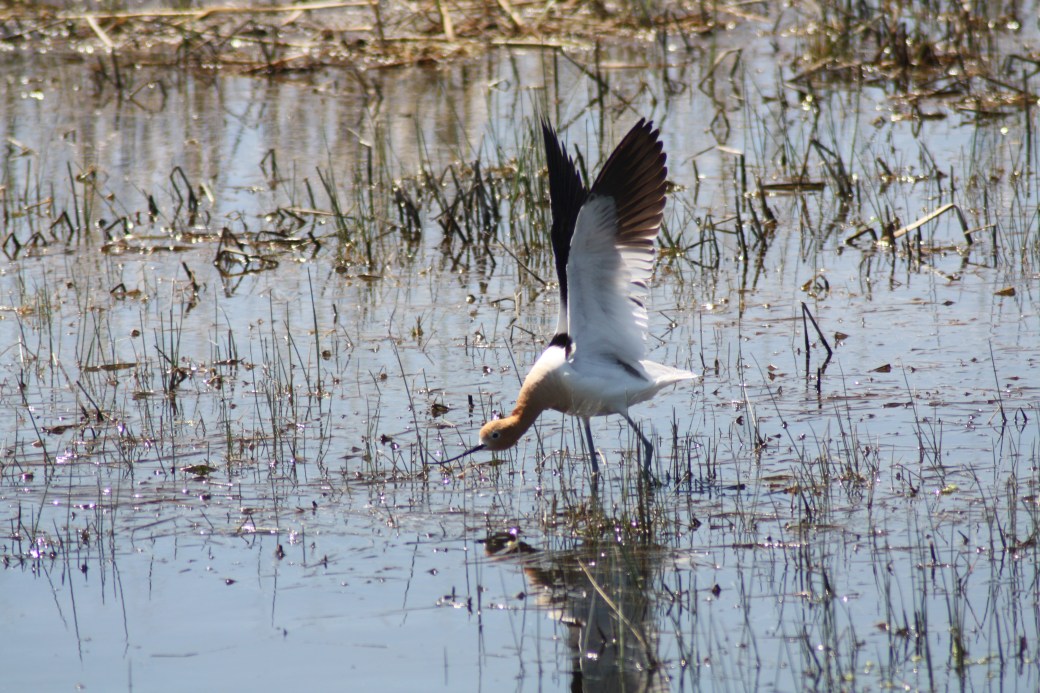
At this junction it is worth noting that the Southwestern Mixed-grass Prairie IBA is also a great place for migrating wetland birds. It is after all part of the prairie potholes region of Manitoba with abundant small wetlands scattered across the area. Early August is also the height of the shorebird migration season where the summer breeding shorebirds (Marbled Godwit, Willet, Killdeer, American Avocet, Wilson’s Phalarope, Upland Sandpiper) have already moulted and began their migration. These are gradually being replaced by boreal and Hudson Bay shorebirds. Early August is a good time to catch both groups of shorebirds and over the course of the afternoon Christian and I certainly managed to do this.

American Golden Plover. Photo by Christian Artuso

American Golden Plover. Photo by Christian Artuso

As I mentioned previously, there are many great wetlands within this IBA and most species recorded within the IBA boundary are birds more associated with wetlands than grasslands. My personal highlight was seeing the American Golden Plovers, a lifer! It was great to finally see this species in the flesh having encountered many a Eurasian Golden Plover when out and about in the uplands of Scotland in my former life. If you take some time to check out the excellent Manitoba Breeding Bird Atlas website (here) you will see that this species breeds on the soft tundra of the Hudson Bay lowlands.

In total we encountered 81 species within this IBA and counted a whopping 1960 individuals. This included 9 species of waterfowl (386 individuals), a disappointing 160 American Coots (see later as to why this figure is deemed disappointing), 45 Pied-billed Grebes, 19 species of shorebird (389 individuals), 272 Black Terns and 250 blackbirds.

Onward towards Whitewater Lake. One thing that struck us even just outside Melita were the number of White-faced Ibis encountered. This species is a relatively recent arrival in Manitoba (see the fantastic ‘The Birds of Manitoba‘ for history of this species in Manitoba prior to 2003). In fact prior to this date there had not been a confirmed breeding record in Manitoba.

White-faced Ibis flock. Copyright Christian Artuso

There are a few things you should read ahead of visiting Whitewater Lake. The first is an excellent trip report from Christian Artuso from a trip taken to Jo Swartz a couple of weeks ago (see see here). There is also an excellent piece in the Manitoba Cooperator (here). To give a bit of background, back to Christians blogpost and here is a great extract describing the background to the booming population of White-faced Ibis:

Whitewater Lake flooding_8737

The viewing mound with road collapsing. Photo copyright Christian Artuso

00_Artuso_Whitewater Lake flooded house_7563Whitewater Lake is a closed basin and has alternated from periods of being bone dry (a few decades ago) to being flooded well past its former shoreline as is the current situation. When I arrived in Manitoba in the early 2000s, the lake was slowly filling back up again and was very shallow at that time. I remember when the whole basin had a shallow layer of water, that the shorebird flocks numbered in the tens of thousands. I recall watching with friends as a Prairie Falcon put up a massive and dense cloud of shorebirds. Then by the mid 2000s, as the lake was getting deeper and the emergent vegetation growing tall in many areas, the lake seemed transformed from a shorebirding destination to a site for rare long-

Broken dyke wall at Whitewater Lake. Photo copyright by Christian Artuso

Broken dyke wall at Whitewater Lake. Photo copyright by Christian Artuso

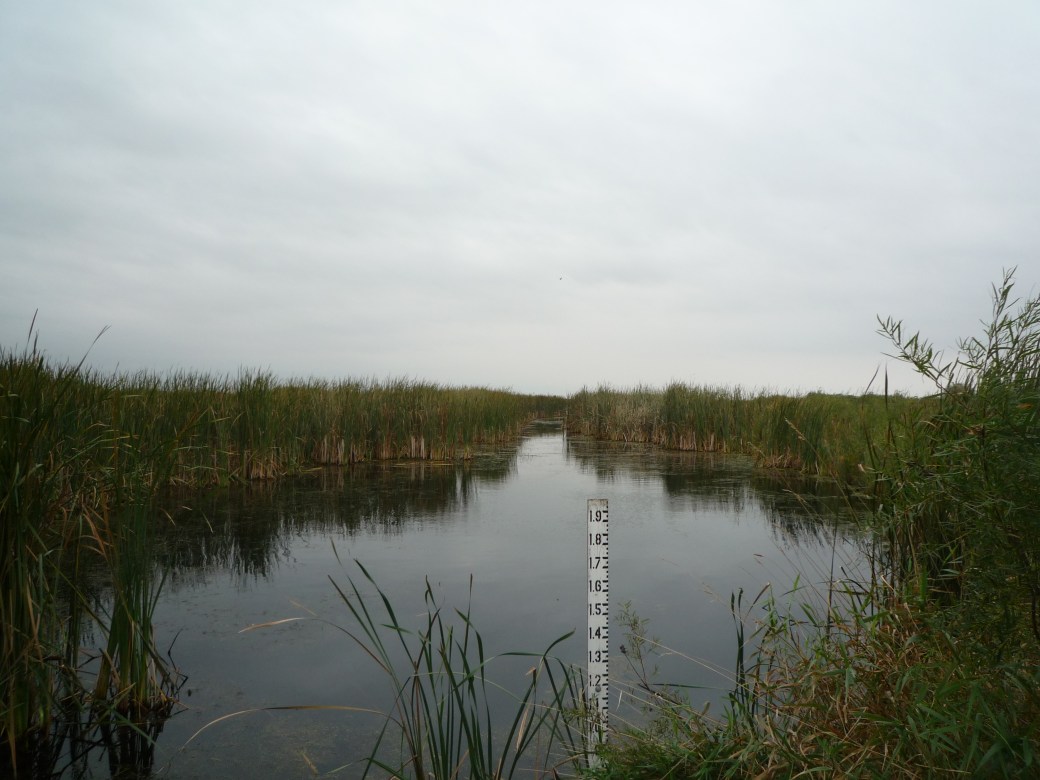
legged waders. In 2006, Ron Bazin and I confirmed breeding of White-faced Ibis in Manitoba for the first time and many rare herons began appearing more and more regularly. In addition to the White-faced Ibis, Great Egrets and Cattle Egrets established colonies and Snowy Egrets were eventually confirmed breeding by Ken De Smet in 2011. All this high water and the great fetch of the prairie winds eventually breached the dyke structures that were built to create cells in the southeastern corner of the lake, such that by 200_Artuso_Whitewater Lake flooding_7550_old road014 they were “united” with the lake and the cattail beds largely drowned out. The road to the main viewing mound is collapsing and is not currently safe to drive. The shorebirds are no longer as concentrated as they used to be and water logged fields one or two miles from the lake are mow the best places to look for them. Although these areas are not currently within the IBA, some of the wetland-upland complexes around the lake represent important ephemeral habitats that host great diversity and concentrations, as well as high productivity.’

Eurasian Collared Doves in, er, Deloraine Manitoba. Photo copyright Christian Artuso

Eurasian Collared Doves in, er, Deloraine Manitoba. Photo copyright Christian Artuso

Before hitting Whitewater we stopped in the nearby town of Deloraine for gas and food and for what felt to me like the daftest bird of the day. Eurasian Collared Dove is something I have seen my entire life in Europe where I was born and raised. To see it in the middle of Manitoba sitting on the top of a street lamp was a pretty surreal experience. Even more surreal was hearing that they were originally introduced to North America via the Bahamas of all places.

Finally Whitewater Lake and not much introduction needed to the situation regarding high water levels after Christians great background piece. The highlight ironically of this part of the day was not even a wetland bird. Prairie Falcons breed in the badlands of Saskatchewan and Alberta and head over to Manitoba post breeding. 07b_Artuso_Prairie Falcon_8678

The reminder of the afternoon was cut short by the need to get home at a decent time but it would be worth pointing out the numbers recorded in a rushed effort to see as much as possible. Unfortunately many of the birds we encountered are no longer in the IBA because the current high water levels extend way beyond the IBA boundary. This is unfortunately a by-product of setting up our IBA boundaries for wetland sites when water levels across the province are much lower than they are currently. However in total we were able to count 11726 birds representing 82 species. Of these we encountered the following:

  • 5672 waterfowl representing 13 species incl. 1820 Mallards and 1179 Gadwall
  • 540 grebes representing 5 species incl. 2 Clark’s Grebe near the viewing mound18_Artuso_Western Grebe_7872_adult and juv
  • 61 herons and allies incl. 36 White-face Ibis
  • 3026 American Coot
  • 550 shorebirds representing 17 species including northern breeders
    Red-necked Phalarope and Hudsonian Godwit. This paled into insignificance against Christians previous week total of 3123 American Avocets, indicating that a) we covered a lot less ground and b) many of these birds have already migrated12_Artuso_American Avocet 2
  • 468 gulls and terns
  • 1050 blackbirds
Cabbage White Butterflies were an abundant food source for birds including Black Terns. Photo copyright Christian Artuso

Cabbage White Butterflies were an abundant food source for birds including Black Terns. Photo copyright Christian Artuso

It’s also worth noting that Birdlife International have changed the name to ‘Important Bird and Biodiversity Areas’ and an emergence of Cabbage White Butterflies was providing great entertainment for insectivorous birds, especially the acrobatic Black Terns. Although Cabbage Whites are an introduced species, it was still a great example of how birds rely so much on the whole ecosystem for resources.

Finally a massive thanks to Christian for the company and guiding on a long day on Saturday.

Christian Artuso, Whitewater Lake. Photo by Tim Poole

Christian Artuso, Whitewater Lake. Photo by Tim Poole

Fruitful Morning in Melita

Another day, another trip to the southwest corner of Manitoba for some Banana-themed fun. Tim gives the lowdown on the morning

Saturday saw Christian and I take another trip to the Manitoba banana belt, a rather a-peeling place to be. Apart from the world’s largest banana statue right in the heart of Melita, there are not really many bananas to be seen but the climate is relatively warmer in summer than the rest of Manitoba, hence the name ‘banana belt’.

DSC_0083

View of the Sunny and Breezy from our table. Photo by Tim Poole

Now Melita has a very joyful looking Banana in the centre of the town called Sunny. Sunny is joined by his friend Breezy the Blue Jay. And what does it say on Breezy’s t-shirt? IBA! Because this is an Important Bird Area and the town itself cherry-ishes this not just with the statue but also with banners on Main Street proclaiming it as the ‘Grassland Bird Capital’ of Manitoba. This is of a course a peach of an area when it comes to birds and, well we could not manage a trip to the southwest without seeing a few birds on the way.

Melita Legion Hall chimney where Chimney Swifts have been recorded breeding for the very first time in Melita. Hopefully swifts have also bred in the other 2 chimneys in Melita which were being used by birds earlier in the season. Photo by Christian Artuso

Melita Legion Hall chimney where Chimney Swifts have been recorded breeding for the very first time. Photo by Christian Artuso

The most important record for the day came from Christian who managed to confirm the first ever successful breeding of a pear of Chimney Swifts in Melita (an entry/exit cycle was observed in the Legion Memorial Hall  chimney and young were heard calling). A second plum bird sighting from the Banana Days was of a Swainson’s Hawk swooping at a Golden Eagle, some sighting at this time of year! The journey down also did not disappoint, with a sub-lime combination of birds from the Pectoral and Baird’s Sandpipers, Grasshopper Sparrow, berry large flocks of blackbirds and good number of Mourning Doves.

Anyhow, I digress and it should be made clear that birdwatching was not our priority on this occasion. We had a grape morning speaking with a number of people, both young and old from from Melita out to Boissevain (and probably further than that). People came for the family fun (bouncers, games, crafts) and probably in a fair few cases, the free banana split! The guys over at the Manitoba Burrowing Owl Recovery Program were great company on the adjacent table especially Koko the Burrowing Owl, a star attraction if ever there were one (http://www.mborp.ca/).

DSC_0085

Tim Poole at the IBA stand before people arrived. Photo by Christian Artuso

Our aim was to promote the Grassland Bird Initiative and the IBA Program in this area. As we blogged earlier this summer (see here; here; here), this area is important for its areas of native mixed-grass prairie and associated bird species. We believe that landowners and local communities are vital to conserving both this habitat and the special birds. Our presence on a Saturday morning is a reflection of this view and we hope in the future to increase our efforts in this regard. Apple-y, it would seem that many people agree with this view by the stream of visitors to our table.

On a separate note, Marshall Birch our summer Green Team Program Assistant has now left the program after his funding ended. We would like to thank Marshall for his enthusiasm, great blog writing and terrific work ethic over the past few months and wish him also all the best with his future plans.

Next we made a trip to Whitewater Lake but that is a story for another blog.

Migration Bird Blitz at North, West and East Shoal Lakes IBA

If you are peruse these pages back far enough you will see some fantastic photos in a post about Least Bitterns at the North, West and East Shoal Lakes IBA from Donna Martin (see Least Bittern). Donna is our Caretaker for the IBA and spends many hours each year monitoring, putting up signs, building nestboxes and watching out for the site.

Donna and I are planning a couple of fall migration bird blitzes in August and October across the Shoal Lakes. Essentially groups of birders will be counting birds early morning in sections of the IBA. We might even have a boat available for some nautical counting in areas which are less accessible from the land. Below is a summary of the plan:

  • Early Migration Count: August 29th (reserve day is the 30th). Sunrise is around 6:39 so expect to begin 30 minutes before this time
  • Late Migration Count: October 3rd (4th reserve). Sunrise is at 7:42 so again expect to begin 30 minutes beforehand
  • Number of teams: 5-6 cars. Each car to have 1 scope and a GPS (IBA Program will provide GPS if required)
  • All data to be added to eBird under the IBA Protocol. I am happy to enter data and share with you if this makes things easier for you

We will meet up for breakfast after each count. I was planning to go to Rosie’s Cafe in Inwood as this is one of the closest available places in the area. The North, West and East Shoal Lakes IBA received a generous donation via Donna which means we can pay for breakfast to thank everyone plus provide some remuneration for fuel.

Please email me at iba@naturemanitoba.ca if you are interested in coming along for the fun on either date

All the best and happy birding!

Tim

Trip Report from Christian Artuso – Whitewater Lake IBA

Christian Artuso is the chair of the Manitoba Important Bird Area Steering Committee, Coordinator of the Manitoba Breeding Bird Atlas and all Bird Studies Canada Projects in Manitoba. On Sunday, Christian visited Whitewater Lake with Jo Swartz, another of our IBA volunteers, and has produced a terrific blog on his personal website – http://artusobirds.blogspot.ca/2015/08/surveying-whitewater-lake-iba.html.

Enjoy!