Oak Lake – Group 2 trip report

Tim here and coming up with the long awaited report for the Oak Lake blitz and the 2nd group. Our team consisted of Katharine Schulz, Luc Blanchette, Sabina Mastrolonardo and me. We were tasked with surveying the western side of Oak Lake, which considering the time limitations was a tall order.

Firstly, a little on the IBA. This is primarily an open water and wetland IBA but with significant areas of grassland and even some small deciduous forests. This gave us the possibility of locating birds typical of the parkland, wetlands, grasslands and open water habitats and a rather large species list. Of course the IBA is centred on a lake and it would have been fantastic to locate where the gull colony(ies) were located and whether there are colonies of herons, but time and access were against us. Instead we focused on wetlands for the most part, picking up a few grassland species as we finished.

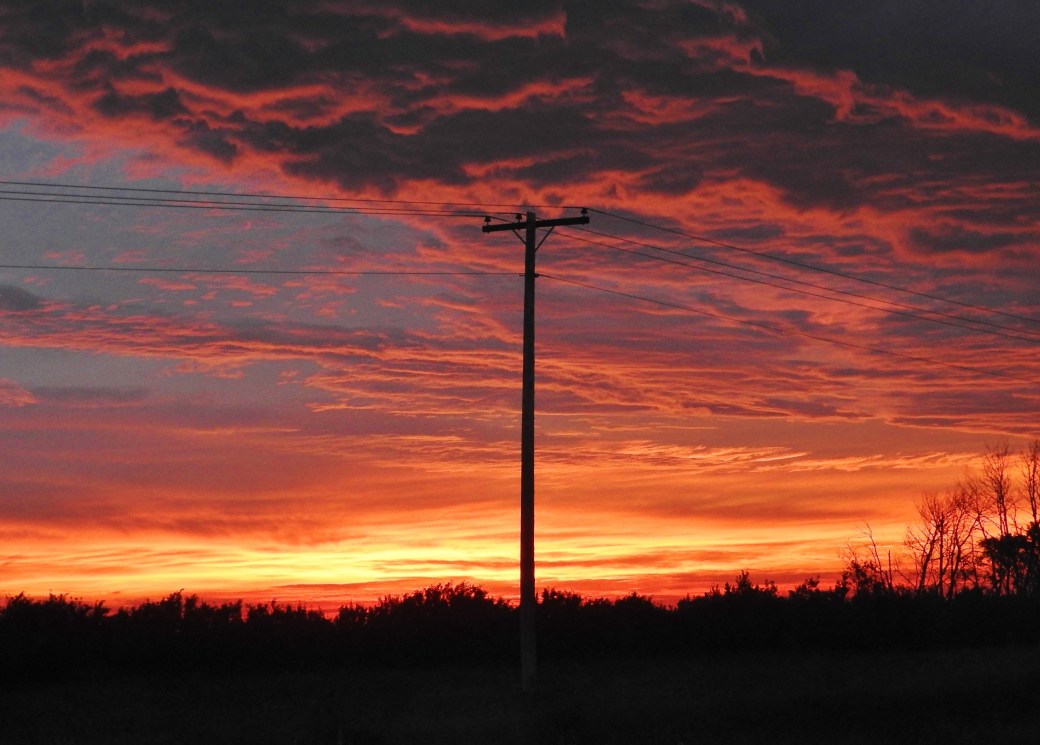
The day did not start especially well judging by the photos below courtesy of Sabina. We began in a thunderstorm at 4am and drove to Oak Lake through rain and  latterly a dense mist which could only be described as dreich if one were Scottish.

Fortunately the mist had cleared by the time we reached Oak Lake and met with the other blitzers. The sun was beginning to peak and we were looking forward to a glorious morning of birding.

Our group began by striking west, picking up common species which we would associate with open habitats such as American Kestrel, Eastern Kingbird, Mourning Dove and Western Meadowlark.

DSC_1572

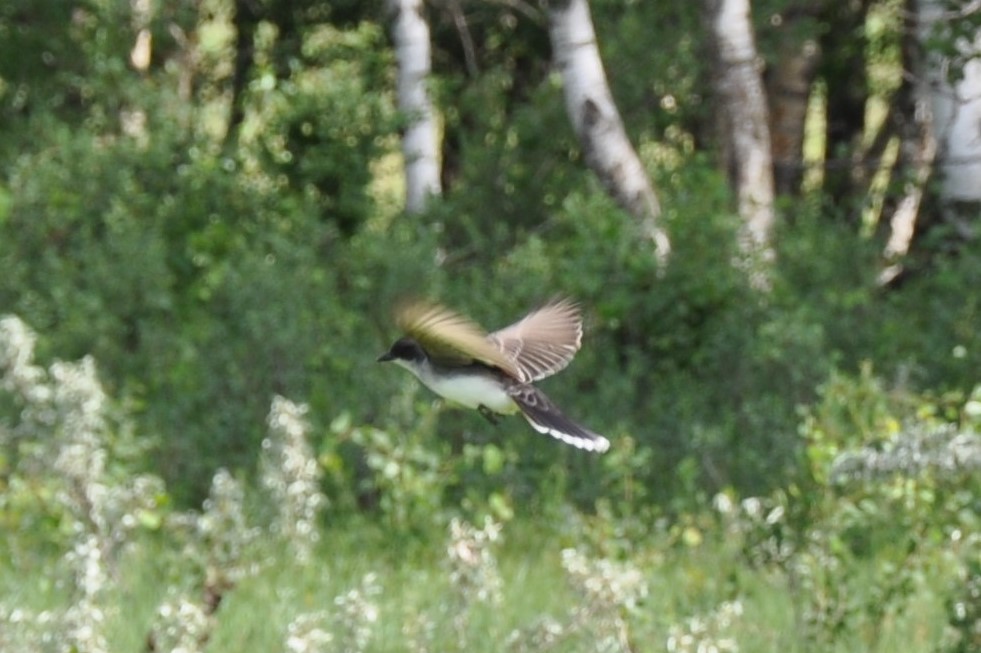
Eastern Kingbird on the hunt. Photo copyright Sabina Mastrolonardo

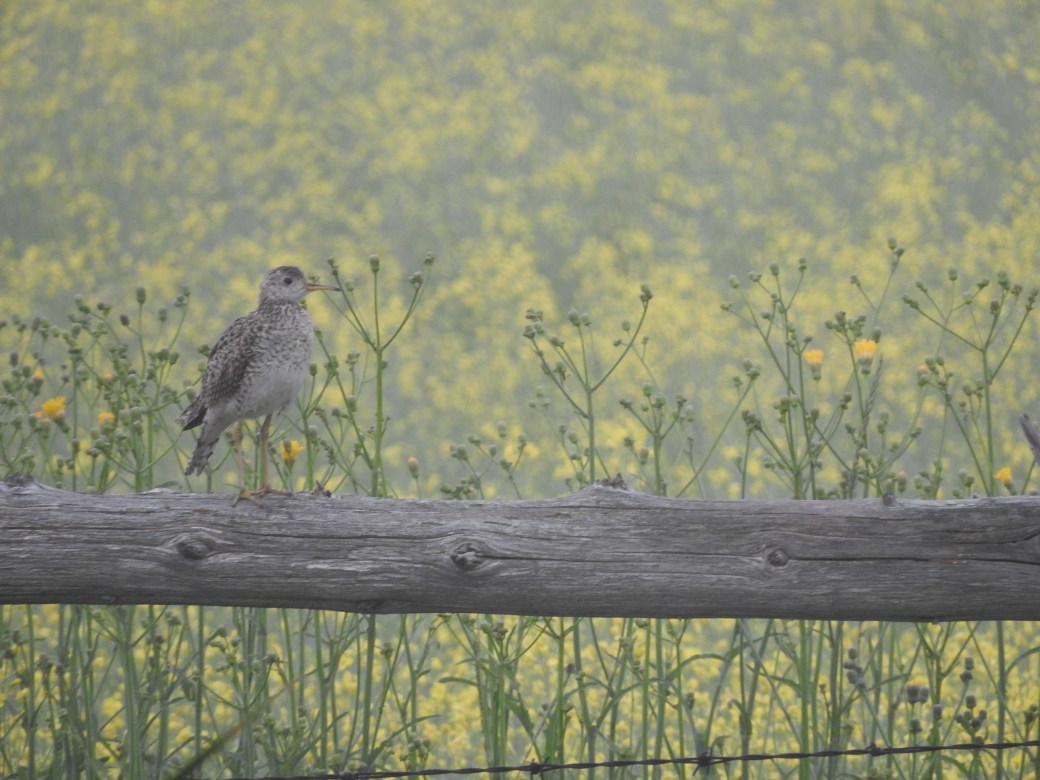
The first exciting bird of the day was the prairie jester, and a personal favorite, the Upland Sandpiper. This one could be heard delivering its unusual whistle. It was around about now that we realised Luc had an exceptional pair of ears when it comes to hearing bird calls. Even while driving he would deliver a constant commentary of species he could hear above the engine outside his window. While driving along we also developed a game of Red-winged Blackbird bingo, in honour of these incredibly abundant marsh dwellers.

DSC_1576.JPG

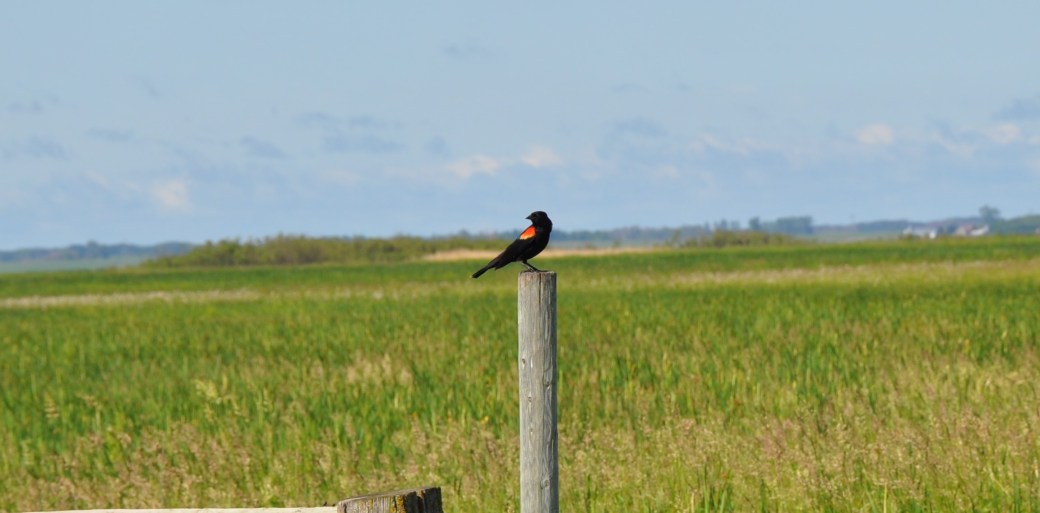
A Red-winged Blackbird, an abundant part of the mixed wetland and prairie landscape. Photo copyright Sabina Mastrolonardo

It must be the low key season for ducks in the IBA. Although we located a good number of species, and all the typical species at that, it is likely that there were a lot more in hidden potholes. The duck highlight was probably a female Bufflehead. Bufflehead breed around lakes in the boreal forest, although a quick perusal of the Breeding Bird Atlas show that they are present here during summer.

Shorebirds are also present in these wetlands during the breeding season, including Wilson’s Snipe and American Avocet. An early Greater Yellowlegs flashed by at one point but this species is still predominantly on its breeding groups in the boreal. Marbled Godwit were also glimpsed on a pasture.

DSC_1567

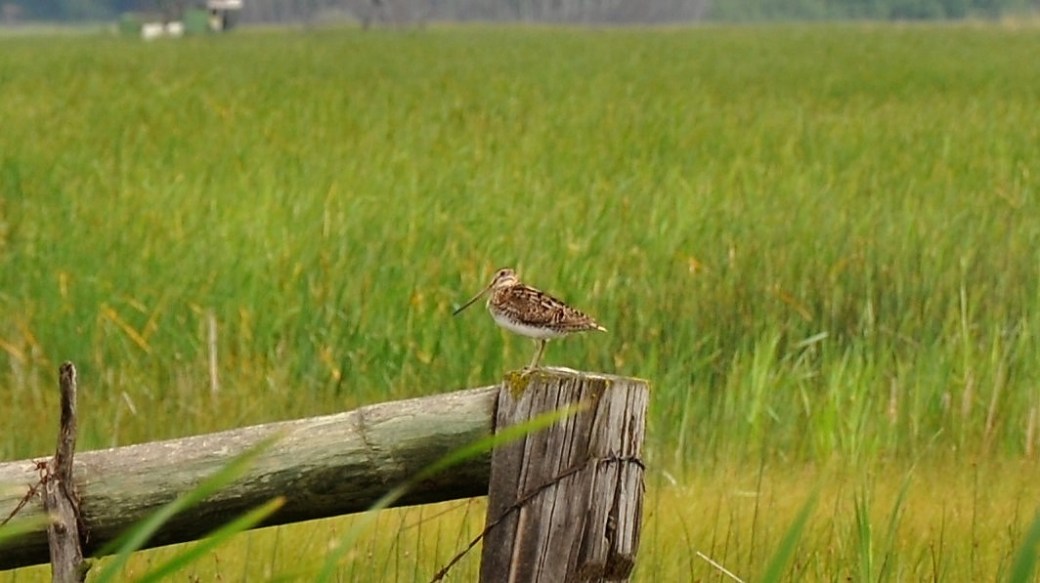
Wilson’s Snipe. Photo copyright Sabina Mastrolonardo

The small marshes were alive with songbirds, Le Conte’s and Nelson’s Sparrow sung, Marsh Wren were fully abundant and Sedge Wren made the occasional foray into earshot. Sora, that laughing rail would regularly pierce in the morning peace and the witchety-witchety-witchety-witch of Common Yellowthroat was a rare but welcome sound. Parkland species were also abundant with the threatened Eastern Wood Pewee being heard on one occasion. Other more common woodland species such as House Wren, Warbling Vireo and Baltimore Oriole were also present.

IMG_1591.JPG

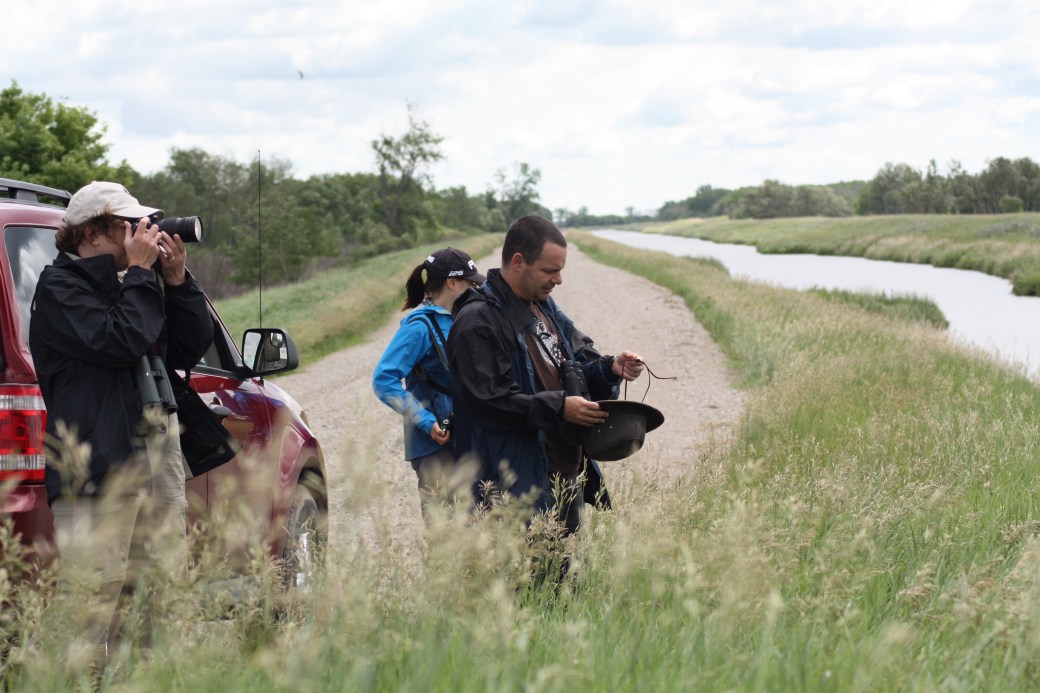
Katharine, Sabina and Luc. Photo by Tim Poole

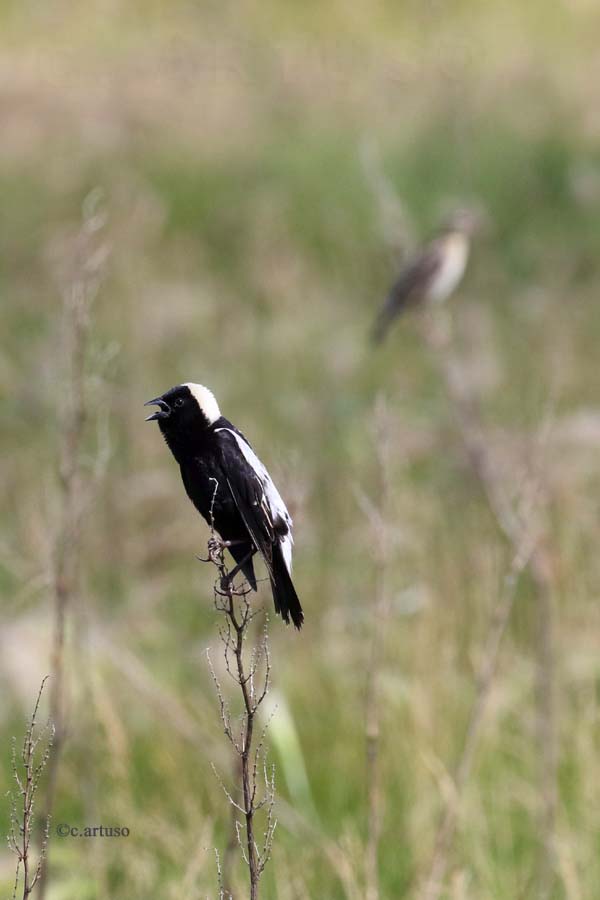
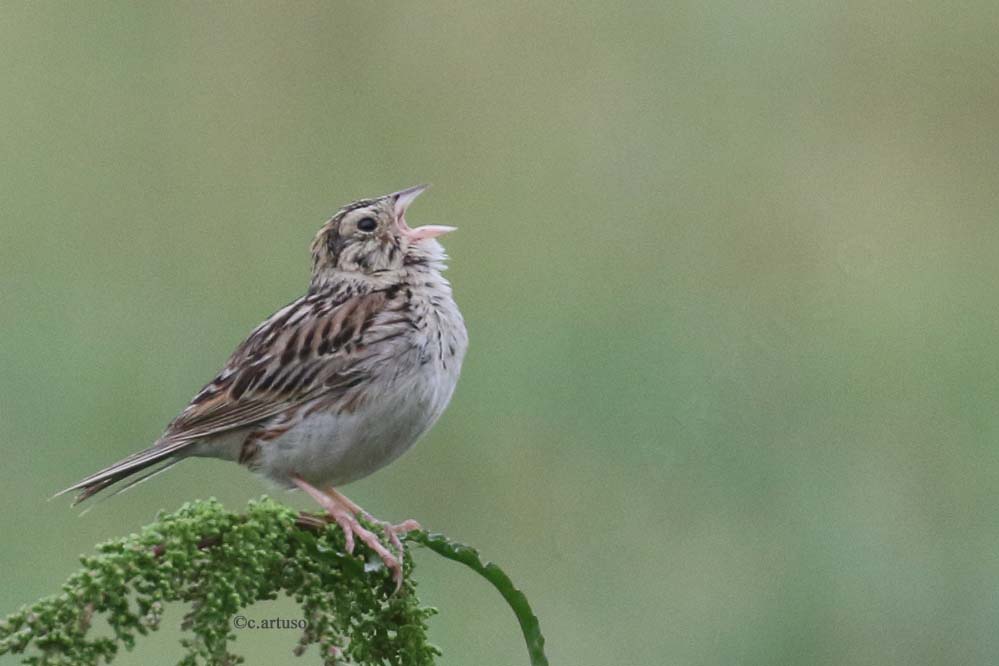
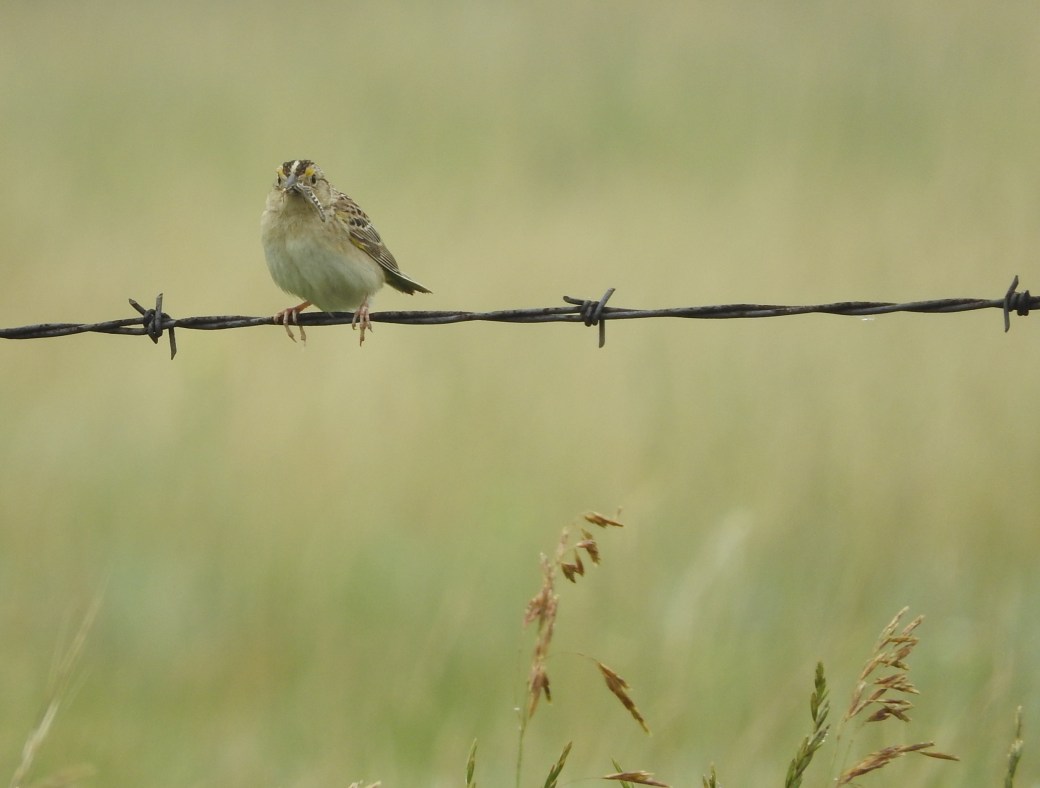
One of our biggest interests is grassland birds and we were not to be disappointed here. Firstly, there were very good numbers of generalist grassland birds such as Wetern Meadowlark (32), Savanna Sparrow (66) and Bobolink (22). The there was the Grasshopper Sparrow and Sprague’s Pipit, two declining species of the Manitoba prairies. The grassland birds were certainly most numerous on the western side of Oak Lake.

The highlight came from a tip from a local landowner. He directed us to a spot along a sluice where apparently each year an American visitor would return because it was the best place he had seen for birds. Following his instructions we found the sluice opening up into a wide shallow area of open water with ducks, coots, Eared Grebe and more. You could imagine it would be even better in fall. If the landowner ever reads this, thanks for the tip!

IMG_1382

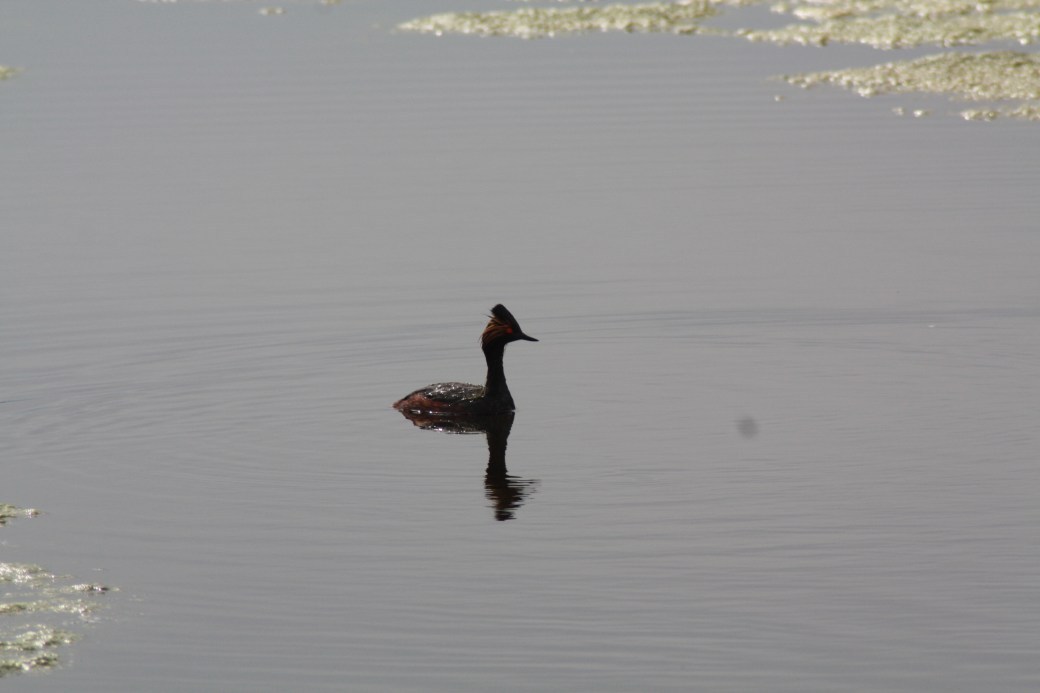
Eared Grebe at Oak Lake and Plum Lakes IBA. Photo copyright Tim Poole

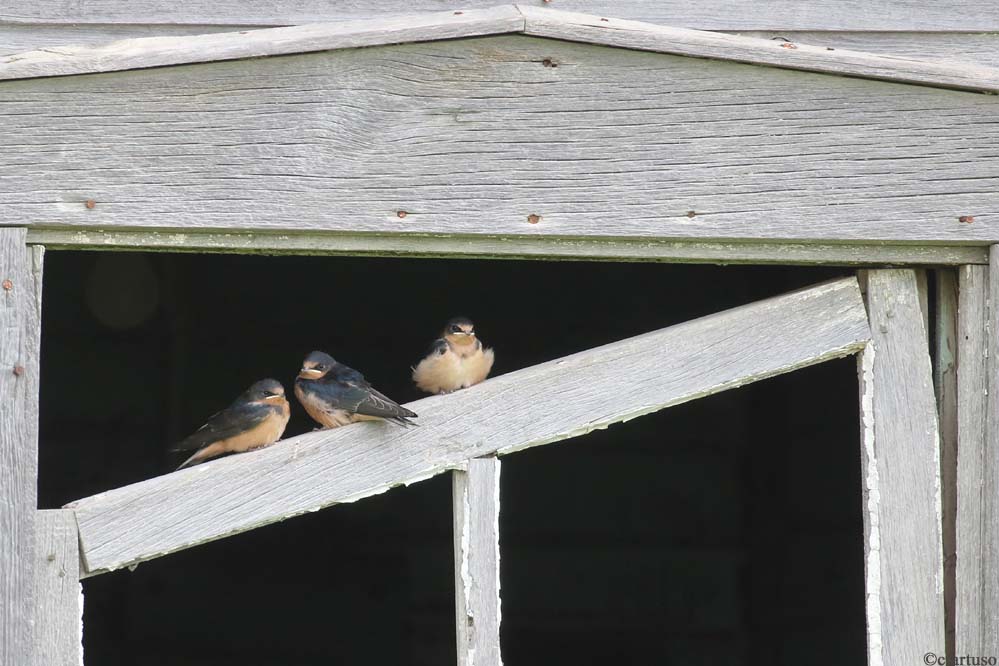
Finally, I have to mention the Cliff Swallows. There were two large colonies, one with approximately 70 and the other 300. Each were feeding around the bridge under which they were nesting. These are incredible sights to behold and I would encourage anyone to visit such places (while obviously keeping your distance). All photos below copyright Tim Poole.

Tomorrow I will post the results of the blitz and then post the findings of our visit to the southwest corner next week.

Manitoba IBA Program in the Media

Couple of bits of news to catch up on. Firstly the Federal Government has added several species to the Species At Risk Act. This has relevance to the Manitoba IBA Program as included in this list are Horned Grebe, Baird’s Sparrow and Buff-breasted Sandpiper. Christian Artuso was interviewed by CBC about this and gave the IBA Program some useful publicity! See CBC article.

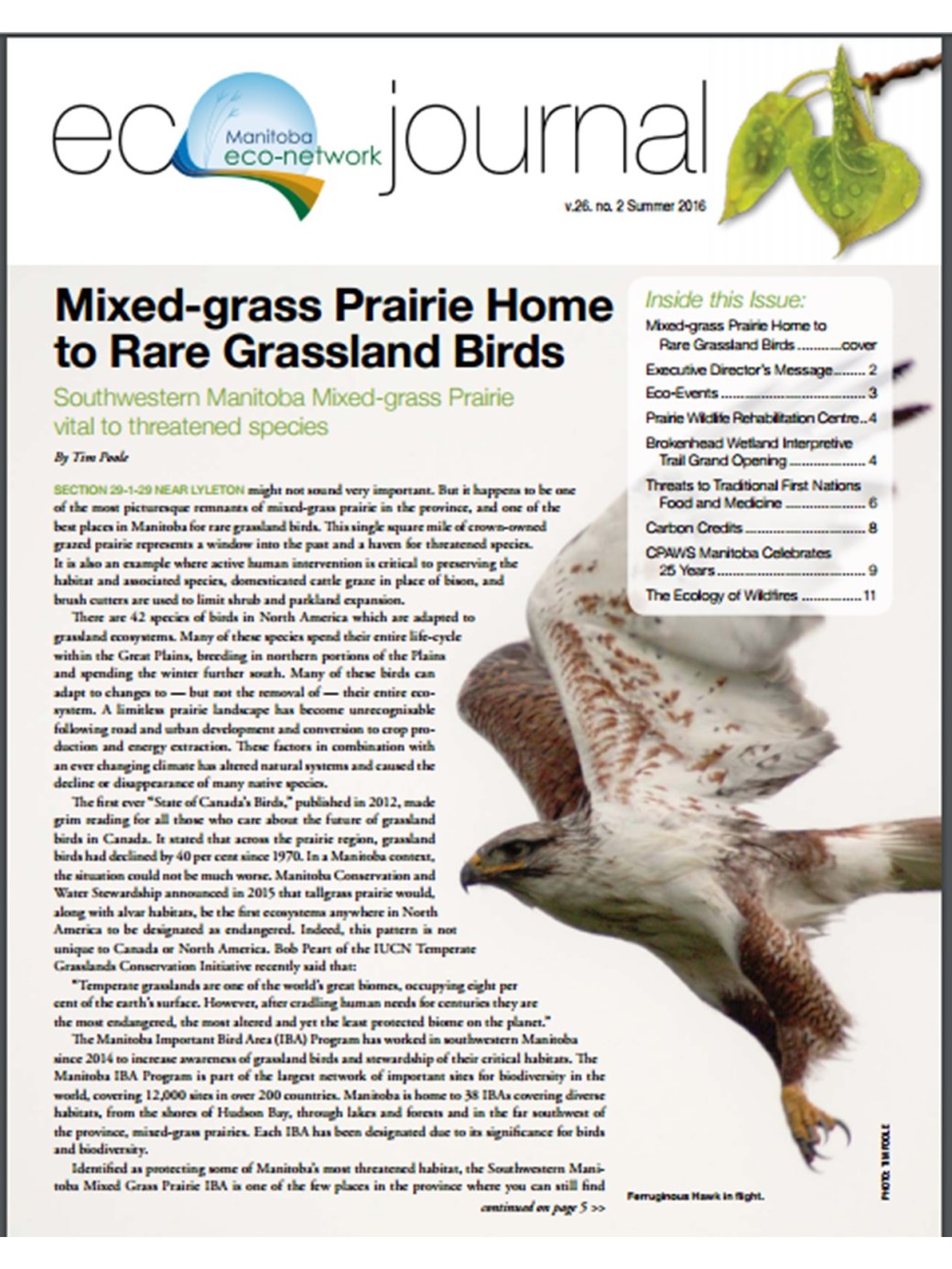
We were also delighted to find ourselves on the front cover of the latest Eco-Journal from the Manitoba Eco-Network. The piece on grassland birds of Manitoba can be read either by following the link or downloaded Eco_Journal-Summer-16_online. If you have never read the Eco-Journal before, it is well worth your time, covering a range of issues from parks to recycling and climate change. And you can even subscribe online!

Eco Journal cover

Oak Lake/Plum Lakes IBA Trip Report

by Marshall Birch

I was picked up by Tim at the wee hour of 4 am to head out for our Bio Blitz of Oak Lake. Despite the pouring rain, we had high hopes for the day as we collected Sabina and Luc, who would be joining in our efforts. Confirming our optimistic outlook, the rain began to clear as we pulled out of Winnipeg, heading West on the Number 1, discussing birds and the nuances of driving various vehicles in various situations, and occasionally crashing said vehicles. Today was to go off without a hitch, though.

Oak Lake Map

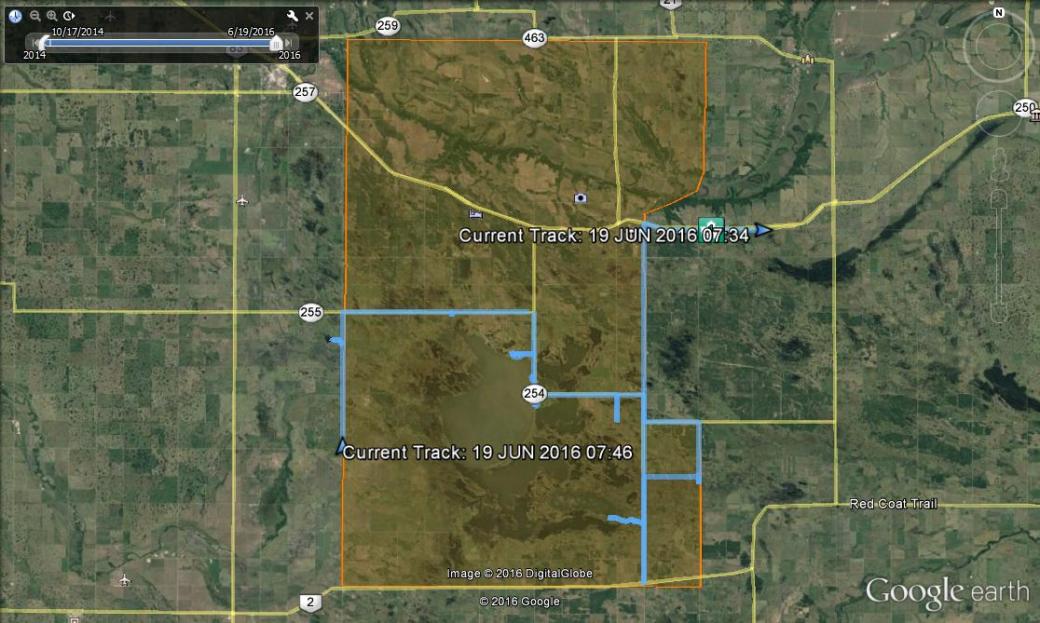
Oak Lake location – the IBA surrounds the lake to the Southwest of the town, and extends slightly above the Number 1 Highway.

Not far from the town of Oak Lake, we met our cohorts for the day, split up into two teams, and tackled the West and East sides of the IBA separately in order to maximize our time. My team included Gillian Richards, Glennis Lewis, and Louanne Reid, skilled birders from Brandon, and we took the East route. Though I had a few decent spottings for the day, it was definitely my three partners who caught the majority of species, with me in back tallying down all sightings and inputting any threatened species into the GPS.

OL%20Jun%2019%20BCNH%206965

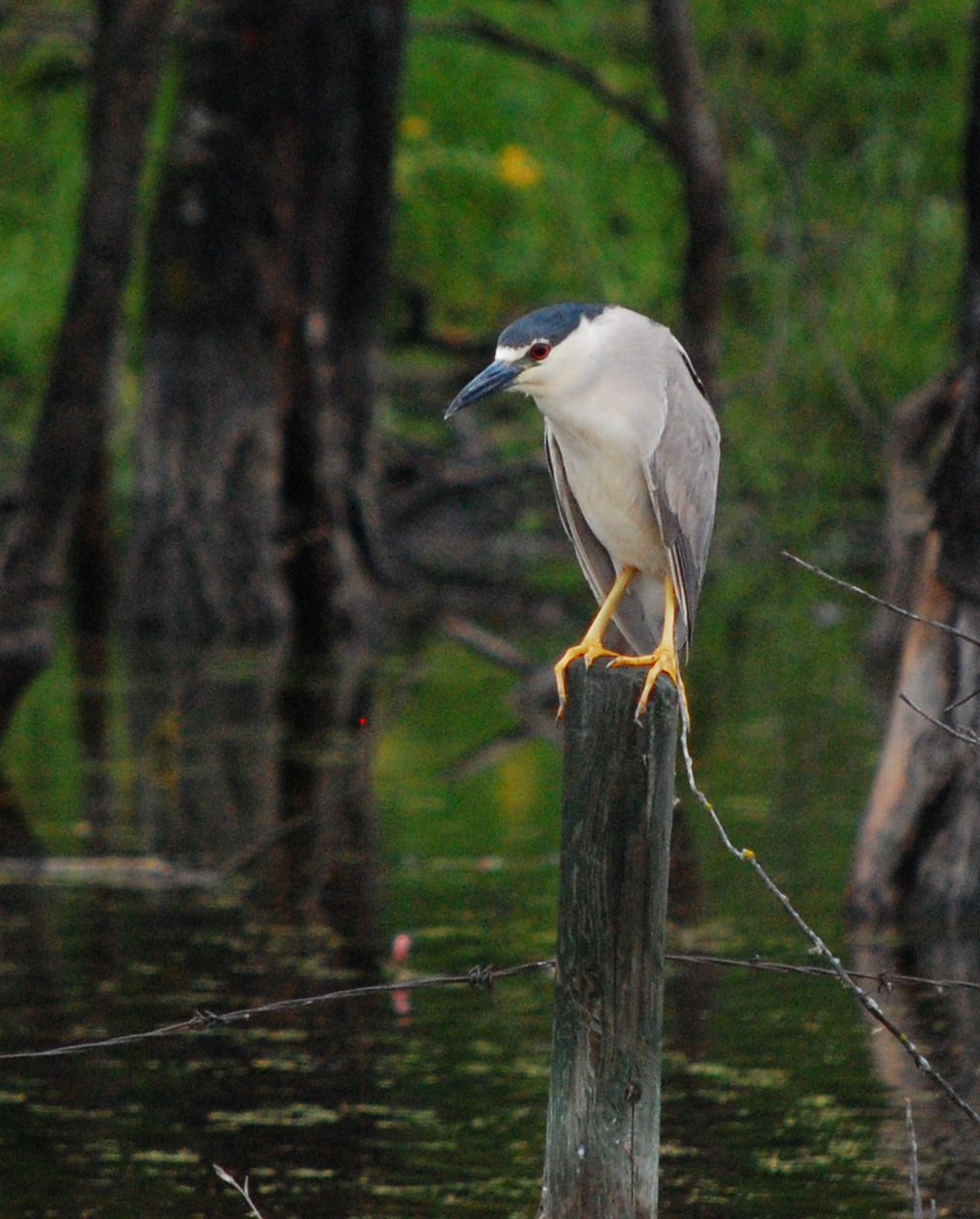
A Black-crowned Night Heron, which the Brandonites spotted before meeting up with the Winnipeggers. Photo by Gillian Richards.

We started things off by heading straight to the cabin/camping/beach area, a pleasantly forested section of the IBA which rewarded us with many songbirds, including Warbling Vireo, Black-capped Chickadee, White-breasted Nuthatch, Black-and-white Warbler, Cedar Waxwing, Least Flycatcher, Yellow Warbler, American Goldfinch, House Sparrow, Black-billed Magpie, and American Robin, and which included a busy Purple Martin feeder showing signs of breeding. Heading out of this section of the IBA, we were greeted by two foxes, one crouched in the long grass alongside the road, and one mangy looking fella strolling about. Neat!

OL%20Jun%2019%20UPSA%206977

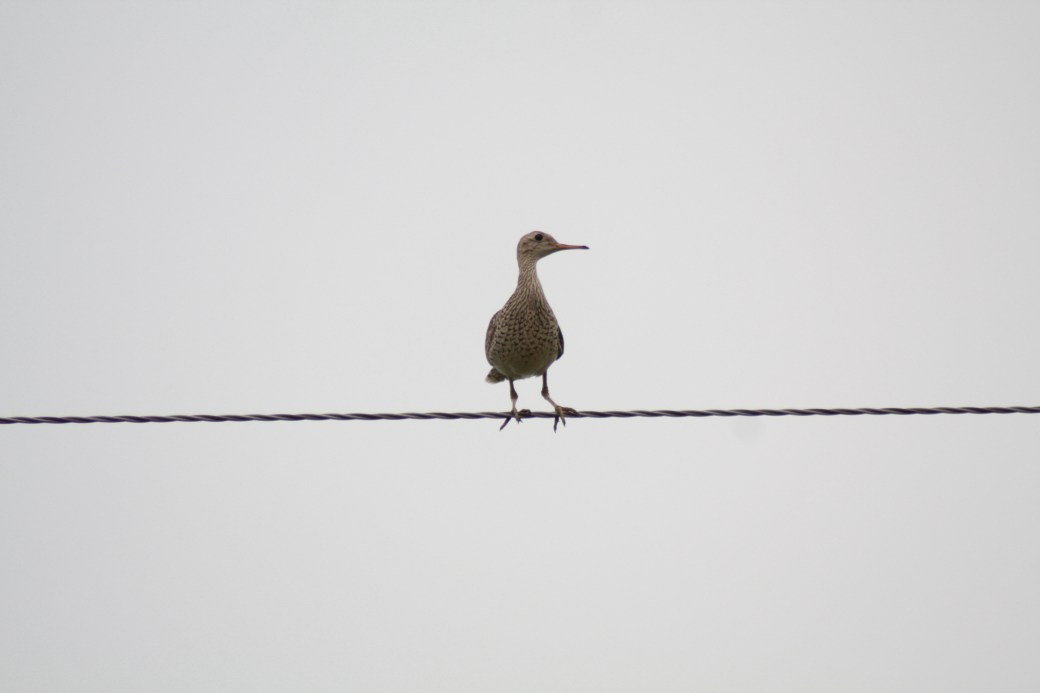
Upland Sandpiper resting of a fence post, as they’re known to do. Photo by Gillian Richards.

The rest of the IBA was spotted with many small wetlands throughout which were many species common throughout the IBA, including Canada Goose, Gadwall, Mallard, Blue-winged Teal, Northern Shoveler, Redhead, Lesser Scaup, Eared Grebe, Red-winged and Yellow-headed Blackbirds, American Coot, and Killdeer. Less common sightings that day included American Wigeon, Northern Pintail, Canvasback, Bufflehead, Green-winged Teal, Ruddy Duck, American Avocet, Wilson’s Phalarope, Marbled Godwit, Lesser Yellowlegs, Marsh and Sedge Wrens, and Northern Harrier. A couple highlights of the day for myself were a pair of Great Blue Herons creeping through the reeds, and a coyote mingling about with a pack of assorted waterfowl, seemingly uninterested in the potential food supply.

OL%20Jun%2019%20BOBO%206987

Calling Bobolink – one of our threatened species for the day. Photo by Gillian Richards.

The rest of the IBA was largely comprised of grasslands (some of which were quite well preserved), the powerlines, fenceposts, and meadows of which afforded us sightings of Willet, Upland Sandpiper, Wilson’s Snipe, Western Kingbird, American Crow, Common Raven, House Wren, Gray Catbird, European Starling, Tree and Barn Swallows, Common Yellowthroat, Le Conte’s, Chipping, Clay-coloured, Savannah, and Lark Sparrows, Western Meadowlark, Common Grackle, Brewer’s Blackbird, and a pile of Mourning Doves and Eastern Kingbirds. Above we caught a couple Turkey Vultures, plenty of Franklin’s Gulls and Black Terns, and a few Red-tailed Hawks – including one juvenile sitting in a nest in a woody thicket, and one angry parent ushering us away.

OL%20Jun%2019%20RTHA%206970a

Juvenile Red-tailed Hawk peeking out from its nest. Photo by Gillian Richards.

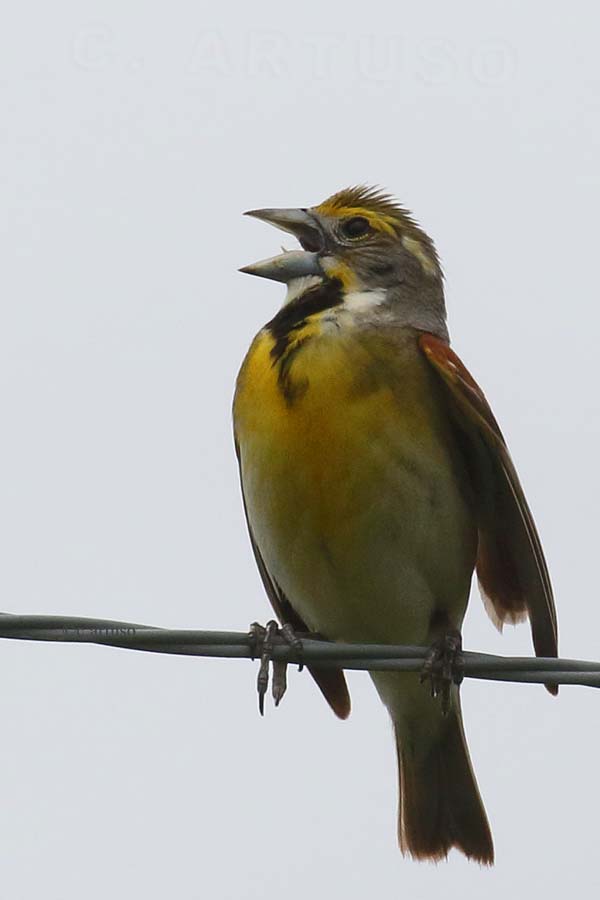
A couple other highlights included: a nice little thicket that was home to a few Yellow-bellied Sapsuckers, Northern Flickers, and Baltimore Orioles; a fine sighting of an Eastern Bluebird and a pair of Mountain Bluebirds, one of which seemed to be carrying lunch home for their young; thirteen Bobolinks and one Grasshopper Sparrow – a couple threatened species for the old GPS.

OL%20Jun%2019%20MOBL%207011

Mountain Bluebird couple – the lil lady’s got a lil worm. Photo by Gillian Richards.

There was only so much time, however, and despite a great day (72 species for our team), there was only so much we could do. Tim and his team covered a similar amount of space as ourselves, which he’ll give you the low-down on in an upcoming blog, but there’s still a lot more to see out at Oak Lake, including an entire section north of the Number 1 – this is somewhere where a caretaker could really help out, but we’ll definitely be back. The day was rounded out with fine dining at Gold’n’Embers in the town Oak Lake, and then I proceeded to sleep through most of the drive home, the fine company I am.

Oak Lake IBA Blitz Totals

We will blog on this again later this week but here are the total bird numbers recorded during our weekend blitz at the Oak Lake/Plum Lakes IBA:

Species Name Species Count
Western Group Eastern Group Additional records TOTAL
Canada Goose 46 19 25 90
Gadwall 43 24 5 72
American Wigeon 2 7 9
Mallard 78 82 15 175
Blue-winged Teal 38 67 105
Northern Shoveler 30 52 82
Green-winged Teal 7 2 9
dabbling duck sp. 19 5 24
Canvasback 8 1 9
Redhead 8 58 66
Lesser Scaup 8 37 3 48
Bufflehead 1 2 3
Ruddy Duck 11 8 19
Pied-billed Grebe 3 3
Red-necked Grebe 1 2 3
Eared Grebe 11 60 10 81
Great Blue Heron 1 2 3
Black-crowned Night-Heron 2 2
Turkey Vulture 2 2
Northern Harrier 3 5 8
Red-tailed Hawk 3 8 11
Virginia Rail 2 2
Sora 11 11
American Coot 26 18 1 45
American Avocet 2 9 11
Killdeer 18 23 2 43
Greater Yellowlegs 1 1
Willet 1 2 3
Lesser Yellowlegs 1 1
Upland Sandpiper 4 1 5
Marbled Godwit 2 3 5
Wilson’s Snipe 19 3 22
Wilson’s Phalarope 2 5 7
Franklin’s Gull 35 65 100
Black Tern 63 43 2 108
Rock Pigeon 6 6
Mourning Dove 16 27 43
Black-billed Cuckoo 2 2
Yellow-bellied Sapsucker 1 2 3
Hairy Woodpecker 1 1
Northern Flicker 1 1 2
American Kestrel 1 1
Eastern Wood-Pewee 2 2
Least Flycatcher 16 8 24
Eastern Phoebe 1 1
Western Kingbird 4 5 9
Eastern Kingbird 21 30 51
Warbling Vireo 8 6 14
Black-billed Magpie 5 3 8
American Crow 4 4
Common Raven 7 10 17
Purple Martin 2 30 32
Tree Swallow 10 37 4 51
Barn Swallow 18 52 70
Cliff Swallow 335 335
Black-capped Chickadee 3 3
White-breasted Nuthatch 6 6
House Wren 3 7 10
Sedge Wren 3 2 5
Marsh Wren 78 2 80
Eastern Bluebird 1 1 2
Mountain Bluebird 2 2
American Robin 18 40 58
Gray Catbird 1 6 7
European Starling 5 2 7
Sprague’s Pipit 1 1
Cedar Waxwing 8 8
Black-and-white Warbler 3 3
Common Yellowthroat 7 6 13
Yellow Warbler 14 35 49
Grasshopper Sparrow 1 1 2
Le Conte’s Sparrow 13 1 14
Nelson’s Sparrow 1 1
Chipping Sparrow 8 8
Clay-colored Sparrow 9 7 16
Lark Sparrow 1 1
Vesper Sparrow 7 7
Savannah Sparrow 66 16 82
Song Sparrow 7 7
Swamp Sparrow 3 3
Bobolink 22 13 35
Red-winged Blackbird 310 135 7 452
Western Meadowlark 32 20 52
Yellow-headed Blackbird 76 129 3 208
Brewer’s Blackbird 20 3 23
Common Grackle 5 29 34
Brown-headed Cowbird 17 45 62
Baltimore Oriole 7 4 11
American Goldfinch 2 5 7
House Sparrow 8 3 11
TOTAL 1701 1372 81 3154

A Gift of Nature for the Southwestern Manitoba Mixed-Grass Prairie IBA

For Canada’s 150th birthday, Nature Canada and CPAWs are asking governments to protect far more of Canada’s wilderness. There is an opportunity to show your support for designating a number of different sites in Canada by sharing on social media and signing the pledge for a ‘Gift of Nature’. There are 3 sites which both organisations would like to see protected in Manitoba, including the Southwestern Manitoba Mixed-Grass Prairie IBA. It would be great if as many birders out there as possible could show their support for this, Manitoba’s most threatened IBA.

See here

Upland Sandpiper

Upland Sandpiper, a typical grassland bird species of the southwestern corner. Copyright Tim Poole

Guest Blog – A Day in the Life of Colin and Gillian, Caretakers for Whitewater Lake IBA

Since 2015, Colin Blyth and Gillian Richards have spent many hours monitoring Whitewater Lake IBA as part of their Caretaker duties. Here Colin, with help from Gillian, have described a day’s monitoring the IBA in May 2016.

8pm Saturday May 21, 2016 I took a look at the forecast in the Deloraine area for the following day. It didn’t look good, 70% chance of showers in the morning and thunder showers in the afternoon. Sunday’s have been the day that Gillian Richards, myself, along with other birders on occasion, go down to one of the best places to look for birds not only in Manitoba, but in Canada. This place is Whitewater Lake: one of 38 Important Bird and Biodiversity Areas (IBA) in the province of Manitoba.

I told my wife that I was still going to be missing around the house even though the weather didn’t look good. I even said things along the lines of “bad weather days can bring about interesting surprises in birding!”. I wasn’t going to miss out on my day down at the Whitewater Lake IBA. Gillian couldn’t have agreed more, because she was up at 5:30am prepping lunch and getting ready for a full day of birding. Also, joining the party on this day was my Dad Scott, and he was at my door at 6:15 sharp, gear ready to go.

We hit the road at 6:30am, which is not crazy early in the birder world, but early enough. Usually when we monitor the IBA, we have a game-plan which involves deciding where we will start and which direction we go from there. Today we decided to start in the northeast corner and travel west going counter clockwise around the lake. The usual chit-chat about eBird and which species were popping up on ManitobaBirds occurred en route. May is truly an amazing month in Manitoba, migration consistently entertains us all with the usual suspects and a nice surprise here and there.

We arrived at the “east” side of the IBA, and I got my binoculars cocked and ready. Savannah Sparrows broke the ice that day as they scurried from the side of the road. Their song of buzzes is hard to describe with words, but a welcoming sound when arriving to the area. Arriving at our first destination, surrounded by bulrushes, we got out of Gillian’s Suburu and scanned the scene. On this day, since Gillian was driving, it was my responsibility to keep track of the birds we see, the numbers of each kind of bird, time, temperature, wind, and usually anything else important we come across. My little moleskin journal has served me well, and in the process of saving space we learned the four-letter species codes for all of the birds we have come across. A four-letter species code is a four letter abbreviation that each bird has been given to speed up the data entry process. There are four-letter English Name codes and six-letter Scientific Name codes (I just learned this as I write this). These codes are also know as Alphabetic or “Alpha” codes. A couple examples: two-word bird American Bittern = AMBI, three-worded bird Red-winged Blackbird = RWBL. Here is a link to all the codes for the birds of Canada:  http://www.bsc-eoc.org/dataentry/codes.jsp?page=species.

WW May 15 FOTE 6114

Forster’s Tern, a species more associated with inland wetlands than the similar looking Common Tern. Photo copyright Gillian Richards

We decided to start the day by taking a stroll down 16N to the west; an old road that has seen better days. We had traveled this road before and saw shorebird potential along the north side. In the past, this area had also been good for Snowy Egret. Marsh Wrens called from a number of directions, Soras made their distinctive yet musical calls, Forster’s Terns bobbed and weaved in the air before dive bombing the open water areas between the marsh, WAUHK! the sound of a Black-crowned Night-heron before not one, but several, jumped up from the edges of the marsh and flew away to the west. We were blown away by the up close and personal experience they gave us. Along the way to one of our viewing spots we encountered Red-winged and Yellow-Headed Blackbirds, both of these species are numerous and sometimes we forget the beautiful reds, yellows, blacks and whites they give us. A small group of Common Grackles perched in the only tree along the road, Song Sparrows sung their scrambled songs from different heights of bulrushes, and in the distance we could see hundreds of Franklin’s Gulls flying in all directions picking up their breakfast on the go. We got to our sweet spot and today it looked great OH WAIT, WHAT’S ‘THAT?!?…… Birders react when they have that moment when they know they have something good in their sights, whether its a FOY (First of Year) bird, or a lifer (First time seeing a species), or even a rare sighting (a bird that shouldn’t be in that spot at that time, or there at all). For us today that moment was when we spotted a Snowy Egret along a narrow, almost canal like, passage through the marsh. The egret looked to be around the same size of a close-by Black-Crowned Night-Heron, the bird had a black bill, black legs, and one of the distinctive field marks… the yellow feet, also known as the “golden slippers”. They aren’t the only white egret that you find at Whitewater Lake. The Great Egret is also found here, though the Snowy Egret is more of a rarity here. It’s interesting to know that in the late 1800’s the plumes of this bird were worth more per ounce that gold. Thank goodness that fashion bit the dust.

WW May 15 BCNH
A Black-crowned Night Heron in flight at Whitewater Lake. Photo copyright Gillian Richards

After enjoying our FOY Snowy Egret for a while we decided to look in a different direction. To our south we had a patch of open water where some waterfowl swam, ate, and slept. There were Blue-winged and Green-winged Teal, Mallard, Gadwall, Redhead, Northern Pintail, and Northern Shoveller. At this same spot, to the north, in late March we had over 1500 Northern Pintail on the only open water in the area. We walked all the way down to where the road disappeared into the marsh to get views of the different species of shorebirds. Ki-Dik Ki-Dik a Virginia Rail sounded off as we set up our scopes to get a closer look at the multiple kinds of shorebirds nearby. Shorebirds (aka waders if you are a Brit) can be a real challenge to birders. Identification is based on size, shape, colour and behaviour all complicated by lighting, distance, and sometimes strong winds messing with the stability of your scope. Today we didn’t have any issues, other than second guessing ourselves. We were treated to sightings of American Avocet, Marbled Godwit, Willet, Short-Billed Dowitcher, Semipalmated, Baird’s, Stilt, and Least Sandpipers, Ruddy Turnstone, the most Dunlin I have ever seen in one place,  Killdeer, Semipalmated Plover, Lesser Yellowlegs, Wilson’s Phalarope and the beautiful migrant Red-Necked Phalarope. Phalaropes are interesting birds for a number of reasons including that the female has brighter/bolder colouring, and the male incubates and cares for the young. On the way back to the vehicle we took pleasure in the nearby White-faced Ibis.

The above photos show the Red-necked Phalaropes in all their glory. Note in the bottom right, the difference between male and female, with the male being on the left. Photos all copyright Gillian Richards

WW May 8 Willet

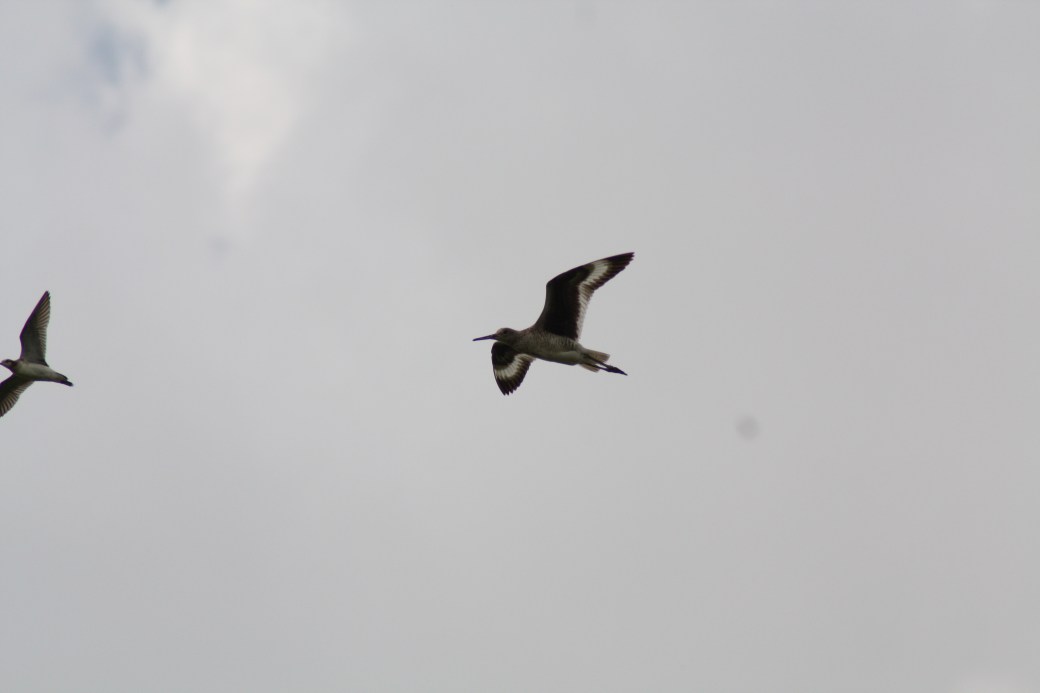
Another shorebird, the Willet. Note the black and white wing patches on this bird, a key identification feature for this species. Photo copyright Gillian Richards

Back on the north side of the lake we made our way west along 20N , stopping where there was potential to hear or see different species. At a farm site we parked and heard a Warbling Vireo singing among the leaves, SWEET SWEET sounds of a Yellow Warbler delighted us, as a Eastern Kingbird hunted for insects in the air. We picked up a few more shorebird species along the north side of the IBA including; White-rumped, Pectoral, Upland  and Spotted Sandpipers. At an abandoned property we discovered a good spot for swallows picking up Cliff, Bank, and Barn. A Clay-colored Sparrow buzzed from a nearby field. Their song is the first one I learned and one of the easiest to remember “BZZZ….BZZZ”. Another little surprise graced our eyes as we came upon a Say’s Phoebe. This was the first time that Gillian or I had seen one in the IBA. My favourite bird, an American Bittern thunder-pumped from the east. I was hoping to get a good look at this member of the Ardeidae family at some point today. Also along the north side of the lake we stopped at a place we call Sextons Point, here you can view Sexton’s Island. Years ago when the water levels were quite a bit lower you could drive right up to Sexton’s Island for a better look. In the last couple of years there has been a Great Egret colony here. At this viewpoint, as usual we saw Red-necked Grebes, as well as Canvasback, Ruddy Duck and Double-crested Cormorants. A few weeks prior to today we had over 20 Horned Grebes at this spot. They had moved on to different areas because we weren’t able to find one anywhere around the IBA.

WW May 22 DSC_6300

White-rumped Sandpipers feeding in the water. Photo copyright Gillian Richards

WW May 15 UPSA

The comical shorebird, the Upland Sandpiper. Photo copyright Gillian Richards

Continuing on to the west side of the IBA we came to Road 132W. With marsh and open water on both sides of the road, this is one of the best places to get close views of  birds in the IBA. Its also one of the best places to see Great Egrets, White-faced Ibis, Western, Eared and Pied-Billed Grebes, American Coot, Ruddy Duck and Bufflehead. This year this stretch has been a good place to see migrant shorebirds. We added Black-bellied Plover to our list of shorebirds for the day. Along this road there have been some amazing sightings this year including Glossy Ibis and Black-necked Stilt. We weren’t so lucky on this day, but enjoyed the area as always.

 WW May 29 WFIB DSC_6669

Gadwall to the left, White-faced Ibis to the right. Photo copyright Gillian Richards

The birds aren’t the only things that fly while you are down at the Whitewater Lake IBA, because time sure does too! We found ourselves out of time for the day and had to hurry through the south side. We were treated to our first Bobolinks of the year for the IBA along the way. Its good to plan for a full day if you want to make the trip. Call us bird crazy, but we can’t get enough of this place! We couldn’t picture ourselves spending our time in a better way!

And by the way, we didn’t have a drop of rain all day. Its not like that would have stopped us anyway!

Colin Blyth and Gillian Richards, Whitewater Lake IBA Caretakers

WW May 8 WEGR

Elegance itself, a beautiful pair of Western Grebes. Photo copyright Gillian Richards

Saskatchewan Shorebird Workshop

Manitoba IBA Program Coordinator, Tim Poole attended a workshop on shorebird identification, ecology and conservation in Chaplin, Saskatchewan. The workshop was organised by the Manomet Shorebird Recovery Program, Chaplin Nature Centre and Nature Saskatchewan. Rather than give a very long blow by blow account of a three day workshop, here are some thoughts and images based on a number of topical issues raised over the 3 days. 

IMG_1389

Sanderling at Reed Lake IBA. Photo copyright Tim Poole

Saskatchewan has some excellent places for birds

Whisper is quietly, but some of those IBAs in Saskatchewan are pretty good for birds. In fact, Chaplin Lake and Reed Lake are (begrudgingly) impressive (;

A visit to Reed Lake with Caretaker Lori Wilson on the first afternoon provided views of a few Arctic shorebirds still fattening up, including Red Knot, Sanderling, Ruddy Turnstone, Black-bellied Plover, Semipalmated Sandpiper and Semipalmated Plover. The first 3 species were especially pleasing, given I had not seen any of them since leaving Scotland over 2 years ago. We also spotted prairie breeding birds, Wilson’s Phalarope, Marbled Godwit, Killdeer and Willet. In addition, large congregations of breeding gulls and terns and Canvasback were breeding on an island in the lake and Eared Grebe and Western Grebe were plentiful. This gave us the first opportunity to test out our shorebird identification.

IMG_1398

Look closely and you can make out Red Knots and Black-bellied Plover in this photo. Photo copyright Tim Poole

IMG_1405

Red Knots at Reed Lake IBA. Photo copyright Tim Poole

On the way back we stopped to look for Cinnamon Teal at a place called Uren (stop tittering). This area of wetland and native prairie is situated in a rather inconvenient location between the eastboudn and westbound parts of the TransCanada. On this occasion we missed out on the teal but lucked out on Black-necked Stilts. This species appears to be expanding its range into Canada, including recent sightings at Whitewater Lake IBA. There were also Baird’s Sparrow and Grasshopper Sparrow calling.

IMG_1416

Black-necked Stilt (deliberately overexposed) at Uren with Red-winged Blackbird behind. Note the long legs. Apparently this species has the longest legs in relation to its body size of any bird bar flamingos. Photo copyright Tim Poole

On the second full day we visited Chaplin Lake IBA. Chaplin Lake is highly saline, so high in fact, it is the location of a mine from Saskatchewan Mining and Minerals. The mining operations have had a positive impact on shorebird populations by creating divisions, each of which is flooded with low depth brine water, ideal feeding habitat. The wider area on the Missouri Coteau is the driest part of the province. Chestnut-collared Longspur and Upland Sandpiper were present on the native prairie. The saline mudflats provided habitat for upwards of 5000 Sanderling, and at peak times, apparently half the worlds population of this species. There were also typical prairie shorebirds, a single Dowitcher (too distant for species i.d.) and my personal highlight, Piping Plovers (more on those later). Early June was beyond peak migration for Arctic shorebirds but still, 5000+ Sanderling is not to be sniffed at!

IMG_1423

Groups of Sanderling at Chaplin Lake. Photo copyright Tim Poole

IMG_1425

The grasslands at Chaplin Lake appeared to be worth further exploration, if only we had more time. Photo copyright Tim Poole


Modern technology is changing our view of shorebird migration

There are 54 species of shorebird in North America, with 74 subpopulations across North America. The traditional view was that shorebirds, and other birds for that matter, follow particular migratory flyways. For example, a shorebird wintering on the California coast would winter in Alaska and a shorebird on the Atlantic shore in the eastern Canadian Arctic. New technology is increasingly revealing that migration of shorebirds is not as simple as that. For example, Marbled Godwits fitted with satellite tags on their wintering grounds on the Georgia coast have been found to migrate to the prairies of North and South Dakota. Concurrently, those wintering in the Gulf of California are breeding in eastern Canada and those wintering in Mexico are breeding in western USA and Canada. Effectively, shorebirds are crossing the entire continent on migration.

IMG_1384

Look carefully and you can see the Chaplin Motus radio transmitter on the top of this grain eleveator. Photo copyright Tim Poole

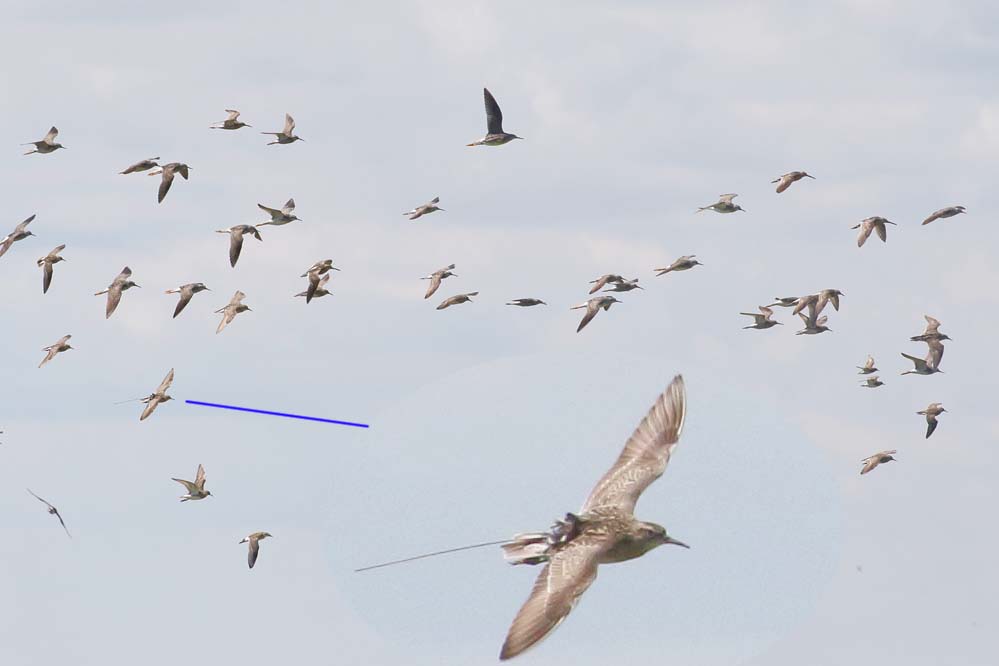
Ongoing research by Christy Morrisey and her team from the University of Saskatchewan is using nanotags to explore Sanderling migratory patterns at Chaplin Lake. These nanotags connect to the Motus Wildlife Tracking System developed and managed by Bird Studies Canada. Motus operates via radio signals which are transmitted to towers at convenient locations, including 3 in Chaplin. The receivers are being put up across North America and into South America, increasing our knowledge of different migratory birds. The great thing about Motus is that anyone can use the system and all the data is sent to Bird Studies Canada for processing at a very reasonable fee. Even better, if you manage your own towers, then the fee is waived – it really is about building up our understanding of bird migration. This particular project is looking at movements of Sanderling in relation to a proposed windfarm project and exploring the potential impact of renewable energy on migratory shorebirds.

Shorebirds are in Peril

This to most people who know about birds is probably an unsurprising statement but is’s worth reiterating. Shorebirds appear to be in real trouble. The just published State of North America’s Birds, 2016 includes the statistic that North American shorebirds have declined by 70% since 1973. This is certainly not an issue confined to North America. North American shorebirds, especially species such as Red Knot, Buff-breasted Sandpiper and White-rumped Sandpiper which breed in the High Arctic, often winter in South America. Outside of the Americas, shorebird declines may be even worse. The world’s most threatened shorebird, the Spoonbilled Sandpiper, breeds in northeastern Russia and winters in an area around Myanmar, Thailand and Bangladesh, occasionally sharing parts of its flyway with some shorebirds from the Pacific Flyway in eastern Asia. In 2015, the IUCN updated its Red List and unfortunately upgraded 8 species of shorebirds (for a Manitoba perspective, see here).

IMG_5375

Northern Lapwings are declining in Europe due to agricultural changes and were added to the IUCN Red List in 2015. Photo copyright Tim Poole

The reasons for these declines are many and complicated, involving multiple issues at multiple sites and multiple countries. Some of the factors include::

  1. Loss of wetlands (5% of US prairie wetlands remain, and those that do are highly fragmented)
  2. Degrading of coastal inlets
  3. Unregulated hunting, mainly in Central and South America and the Caribbean (Lesser Yellowlegs in the Lesser Antilles was highlighted as an example)
  4. Disturbance, including by dogs
  5. Energy extraction, oil spills, etc
  6. Climate change which is shifting when different animals breed. A particular example being that cranefly, the primary food for Eurasian Golden Plover chicks in Scotland, are dying due to increased temperatures. This leads to fewer emergent craneflies for the chicks to feed on, increasing chick mortality and reducing population size.
  7. Environmental pollutants which might impact on body condition and therefore the ability of birds to migrate

We are dealing with migratory birds wintering often in different continents to the one they breed. Inevitably this leads us to a situation where shorebirds are reliant on a network of important sites for wintering, staging and breeding, a concept which sounds somewhat familiar!

Western Hemisphere Shorebird Reserve Network

This network currently covers 95 sites across the Americas and an area of 34 million hectares. Each reserve is identified for its hemispheric, international or regional importance. Saskatchewan currently has 3 sites, including Chaplin/Old Wives/Reed Lakes as a single reserve, whereas Manitoba does not have one. Should Manitoba have a WHSRN? In my view, and a few others, Whitewater Lake would certainly challenge the criteria. The challenge is that we would need to put together an application with good solid data (which is coming together thanks mainly to Colin and Gillian, our caretakers) and community involvement. Anyway, for any interested readers, here is some more information.

Atlantic Flyway Shorebird Initiative

Brad Winn of Manomet spoke briefly about the Atlantic Flyway Shorebird Initiative, a collaborative approach to shorebird management across the flyway from South America to northeastern Canada. As someone who has written management plans and conservation frameworks previously, what interested me about this approach was not so much the international cooperation of which this is obviously a great example, but the approach to actually realising their goal via the Atlantic Flyway Shorebird Initiative Business Plan. If you click on the link, you will see that the plan is not only extremely well targeted, with very clear goals and outlines, it also is specifically aimed at funders from the business community. It includes SMART goals (Specific, Measurable, Achievable, Realistic, Time-bound) and budgets for a 10 year program. Funding (more of that in a bit) is always the pinch-point for conservation projects and therefore this approach certainly has huge merit. Could Manitoba contribute to a Central Flyway Shorebird Initiative and what would our priorities be? Maybe we haven’t heard the last of this.

Piping Plover International Census

We have blogged on this before! It is important to look out for any Piping Plovers. unfortunately here in Manitoba, water levels are still pretty high. Christian Artuso did see some areas with potential for Piping Plovers around Red Deer Point and I guess there must be some more saline mudflats around Lake Winnipegosis. So keep your eyes and ears open and maybe Manitoba will be able to add something to this important body of work. in terms of stewardship, Rebecca Magnus of Nature Saskatchewan gave an interesting presentation on the Plovers on Shore Program, which highlights the importance of landowners to delivery of conservation of shorebirds.

IMG_1428

Saline mudflats like this at Chaplin Lake are ideal for Piping Plover. Photo copyright Tim Poole

Shorebird Monitoring

As the IBA Program is only too aware, without updated population information, it is very difficult to determine population trends of species at site and population levels. Most of our knowledge of shorebird trends comes form aerial surveys carried out in the past. This is one of the benefits of the Caretaker Program. Manitoba has some very good shorebird sites but apart from a few in southern Manitoba, I would argue that monitoring is limited. Even on those that we do get in to monitor, we are often unable to cover the entire site in a single day, or our access is limited to certain areas. This is the reason for undertaking blitzes at places like Whitewater Lake. We also have long-term monitoring at a number of IBAs in southern and central Manitoba, which will hopefully begin to build up a picture of shorebird trends over time. There is more to be done though. The northern IBAs, apart from Churchill receive no monitoring and there is surely more to be done at Churchill itself. Below I have pasted some data from the Southwestern Manitoba Mixed-Grass Prairie IBA collected along 2 stretches of road east of Melita by Christian Artuso and me. I have included this to show that the many ephemeral wetlands of the IBA, of which there are many, are full of feeding, resting shorebirds. Ok, numbers are not in the thousands, but there are many more ephemeral wetlands across that region and literally no one is checking them for shorebirds.

East of Melita (4km) Blind Souris (7.5km) TOTAL
American Avocet 0 4 4
American Golden-Plover 2 0 2
Semipalmated Plover 3 0 3
Killdeer 27 23 50
Solitary Sandpiper 1 1
Greater Yellowlegs 2 2 4
Willet 19 4 23
Lesser Yellowlegs 4 11 15
Upland Sandpiper 0 1 1
Stilt Sandpiper 3 2 5
Baird’s Sandpiper 14 3 17
Least Sandpiper 17 1 18
Pectoral Sandpiper 11 58 69
Semipalmated Sandpiper 2 2 4
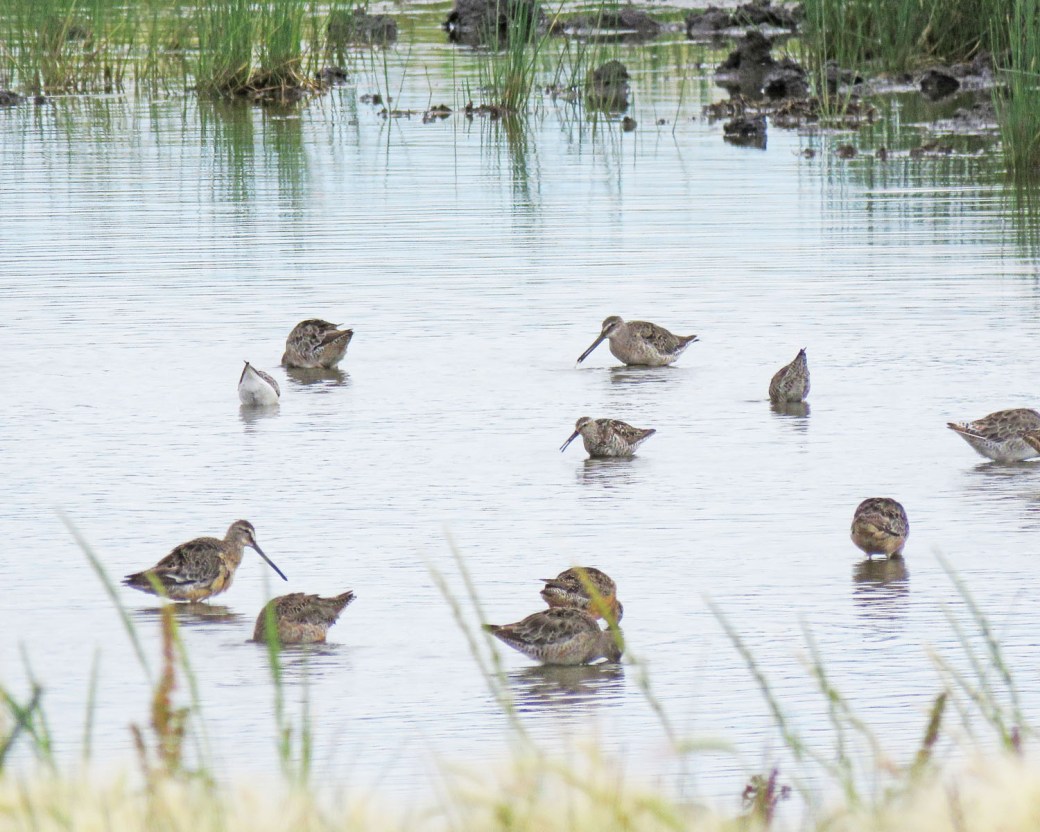
Short-billed Dowitcher 10 0 10
Long-billed Dowitcher 5 0 5
Short-billed/Long-billed Dowitcher 135 0 135
Wilson’s Snipe 1 0 1
Wilson’s Phalarope 2 0 2
Red-necked Phalarope 4 2 6
 TOTAL 261 114 375

Shorebirds respond to management

This is the good news. There is plenty of evidence which demonstrates shorebird populations responding to conservation management, whether intentional or as part of wider habitat management. If habitat loss is seen as one the primary drivers of population decline then increasing the area and/or quality of habitat should at least have a mitigating effect. Understanding the ecology of shorebirds is critical in this including the provision of habitat for invertebrates, availability of gently sloping edges to wetlands and water depth (generally shorebirds prefer depths between 0-10cm). Periods of drawdown in artificial wetlands especially during migration will also encourage shorebirds to feed in particular wetlands. Most, but not all, shorebirds avoid shrubs which are known to harbour predators. These birds prefer open habitats and short vegetation around prairie wetlands. Conflict can also arise where people may recreate near shorebirds. Visitors to Grand Beach a few years back would have been familiar with this topic via fenced exclosures protecting Piping Plover nests. Although other factors may have had greater influence on Piping Plovers in Manitoba, this type of scheme has been successful in other parts of North America.

Linking Communities – Wetlands and Migratory Birds

This interesting program links wetlands in Mexico (Marismas Nacionales, Nayarit), USA (Great Salt Lake) and Canada (Chaplin and Quill Lakes). All the three wetland areas share three common conservation goals:

  1. Conservation
  2. Environmental Education
  3. Ecotourism

They also share many of the same shorebird species, are each a WHSRN and IBA and have similar economic, social and environmental needs. This program is a fantastic example the need to think big, cross-borders and cultures to work together for conservation across a continent.

IMG_1418.JPG

Beautiful diorama at the Chaplin Nature Centre. Photo Tim Poole

Of course, Manitoba already has an example but with a twist, as Oak Hammock Marsh has been twinned with the Hula Valley in Israel. However the idea of linking the actual communities near major migratory hotspots across North, and possibly South America, does add a certain appeal.

IMG_1420

A Piping Plover and American Avocet outside the Chaplin Nature Centre. Photo Tim Poole

And thanks

Finally, I would like to thank the organisers who made this interesting and useful workshop happen, especially Manomet (Monica, Brad and Brian), Chaplin Nature Centre (Lori, Clem and a great team behind the scenes) and Nature Saskatchewan.

This event has struck a chord. Shorebirds have for me been a fun group to watch ever since I was asked to count wintering Northern Lapwing, Eurasian Golden Plover and Grey (Black-bellied) Plover during my period in France. Over 6 years in Scotland, the declines in shorebirds, especially breeding birds, was becoming an increasingly high priority. Many of the same issues appear to be impacting on these birds across continents. A number of our IBAs in Manitoba are important areas in the lifecycle of shorebirds. With populations continuing to decline across global and regional ranges, we in Manitoba need to consider shorebird conservation  more than we may have done previously.

IMG_1293.JPG

Willet, another prairie species at Oak Hammock Marsh earlier this spring. Photo copyright Tim Poole

Manitoba IBA Program Update For Early June

Here is our early June update on the Manitoba IBA Program

Summer Blitz Program

We are aiming to organise three bird blitzes of Manitoba’s IBAs by the end of the first week in August. All of these will be in southwestern IBAs. Unfortunately poor weather prevented us from delivering the Delta Marsh blitz in late May but we believe the three planned will provide good variety of places and species to keep everyone on their toes. The current plan is:

  1. Sunday June 19 – Oak Lake and Plum Lakes IBA near Virden
  2. July 16 or 17 – Southwestern Manitoba Mixed-Grass Prairie IBA
  3. Sunday August 7 – Whitewater Lake IBA, Deloraine

For more information see https://importantbirdareasmb.ca/2016/06/10/volunteers-needed-for-summer-iba-blitzes/

Summer Student

Thanks to a grant from the Province of Manitoba Green Team, we welcomed Marshall Birch back as Program Assistant for a few months over this summer. Marshall has been a great help on a number of tasks, including helping with making resources for the program, research and assisting with the blitz program.

IBA in the news

Following an appearance on CBC, Donna Martin was joined by a journalist from the Express Weekly. You can see a link to the article (or a scan) , including quotes from Donna and me at https://importantbirdareasmb.ca/2016/05/20/news-feature-in-the-weekly-express/.

More Monitoring Needs

We are keen to partner with other organisations and programs as we are all contributing ultimately to the same outcomes – conservation of birds. We are therefore asking people to support a couple of things if possible:

  1. Oak Hammock Marsh Summer Breeding Census, https://importantbirdareasmb.ca/2016/05/27/oak-hammock-marsh-summer-bird-census/
  2. Piping Plover International Census, https://importantbirdareasmb.ca/2016/05/25/international-piping-plover-census/

Some of our volunteers are already involved in supporting other programs such as the Breeding Bird Survey, a critical long-term monitoring scheme for birds across North America.

Trip blogs

One of the delights of the summer is the opportunity to get out and see IBAs, preferably with our volunteers. Here is a summary of recent blogs:

Proven Lake trip blog by Marshall – https://importantbirdareasmb.ca/2016/06/03/proven-lake-trip-report/

Proven Lake trip ‘videos’ – https://importantbirdareasmb.ca/2016/06/08/proven-lake-videos/

Oak Lake and Plum Lakes IBA trip – https://importantbirdareasmb.ca/2016/06/08/oak-lake-and-plum-lakes-iba-trip/

Douglas Marsh IBA – https://importantbirdareasmb.ca/2016/06/08/douglas-marsh-iba/

Big Grass Marsh IBA Trip report – https://importantbirdareasmb.ca/2016/06/07/big-grass-marsh-trip-report/

IBA Protocol

Finally, I have been contacting folk about the IBA Protocol on eBird. It is important to use it on every trip to an IBA as your data would not maximise its potential without it. Here is a quick note – https://importantbirdareasmb.ca/2016/05/20/iba-protocol-on-ebird/

Thanks and have a great weekend

Tim

IMG_4019

Donna Martin took this photo of a White-faced Ibis earlier this year. Come along in early August to see this and more at Whitewater Lake. Photo copyright Donna Martin

Volunteers Needed for Summer IBA Blitzes

Good afternoon everyone

Firstly, we will be going ahead with a blitz of Oak Lake and Plum Lakes IBA next Sunday, June 19th. Start time tbd but probably between 7-8. We have enough people for 2-3 teams currently but it would be great if we could get more folk coming along to really give the IBA Program in the area some additional help. This is a globally important IBA, mainly for waterbirds but also has a mix of habitats making it an interesting area to bird. I will be leaving with a few people from Winnipeg early in the morning if anyone else might be interested.

We are also looking to do a couple of blitzes in other southwestern IBAs by the end of the 2016 season. The plans currently are:

July 15 or 16 – Southwestern Manitoba Mixed-grass Prairie IBA

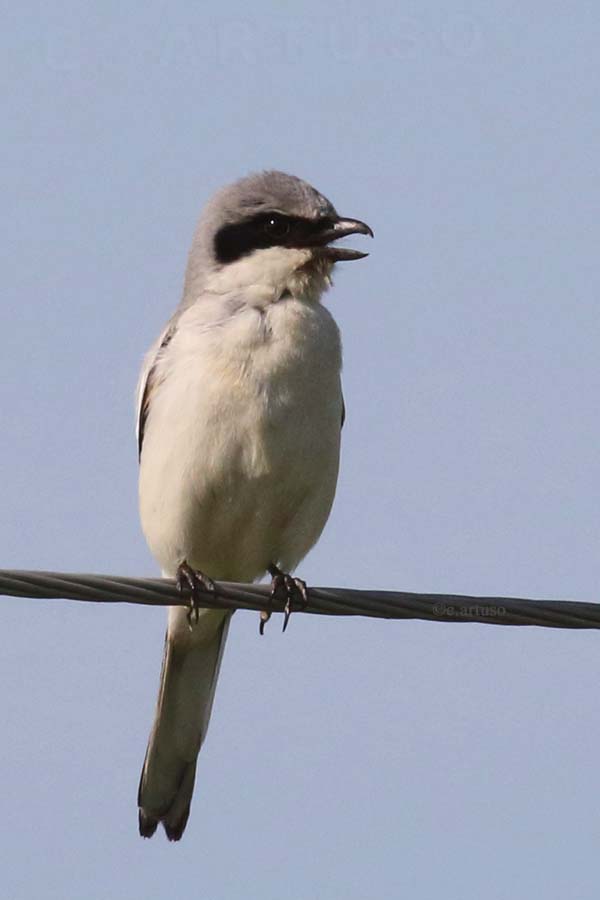
We would be monitoring breeding birds, however in this case we will target Species At Risk, especially Sprague’s Pipit, Chestnut-collared Longspur, Loggerhead Shrike, Ferruginous Hawk and Baird’s Sparrow, plus other rarities such as Grasshopper Sparrow and Bobolink.

Last year we did this in 5 teams and that would be my intention for 2016. We also managed to get permission to enter a few properties and again, I would hope to replicate this. We would start early and meet for lunch at the Chicken Chef in Melita. We have a few folk who will likely come from Winnipeg but again we would love getting volunteers from the Southwest. I would also be really keen to team up some local people with our IBA volunteers.

IMG_0199

Ferruginous Hawk in the Southwestern Manitoba Mixed-Grass Prairie IBA. Photo copyright Tim Poole

August 7 – Whitewater Lake

We would target the large concentrations of shorebirds in the ephemeral wetlands. There were large populations across these wetlands in 2015 and we suspect there may be globally important congregations passing through Whitewater. We will probably go for the Sunday and get groups to cover the lake edges (or nearest roads) and some of the potholes to the north and west finishing in Boissevain for lunch. Again we can provide gas cards for people who travel further.

Spaces might be limited on these blitzes depending on interest so please let me know if you would like to join us for some fun birding!

IMG_0382

This Virginia Rail peeked his head through the grass at Whitewater Lake IBA in 2015. And maybe 2016? Photo by Tim Poole

Proven Lake Videos

This is a follow-up to Marshall’s post on Proven Lake. Ok, so Marshall tried to avoid this but we thought we would post a couple of videos to the site. Below we demonstrate how we monitor an IBA in Manitoba, or more precisely, how pointless these videos really were!

Video 1 – Finding the lake

Reaching the end of the channel, we realised that we cannot even make it onto the lake due to the dense, dead cattails.

Video 2 – Beaver lodge

Here is an old, presumably no longer used beaver lodge. The lack of fresh material suggests that beavers are not using this lodge. Extra prize to the person who can identify the bird calling – ok, it’s a bit easy, so no prize!