June IBA Contest – Grassland Birds

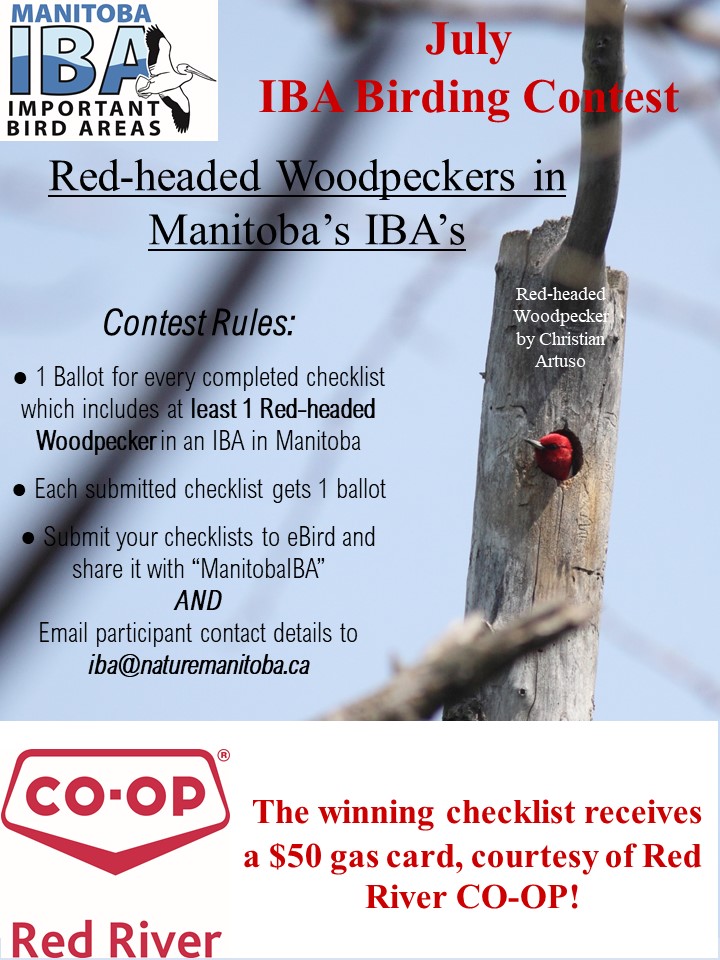
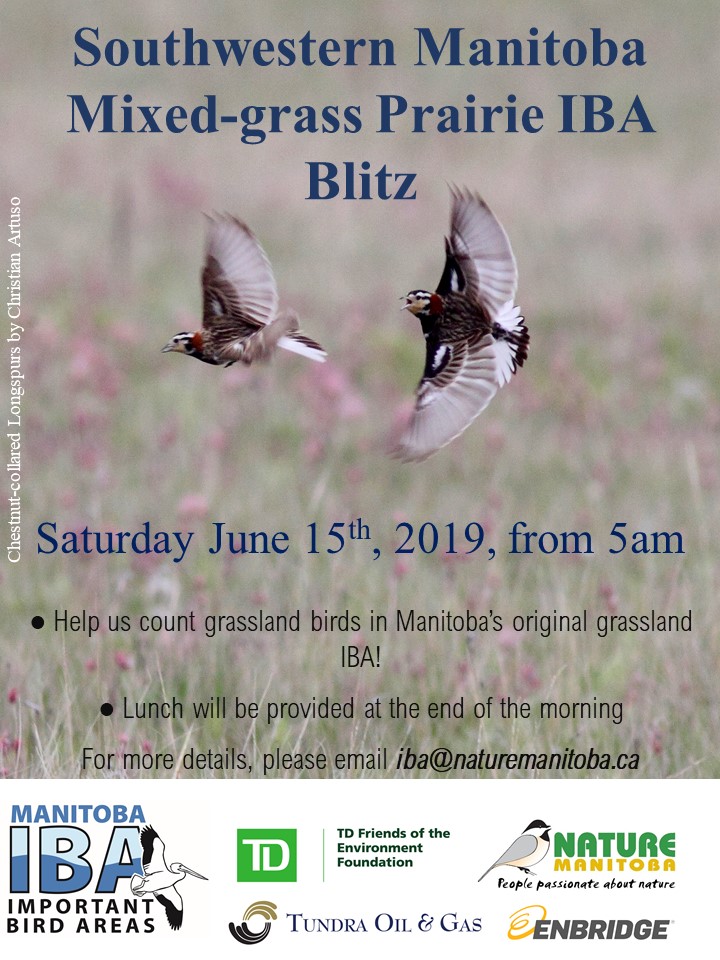
Slide1.JPG

Here is the list of eligible species:

Baird’s Sparrow

Grasshopper Sparrow

Sprague’s Pipit

Chestnut-collared Longspur

Savannah Sparrow

Bobolink

Western Meadowlark

Loggerhead Shrike

Ferruginous Hawk

Sharp-tailed Grouse

Marbled Godwit

Willet

Upland Sandpiper

Burrowing Owl

Whitewater Lake ISS Trip with Lynnea Parker and Randy Mooi

Yesterday, May 29th, Randy Mooi, Curator of Zoology at the Manitoba Museum, and Lynnea Parker headed to Whitewater Lake to carry out International Shorebird Survey (ISS) transects. The day was pretty cloudy, smoke from Alberta creating dull, Mordor-like skies. Randy commented as follows:

‘Not the most fantastic day to be at Whitewater, but decent shorebird numbers of a variety of species. Shocking to have no ibis, and pretty much as weird to see only two coots! Grebes were pretty uncommon.’

Shorebirds 2 Whitewater east end May 29 2019 red

Ashen skies, and distant shorebirds, the changing face of Whitewater Lake? Copyright Randy Mooi

With a focus on shorebirds, there were plenty of undercounts of other groups. But the lack of coots, grebes and herons/ibises has also been noted by other birders this year. Strange! In total, they counted 69 species and 2,206 individuals. Of these, there were 18 species of shorebird, and 1,246 individuals, a little over half of all birds counted.

At least this plunging american Avocet gave some light relief. It almost looks a bit giraffe-like (all photos copyright Randy Mooi).

There was not much of an east-west split, although due to road conditions, part of the east was not covered.  Lynnea suspected that concentrations were highest in the northeast corner. Interestingly, and in sharp contrast, this area was almost devoid of water during our workshop on the 18th. Semipalmated Sandpiper was the most abundant species (464), with the next being, perhaps surprisingly, American Golden Plover. There were zero American Golden Plover and Baird’s Sandpiper on the 18th. On this occasion there were no dowitchers. This goes to show the seasonal changes being noted, something that ISS was established to examine.

Golden Plover 2 cropped Whitewater May 29 2019

Gorgeous flock of American Golden Plovers. Copyright Randy Mooi


Thank you to Lynnea and Randy for completing these surveys. We would also like to thank the Manitoba Museum for donating Randy’s time to help, and Canada Summer Jobs for funding Lynnea’s work in southwestern Manitoba this summer (there will be more to come on this).

We still need to do one more visit next week to the lake. If you are interested in helping out we would love to hear from you. Our long-term vision is that we would be able to get visiting groups of birders to run the ISS routes when they are at the lake – the routes cover some of the best places for birding anyway!

And, as ever, here are the results (please note, the 3 zones, east, west and Sexton’s are covered in the maps on this page).

Species Name Eastern ISS Routes Western ISS Route Sexton’s Island ISS Stop TOTAL
Snow Goose 0 36 0 36
Canada Goose 0 41 0 41
Blue-winged Teal 5 20 2 27
Northern Shoveler 2 94 3 99
Gadwall 4 48 2 54
American Wigeon 0 1 0 1
Mallard 2 112 2 116
Northern Pintail 0 6 0 6
Green-winged Teal 0 2 0 2
Lesser Scaup 0 40 0 40
Bufflehead 0 2 0 2
Ruddy Duck 0 1 0 1
Horned Grebe 0 1 0 1
Eared Grebe 0 3 0 3
Western Grebe 0 21 0 21
Mourning Dove 2 2 0 4
Sora 2 1 0 3
American Coot 2 1 0 3
American Avocet 11 52 2 65
Black-bellied Plover 1 2 0 3
American Golden-Plover 24 124 0 148
Killdeer 12 21 1 34
Marbled Godwit 1 15 1 17
Ruddy Turnstone 0 3 0 3
Stilt Sandpiper 4 75 0 79
Sanderling 20 0 0 20
Baird’s Sandpiper 60 53 17 130
Least Sandpiper 0 4 5 9
White-rumped Sandpiper 120 2 0 122
Pectoral Sandpiper 0 3 0 3
Semipalmated Sandpiper 250 210 4 464
Wilson’s Phalarope 5 16 2 23
Red-necked Phalarope 17 85 3 105
Spotted Sandpiper 0 2 0 2
Willet 5 10 3 18
Lesser Yellowlegs 0 1 0 1
Franklin’s Gull 29 0 0 29
Ring-billed Gull 25 0 0 25
Black Tern 1 0 0 1
Forster’s Tern 11 24 11 46
Double-crested Cormorant 0 6 0 6
American White Pelican 2 93 0 95
Great Egret 0 0 14 14
Turkey Vulture 1 0 0 1
Northern Harrier 2 1 1 4
Red-tailed Hawk 0 1 1 2
falcon sp. 0 1 0 1
Eastern Kingbird 0 6 0 6
Black-billed Magpie 1 0 0 1
Horned Lark 1 5 0 6
Barn Swallow 0 1 0 1
Cliff Swallow 0 3 0 3
Sedge Wren 6 9 0 15
American Robin 2 1 0 3
European Starling 0 3 0 3
American Goldfinch 2 0 0 2
Clay-colored Sparrow 1 0 0 1
Nelson’s Sparrow 1 0 0 1
Savannah Sparrow 12 4 1 17
Song Sparrow 5 1 2 8
Swamp Sparrow 1 0 0 1
Yellow-headed Blackbird 3 79 X 82+
Bobolink 1 0 0 1
Western Meadowlark 1 2 0 3
Red-winged Blackbird 42 X X 42+
Brown-headed Cowbird 7 14 0 21
Brewer’s Blackbird 6 X 0 6+
Common Grackle 7 43 0 50
Common Yellowthroat 3 0 0 3
Golden Plover 2 crop Whitewater May 29 2019

Close-up of the American Golden Plovers. Copyright Randy Mooi

Brandon Shorebird Workshop

On May 17th and 18th, Tim Poole and Christian Artuso delivered a Shorebird Workshop to the new Brandon Birders Group. On the evening of the 17th, we gave a presentation on shorebird identification to the group in a room at Brandon University. The room was donated for free for the evening, so special thanks to the folk at the University Geography Department.

On the morning of the 18th, we were joined by a group of 9 people for a trip to Whitewater Lake. The plan was to find some large groups of shorebirds around the lake and help them to identify the various species in the field, looking specifically at field marks.

When selecting dates for birding events, there is always an aspect of cross your fingers, hoping that it’s not bad weather. Well, we picked a day which was cold and windy, and pretty unpleasant to be outside. We did though plough on, knowing that the shorebirds would still be present in the area.

Christian and I (Tim) had been out at Oak Lake the previous day, completing the ISS survey for this IBA. On the way back to Brandon we were again astounded to see thousands of geese at Deleau, just outside the boundary of the Oak Lake and Plum Lakes IBA. Included in the mass of geese were over 1,000 Ross’s Geese, a significant spring concentration for southern Manitoba. There were also hundreds of geese on the way into Whitewater from Highway 10.

Ross's Goose_8254c_Snow Goose

Spot the smaller Ross’s Geese in the foreground, and compare with the larger Snow Geese behind. Copyright Christian Artuso

Starting at the east end at 19N (for a map of the IBA, click here), we encountered the unexpected, a vast area of open mud, small pools of water, and distant shoreline. This was in stark contrast to fall 2018. Back then, this area is was covered in shallow water and mudflats, ideal habitat for shorebirds. We could make out some distant Black-bellied Plover. Most impressively, Christian spotted a group of shorebirds flying directly towards us. The unmistakable round, russet forms of 13 Red Knots were a definite highlight of the day, everyone managing to get great views in their binoculars as they flew past.

shroebird workshop at Sexrtons_20190518_103201

Watching shorebirds at Sexton’s and trying to stay warm. Copyright Christian Artuso

We carried on along 20N towards the west. At one stage we picked out a vast flock of Snow Geese, over 19,000 splayed across the dull grey skyline. Along the road we also had Ross’s Goose and Greater White-fronted Goose. We also saw our only White-faced Ibis.

Ross's Goose_8460_Snow Goose_Artuso

There were clouds of Snow Geese at Whitewater on the day. Copyright Christian Artuso

Sexton’s Point had a few shorebirds to show, the highlight being a Hudsonian Godwit. We were able to show everyone the distinctly darker plumage and rufous chest. Another highlight was a Clark’s Grebe.

American Avocet_8771_Artuso

The unmistakable blue legs, salmon head and upcurved beak of an American Avocet. Copyright Christian Artuso.

At this point we still had not seen the large groups of shorebirds that we were expecting. We eventually did find one such group along the western edge of the lake.

shorebird fiock_9006_REKN_STSA_LESA_MAGO_Artuso

Mixed flock of shorebirds. Copyright Christian Artuso

Least Sandpiper, White-rumped Sandpiper, Dunlin, Pectoral Sandpiper, Stilt Sandpiper and Red-necked Phalarope were among the shorebirds foraging in a small wetland next to the road.

P1050803.JPG

Shorebirds feeding along the shoreline, note how grey it is! Copyright Tim Poole

We were able to use the scopes to really zoom in and show people the intricate details. For example, we showed everyone how to distinguish Least Sandpiper from the White-rumped Sandpiper (a lack of Semipalmated and Baird’s made this a lot easier). We asked everyone to focus first on the wing length versus tail length. Then we zoned in on other features (plumage, bill shape and length, leg colour, etc).

Least Sandpiper_8160_Artuso

Least Sandpiper. note that the primary feathers on the wings reach the same point on this bird as the tip of the tail feathers. This is typical of Least and Semipalmated. Note the yellow legs, brown plumage and decurved beak, all distinguishing features when compared with with Semipalmated Sandpiper. Copyright Christian Artuso

P1050800.JPG

Showing how cold we were, everyone sheltering behind the Atlas truck and sitting down. Copyright Tim Poole

There were small numbers of dowitchers mixed in with the general shorebird flocks. At this point, Whitewater Lake IBA Caretaker, Gillian Richards identified that one of these birds was a Long-billed Dowitcher. This was a great spot! We spent some time focusing on the differences between neighbouring Short-billed Dowitchers and the single Long-billed Dowitcher. The first thing that Gillian had noticed was that the flanks of the Long-billed were barred rather than spotted. The plumage was also darker red versus the salmon plumage of the Short-billed. Finally, the clincher was the contrast on the scapular and back feathers. In the case of the Long-billed, these have white tips, and the case of the Short-billed, they have buff tips. Christian very helpfully has provided a contrast collection of his photos from the day so you can really see what we are talking about!

Long-billed versus Short-billed Dowitcher comparison.jpg

Composite images by Christian Artuso

At this point, cold and wind battered, we headed in different directions. We hope everyone had a good trip, and learnt more about shorebirds, and we hope to do this again soon in eastern Manitoba!


While doing this, we completed the International Shorebird Survey route for west Whitewater Lake. If you would like to find out more about our involvement in this, and would like to contribute to shorebird monitoring, first take a look at this blog. There you will find maps. We would love to hear from you of course if you are interested in finding out more. Email us at iba@naturemanitoba.ca.


We are also providing links to some documents and resources which might prove useful to you as you learn more about shorebird identification.

IBA Shorebird Photo Identification Card (email if you would like us to mail you a laminated copy)

Copy of Christians’ shorebird presentation and notes

Christian’s shorebird notes handout

An old IBA blitz blog with some good info on fall identification of dowitchers

Christian’s Dowitcher notes

Surfbirds excellent Dowitcher comparison


Thank you to Glennis, Gillian and Alex for organising the workshop. We would also like to pass on thanks to our funders, notably the Baillie Fund, Enbridge and Tundra Oil and Gas for providing funds for our attendance.


Apart from Snow Geese, the most impressive numbers were of Least Sandpipers, and Stilt Sandpipers. Here is the eBird summary of the days birding.

Species Name Species Count
Snow Goose 22,154
Ross’s Goose 2
Greater White-fronted Goose 14
Canada Goose 180
Tundra Swan 31
Blue-winged Teal 66
Northern Shoveler 130
Gadwall 121
American Wigeon 6
Mallard 121
Northern Pintail 16
Green-winged Teal 3
Canvasback 43
Redhead 10
Ring-necked Duck 9
Lesser Scaup 6
Sharp-tailed Grouse 1
Red-necked Grebe 1
Eared Grebe 8
Western Grebe 95
Clark’s Grebe 1
Rock Pigeon 3
Eurasian Collared-Dove 1
Mourning Dove 4
American Coot 2
American Avocet 74
Black-bellied Plover 4
Semipalmated Plover 9
Killdeer 15
Upland Sandpiper 2
Hudsonian Godwit 1
Marbled Godwit 27
Red Knot 13
Stilt Sandpiper 183
Dunlin 9
Baird’s Sandpiper 5
Least Sandpiper 746
White-rumped Sandpiper 9
Pectoral Sandpiper 1
Semipalmated Sandpiper 5
Short-billed Dowitcher 18
Long-billed Dowitcher 1
Short-billed/Long-billed Dowitcher 1
Wilson’s Phalarope 48
Red-necked Phalarope 74
Spotted Sandpiper 1
Willet 15
Lesser Yellowlegs 12
shorebird sp. 500
Franklin’s Gull 441
Forster’s Tern 57
Double-crested Cormorant 2
American White Pelican 8
Great Egret 3
White-faced Ibis 1
Turkey Vulture 1
Northern Harrier 3
Red-tailed Hawk 3
Great Horned Owl 1
Peregrine Falcon 1
Common Raven 3
Horned Lark 1
Tree Swallow 4
Barn Swallow 13
Marsh Wren 1
American Robin 6
European Starling 3
American Pipit 1
Vesper Sparrow 2
Savannah Sparrow 9
Yellow-headed Blackbird 83
Bobolink 3
Western Meadowlark 7
Red-winged Blackbird 105
Brown-headed Cowbird 2
Common Grackle 36
Northern Waterthrush 1
Yellow Warbler 1
Palm Warbler 2
Yellow-rumped Warbler 1
House Sparrow 2

Thank you Tundra Oil and Gas!

The Manitoba IBA Program was delighted to receive a donation from Tundra Oil and Gas, part of the Richardson Foundation. The donation of $10,000 will go towards our outreach work in southwestern Manitoba, especailly around the Southwestern Manitoba Mixed-grass Prairie IBA, Oak Lake and Plum Lake IBA, and Whitewater Lake IBA.

Our Coordinator, Tim Poole was at hand to collect the cheque in Oak Lake from Chris Masson. The story was also featured in the Virden Empire Advance.

Thank you for your contribution to our continued work!

P1050708.JPG

Tim (on left) receiving the cheque from Tundra Oil and Gas employee Chris Masson

More details – Shorebird Workshop,Friday 17 and Saturday 18 May, Brandon and Whitewater Lake

Posted on behalf with, and in partnership with the Brandon Birders

Dear Birders,

We are pleased to offer a Shorebird Identification Workshop for the upcoming weekend of May 17th and 18th. The Workshop is designed to help improve shorebird identification skills, and further understanding of the biology of these fascinating birds. Birders of all skill levels are welcome, whether you are part of an organized effort to monitor shorebirds for conservation efforts or just enjoy watching shorebirds in the field. The Workshop is organized in two parts (details set out below). You can attend one of the events or both if you choose.

Friday, May 17th – Shorebird biology and identification session with Tim Poole and Christian Artuso from Manitoba’s Important Birds Area Program. The session will take place at Brandon University in the Brodie Building, Room 3-47 (third floor) from 7-9 pm. Tim and Christian will look at the different shorebirds found in Manitoba, discuss their biology, and talk about the best field marks to identify them.
The doors to the Brodie Building will be unlocked for us between 6:30-7:15 pm. Please be prompt, as the doors will shut after 7:15pm. Free parking is available on the street outside the building or in Lot 10 opposite. The Brodie Building is the first building on the right as you turn West onto Louise Ave from 18th St.  https://www.google.com/maps/place/49°50’37.8″N+99°57’45.7″W

Saturday, May 18th – Field trip to look at shorebirds in the Whitewater Lake IBA with Gillian Richards, Christian Artuso and Tim Poole. The purpose of this trip is to look at the various shorebirds (and other birds) in the field, see identification field marks, learn how to count flocks, and how to monitor these declining birds in their natural habitats.

Participants who wish to car pool from Brandon can meet at Glennis’ house (722 21st St.) at 7:30 am. Parking is on the street or in the driveway.

All participants will meet outside the Bordertown Restaurant and Lounge in Boissevain at 8:30 am. Please note that coffee and snacks will be provided in Boissevain, but bring everything you will need for several hours in the field, including;

  • Binoculars, spotting scope (if you have one)
  • Suitable clothing and footwear (rubber boots might be a good idea), remember it might rain…
  • Water, and a lunch,
  • Insect repellent (yes, the ticks are out), sunscreen and/or a hat.

We don’t expect that much walking will be involved. We estimate that we will finish by 2:00 pm at Whitewater at the latest.

If you plan to attend, please email the Brandon Birders at brandonbirders@gmail.com.

We look forward to seeing you there.
….
Brandon Birders

P1050769

Douglas Marsh IBA

It was notable yesterday that the vegetation at Douglas Marsh might be changing. In recent years, the areas that folk use to listen for Yellow Rails, along PR340, has been dominated by tall cattails. Right now it looks like the sedges may be taking over again.

If this is the case, there should be some good listening opportunities for rails this year!

Just be careful of the road (maybe wear a high visibility vest).

Oak Lake and Plum Lakes IBA and Deleau

Following a fun morning workshop at Oak Lake Community School yesterday (May 9th), I (Tim), took a quick drive south through the Oak Lake and Plum Lakes IBA. There were plenty of waterfowl in the wetlands north and east of the Oak Lake Resort, including a few Tundra Swan. Shorebird numbers were few. In my view, the water levels were a bit too high, and the area of exposed wet mud too low for these birds. I did check out some of our shorebird monitoring route, and found around 30 American Avocets, a Solitary Sandpiper, Wilson’s Phalarope and plenty of yellowlegs.

P1050714

Tundra Swans at Oak Lake and Plum Lakes IBA. Copyright Tim Poole

Here are the counts from quick outing.

Species Count
Snow Goose 3
Canada Goose 32
Tundra Swan 16
Wood Duck 2
Blue-winged Teal 39
Northern Shoveler 20
Gadwall 24
American Wigeon 2
Mallard 40
Green-winged Teal 2
Canvasback 14
Redhead 4
Ring-necked Duck 16
Greater Scaup 2
Lesser Scaup 50
Bufflehead 8
Hooded Merganser 12
Ruddy Duck 2
Pied-billed Grebe 4
Red-necked Grebe 13
Eared Grebe 2
Mourning Dove 4
American Coot 2
American Avocet 28
Killdeer 5
Wilson’s Phalarope 1
Solitary Sandpiper 1
Greater Yellowlegs 1
Lesser Yellowlegs 16
Franklin’s Gull 30
Double-crested Cormorant 1
American White Pelican 6
Turkey Vulture 1
Northern Harrier 1
Swainson’s Hawk 1
Red-tailed Hawk 1
Northern Flicker 2
American Kestrel 4
Blue Jay 1
Black-billed Magpie 2
American Crow 2
Common Raven 1
Purple Martin 1
Tree Swallow 40
Black-capped Chickadee 1
White-breasted Nuthatch 1
Marsh Wren 1
Ruby-crowned Kinglet 1
Swainson’s Thrush 1
American Robin 8
European Starling 2
Chipping Sparrow 4
Dark-eyed Junco 1
White-crowned Sparrow 2
White-throated Sparrow 1
Savannah Sparrow 12
Swamp Sparrow 4
Yellow-headed Blackbird 400
Western Meadowlark 10
Red-winged Blackbird 200
Brown-headed Cowbird 2
Brewer’s Blackbird 30
Common Grackle 40
Orange-crowned Warbler 1
Yellow-rumped Warbler (Myrtle) 6
House Sparrow 12

Heading back towards Winnipeg on Highway 2, I came across several thousand geese at the bend in the highway east of Deleau. In total, I estimated at least 6,000 geese, primarily Snows. in among the Snows were some smaller white morph Ross’s and Greater White-fronted (I had down around 100 of this species). There were also Cakling Geese mixed in with the Canada’s

P1050749

Some of the nearly 5000 Snow Goose at Deleau. Copyright Tim Poole

P1050744

Launching Snow Geese. Copyright Tim Poole

P1050739

A number of Greater White-fronted Geese were dotted around the area. Copyright Tim Poole

So a great chance to see all five typical Manitoba spring migrating geese if you are in the area. There were also a few more shorebirds, including Willet and Marbled Godwit in this spot.

P1050769

Preening Willet. Copyright Tim Poole

This corner is currently just outside the IBA boundary. On yesterdays evidence, the boundary might need a rethink!