August IBA Contest and Result from July

August IBA Contest

August is a great month for shorebirds in Manitoba’s IBAs. You can also enter by submitting observations through our website at https://importantbirdareasmb.ca/submit-your-observations-comments/. At the end of the month we will do a draw of all eligible checklists for an opportunity to win a $50 gas card from Co-op, donated by Red River Co-op.

July’s contest was won by Jo Swartz, Betsy Thorsteinson, Kelsey Bell and Katherine Schulz for this checklist from our Shoal Lakes IBA Blitz – https://ebird.org/view/checklist/S58423556.

Pulling Weeds for Plovers – a Report from our First Work Party of 2019

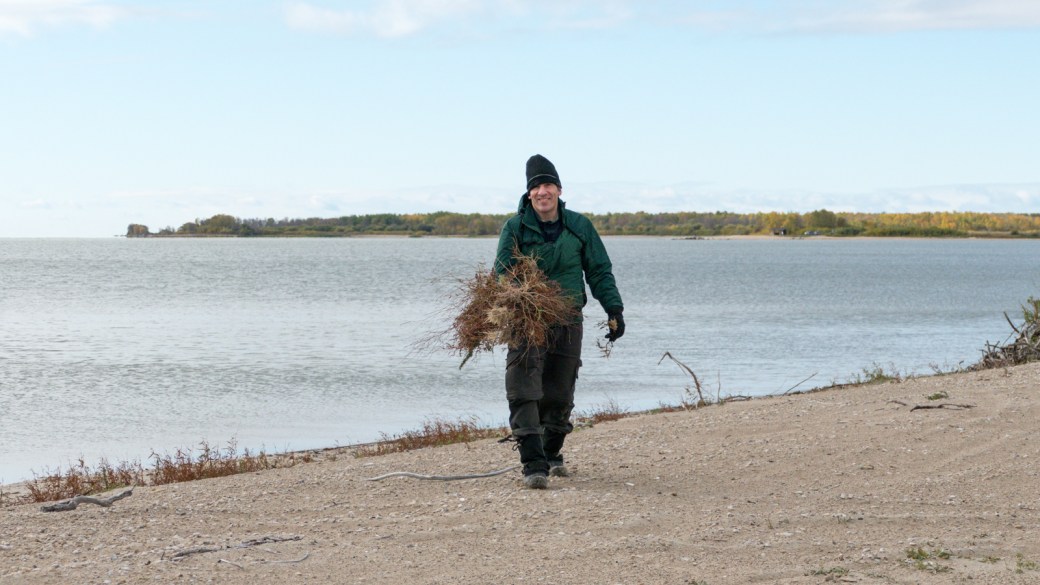
On Saturday July 20th, a group of intrepid volunteers traveled to Riverton Sandy Bar to pull weeds. Thank you to Joanne, Lynnea, Kelsey and Bonnie for taking care of the days event. Kelsey Bell gives us a rundown of the mornings fun.

Often when you think of habitat loss, you think of trees being cut down for paper, areas being cleared for development, or land conversion for agriculture. So, it might be strange to think that the removal of vegetation can actually create habitat for a species of bird, the Piping Plover.

Piping Plovers nest on wide, sandy beaches with little vegetation. In Manitoba, areas such as this are under threat due to above average water levels or encroachment of weeds. Historically, Piping Plovers used the sand bar between the west shore of Lake Winnipeg and Hecla Islands (which together make up the Riverton Sandy Bar IBA) as nesting habitat. However, the last confirmed sighting was in 2000. Unfortunately, this likley due to the presence of white-sweet clover, an invasive weed that has taken over the sand bar.

The early morning trek out to the sand bar was a little chillier than expected, but upon arrival and after a quick survey of the area, 23 eager volunteers set to work. Volunteers from Winnipeg, Gimli and surrounding areas came for the morning, as well as a team from the East Interlake Conservation District and Manitoba Sustainable Development. With so many hands on deck, we quickly made headway.

Turns out the cooler weather was a blessing, because weed pulling is hard work. Everyone grabbed a bag and got to work. In no time at all, we had a pile of sweet clover filled bags. First, we started with some maintenance in the areas that had been worked on in previous years. It was great to hear all the positive comments from volunteers that had been involved for multiple years. Many commented on how great it looks since the weed pulls began and how much of a difference it has made for the habitat.

Once the maintenance was done, we dug into the bigger weed clearing. Everyone worked together, old friends and new acquaintances, with plenty of laughs and good conversations to go around; it hardly felt like work. As the final bags were being filled our day was cut just a little short by a sudden rain system moving through. We collected our bags, packed up our things and hiked back to our vehicles.

You’ve heard of “pack out what you pack in” or “leave it as you found it”, but with the help of so many hard working hands, I think we left it better than we found it. And we most certainly packed out more than what we packed in.

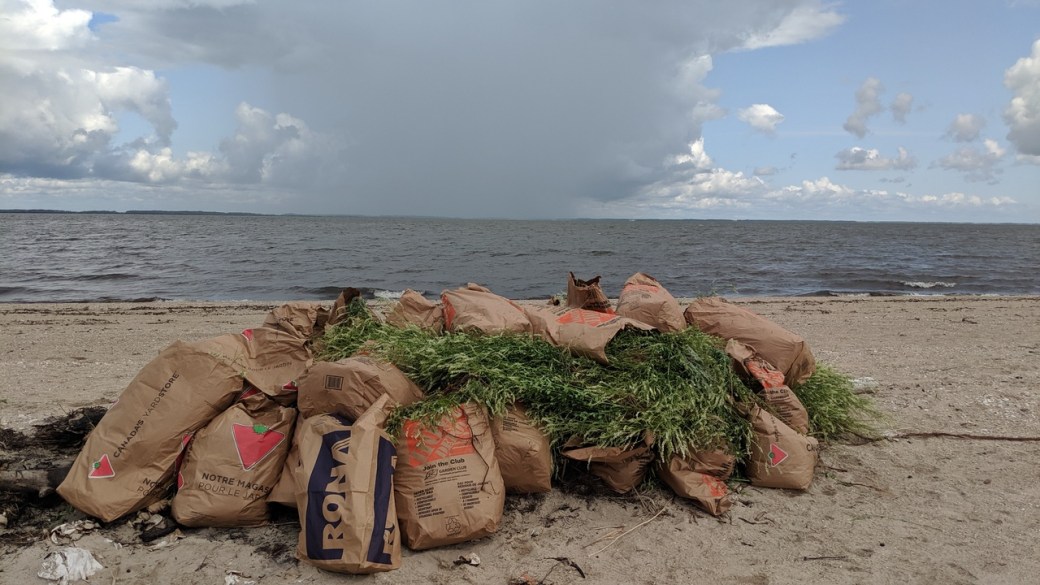
IMG_20190720_114315

The pile of weeds pulled by IBA volunteers, copyright Kelsey Bell.

Thank you to everyone who came out! If you would like to help out, or you missed the last one, don’t worry! We have another fun filled day of weed pulling for plovers on Friday, August 16th. You can find information about the day here.

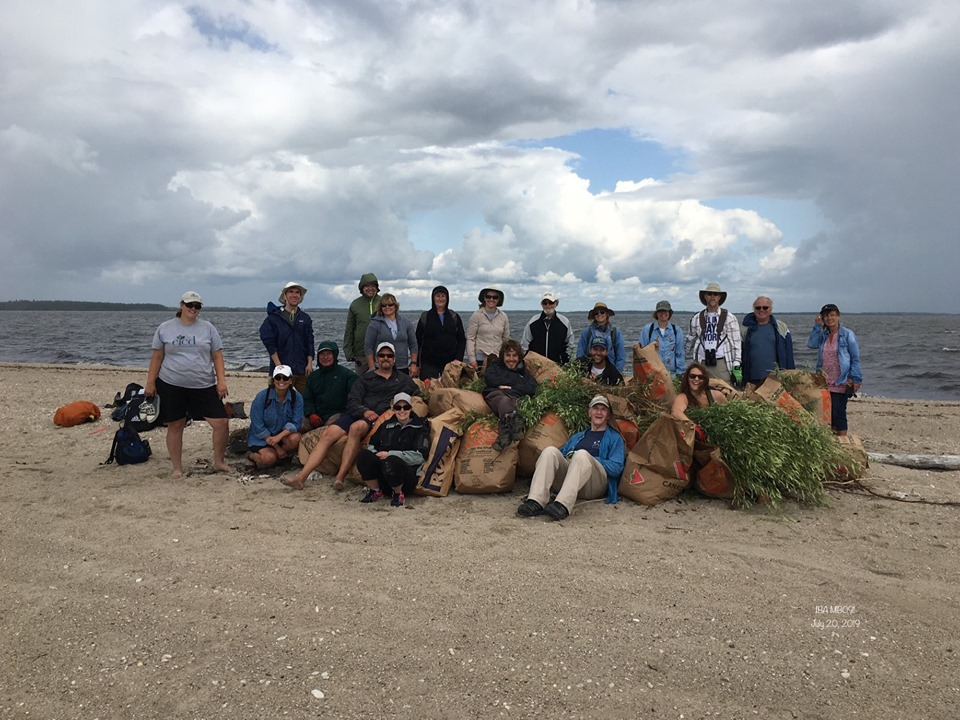
67327249_2303688426383293_2004242889495805952_n

The volunteers after a hard days work, copyright Joanne Smith.

And of course, below is the list of birds observed that day:

Species Count
Killdeer 1
Lesser Yellowlegs 17
Franklin’s Gull 280
Ring-billed Gull 71
Herring Gull 1
Common Tern 3
American White Pelican 6
Osprey 1
Bald Eagle 2
Merlin 1
Least Flycatcher 7
Eastern Kingbird 2
American Crow 1
Barn Swallow 3
Marsh Wren 13
Song Sparrow 9
Swamp Sparrow 4
Red-winged Blackbird 32
Common Yellowthroat 6
Yellow Warbler 7

Summary update of Upcoming Events and News

Given we are now at the last day in July, I thought it would be a good time to send an update on the program, including some events coming up in August and a few other matters coming forward: Firstly, below is a list of events, with a link to more information on our website on the event.

Sunday August 11th

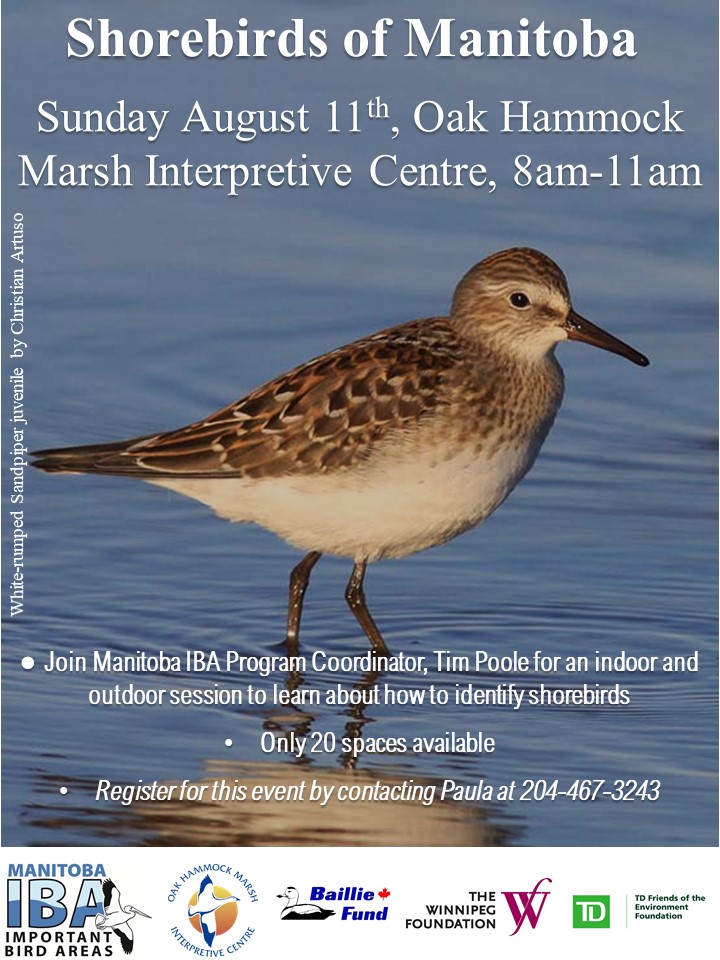
Shorebird Workshop, Oak Hammock Marsh Interpretive Centre – there are 13 spots remaining on this as of yesterday lunchtime, so please get in quick before we fill up.

Shorebirds Workshop at OHMIC 11th August 2019 WRSA

Friday August 16th

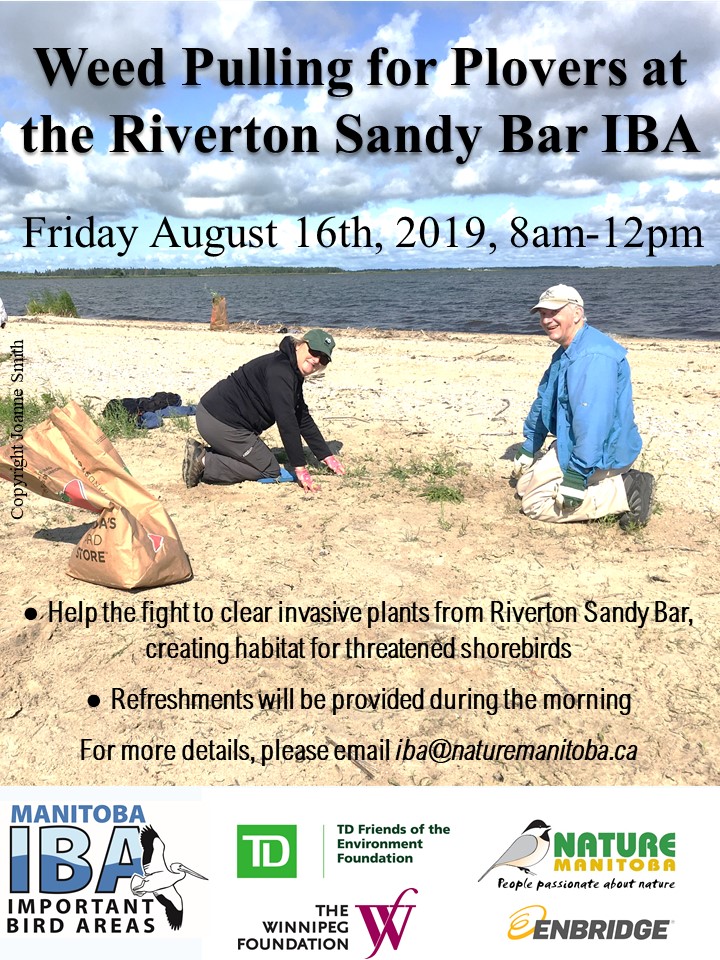
Weed pull at Riverton Sandy Bar IBA

Slide5

Saturday August 17th

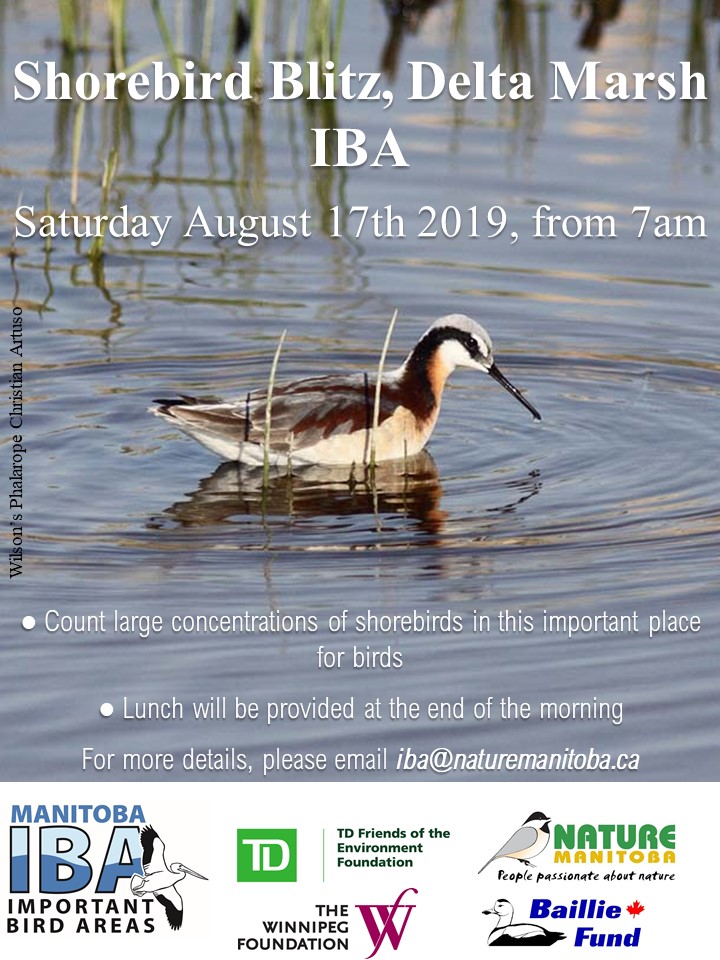
Shorebird Blitz at Delta Marsh IBA

Slide3

Sunday August 25th

Shorebird blitz at Whitewater Lake IBA

Slide4

Earlier in July we had our latest blitz, a Red-headed Woodpecker search at the North, West and East Shoal Lakes IBA. You can read Kelsey Bells account at https://importantbirdareasmb.ca/2019/07/19/shoal-lakes-area-iba-red-headed-woodpecker-blitz/.

The final results are also available, including a map of the location of each pair at https://importantbirdareasmb.ca/2019/07/24/the-final-results-from-the-red-headed-woodpecker-blitz-at-shoal-lakes/.

We also had a small group from the Westman Naturalists check for Red-headed Woodpeckers at the Oak Lake and Plum Lakes IBA.

Finally, Christian Artuso will be leaving Bird Studies Canada today, and Manitoba by the end of next month. Christian has been a leading light in Manitoba bird conservation and monitoring programs for over a decade and will be sorely missed. We have a short piece on our website, and there is also a tribute on the Nature Manitoba website.

Christian Artuso – thank you!

Since 2012, Christian Artuso has served as the Chair of the Manitoba Important Bird Areas Program Steering Committee. We were recently sad to hear that Christian has accepted as post with the Canadian Wildlife Service in Ottawa. He will be leaving Bird Studies Canada at the end of this month and starting his new role in August, departing for Ottawa by the end of that month.

We will miss Christian’s incredible dedication to bird conservation in Manitoba, his enthusiasm, his warmth, quirky sense of humour and of course, his incredible birding skills which is always only so happy to pass on to everyone.

Without Christian’s support, we would have no IBA Program in Manitoba. Along with Carol Scott and Paula Grieef, it was Christian who worked to establish the program. For the three coordinators, it was Christian who would be our go-to person for advice, a sounding board, and a friend.

Christian is a well known figure in the Manitoba birding world. As well as his IBA involvement, he has been a long-standing committee member for the Manitoba Chimney Swift Initiative. He also served on various other committees, advising Masters and PhD students, the management of community pastures, the COSEWIC subcommittee for birds, and so much more. Of course Christian’s lasting legacy will be the superb manitoba Breeding Bird Atlas.

For these reasons Christian will be very much missed by the entire Manitoba birding community.

Thank you Christian for everything you have done for bird conservation in our province!

Sandy Bar Weed Pull-October 2018-Lynnea A Parker-1120814

Delta Marsh IBA Blitz, August 17th 2019

Slide3

Our next blitz will be a shorebird blitz of Delta Marsh IBA. We will be looking to fill 5 groups of between 2 and 4 people per group. We are focusing on finding large groups of shorebirds and potentially other waterbirds. We are also interested in recruiting 2 or 3 people willing to walk along the beaches of the IBA.

We will provide a light picnic lunch at the end of the morning.

Please email iba@naturemanitoba.ca to express an interest in registering.

Riverton Sandy Bar Weed Pull, August 16th

Slide5

Location: Meet at parking lot at Riverton Sandy Bar IBA – Click here for the location of the Riverton Sandy Bar Parking lot.

Date: Friday August 16th

Time: 8am to 12pm

Please note that there is no outhouse at this parking lot.  Closest bathrooms will be in the town of Riverton.

We are planning our second weed pull in 2019 at the Riverton Sandy Bar IBA.

The purpose of this Weed Pull is to once again clear an area of Sandy Bar to make the habitat more attractive to Piping Plover. This shorebird species last nested at Sandy Bar in 2004. With low lake levels and a large open sandy area we hope that the Piping Plover may once again make an appearance at Sandy Bar.

This is always a popular event. We are planning an earlier weed pull in 2019 following advice from botanists that we should pull the invasive clover before the fall when the plants turn to seed.

It would be great to have you join us on the 16th. Please feel free to forward this to others who may be interested in pulling weeds, meeting others and learning about the migrating birds at Sandy Bar.

Things to bring: Please bring:

  • Weather appropriate clothing and footwear
  • Gardening gloves if you have them
  • Binoculars
  • Water
  • a bagged lunch (coffee and snacks provided at start)
  • sunscreen
  • a hat
  • rain jacket if required

Please email iba@naturemanitoba.ca to express an interest in registering.

Red-headed Woodpecker Blitz at Oak Lake and Plum Lakes IBA

On July 14th 2019, there were two blitzes looking for Red-headed Woodpeckers in IBAs. The first was in the North, West and East Shoal Lakes IBA (see here and here). A group from the Brandon Naturalists, Gillian, Glennis, Louanne and Kathryn, set out in two groups to look for Red-headed Woodpeckers. They looked in an area on the east side of the IBA, focusing on previous sightings. In total they found breeding pairs, all marked on the map below. They also found a single dead bird on the road.

Thank you to everyone who took this initiative to go and find these endangered birds in this IBA!

July 14 2019 Oak Lake RHWO Map.jpg

The Final Results From the Red-headed Woodpecker Blitz at Shoal Lakes

Thank you Kelsey for an excellent report last week on our Red-headed Woodpecker Blitz at the North, West and East Shoal Lakes IBA. This is a short blog, with a few photos from the day, and a review of the results.

You can read Kelsey’s report at this link.

Birds

In total we counted over 3,800 birds and 120 species. Over 80% of the birds were counted in the IBA. The most common species was our old friend the Red-winged Blackbird, with 589 counted, of which 430 were in the IBA. Other impressive numbers were Song Sparrow (187) and Western Grebe (162). The Western Grebes, mainly counted from PR415, were carrying young. A windstorm had wiped out some of the colony earlier in the spring, so the sight of young was very much a good news story.

Great Egrets, American Bittern and Great Blue Herons are always good species to find. The Snowy Egret though did not show itself on the day. 51 Great Egrets suggests there must be a sizable colony within the IBA, possibly on the strip of land between West and East Shoal Lake. A surprisingly high number of Sandhill Crane (49) were encountered.

Great egret eating in the rain r.jpg

Great Egret and a mouth full of something slimy. Copyright Randy Mooi

We encountered nine species of raptor, including 22 Red-tailed Hawk. Bald Eagles and Northern Harriers were unsurprisingly fairly numerous. 32 American Kestrel is not a surprise given that this species nests in the same habitat as our target Red-headed Woodpeckers. Below photos of a Red-tailed Hawk and an angry Merlin, both copyright of Randy Mooi.

Shorebirds are always fun, and we found 14 species, with Stilt Sandpiper being the most common. Early records of these northern breeders might suggest that these were failed breeders already taking part in their southbound migration.

WISN on post r

A gorgeous Wilson’ Snip on a fencepost. Copyright Randy Mooi.

Red-headed Woodpeckers

Finally, our target species. the Red-headed Woodpecker is fairly abundant in this IBA. We also surveyed a large area around the IBA. In total we found this species at 14 points in the IBA. At two of these points, three woodpeckers were detected. This suggests a breeding population of around 16 breeding pairs in the IBA. We also found at least 7 breeding pairs around the IBA. In total there were 21 Red-headed Woodpeckers in the IBA and 11 outside the IBA, giving a total of 32 for the day.

July 14 2019 Shoal Lake RHWO Map

How we saw RHWO most of the time

A common view of a Red-headed Woodpecker. Copyright Randy Mooi

Thank You!

Finally, thank you to everyone who took part: Randy, Odette, Garry, Rudolf, Jo, Betsy, Katharine, Kelsey, Pat, Wally, Bonnie, Chris, Jon and Garry.

Species Name Inside IBA Outside IBA TOTAL
Canada Goose 16 2 18
Trumpeter Swan 2 0 2
Wood Duck 2 0 2
Blue-winged Teal 44 6 50
Northern Shoveler 16 0 16
Gadwall 4 7 11
American Wigeon 10 0 10
Mallard 90 14 104
Green-winged Teal 21 0 21
Canvasback 9 0 9
Ring-necked Duck 11 2 13
Bufflehead 11 6 17
Common Goldeneye 5 0 5
duck sp. 131 0 131
Gray Partridge 2 0 2
Sharp-tailed Grouse 1 0 1
Pied-billed Grebe 4 1 5
Red-necked Grebe 4 3 7
Western Grebe 162 0 162
Mourning Dove 21 5 26
Black-billed Cuckoo 1 0 1
Virginia Rail 1 0 1
American Coot 4 0 4
Sandhill Crane 42 7 49
Killdeer 34 6 40
Marbled Godwit 1 0 1
Stilt Sandpiper 30 0 30
Baird’s Sandpiper 8 0 8
Least Sandpiper 1 0 1
Pectoral Sandpiper 3 0 3
Semipalmated Sandpiper 19 0 19
peep sp. 25 0 25
Short-billed/Long-billed Dowitcher 22 0 22
Wilson’s Snipe 21 3 24
Wilson’s Phalarope 3 0 3
Spotted Sandpiper 5 1 6
Greater Yellowlegs 16 0 16
Willet 3 0 3
Lesser Yellowlegs 18 0 18
Franklin’s Gull 5 0 5
Ring-billed Gull 20 10 30
gull sp. 6 0 6
Black Tern 28 0 28
Forster’s Tern 8 0 8
Common Loon 0 2 2
Double-crested Cormorant 9 0 9
American White Pelican 89 11 100
American Bittern 3 0 3
Great Blue Heron 16 0 16
Great Egret 51 0 51
Black-crowned Night-Heron 1 0 1
Turkey Vulture 3 1 4
Northern Harrier 6 6 12
Sharp-shinned Hawk 1 0 1
Cooper’s Hawk 2 1 3
Bald Eagle 6 1 7
Broad-winged Hawk 0 3 3
Red-tailed Hawk 19 3 22
Yellow-bellied Sapsucker 9 3 12
Red-headed Woodpecker 21 11 32
Downy Woodpecker 2 0 2
Hairy Woodpecker 5 0 5
Northern Flicker 16 4 20
American Kestrel 21 11 32
Merlin 2 0 2
Eastern Wood-Pewee 2 0 2
Alder Flycatcher 5 0 5
Least Flycatcher 60 31 91
Eastern Phoebe 3 8 11
Great Crested Flycatcher 5 4 9
Eastern Kingbird 38 10 48
Yellow-throated Vireo 2 0 2
Warbling Vireo 42 5 47
Red-eyed Vireo 17 16 33
Blue Jay 9 5 14
Black-billed Magpie 49 1 50
American Crow 29 33 62
Common Raven 14 15 29
Purple Martin 0 10 10
Tree Swallow 79 1 80
Bank Swallow 4 0 4
Barn Swallow 100 42 142
Cliff Swallow 2 0 2
Black-capped Chickadee 3 0 3
White-breasted Nuthatch 1 0 1
House Wren 24 8 32
Sedge Wren 19 5 24
Marsh Wren 56 10 66
Eastern Bluebird 6 3 9
Veery 7 1 8
Swainson’s Thrush 1 0 1
American Robin 78 25 103
Gray Catbird 12 15 27
Brown Thrasher 8 1 9
European Starling 56 17 73
Cedar Waxwing 13 9 22
American Goldfinch 26 23 49
Chipping Sparrow 0 4 4
Clay-colored Sparrow 67 37 104
White-throated Sparrow 8 5 13
Vesper Sparrow 4 0 4
LeConte’s Sparrow 2 1 3
Nelson’s Sparrow 3 0 3
Savannah Sparrow 75 9 84
Song Sparrow 135 52 187
Swamp Sparrow 27 2 29
Yellow-headed Blackbird 3 0 3
Bobolink 6 0 6
Western Meadowlark 59 14 73
Orchard Oriole 1 0 1
Baltimore Oriole 12 0 12
Red-winged Blackbird 430 159 589
Brown-headed Cowbird 105 13 118
Brewer’s Blackbird 33 11 44
Common Grackle 33 2 35
Black-and-white Warbler 0 1 1
Common Yellowthroat 72 21 93
American Redstart 2 2 4
Yellow Warbler 36 6 42
Chestnut-sided Warbler 6 0 6
Rose-breasted Grosbeak 5 1 6
House Sparrow 10 0 10
TOTAL NUMBER BIRDS 3078 765 3843
TOTAL NUMBER SPECIES 114 67 119