Trumpeter Swans, IBA and The Express Weekly News

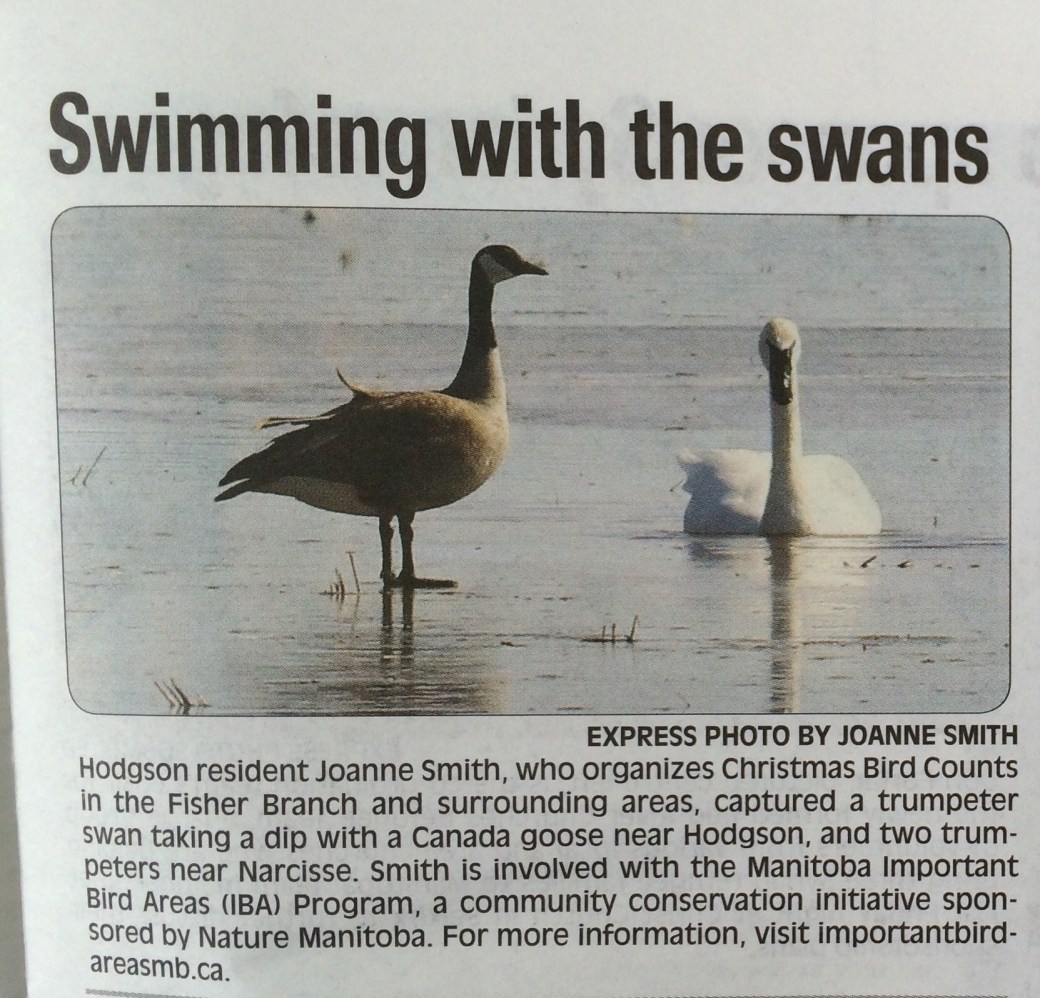
Nice little piece in The Express Weekly News this week, with a photo taken by Riverton Sandy Bar IBA Caretaker, Joanne Smith. The lovely photo of a Trumpeter Swan swimming next to a Canada Goose standing on some ice sums up current weather conditions nicely. Although taken near her home in Hodgson rather than Riverton, the text mentions the IBA Program, so well done Joanne!

Joanne photo Express Weekly.jpg

New Landowners Guide to Grassland Birds in Manitoba

Since June 2013 the Manitoba Important Bird Areas Program have been working on the Manitoba Grassland Conservation Initiative. This program was established with the aim of engaging landowners and communities in Manitoba about the fast declining populations of grassland birds. Over the intervening period, the program has delivered the objectives of the program. This has included attendance at local fairs, giving talks promoting the program, finding out about how landowners view grassland birds in a stakeholder survey, involving volunteers in monitoring the grassland IBAs and providing workshops on the birds of the prairies. At the culmination of funding from Environment Canada’s EcoAction Community Funding Program, we have produced a ‘Landowners’ Guide to Grassland Bird Conservation in Manitoba’. This guide provides an overview of the issues which cause bird populations to thrive and those which cause them to decline. It gives a brief overview of the added activities, in addition to farming livestock, which might benefit birds. Finally it describes some of the threatened species that might be found on each parcel of land. Designed by Carrie-Anne Lander and based on a literature review from Marshall Birch, we hope it will be a valuable addition to bird conservation in Manitoba.

Picture2

Image of the front cover of the guide

A copy of the guide can be downloaded at the bottom of this page: https://importantbirdareasmb.ca/manitoba-grassland-bird-initiative/. If you would like a hard copy of the guide, please contact Tim Poole at iba@naturemanitoba.ca or (204) 943-9029.

IBA Monitoring Priorities – Oak Hammock Marsh IBA

With a seemingly early spring jolting the world around us to life, it seems like the time has come to get ready for annual monitoring of Manitoba’s 38 IBAs. Over the next month or so, I am going to attempt to post some quick reviews of monitoring and caretaker opportunities for individual IBAs. This will help anyone going out to these places to consider entering their data under the IBA protocol. Today, I am going to start with the most well-known and well-visited IBA in Manitoba, Oak Hammock Marsh.

Oak Hammock Marsh is the most well visited IBA in Manitoba. Funnily enough I suspect it has the least entries under the IBA Protocol of all the most well known Manitoban IBAs. It would be fantastic if people would consider entering all their checklists in eBird (or send them to me to enter them), so to build a more accurate reflection of bird populations in this IBA. For anyone interested in learning a bit more about how to do this, there will be a short walk and talk on May 14th as part of the International Migratory Bird Day (see here).

If you don’t know, Oak Hammock Marsh is a 20 minute drive north of the Winnipeg perimeter between highways 7 and 8 (see directions). You can see a pdf of the IBA boundary by clicking on the link below:

MB010 Oak Hammock Marsh WMA

Originally designated for large populations of waterbirds, including waterfowl, shorebirds and other marsh birds, Oak Hammock Marsh is especially important during migration season. There are globally important populations of Canada Goose in spring and fall and Snow Goose during fall. Being a hemi-marsh, the water levels are human-controlled. Currently most of the marsh is not in drawdown and therefore the habitats are more suitable for waterfowl than shorebirds. The sod fields north of Oak Hammock, although not in the IBA are the best place currently for the globally Near-threatened Buff-breasted Sandpiper. The original trigger species were:

  1. American Coot
  2. Black-crowned Night-Heron
  3. Canada Goose
  4. Franklin’s Gulls
  5. Hudsonian Godwit
  6. Lesser Snow Goose
  7. Mallard
  8. Short-billed Dowitcher
  9. Tundra Swan
  10. White-rumped Sandpiper

Other key species to look out for are:

  1. Buff-breasted Sandpiper
  2. Rusty Blackbird

The monitoring priorities for 2016 are:

  • Complete checklists to be entered into eBird. If possible these checklists should follow the IBA Protocol.
  • Prioritise counting large flocks of waterbirds.
  • Although not in the IBA, enter Buff-breasted Sandpiper data from the sod fields to the north under the IBA Protocol.
  • Participate in the Oak Hammock Marsh Summer Breeding Census (watch the Manitoba Birds Yahoo Group for details.
  • Participate in the fall goose counts (more details will appear on http://www.oakhammockmarsh.ca/).

IBA Protocol routes exist and follow the Oak Hammock Marsh Summer Census zones. If possible enter your checklists under the zones used in this map:

MB010 Oak Hammock Marsh IBA monitoring route map

Any questions please let me know  on the contact details provided on this website.

Southern Cone Grassland Alliance – an Inspiration

I thought I would share a link to a story I received this morning from Birdlife International about Birdlife Americas Southern Cone Grassland Alliance. The alliance has just received an award for ‘International Cooperation’ from the prestigious U.S. Forest Service’s 2016 Wings Across the Americas Awards for outstanding conservation achievement. See Birdlife America’s Southern Cone Grassland Partnership.

Late last year, Bird Studies Canada’s (and MB IBA steering committee chair), Christian Artuso, presented a talk, together with Audubon, on North American grassland bird conservation at a gathering of ranchers, NGOs, government officials and academics in Brazil. This gathering was arranged by an inspirational partnership for conservation involving ranchers from four countries (Argentina, Uruguay, Brazil and Paraguay), conserving native grasslands and in return receiving a grassland bird-friendly beef certification. This certification provides ranchers with a higher price for their beef.

Why is this of interest to the Manitoba IBA Program? For starters, cattle producers, especially in the Southwestern Manitoba Mixed-grass Prairie IBA, face many of the same challenges as those in South America. In both Manitoba and the Southern Cone, almost all grasslands are privately owned. Retaining cattle production is vital to retaining the remaining patches of native grassland, especially given the loss of native bison in Manitoba. Conserving native grasslands is also key to conserving our special grassland birds such as Sprague’s Pipit, Chestnut-collared Longspur and Ferruginous Hawk. In both cases, cattle production is beneficial to birds.

Landowners must also turn a profit to retain cattle on the landscape. Across the Americas native grassland have been converted to crops or in some cases in the north, areas of grassland are given over to energy extraction due to financial pressures. This has meant that in North and South America, entire grassland ecosystems have become endangered, leading to declines of well-known grassland birds such as Bobolink and Loggerhead Shrike.

Also of interest is how this type of initiative might influence migratory birds from Manitoba. Birds of the Manitoba grassland like the Upland Sandpiper and Swainson’s Hawk spend the winter on South American grassland. What’s more, some open tundra species of the high Arctic, think Buff-breasted Sandpiper, and those of the Hudson Bay lowlands, say, Hudsonian Godwit, also winter on the grasslands of the Southern Cone. This demonstrates the importance of a fully functioning network of sites for conservation, such as IBAs, across borders and continents. It also presents a challenge to decision-makers and stakeholders in North America in responding to such a positive initiative.

Could a similar certification award and partnership could work in North America? Maybe in a few years there will be an option of purchasing grassland bird-friendly beef from the native prairies of southwestern Manitoba. That would certainly be a step in the right direction for threatened grassland birds!Upland Sandpiper


IBA MB091 Riverton Sandy Bar 2015 (The Year of “The Good, The Bad and The Ugly”.)

Joanne Smith, Caretaker for Riverton Sandy Bar IBA shares her experiences and photos from 2015 in this blogpost.

Processed with Moldiv

Bonnie Chartier, Willet, spring sky, Snow Buntings. Copyright Joanne Smith

It’s amazing how an IBA such as Sandy Bar can change its appearance from one summer to the next.  In 2014, the main sand bar (Sandy Bar) was completely separated from the main land during the breeding season and was only accessible by boat, canoe or kayak.  However, this past 2015 breeding season provided a kilometer long sand bar that was easily accessible by both foot and ATV. As usual, Hecla Bar was only accessible by boat as it is on the Hecla Island portion of this Important Bird and Biodiversity Area.

Processed with Moldiv

Lapland Longspur, erosion, American Goldfinch, Lynda Baker. Copyright Joanne Smith

Despite the winter of 2014/15 being normal as far a snowfall amounts, there were still 4 to 5 foot snow drifts at the southwest end of Sandy Bar on April 16th. The lake was beginning to open up by April 9th and was a warm welcome to some 300 Herring Gulls. Despite a small snow drift lingering on May 5th, there were hundreds of ladybugs on the sand bar and the lake within the IBA was ice free. Unlike the high water levels in Lake Winnipeg in 2014, this past year proved to have much lower levels and no major wind/rain storms played havoc on Common Tern, Ring-billed Gull or Herring Gull colonies.  However, 2014 and 2015 were similar in that by mid to late August the lake on the north side of the sand bar was thick with algae. The algae that washed ashore would leave interesting designs in the sand a few weeks later.

Processed with Moldiv

Algae, ladybugs, zebra mussel. Copyright Joanne Smith

There were a few good bird highlights as well as a few disappointments during the 2015 birding season at Sandy Bar.  On May 11th the Herring Gulls had established their colony.  With approximately 180 adult gulls and 70 nests, there was hope that 2015 would be a far better year for the Herring Gull chicks than 2014 was.  By June 8th, 15 young could be seen from a distance so things were looking up.  Surely there would be more young in the next week or two but by July 6th, only 4 young Herring Gulls remained.

Processed with Moldiv

Herring Gull colony and Sandy bar marsh with Yellowlegs, Dunlin, Green-winged Teal and American Wigeon. Copyright Joanne Smith

Things were also rather dismal for the Ring-billed colony.  On June 8th approximately 170 Ring-billed Gull adults had set up their colony of 30 nests within 300 meters of the Herring Gull colony.  However, on June 18th no occupied nests remained.  The Ring-billed colony no longer existed. No Common Terns nested on this main sand bar in 2015 either.

Processed with Moldiv

Common Term, Double-crested Cormorant, Herring Gull, Dunlin, Ruddy Turnstone

On July 7th, Manitoba IBA coordinator Tim Poole, summer student Green Team employee Marshall Birch, my husband Dave and I launched the boat at the dock in Riverton, drove down the Icelandic River into Lake Winnipeg and then over to Hecla Bar.  This was to be our first IBA visit to this portion of IBA MB091.  The lake was rather rough and we could see that there were at least 16 nests on this Hecla sand bar along with a few young (which proved to be Common Tern after checking photos) so we decided to remain in the boat rather than get out and disturb the birds.  Four people trying to count and photograph birds from a rocking, rolling 16 foot boat proved to be quite interesting.  However, the view did provide decent looks at American White Pelican, Common Tern, Herring Gulls, Ring-billed Gulls, Franklin’s Gulls, and Bonaparte’s Gulls.

Processed with Moldiv

herring gull with chick, Marshall Birch, Dave Smith, Tim Poole, Ring-billed Gull colony, Herring Gull. Copyright Joanne Smith

Some of the more positive sightings on the Sandy Bar portion of the IBA in 2015 included a Whimbrel on May 15th (when Bonnie Chartier and I were setting up “Caution Ground Nesting Birds” signs), three Whimbrel on June 18th and another lone Whimbrel sighting on August 25th.  This Whimbrel stayed around long enough to be seen by Bob Shettler on August 26th and by Donna Martin on August 27th.

Processed with Moldiv

American Robin, Whimbrel, Forster’s and Ring-billed Gulls. Copyright Joanne Smith


On May 14th Randy Mooi had a Virginia Rail in the marsh area of Sandy Bar and on May 23rd John Gordon, Donna Martin and Ray Methot added two Red Knot to the species list. Many other species were seen during the summer months including Bald Eagles, Sanderling, Merlin, Black-bellied Plover, American Golden Plover, Dunlin, Semipalmated Sandpiper, Rusty Blackbird, Yellow Warbler, Marsh Wren, Barn Swallow (nesting at the old fish shed near the parking area), and Spotted Sandpiper, just to name a few. The target species Snow Goose, Canada Goose, American White Pelican, Ruddy Turnstone, Sanderling, Ring-billed Gull, Herring Gull, Common Tern, and Forster’s Tern (some mentioned previously) were all seen.  The only target species not seen was the Piping Plover.


Processed with Moldiv

Marsh Wren, Common Grackle, Common Yellowthroat, American Tree Sparrow. Copyright Joanne Smith

IMG_8298.JPG

Sanderling, Killdeer, ATV tracks, fall sky. Copyright Joanne Smith

Fall visitors to Sandy Bar included Horned Lark, Snow Bunting, Lapland Longspur, American Tree Sparrow and American Pipit.  On October 18th, Riverton resident Marvin Hamm emailed me to tell me that he had seen two beautiful Snowy Owls on the main sand bar that afternoon.  On October 22nd, Lynda Baker and I would also be fortunate enough to see these two owls.  However, on a sad note, we also found what turned out to be the first of several zebra mussel shells.  On an October 29th visit one Snowy Owl remained but we were to find two more zebra mussel shells on the beach near the parking area.

Processed with Moldiv

Red Admiral, Red-necked Phalarope, American Pipit, sand islands. Photo copyright Joanne Smith

On November 12th, winter could definitely be felt in the air at Sandy Bar as the NW 19km/h winds made it feel like -3 and the snow began to fall.  The walk out to the end of Sandy Bar was snow free but the return walk included a brief whiteout which left enough snow to show the footprints of one crazy human who had ventured out amongst the handful of remaining birds in this mini blizzard.

Processed with Moldiv

Snowy poo is big! Like gummy worms! Joanne didn’t sample them unfortunately(:, the sand bar in the snow and Snowy Owls on the bar. Photo copyright Joanne Smith

The 2015 season had provided views of good birds (I guess all birds are good) like Red Knot and Whimbrel, the sad disappearance of the Ring-billed Gull colony, the bad zebra mussel findings and the ugly algae concentrations.  It’ll be interesting to see what 2016 holds in store for IBA MB091 Riverton Sandy Bar.

Joanne Smith

Processed with Moldiv

Horned Lark, Linda Curtis & Lynda Baker, Black-bellied Plover. Photo copyright Joanne Smith


The Years End

As the wind and howling snow blasts away the last cobwebs of 2015, the IBA Program can look back on a successful year. There have been many things achieved and it would be impossible to name all of them, so instead I am going to share a few photo highlights. I am sure our volunteers will have many more interesting experiences and I hope that one or two might share those here at some point…

30th April – West and North Shoal Lake (part of the North, West and East Shoal Lakes IBA)

IMG_0061

Pair of Red-necked Grebe. Photo copyright Tim Poole

IMG_9853

Compared to the fall migration blitzes, the spring numbers of migrant ducks appeared to be higher especially in the sheltered areas of West Shoal Lake. Here we have Lesser Scaup, Canvasback and Bufflehead. Photo copyright Tim Poole

IMG_9861

Great Blue Herons and Great Egrets are fairly numerous in the Shoal Lakes. Photo copyright Tim Poole

A first ever trip to the Shoal Lakes and an opportunity to meet with Donna Martin for the very first time. I was late meeting Donna but in my defence, I took the road along the west of West Shoal Lake and managed to get overwhelmed by the numbers of birds. Seriously huge! Donna had a good tour and managed to see among others, Marbled Godwit, American Avocet, Sandhill Crane, Horned Grebes, Broad-winged Hawk, 12 species of duck and Wilson’s Phalarope (a lifer and personal highlight).

May 9th – International Migratory Bird Day (Click for blog)

IMG_2358.JPG

Sora at Oak Hammock Marsh IBA. Photo by Tim Poole

The IBA Program celebrated International Migratory Bird Day at Oak Hammock Marsh Interpretive Centre. Starting with an early morning bird walk with members of the public (highlights included Least Sandpiper, Spotted Sandpiper and Harris’s Sparrow), I then got to meet our Caretakers for the first time as we had a meeting together. The day was finished off with a talk about IBAs and the superb eBird by Christian. A good day out all in all.

27 May – Lake Manitoba

IMG_9965

Horned Grebes (Slavonian Grebe for any Europeans out there) have been added to the global vulnerable list since this bird was photographed. Photo copyright Tim Poole

Bonnie Chartier and I were very fortunate to be given permission to visit one IBA on private land. So fortunate alas that unfortunately I am not even sure I can release the name. Seriously, I’m not! We had an amazing day with this Brit being able to secure a bunch of lifers but even more impressive were the final numbers 72 species, 4092 individuals including 14 species of duck and 5 species of grebe. My personal highlights were the shorebirds, 16 species including lifers (Semipalmated Plover and Sandpiper, Red-necked Phalarope, Short-billed Dowitcher, White-rumped Sandpiper and Stilt Sandpiper. We also managed to get a cracking view of a Virginia Rail wandering around in the open in broad daylight.

IMG_0012

American Avocets are certainly one of the most charismatic shorebirds of the prairie wetlands. Photo copyright Tim Poole

IMG_9995

Migrating shorebirds like this Lesser Yellowlegs were present in good numbers in late May

IMG_9989

Every biology student is probably familiar with phalaropes as natures polyandrous bird species. A single female Wilson’s Phalarope will have more than one mate and then leave the male to raise the kids – most modern! Photo copyright Tim Poole

19th June – Pipestone (Click for blog)

IMG_0149

Pair of baby skunks at the side of the road. Photo by Tim Poole

Not strictly in the Southwestern Mixed-grass Prairie IBA but my first ever experience of a Sprague’s Pipit needs to be recorded in itself. Plus skunks, badgers and a host of other things. This was the start of a very successful weekend for the IBA Program. Oh and we even managed to stop in on Douglas Marsh, which was, er, marshy.

20th June – Southwestern Mixed-Grass Prairie (Click for blog)


Group photo copyright Carla Church. Ferruginous Hawk, Mule Deer and Great Horned Owls all copyright Tim Poole

From early morning Ferruginous Hawks to owls in a barn, a glimpse of a Lazuli Bunting and Loggerhead Shrikes, this was some day! Not forgetting our landowner workshop and a trip to Chicken Chef. A true rural Manitoba experience!

21st June – Prairie blitz (Click here for blogand hereand check this out too)

41 Sprague’s Pipits and over 230 Chestnut-collared Longspurs for our blitzers. Chest-collared Longspur and Sprague’s Pipit photos copyright Christian Artuso.

22nd June – Whitewater Lake (Click here for blog)

IMG_0382

Not a California Gull or Ibis maybe but this Virginia Rail peeked his head through the grass at Whitewater Lake IBA. Photo copyright Tim Poole

A good visit to this gem in prairies and abundant bird life to savour including Manitoba’s first recorded breeding colony of White-faced Ibis and a California Gull. It was wet, dreary, the roads were a mess. A bit like Scotland in fact…

7th July – Riverton Sandy Bar (Click here for blog)

Marshall and I joined Joanne Smith and her husband Dave on a boat trip out to monitor the birds at Hecla Bar. This proved that birdwatching from a boat isn’t as fun as it sounds. Good numbers of pelicans, cormorants, gulls and terns were present. I also got to see firsthand tracks from ATV users which are potentially a threat to the breeding birds at Riverton. All photos above copyright to Joanne Smith.

8th August – Banana Days and Whitewater Lake (Click here for blog and here for another)

At risk of covering old ground and giving people sour grapes, this was a very fruitful day, in fact a peach of a day in the southwest. We even got to visit a pear of IBAs and caught a glimpse of a magnificent Prairie Falcon. Prairie Falcon and American Avocet photos copyright Christian Artuso.

29th August and 3rd October – Shoal Lake Blitz (Click here for August blog, and here for an update, and here for October)

Thanks again to all the volunteers who made these events a success. There were many highlights, not least the Surf and White-winged Scoters, Trumpeter Swans, a Yellow Rail and a bear (or was it a cow). In total we counted over 140 species and nearly 20,000 individual birds over the 2 days. A possibility for another go in May 2016……

Below are some of the photo highlights

Photos copyright Garry Budyk

Photos copyright Christian Artuso

Photos copyright Donna Martin

Photos copyright Bill Rideout

Photos copyright Jo Swartz

August 31st – Delta Marsh

P1030923

Washing the car two days earlier seemed like a waste of time

The most Scottish of days yet, it made the earlier trip to Whitewater Lake appear dry by comparison. It was so soggy in fact it changed our blue car to an interesting shade of brown. I never got around to blogging this trip but thanks to Carrie Braden, the local coordinator for the Breeding Bird Atlas and a volunteer with the IBA Program for showing me around the entire IBA, which if you know Delta Marsh, you would know that is some undertaking. There were plenty of birds too, including gathering flocks of thousands of ducks readying for the coming journey south and large numbers of Western Grebes gathered in the channels.

P1030928.JPG

Note to oneself, next time take a proper camera to visit an IBA. Those brown blogs are meant to be Western Grebes. Photo (unashamedly) by Tim Poole

Oh, and if you wish to know more about Delta Marsh or are in need of a last minute Christmas gift, why not purchase the new book ‘Delta: A Prairie Marsh and its People’ by among others, Glen Suggett from Manitoba Conservation.  See http://www.mcnallyrobinson.com/9780921950516/gordon-goldsborough/delta?blnBKM=1#.VnMNFPkrLDc.

15th September – Grant’s Lake

P1030944

The channels at Grant’s Lake make great breeding habitat for marsh birds. Photo by Tim Poole

Another trip which failed to make the blog, mainly because time just rushed away from me. Dave Nichol, our local caretaker was my tour guide this time. Given this is a lake we did this trip in style in a canoe. This is a globally important site for migrating Canada Geese but we appeared to have hit it a wee bit early. Instead there were large numbers of ducks and coots gathering for migration. And we didn’t get lost in the channels. Well, not too lost anyway.

P1030942

Just to prove it was a canoe… Photo by Tim Poole

Finally, a big thanks to everyone who has been involved in making 2015 a success for the Manitoba Important Bird Areas Program. Have a merry Christmas and happy New Year and and we look forward to more success in 2016.


Zebra Mussels located at Riverton Sandy Bar

Joanne Smith, Caretaker for Riverton Sandy Bar IBA made the Program aware recently that Zebra Mussels have been found on Lake Winnipeg near Riverton Sandy Bar. Joanne subsequently found Zebra Mussel shells within the boundary of the IBA. Manitoba Conservation and Water Stewardship are taking a lead on attempting to stall the progress of this aggressive invasive species which has now been found almost as far north as The Pas, in Cedar Lake.

The presence of Zebra Mussels will have an impact on all users of Manitoba’s wetlands and lakes and has led to Conservation and Water Stewardship Minister Tom Nevakshonoff releasing a statement last week revealing that new legislation has been scripted to prevent their continued spread across our province. The law now states that all watercraft users will now need to ‘Clean, Drain, Dry and Dispose’. There are more details in the release and on the website.

This will have implications for our IBA volunteers and I will need to follow this up in the winter and spring but for the moment, the people at Manitoba Conservation and Water Stewardship have helpfully produced this informative factsheet: zebra_mussel_fact_sheet. All our volunteers using watercraft will have to follow these new laws, so this is a heads-up!

Finally, here are the photos and text from Joanne’s IBA Riverton Sandy Bar MB091 Facebook page to give you a flavour of what to look out for:

ZEBRA MUSSELS. Yes, these shells were found today at IBA MB091 Riverton Sandy Bar this afternoon. It wasn’t really a surprise as they have been found in the Riverton, Hecla and Matheson Island areas in the last few months. A more recent MB finding was at the more northerly location of Cedar Lake, west of Grand Rapids.

One shell was found last week at Sandy Bar washed up in the area of the rocks seen below. The two shells seen today (in the photos below) were also in this same general area, within 30 meters of the parking area.

Photos all copyright, Joanne Smith
IMG_0559 IMG_0560  IMG_0562

NCC Mixed-Grass Prairie Conservation Workshop, guest blog by Callie Bowman

Callie Bowman has been working as a data reviewer for Christian Artuso since the beginning of July 2015 thanks to a Science Horizons grant (a federal youth employment grant that gives recent grads work experience in their field of interest). During the summer, she assisted with field work looking at avian malaria in Golden-winged Warblers for Chelsea Enslow, a Masters student from the University of Manitoba. Since then, she has assisted Christian, gaining experience in grant writing, database management, bird surveys and preparing various publications. Here Callie blogs about a meeting she attended earlier this week organised by Nature Conservancy of Canada on the future of Manitoba’s Mixed Grass Prairies.

On Wednesday, October 28, 2015, at the crack of dawn (well actually before dawn), Christian Artuso and I, along with some other folks from the Wildlife Branch of Manitoba Conservation headed off for Melita for the day.  The Nature Conservancy of Canada had organized a Conservation Workshop, aimed at bringing together knowledge and expertise from various groups, organizations and locals who live and work in the Mixed-grass Prairie of the West Souris region.  Luckily the long drive was broken up by a quick stop in Brandon to have breakfast but after that, it was straight on to Melita.

There were roughly 30 people in attendance, representing a wide range of groups including various governmental organizations, NGOs, local Conservation Districts and landowners.  The mix allowed for great conversations, bringing to light new perspectives from lots of different interested parties.

The morning started with some presentations about NCC and specifically what they are doing in the West Souris region, followed by a presentation by Christian about the state of prairie birds in the area.  Unfortunately (as we probably all know), the presentations on the sad state of the mixed-grass prairie and grassland birds in the area left everyone ready to swing in to planning action to come up with ideas of how combat these declines!

CSaveGGUwAACyPg

Christian presenting his talk on grassland birds. Photo taken by Cary Hamel of NCC (@caryhamel)

The afternoon involved a lot of discussion-based activities in small groups.  In my group, we had representation from NCC, Environment Canada, Manitoba Conservation, local Conservation Districts, a local farmer and the local PFRA. We discussed topics such as the pros and cons to economic and energy development in the area, barriers to conservation and strategies moving forward.  The afternoon was concluded with a large group discussion, summarizing what each group had come up with.

As someone who was totally unfamiliar with this ecosystem before arriving at the workshop, I gained a lot of valuable information about the issues that face the Mixed-grass Prairie and possible ways to conserve what we have left for the future.  It was especially valuable having so many parties represented because it allowed for everyone to share knowledge and perspectives from groups who don’t always have the change to sit down and talk to one another. By the end of the day, it seemed everyone was a little more optimistic about what can be done to protect the habitat and species that live there.  One of the continued solutions that kept coming up throughout the afternoon was education (unsurprisingly); all types of education, ranging from programs at local schools, to training farmers on best practices to aid conservation, to signs along roads to educate visitors on important species or habitats in the area.  Lots of positive strategies and lots of excitement!

Then it was home to Winnipeg. Despite it being a long, 14+ hour day, I am very grateful for the opportunity to attend and participate in such an informative and positive day!

The tumbling flight song of the Sprague's Pipit is increasingly rare to hear. Seeing a Sprague's Pipit on the ground is even rarer. Photo copyright Christian Artuso (http://artusophotos.com/)

Long gone on migration now, the Sprague’s Pipit is one of the most threatened birds of the Mixed-grass Prairie. Hopefully the outcomes from discussions on Wednesday will lead to a more positive future for birds such as this. Photo copyright Christian Artuso (http://artusophotos.com/)

New IUCN Red List implications for Manitoba’s IBAs

For anyone who has ever visited the great open grasslands of Africa or who cares about the critical role played by scavengers as the great ecosystem cleaners, today has been a wake-up call. IUCN have published their latest Red List of species threatened with extinction and the headlines are sober reading for conservationists:

’24 bird species are now classified as having a higher risk of extinction (either Vulnerable, Endangered or Critically Endangered) in the 2015 Red List update of birds, with seven species being upgraded to Critically Endangered. Another 16 bird species have seen their status change from Least Concern (the lowest level of threat) to Near Threatened. 23 species have been downgraded to lower threat categories.’

Back to the vultures, and now 4 of African species are listed as ‘Critically Endangered’ and 2 species as ‘Endangered’. Having seen at least 4 of these species (need to check my notes but Egyptian, White-backed, Lappet-faced and Ruppels Griffon are certainly there), this really is a reality check. The reasons for this terrible state of affairs are varied and rather than state them here, I will leave that up to an excellent guest blog piece by Chris Bowden, RSPB’s Globally Threatened Species Officeron Mark Avery’s blog (Mark is the ex-RSPB Director of Conservation).

vultures-of-africa-extinction

As a native Brit, the new list has now highlighted declines in some of the most iconic species in the UK. Well, iconic in my view anyway! Population declines of farmland and cliff-nesting seabirds were certainly two pressing (and depressing) priorities, rising up the conservation agenda. Familiar species like the Atlantic Puffin, Razorbill, Eurasian Oystercatcher and Northern Lapwing had their conservation status uplisted, with puffin ‘Vulnerable’ to extinction. The lesser-known (but bird of the year in New Zealand, 2015) Bar-tailed Godwit is also included. Atlantic Puffin was one of the 10 species shortlisted in a recent vote for the National Bird of Great Britain, and although it came tenth (I voted for it), it is still a much-loved species. Just not as loved as the plain garden Robin apparently! The causes of these declines are going to be different for all these species, yet at the root of all of them are the impacts of people on the natural environment.

Northern Lapwings are declining in Europe due to agricultural changes. Photo copyright Tim Poole

Northern Lapwings are declining in Europe due to agricultural changes. Photo copyright Tim Poole

There were 3 other species present in the UK on the list which should be of special interest to people in Manitoba. These are:

  1. Horned Grebe (known as Slavonian Grebe in the UK) (IUCN – Vulnerable)
  2. Common Eider (IUCN – Near threatened)
  3. Red Knot (IUCN – Near threatened)

Of these species, the Horned Grebe and Common Eider both breed in Manitoba.

Horned Grebe has not previously been recognised as a trigger species for any of Manitoba’s IBAs but with this new Red Listing, one or two of our IBAs may now be considered globally important. Birdlife International have identified that this species is undergoing rapid declines due to forestry operations, human disturbance, fluctuating water levels in lakes and introduction of Rainbow Trout. In fact the decline in North America has been -75.9% over 40 years. According to the Manitoba Breeding Bird Atlas, Horned Grebe breed across Manitoba but concentrate in a few areas, including in and around the southwestern IBAs and the Saskatchewan River Delta IBA. For most birders, Horned Grebe are more regularly recorded on passage, including recently at North, West and Eastern Shoal Lakes IBA (and in the fall near my house in Winnipeg).

Horned Grebe copyright Garry Budyk

Horned Grebe in winter plumage at North, West and East Shoal Lakes IBA. copyright Garry Budyk

Much like another sea duck, the Long-tailed Duck, the Common Eider is not considered endangered in Canada. According to Birdlife International, the recent uplisting to ‘Near-threatened’ is due to slight declines in the European population (>40% over three generations). Here in Manitoba we have the Hudson’s Bay subspecies (c. 6% of the global population) which breed in coastal areas including pools and lagoons in the far north of the province. Although previously considered a trigger species in any of Manitoba’s IBAs, the best place for viewing them is within the Churchill and Vicinity IBA. Indeed, our very own Bonnie Chartier recorded 125 during a trip in June this year. Another IBA with records on eBird for this species is Seal River Estuary IBA, north of Churchill.

Common Eider Ducks on Hudsons Bay. Note the dimorphism between male and female. Photo by Christian Artuso

Common Eider Ducks on Hudsons Bay. Note the dimorphism between male and female. Photo by Christian Artuso

Our final species is the Red Knot. The ‘rufa’ subspecies in North America was already considered as threatened but today we learn that the entire species is now globally ‘Near threatened’. Birdlife International justify the new status as ‘two subpopulations use the East Asian-Australasian Flyway and have experienced significant declines owing to loss of habitat in the Yellow Sea’. They also acknowledge declines in other subpopulations including our own. Red knot do not breed in Manitoba, yet they are often recorded on passage. Again, Churchill and Vicinity IBA is the most important place in Manitoba for this species (3500 were recorded in spring 1974, continental important numbers). Other sites where Red Knot were recorded in 2015 include Riverton Sandy Bar IBA, Whitewater Lake IBA and Delta Marsh IBA.

Red Knots in breeding plumage photographed at Chalet Beach in Netley-Libau Marsh IBA in 2004. Photo copyright, Christian Artuso

Red Knots in breeding plumage photographed at Chalet Beach in Netley-Libau Marsh IBA in 2004. Photo copyright, Christian Artuso

It is not all bad news. Hidden away in the gloom are some conservation success stories, such as the Audouin’s Gull. But the implications are there to see. IBAs are only likely to become more important in the future for declining species of bird, and careful stewardship of Manitoba’s IBAs will be our contribution to a global program of site conservation.

North, West and East Shoal Lake Bird Blitz Part 2

On Saturday October 3rd we returned to the scene of our first fall bird blitz, deciding to give it another go! The first blitz was a great success revealing healthy numbers of birds and a good diversity of species. If you have not read the blog why not take a look here. Tim Poole gives us the lowdown on a good morning out.

Big sky over Erinview on the morning of the blitz. Photo copyright Jo Swartz

Big sky over Erinview on the morning of the blitz. Photo copyright Jo Swartz

Having arrived at the IBA on the 29th August in thick mist, I have to confess to being slightly apprehensive at what might greet us. Fortunately we had nothing to worry about. We were greeted by clear skies, even though the outside temperature was 1 degree celsius. This time I had decided to bring some support along in the shape of Frank and Jacqui Machovec and Callie Bowman.

Shoal Lakes IBA blitz group_2071

Our team birding away. Photo copyright Christian Artuso

Our first job was to visit a spot south of West Shoal Lake where Jo, Liis and Betsy had counted in August. I had decided an 8am start should be ok. Unfortunately the birds had other ideas and large flocks of Canada Geese were on the move as we drove towards the count point. Not deterred, we counted the geese from the car. Beforehand we came up with a counting plan. Jacqui was responsible for recording non-water birds, Callie recorded waterbirds, Frank drove and I yelled out numbers of birds from the front seat while the others desperately tried to make sense of the nonsensical gibberish emanating from my mouth. Arriving at the first spot, we counted a plethora of waterbirds moving out of the lake area including over 2000 Canada Geese. This area seems so key for waterfowl that next time we will post someone here from first light to count geese leaving. It is obviously important to continue to learn how to improve things as we go along.

Open wetlands like this are great for roosting waterfowl. Photo copyright Garry Budyk

Open wetlands like this are great for roosting waterfowl. Photo copyright Garry Budyk

After completing our count, we headed towards our main area for the morning, Bluff Road between North and West Shoal Lakes. This area had been absolutely teeming with waterbirds last time and given the time of year, I was expecting good numbers today. The first sign that it might not work out the way I hoped were the 2 cars parked halfway down the road. As we exited our car, a couple of guys headed towards us on quad bikes with their hunting gear. Hmm, lesson number 2, don’t organise a bird counting event in an area open for hunting during hunting season.

A few gunshots were not going to prevent us getting a count of the birds and there were a few although not many compared to August. The highlight were a group of 3 Long-billed Dowitchers, a long-billed shorebird. Callie and I came prepared with rubber boots to ford as area of water to get to the lake shore. There were a few Pied-billed Grebes, Blue-winged Teal and a nice groups of American Widgeon but the Red-necked Grebe family had moved on.

Greater Yellowlegs were the most abundant shorebird for the second blitz in a row. Photo copyright Donna Martin

Greater Yellowlegs were the most abundant shorebird for the second blitz in a row. Photo copyright Donna Martin

Returning to the car we caught up with Christian Artuso who had walked across the old 415 again. A lineup of hunters limited Christians capacity to ferret birds out from all corners. In fact the fear of acting as a ‘beater’, flushing birds into the waiting guns suppressed any desire to move from the track.

Christian Artuso in full flow. Photo copyright Jo Swartz

Shock of the day, Christian forgot to bring his tripod on a birding trip. Photo copyright Jo Swartz

Still Christians numbers were very impressive, 2605 birds in total, including 115 Rusty Blackbirds. The last figure is important as it would make the IBA a globally significant site for this species which has been designated by IUCN as Vulnerable. He had also met with Matt Gasner, Jillian Detwiler and Dana Schroeder who had been covering the ground on the other side of the 415. Apparently Jillian, Matt’s wife, has made past visits to Shoal Lakes as a parasitologist at the University of Manitoba. This reminds me of those distant university labs dissecting Sticklebacks in the search for parasites……

The internationally threatened Rusty Blackbird in all its rusty glory. Photo copyright Donna Martin

The internationally threatened Rusty Blackbird in all its rusty glory. Photo copyright Donna Martin

Our group moved towards Inward and lunch to see how everyone else had got along. The general consensus was that numbers were down on last time but this might be mitigated by the fact that hunters were present along most of the routes. Obviously a few hunters are not going to have a massive impact on the number of birds but the disturbance will move birds to less accessible ‘refuges’ and reduce ther total counts.

The other groups had it seemed enjoyed a productive morning. Two groups had been fortunate enough to spy White-winged and Surf Scoter on the lake. The first group to do this was that of Joanne Smith, Bill Rideout and Sabina Mastrolonardo. Their job was to survey the area west of North Shoal Lake. This time Joanne failed to record a single bovine-bear but the scoters (at least one person had a lifer) more than made up for this. They also recorded the sole Mourning Dove of the day in a total of 363 birds, a big drop on last time.

No one caught a great photo of the White-winged Scoters on the day but here is a photo from Seal River Estuary IBA in northern Manitoba. Photo copyright Christian Artuso

No one caught a great photo of the White-winged Scoters on the day but here is a photo from Seal River Estuary IBA with a couple of Eider Ducks in northern Manitoba. Photo copyright Christian Artuso

Further south at East Shoal Lake, the combination of Jo Swartz, Betsy Thorsteinson and Rob Parsons had also recorded both scoter species. This group seemed to run the monopoly on finding species that no other group were able to locate; Ruffed Grouse, Common Loon, Western Grebe, Osprey and Yellow-headed Blackbird were on their daily checklist. Other highlights were 13 Tundra Swans and 1577 Canada Geese.

Tundra Swans in flight. Photo copyright Donna Martin

Tundra Swans in flight. Photo copyright Donna Martin

Across from them on the western side of West Shoal Lake, were John Weier, Garry Budyk and John Hays, ‘the dream team’. A couple of Hooded Merganser, Horned Grebe, a Peregrine Falcon and a House Wren were among their total of 1665 birds and 61 species they recorded.

Horned Grebe copyright Garry Budyk

Horned Grebe copyright Garry Budyk

Lapland Longspur numbers were starting to build up by this point. Photo copyright Donna Martin

Lapland Longspur numbers were starting to build up by this point. Photo copyright Donna Martin

That was a quick summary of all the different groups. Well almost all the different groups. We planned to meet for lunch around 1:30 but by 2pm there was still no sign of our final group Donna Martin and Ray Methot. As I was dialing for the rescue helicopter, they appeared having birded the backtracks in Ray’s quad. Stylish! I must get myself one of those for the IBA Program! This groups seemed to be the best for winkling out the teals, with 252 Green-winged and 102 Blue-winged Teal as well as a good mix of other species.

Another of the wetlands surrounding the lakes. Photo copyright Garry Budyk

Another of the wetlands surrounding the lakes. Photo copyright Garry Budyk

After lunch and an unsavory incident which we shall studiously avoid mentioning involving a piece of pumpkin pie, a candle and some very bad singing, a few of us went looking for the scoters along North Shoal Lake. We managed to find the White-winged Scoters but had to leave before the others had located Surf Scoters, completing a very successful day.

From left to right: Donna, Ray, John H and John Weier. Photo copyright Garry Budyk

From left to right: Donna, Ray, John H and John Weier. Photo copyright Garry Budyk

Thanks again to everyone for coming along and giving up your time on a beautiful Saturday morning. To finish this blog, I learnt 2 important lessons. These were:

  1. Don’t organise a bird blitz during hunting season as the birds will shift around the area
  2. Never joke to Donna about birthday cake
North, West and East Shoal Lake sign below the RM of Armstrong sign. Note that the bullet holes in the RM sign. Classy! Photo copyright Christian Artuso

North, West and East Shoal Lake sign below the RM of Armstrong sign. Note the bullet holes in the RM sign. Classy! Photo copyright Christian Artuso