Oak Lake and Plum Lakes IBA Blitz on June 3rd 2018

On June 3rd, 2018, the IBA Program organised a bird blitz at the Oak Lake and Plum Lakes IBA in southwestern Manitoba. Our objective was to identify and count as many shorebirds, grassland birds, Franklin’s Gulls and Red-headed Woodpeckers as possible, as well as finding the multitudes of other birds in this wonderful place for birds. Here is our report in three parts.
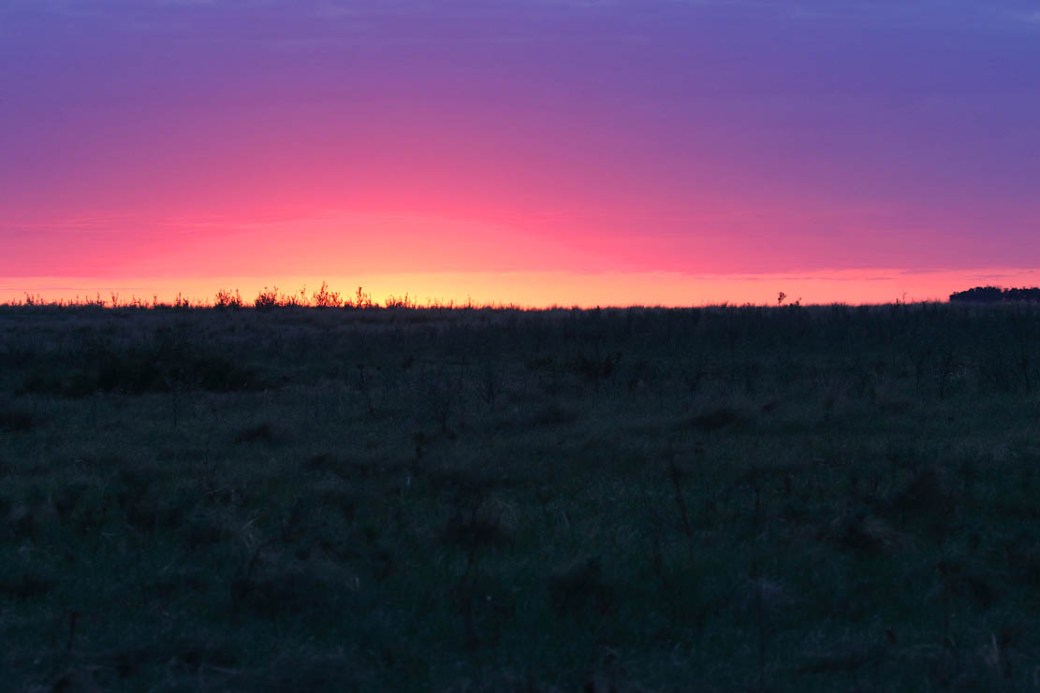
prairie sunrise_9114_Artuso

Early morning in the PIpestone area. Southwestern Manitoba does not look too shabby in the dawn! Copyright Christian Artuso


Sabina Mastrolonardo

On June 3rd 2018, The Important Bird Area (IBA) of the Oak-Plum Lakes area were divided into 5 zones and Katharine Schultz and myself (Sabina Mastrolonardo) were in charge of surveying birds in the northwest side of the IBA (named Zone 1). We began heading south on Highway 1 at 7AM, now entering our zone of the IBA and beginning to listen and look for all bird species. Over 60 Least Flycatchers, 37 Warbling Vireos, 27 Clay-colored Sparrows, 23 Marsh Wrens, and 21 Yellow Warblers wanted to be heard as they were the most frequent singing birds around all day. In addition, 15 Baltimore Orioles, 3 Great Crested Flycatchers, 1 Vesper Sparrow, and 3 Le Conte’s Sparrows were often heard during the survey before spotting them through binoculars.
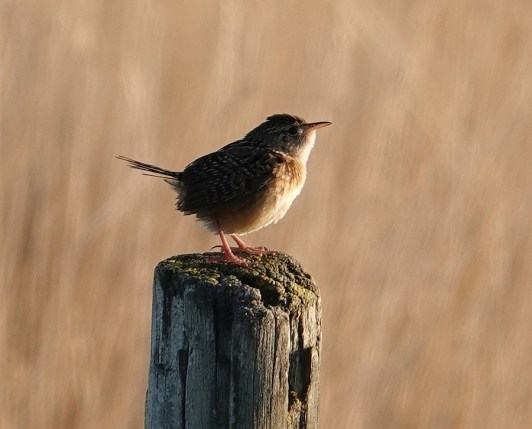
Sedge Wren ready for song lr_copyright Randall D. Mooi

Sedge Wren perched on a post; a songbird often detected first by song. Copyright Randall D. Mooi.

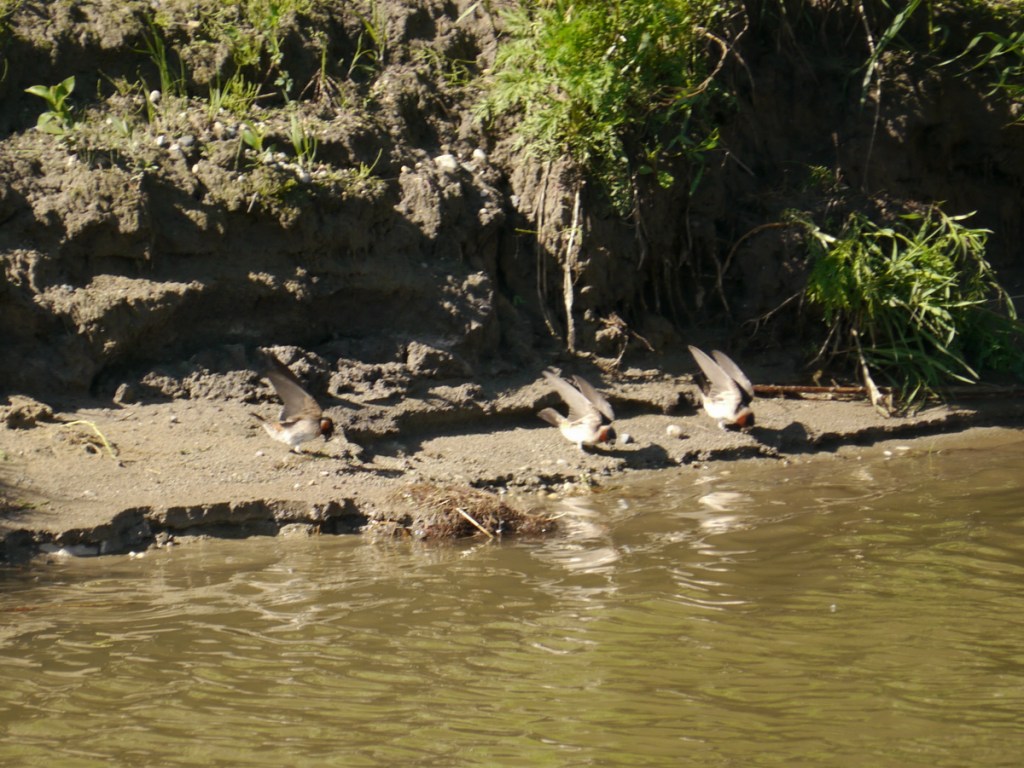
Zone 1 included large numbers of swallow colonies, with an estimated 100 Cliff Swallows under a bridge (130 total in Zone 1 of the IBA), 23 Barn Swallows, 4 Tree Swallows, and even 41 Bank Swallows. The Bank Swallow colony was a surprising discovery near the end of a gravel road with Veeries and American Goldfinches singing in the distance.


Despite Brandon and the southwest part of the province receiving quite a bit of rain over the last couple days, the gravel roads were in pretty good shape, making accessibility to the lake achievable! Shorebird highlights were 4 White-faced Ibis with some feeding and some in flight, 2 Great Blue Herons, and 1 Marbled Godwit and 1 Wilson’s Snipe next to each other showcasing a great example of size and bill length differences (not photographed – but photos of species separate below).


By noon it was time to wrap up the bird monitoring and meet the other groups for a picnic lunch at Cherry Point near Oak Lake Resort, allowing us to be around a flock of Cedar Waxwings, many Western Kingbirds and even a pair of Orchard Orioles. A fine Sunday indeed out at the Oak-Plum Lakes area with more to come about the entire IBA totals and other groups successes!  Stay tuned….

Oak_Lake_IBA_Blitz_Orchard_Oriole_sighting_OakPlum Lakes_June 32018_copyright Cam Nikkel

Birders flocked together while spotting an Orchard Oriole pair just before the picnic lunch. Copyright Cam Nikkel.


Lynnea Parker

Glennis Lewis and I (Lynnea Parker) took charge of zone 3 which covered the area from Jiggins Bluff (located off road 43N) south to HWY 2 (by Deleau) and west to road 150W. This area is characterized by a mosaic of wetlands, deciduous woodlands, grasslands, and agricultural fields. With such a diversity of habitats, it was no surprise to us that we detected 77 species (zone 3 checklist).

Most species detected were local breeders as the bulk of migratory shorebirds and warblers had already passed through. Our highlights included a single Horned Grebe which is currently ranked as Special Concern by COSEWIC. You can learn more about Horned Grebes in Manitoba by visiting this species account published by the Manitoba Breeding Bird Atlas. Other Species At Risk (SAR) included 1 Eastern Wood-Pewee, 12 Bank Swallow, 69 Barn Swallow, 1 Grasshopper Sparrow, and 10 Bobolink.
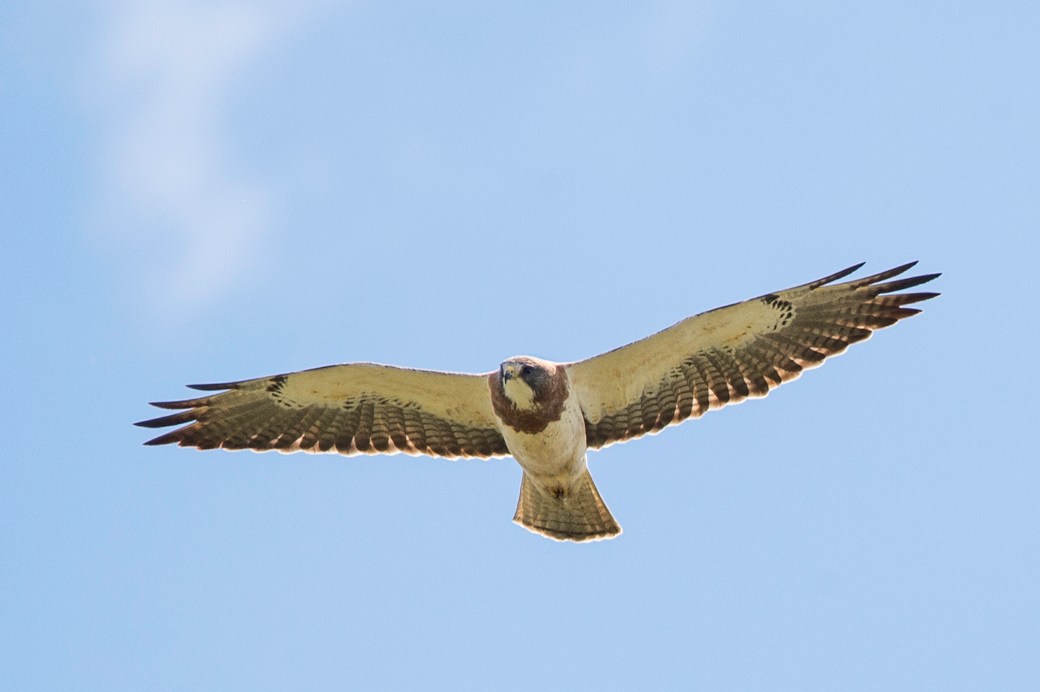
SWHA_e-bird_2048p.jpg

Stunning Swainson’s Hawk. Photo copyright Cam Nikkel

All in all, it was a fantastic morning to get out and document the rich bird diversity the area had to offer. The day before the event a series of rainstorms swept through the area. Despite this, road conditions were quite good and we were able to get decent coverage of our zone.
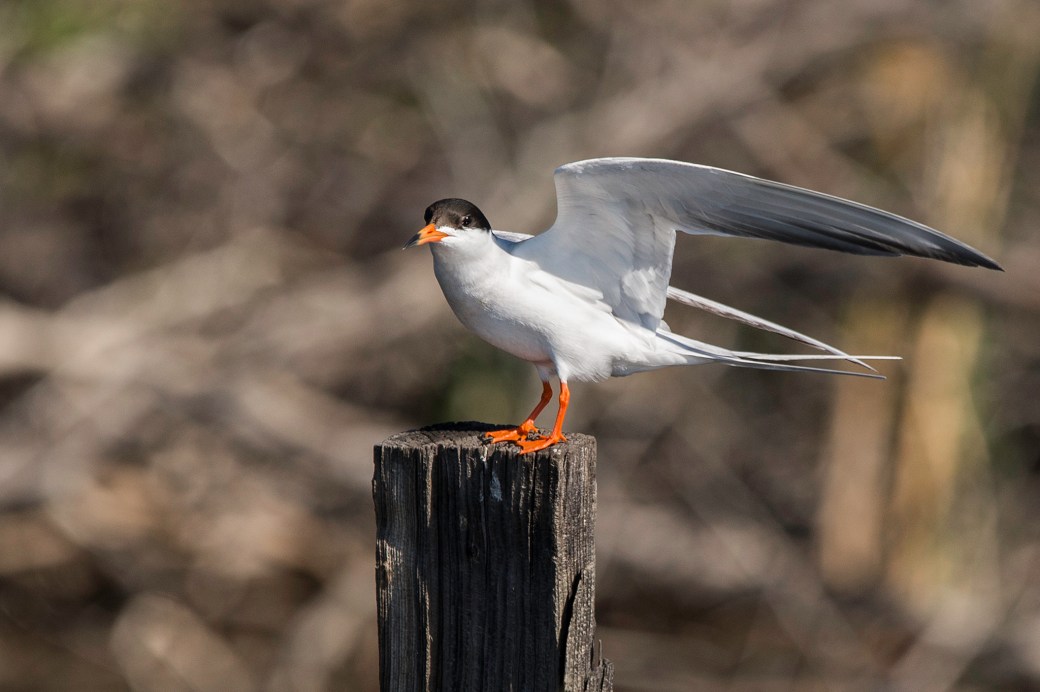
FOTE_ebird_2048p

Almost statuesque elegance of the Forster’s Tern captured magnificently here by Cam Nikkel.


Tim Poole

A group of Jen and her 7 year old daughter, Anna, Matt and Tim headed to the southeast extension of the IBA. This area covered the northern parts of the Lauder Sandhills, and the eastern part of Maple Lake. The habitats in this area varied: tame and native pastures; alfalfa hay meadows and occasional crop fields; shallow lakes with emergent vegetation and; large areas of sandhill with broadleaf woodland. The mix of bird species was therefore expected to be slightly different to the other areas.

The torrential downpours of Saturday meant that the original intention of starting with the wetland areas was delayed. instead the group forged into some of the eastern grassland habitats, quickly detecting Grasshopper Sparrows and Bobolink. Excitement levels raised when finding an extensive area of open woodland, ideal for the threatened Red-headed Woodpecker. It wasn’t long before Matt spotted the first woodpecker, and although it is likely that multiple pairs were present, only 2 individuals could be confirmed. A few minutes later, a stray call in another area, confirmed a third woodpecker – unfortunately this was it for the morning for this species (I’m sure there were more out there).
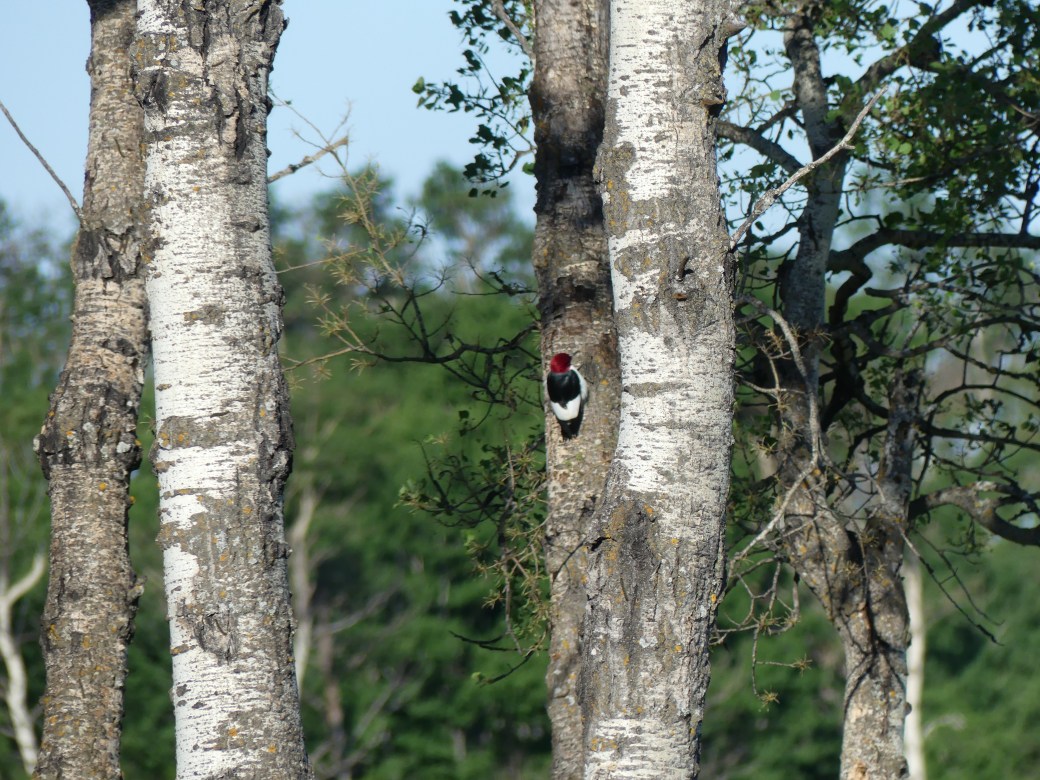
P1040830

One of only a handful of Red-headed Woodpecker detected during the blitz. Photo copyright Tim Poole

With the roads drying out, a decision was made to go for the Maple Lake area. Tim had previously visited these areas, and had re-found the Franklin’s Gull colony discovered by Ken De Smet in 2017. The area was full of White-faced Ibis, a magnificent species! There were fewer gulls than Tim’s 10,000 from the previous week, but we still put down a cool 5,000 for the day. There were also Eared Grebes in good numbers, White-rumped Sandpipers and Redhead and Canvasback. Nelson’s Sparrow were calling from the sedges, a lifer for Jen, and Black and Forster’s Tern risked the wrath of the superabundant gulls.
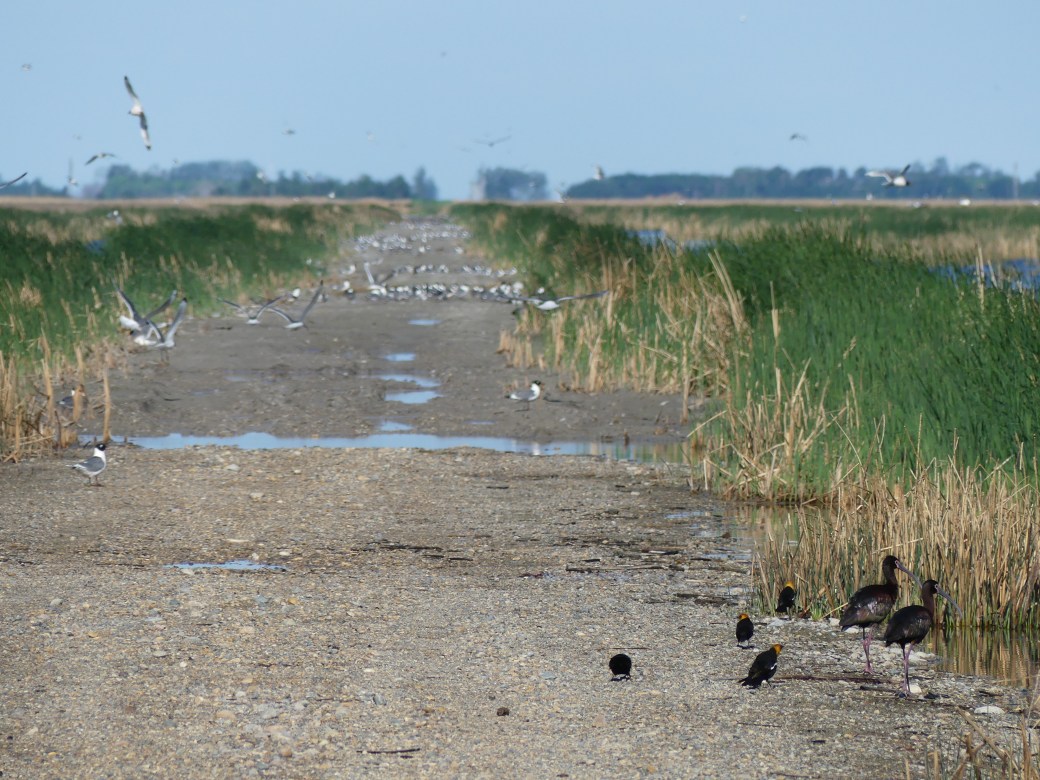
P1040838

Franklin’s Gulls, White-faced Ibis and Yellow-headed Blackbird on the washed out road. Copyright Tim Poole

Tim then decided to try to drive the car through the Lauder Sandhills. This would have been an immense drive – if the roads were a bit drier, but even the most pushy of drivers decided to turn and flee for harder tracks. On that note, it was interesting that the Provincial Road condition was significantly worse than the RM gravel roads. Some of them almost needed an amphibious vehicle to get through the damage caused by heavy vehicles.

On a final note, it was fantastic to be joined by Jen and Anna. Enthusing young people about nature is incredibly important. As a parent of young children, this is something close to my own heart. Unfortunately, there is a great need to have some more formal nature groups for young people in Manitoba to support and encourage young people to learn about nature, and to start a lifelong interest in wildlife. Food for thought….
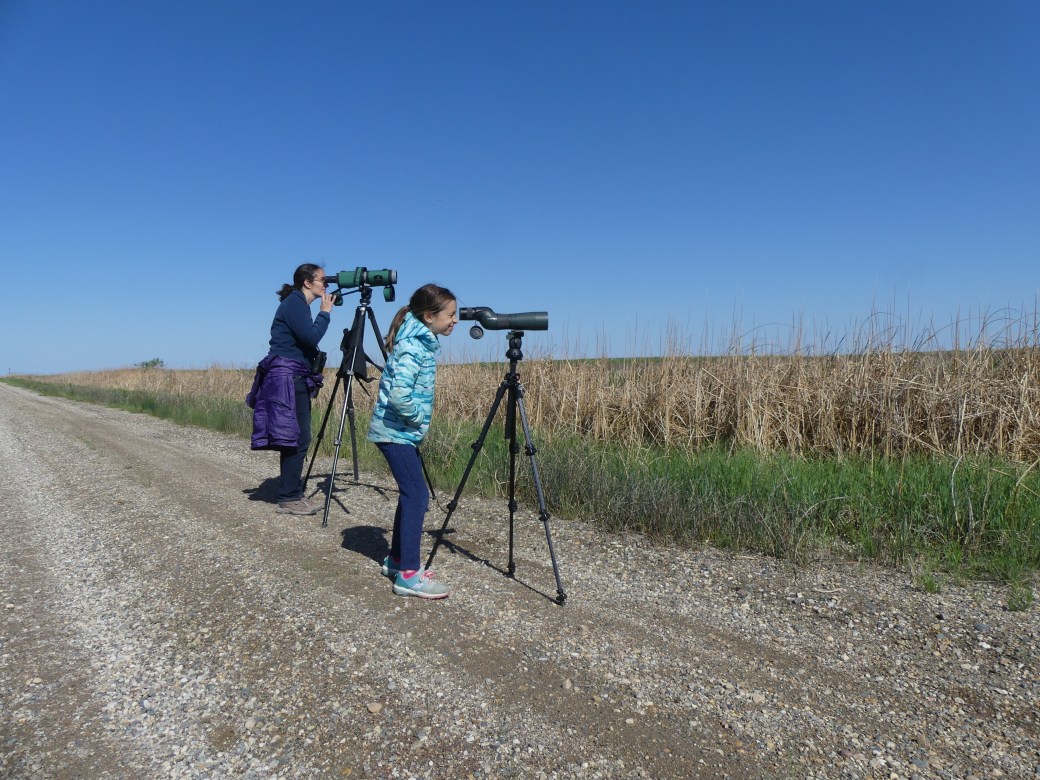
P1050005

Jen and Anna watching the Eared Grebes in the Maple Lake area (thanks Jen for permission to use the image). Photo copyright Tim Poole


Here is a summary of our remaining two or three groups (depending on whether Christian decides he was part of a group, or a singular man on a mission).

The handsome Loggerhead Shrike feeding in the IBA later on the same day. Photos all copyright Katharine Schulz.

Randy and Peter birded the southwest corner around Pipestone. There were some grassland birds in this area, including Loggerhead Shrike, Chestnut-collared Longspur and Sprague’s Pipit. Christian added some species from grassland bird surveys in this area, and we had a nice total here. The total of 11 Sprague’s Pipit and 7 Chestnut-collared Longspur’s is a really good result for this area in 2018.
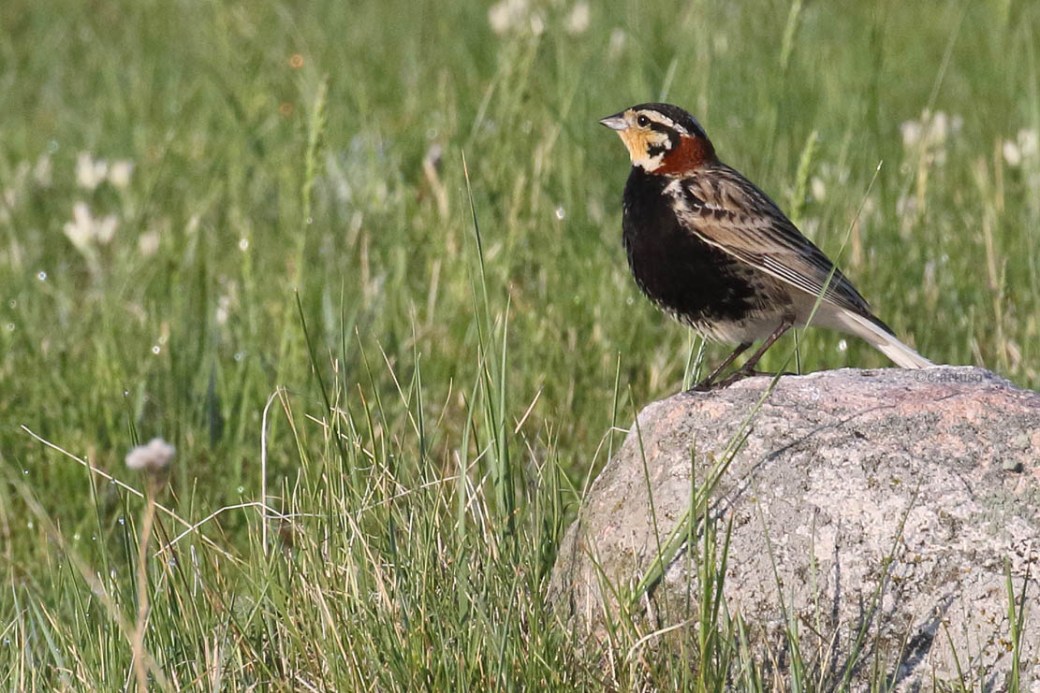
Chestnut-collared Longspur_9817_Artuso.jpg

A Chestnut-collared Longspur just posing to be photographed! Copyright Christian Artuso

Christian, in addition to helping out with some of the above, also found several thousand Franklin’s Gulls feeding in fields, and the largest group of shorebirds for the day, mainly White-rumped Sandpipers, and a rarely seen spring migrant, a Buff-breasted Sandpiper. All these birds turned up in a muddy, flooded field.
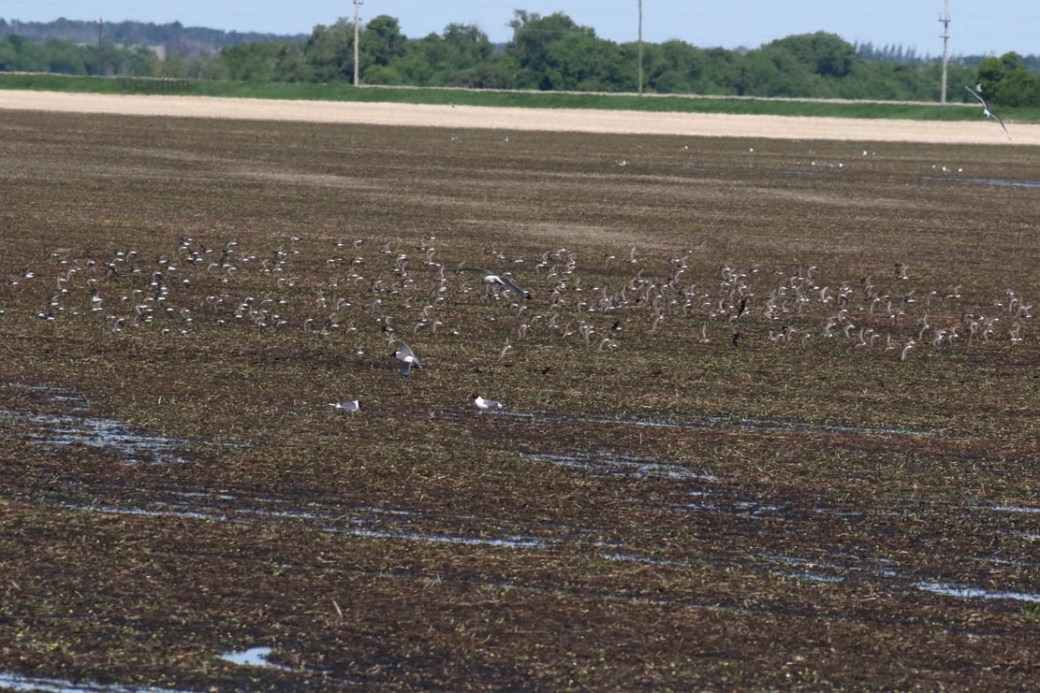
White-rumped Sandpiper_8887__BASA_SESA_flock in flight

Those brown dots are a multitude of shorebirds! Cpyright Christian Artuso

Bonnie, Cam and Bill hit the northeast, and added Mountain Bluebird straight away (Bonnie was determined to swell her year list). They also found a number of interesting birds, not least one of the days better hauls of shorebirds.
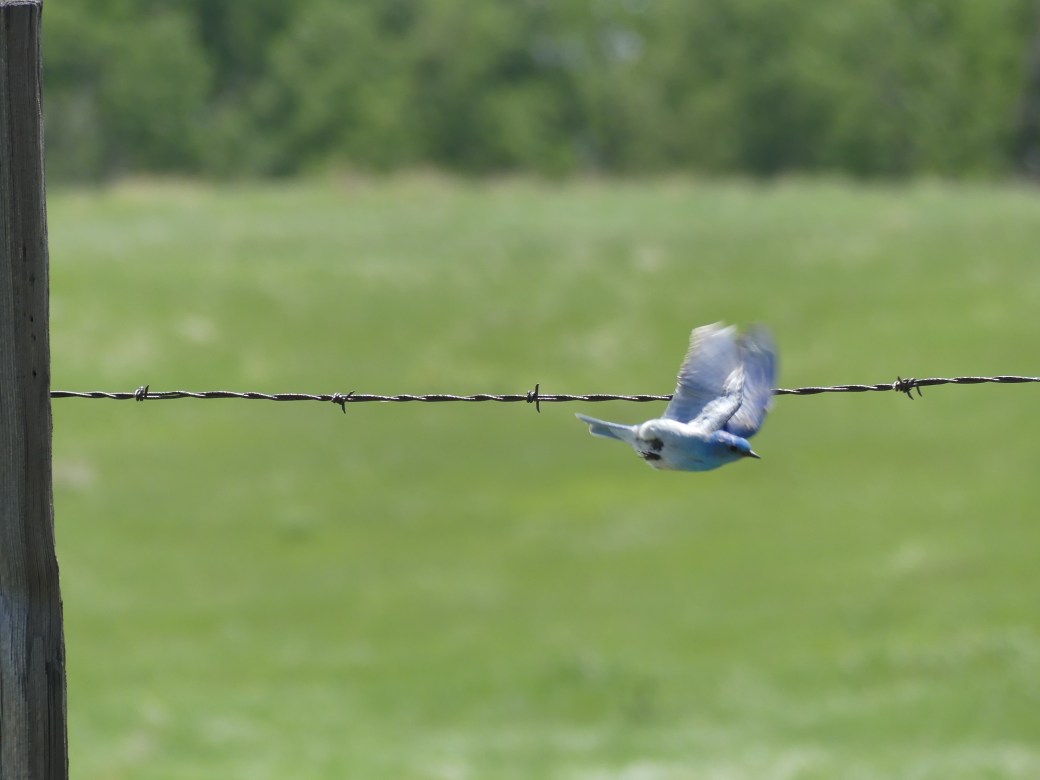
P1050012

Mountain Bluebird taking flight. Copyright Tim Poole

Of most interest was the towhee find, what appeared at first to be a rare Spotted Towhee.
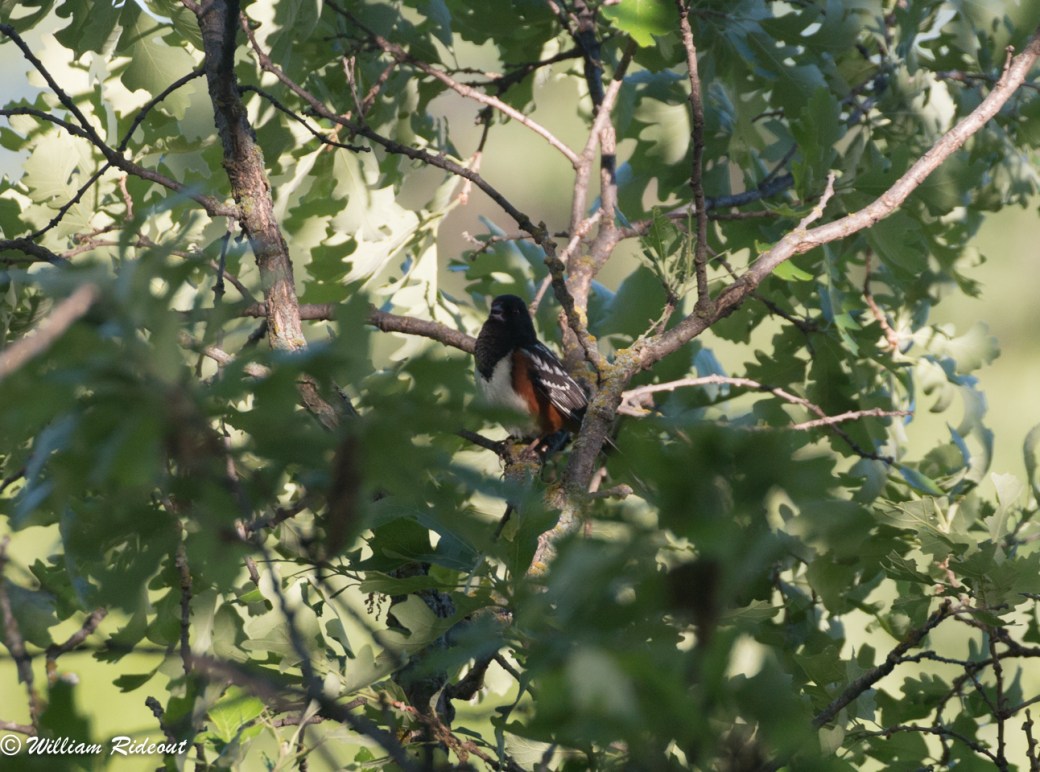
Spotted x Eastern Towhee Bill Rideout

A Spotted Towhee – or is it? Copyright Bill Rideout

Here is Christian Artuso’s thoughts on the photos from Bill:

  1. obviously perfect rows of spots on wing coverts and mantle plus thick white edge to tertials immediately rules out Eastern Towhee (Eastern shows no white in any of these places but instead show a small pocket hanky of white at the base of the primaries and white along the edge of the outer primary)
  2. The problem with calling this a spotted is that it shows a TINY amount of white at the base of the primaries (despite all their spots elsewhere, this area should be black in Spotted Towhee) the mix of this white pocket hanky plus spots elsewhere is usually attributable to hybridisation… in this bird though the amount of white is the key area is miniscule and only noticeable when the primaries and slightly apart… it is so little white it is tempting to write it off but…
  3. The eye is clearly red as expected in both species but it is usually a bit deeper red in Eastern and this bird seems to have a dark red eye (sadly there is no photo where the eye is in good sunlight to really judge this)

So, this is why I say MOSTLY Spotted Towhee – almost everything looks right for Spotted except two tiny tiny details… as for their song, all I can say is those two are extremely similar and it takes practices to separate them with confidence! 
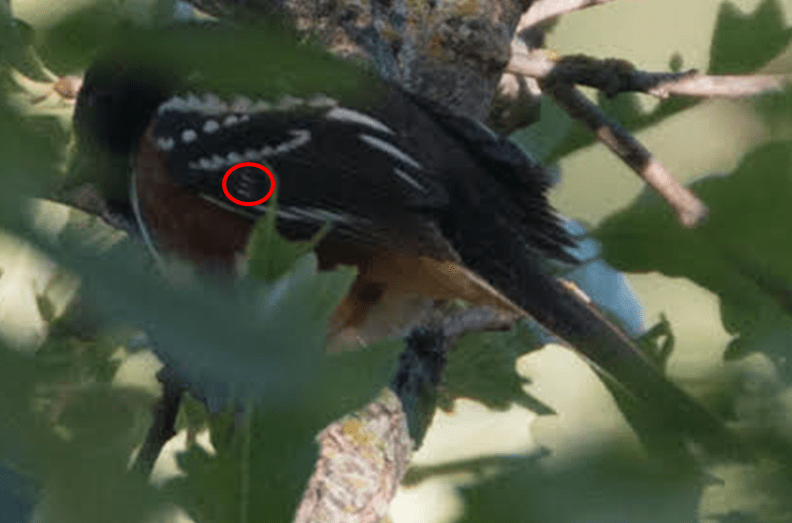
hyrbird towhee Bill Rideot

The offending blemish – only a very careful eye could pull this out. Copyright Bill Rideout


Thank you to everyone for coming along, it was a fantastic day, and we had some very valuable data collected. Of most note, was the excess of 10,000 Franklin’s Gulls. This would trigger the 1% global population of this species.

Here is our total list:

Species Name Species Count
Snow Goose 4
Canada Goose 786
Wood Duck 4
Blue-winged Teal 133
Northern Shoveler 123
Gadwall 59
American Wigeon 3
Mallard 241
Northern Pintail 1
Green-winged Teal 15
Canvasback 87
Redhead 35
Ring-necked Duck 15
Greater Scaup 4
Lesser Scaup 19
Bufflehead 3
Hooded Merganser 9
Ruddy Duck 29
Gray Partridge 2
Ruffed Grouse 1
Sharp-tailed Grouse 4
Pied-billed Grebe 2
Horned Grebe 1
Red-necked Grebe 11
Eared Grebe 70
Western Grebe 12
Double-crested Cormorant 14
American White Pelican 5
American Bittern 2
Great Blue Heron 4
Great Egret 1
Cattle Egret 3
Black-crowned Night-Heron 10
White-faced Ibis 33
Turkey Vulture 2
Northern Harrier 8
Cooper’s Hawk 4
Swainson’s Hawk 13
Red-tailed Hawk 30
Virginia Rail 3
Sora 9
American Coot 12
Sandhill Crane 10
American Avocet 19
Killdeer 68
Upland Sandpiper 9
Marbled Godwit 15
Baird’s Sandpiper 46
White-rumped Sandpiper 377
Buff-breasted Sandpiper 1
Semipalmated Sandpiper 11
Wilson’s Snipe 58
Wilson’s Phalarope 36
Spotted Sandpiper 3
Willet 25
Franklin’s Gull 10,127
Ring-billed Gull 5
Black Tern 54
Common Tern 1
Forster’s Tern 7
Rock Pigeon 44
Mourning Dove 131
Black-billed Cuckoo 1
Great Horned Owl 1
Ruby-throated Hummingbird 1
Belted Kingfisher 1
Red-headed Woodpecker 3
Yellow-bellied Sapsucker 13
Hairy Woodpecker 2
Northern Flicker 9
Pileated Woodpecker 1
American Kestrel 10
Eastern Wood-Pewee 4
Alder Flycatcher 3
Least Flycatcher 181
Eastern Phoebe 12
Great Crested Flycatcher 7
Western Kingbird 28
Eastern Kingbird 175
Loggerhead Shrike 1
Blue-headed Vireo 1
Warbling Vireo 141
Red-eyed Vireo 21
Black-billed Magpie 30
American Crow 45
Common Raven 34
Horned Lark 15
Purple Martin 39
Tree Swallow 126
Bank Swallow 53
Barn Swallow 247
Cliff Swallow 448
Black-capped Chickadee 3
White-breasted Nuthatch 1
House Wren 57
Sedge Wren 48
Marsh Wren 97
Eastern Bluebird 8
Mountain Bluebird 2
Veery 2
Swainson’s Thrush 1
American Robin 118
Gray Catbird 20
Brown Thrasher 2
European Starling 29
American Pipit 1
Sprague’s Pipit 11
Cedar Waxwing 61
Chestnut-collared Longspur 7
Ovenbird 2
Black-and-white Warbler 3
Common Yellowthroat 23
American Redstart 13
Yellow Warbler 174
Grasshopper Sparrow 20
LeConte’s Sparrow 23
Nelson’s Sparrow 6
Chipping Sparrow 15
Clay-colored Sparrow 195
Lark Sparrow 3
Vesper Sparrow 39
Savannah Sparrow 206
Song Sparrow 55
Swamp Sparrow 2
Eastern Towhee 2
Rose-breasted Grosbeak 1
Yellow-headed Blackbird 329
Bobolink 81
Western Meadowlark 227
Orchard Oriole 8
Baltimore Oriole 95
Red-winged Blackbird 796
Brown-headed Cowbird 107
Brewer’s Blackbird 204
Common Grackle 81
American Goldfinch 115
House Sparrow 84
EAKI_e-bird-2048p

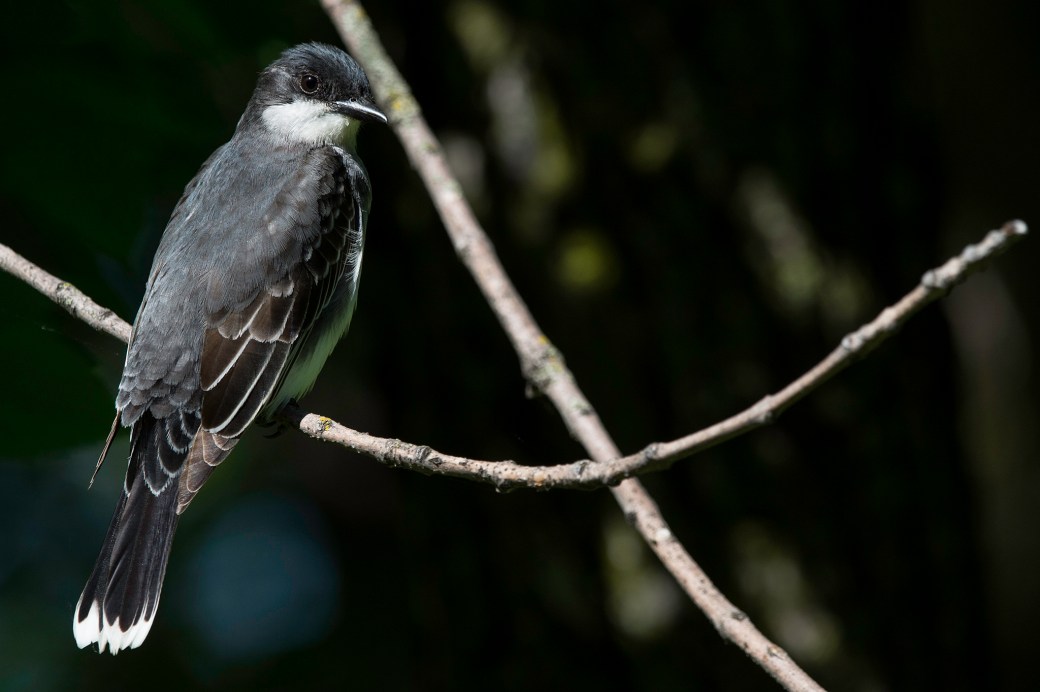
Eastern Kingbird looking alert. Copyright Cam Nikkel

Manitoba Shorebird Conservation, Management, and Monitoring Workshop Day 2

On Thursday May 24th 2018, organizations, biologists, and volunteers met on an impressive Nature Conservancy of Canada (NCC) property named Jiggen’s Bluff to start the second day of the Shorebird workshop. If you missed our blog post featuring the first day of the workshop, you can read it here. The MB Shorebird Conservation, Management, and Monitoring Workshop was organized by the Manitoba Important Bird Area (IBA) program, Manomet Shorebird Recovery Program and NCC, bringing together around 25 participants. A few main objectives of the workshop were to work on shorebird identification, connect shorebirds migrating/using the Central Flyway, address threats, and establish a long-term International Shorebird Survey (ISS) in Manitoba.

The schedule for the second day of the workshop was modified due to changes in the weather forecast. The original order of events would have had us watching presentations in the morning, with a trip to Whitewater Lake in the afternoon. To avoid the impending rain we all met at Jiggin’s Bluff at 8:30AM for a presentation by Brian Harrington on Flock Estimation. After discovering how terrible we could be at estimating flock sizes (and realizing why continuous practice is so important), everyone hopped on the bus and headed to Whitewater Lake.

Waterwater Lake IBA provided excellent opportunities to ID Shorebirds in the field, count species numbers, and estimate flock sizes.

At our first stop we had 13 species of Shorebirds including: American Avocet, Semipalmated Plover, Killdeer, Marbled Godwit, Ruddy Turnstone, Stilt Sandpiper, Baird’s Sandpiper, Least Sandpiper, White-rumped Sandpiper, Semipalmated Sandpiper, Wilson’s Phalarope, Red-necked Phalarope, and Willet (complete checklist). Everyone split into groups to ID and count. After everyone had finished their tally, results were compared. Aside from slight variation, which can be due to a difference in detection as birds come and go, results were quite even across the groups. A challenging species to count was the 160 Red-necked Phalarope which flushed regularly and were actively feeding in a large groups with new individuals arriving throughout our observation period. The 20 Ruddy Turnstone were well camouflaged where they were foraging in the bare agricultural field, with some groups not noticing their presence until the very end!


American Avocet (Left), Red-necked Phalarope (Top-right), Ruddy Turnstone (Bottom-right), Photos by C. Artuso

At our second stop we had 12 species of Shorebird, with 3 additional species: Hudsonian Godwit, Dunlin, and Lesser Yellowlegs (complete checklist). We were also quick to note the 2 Greater White-fronted Geese present. This location was not the best for learning opportunities due to the harsh glare of the sun and the distance of the birds, so after taking account of the species we moved on to stop 3.

P1040776.JPG

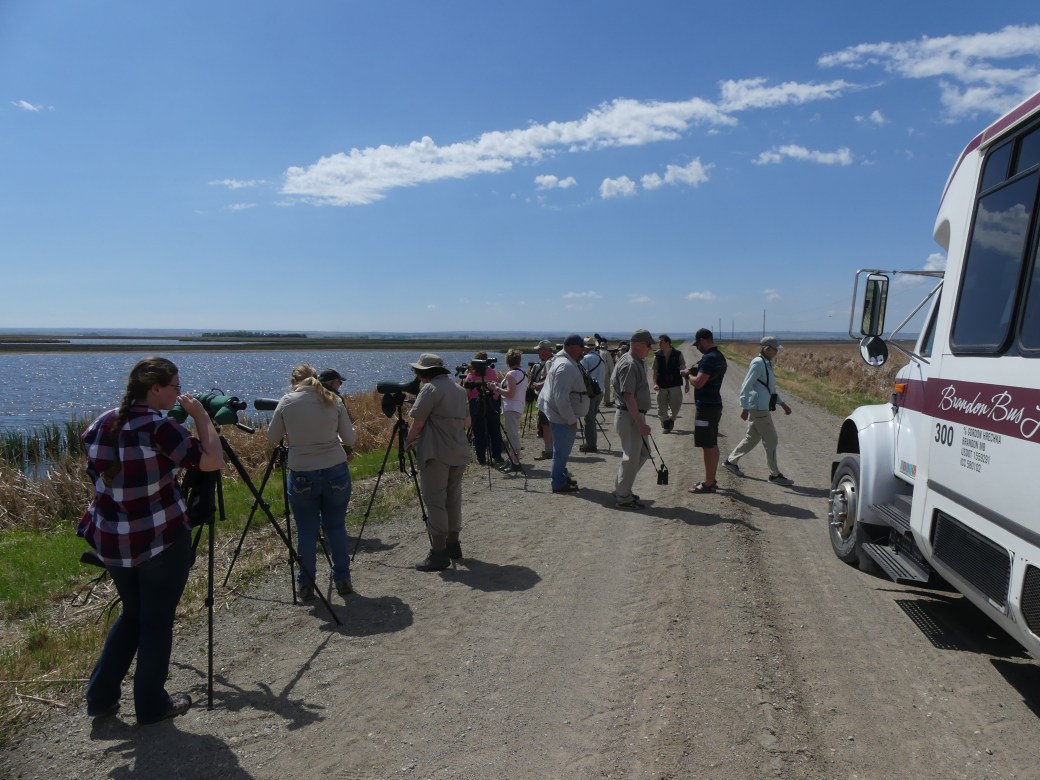
Workshop attendees straddled along the road looking for shorebirds. Copyright Tim Poole

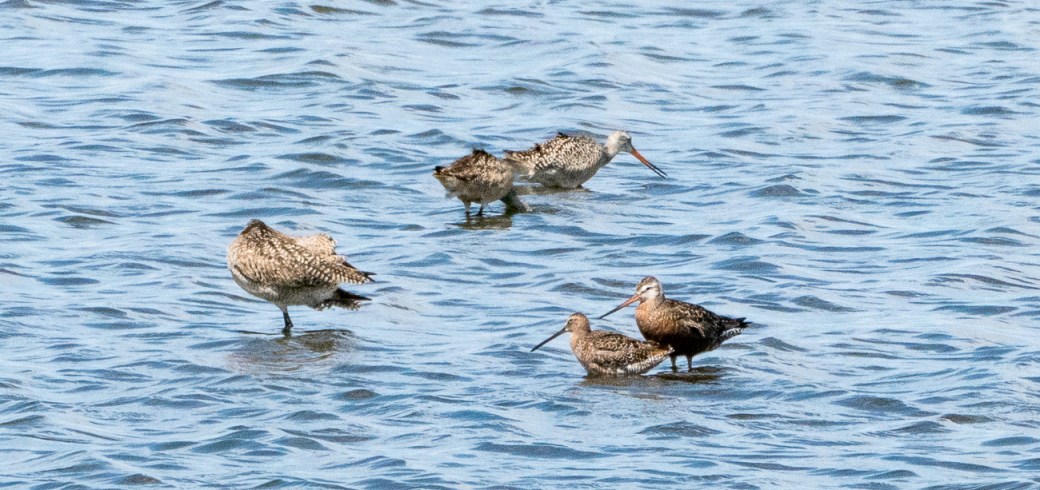
At the third stop we had 15 species of Shorebird, with 2 additional species: Black-bellied Plover and Long-billed Dowitcher (complete checklist). The Long-billed Dowitcher was a fantastic find, and we spent a good amount of time examining this bird which was foraging with 6 Marbled Godwit and a single Hudsonian Godwit. The close-up scope views of the Marbled Godwit and Hudsonian Godwit provided a unique opportunity to compare these species.

shorebird workshop day 2-1090557

3 Marbled Godwit (Left), 1 Long-billed Dowitcher standing in front of 1 Hudsonian Godwit (Right), Photo by Lynnea Parker

Our last stop landed us at Sexton’s Point, an area known for Western Grebe, Clark’s Grebe, and Great Egret. We were rewarded with 2 Clarke’s Grebe which are considered uncommon in Manitoba. Although uncommon, Clarke’s Grebe are known to breed at Whitewater Lake and sometimes even hybridize with the locally abundant Western Grebe. At this location we had 1 additional species of Shorebird: American Golden-Plover (Complete Checklist). Out on a distant spit of gravel, 20 American Golden-Plover were resting with a flock of 180 Black-bellied Plover. It is always a treat to see these two species in spring migration.


Additional species seen throughout the morning can be found on this checklist

In the early afternoon we found ourselves back at the Jiggin’s Bluff house for lunch and continued presentations. Monica Iglecia started off the afternoon talking about threats to Shorebirds and the status of Shorebird populations. It was alarming to learn that 40% of Shorebirds globally are experiencing declines. In North America, 40% of our Shorebird species are in decline, highlighting the need for a central flyway Shorebird monitoring program. Manitoba is located in the central flyway, and our establishment of an International Shorebird Survey (ISS) will fill a gap in regional, continental, and global monitoring efforts.

Monica’s presentation highlighted several challenges with Shorebird conservation, including:

  • Shorebirds tend to have low fecundity (small number of eggs per breeding pair)
  • Shorebirds face habitat loss and/or degradation at migratory stop-over locations and on breeding grounds
  • Climate change is an unknown variable what will undoubtedly affect Shorebirds in various ways
  • Unregulated hunting of Shorebird populations still exists in South America and the Caribbean.

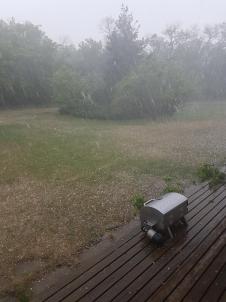
20180524_143245During the presentation a considerable hail storm descended upon the area, which captured everyone’s attention. As it turns out, we were correct in changing our schedule to do field observations in the morning!
Rebecca Neufeld presented next on Threats and Habitat Priorities in Oak Lake and Sandhill Conservation Plan. Issues that were identified for this area included the threat of Zebra Mussels establishing in the lake, invasive species management (focus on plants), fire suppression, and the encroachment of woody species in grassland areas.

Management of the Oak Lake and Sandhill conservation areas is directed towards grassland birds, mixed-grass prairie, sandhill blowouts, and riparian areas.

Our third presentation of the afternoon was an Introduction to Shorebird Management by Brad Winn. Brad explained that Shorebirds often respond rapidly to beneficial management. The three core needs of a migrating Shorebird were identified as:

  1. Food
  2. Staging areas to rest at stop-over locations
  3. Night roosting areas

Conservation of Shorebirds means addressing these needs, and ensuring that they can be met. Brad explained how Manomet works with local communities around the globe to establish Shorebird conservation initiatives. An important take-home message from this presentation was that managing for wildlife frequently means changing human behaviour, attitudes, and policy. It is a long process that one must be prepared for!

Christian Artuso was the last presenter of the day, speaking on the need for ISS monitoring in Manitoba. Christian explained why southwestern Manitoba was an exceptional location for migratory Shorebirds. He described how Manitoba’s current wet cycle and numerous ephemeral wetlands provided reliable (but constantly changing) habitat. Whitewater Lake itself is a vital stop-over location in the central flyway. Christian further highlighted that most of the Shorebird research in the province has been conducted in Churchill (northeastern Manitoba), with little attention being given to the southwestern region.

Manitoba Shorebird Conservation, Management, and Monitoring Workshop Day 1

On Wednesday May 23rd 2018, organizations, biologists, and volunteers met on an impressive Nature Conservancy of Canada (NCC) property named Jiggen’s Bluff to kick-start a two and a half day Shorebird workshop. The MB Shorebird Conservation, Management, and Monitoring Workshop was organized by the Manitoba Important Bird Area (IBA) program, Manomet Shorebird Recovery Program and NCC, bringing together around 25 participants. A few main objectives of the workshop were to work on shorebird identification, connect shorebirds migrating/using the Central Flyway, address threats, and establish a long-term International Shorebird Survey (ISS) in Manitoba.

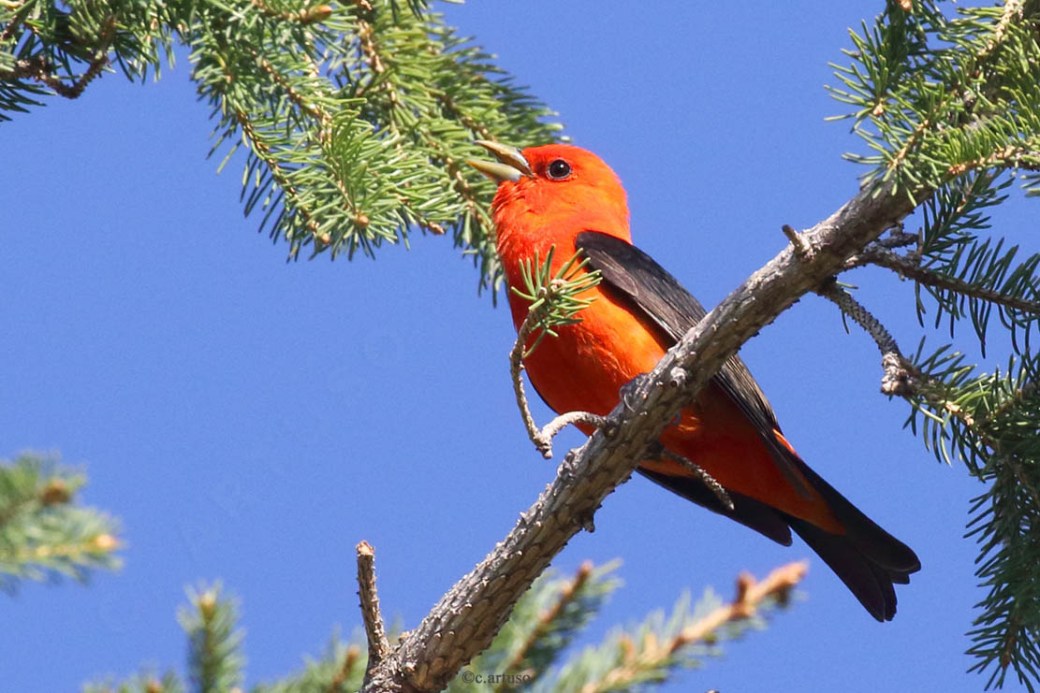
A Scarlet Tanager quickly became the unofficial mascot of the Manitoba IBA program shorebird workshop at Jiggen’s Bluff as he was singing loud and clear upon opening the car doors. The workshop was broken into classroom time where we spent the first half of the morning focusing on shorebird identification, life histories, and habitat requirements followed by field time to work on shorebird identification and accurate surveying (i.e. counting all birds in a given area).

Scarlet Tanager_7431_m_singing_Christian Artuso.jpg

Scarlet Tanager singing high in the tops of the conifer trees. Copyright Christian Artuso.

Presentations on the local area such as Jiggen’s Bluff were done by Kevin Teneycke from NCC explaining Manitoba has nine priority landscapes with the Souris River Valley being one of them. Tim Poole from the IBA program showed important changes that two IBAs (Whitewater Lake and The Oak-Plum Lakes) in Manitoba have gone through over the years due to variable weather conditions and the huge importance of these areas for supporting hundreds of thousands migratory shorebirds. For example, Manitoba has one of the largest colonies of Western Grebe and have seen up to 4.3% of the global population of Eared Grebes on migration. Monica Iglecia from Manomet discussed the different areas that their shorebird program focuses on, the many habitats that shorebirds can occupy (i.e. shallow water, open landscapes with short grassed areas), and how a network of people (citizen scientists) can help!

20180523_121058.jpg

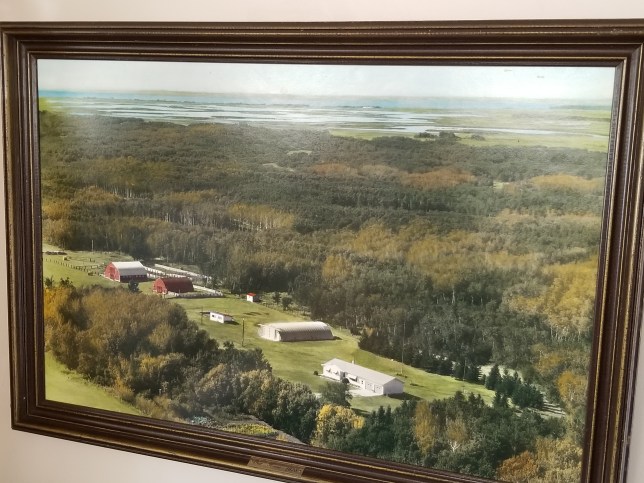
Nature Conservancy of Canada Jiggen’s Bluff property. Copyright Sabina Mastrolonardo.

Robert Penner from Kansas, Texas introduced what a WHSRN (Western Hemisphere Shorebird Reserve Network) site is and the importance of the Central Flyway to 65% of shorebirds who use it and are connecting us all. Brad Winn from Manomet dove into shorebird life history and how there are 222 shorebird species worldwide and North Americas supports 51 breeding species (23%). Brian Harrington presented on the limited reproduction in shorebirds as most species only lay a maximum of four eggs which is even lower in temperate regions, and how many adult shorebirds must lay approximately 200 eggs in their lifetime to replace itself. Monica then finished up the morning presentations talking about food resources for shorebirds (i.e. annelids, molluscs, arthropods, and even biofilm). One key take-away message was that conservation starts with you! The individual which adds up to meaningful change protecting shorebirds from the Arctic all the way down to South America.

Brad Winn provided quick key features, size differences, and behaviours for the shorebirds we could potentially see out in the field, such as the Dowitcher feeding straight down or Greater Yellowlegs with its bill being longer in comparison to the head. The group piled into a bus all together and off we were approximately 20 minutes away in and around wetland and upland habitats in the Oak-Plum Lakes region to I.D shorebirds in the field.

Shorebird workshop with Manomet_8208_Christian Artuso.jpg

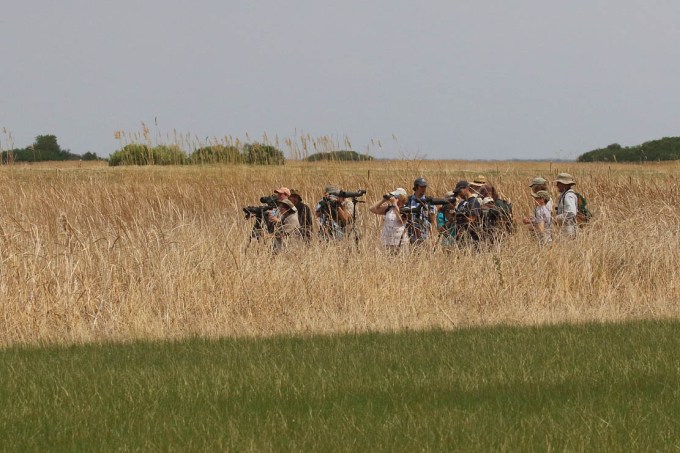
Workshop participants hard at work in the field looking and counting shorebirds. Copyright Christian Artuso.

Shorebirds were not overwhelming at the first site but still plentiful and an especially nice number and ease for those beginner shorebird ID’ers. The challenging peeps were identified to be 12 White-rumped Sandpipers, 9 Baird’s Sandpiper, 3 Least Sandpipers, and 5 Semipalmated Sandpiper. In addition there were 8 American Avocets, 3 Willet, 3 Marbled Godwits, 7 Stilt Sandpipers, and 6 Pectoral Sandpipers. About half way through the identification session, majority of the shorebirds flew up from the water in a whimsical motion all together avoiding a predation attempt, long before we could identify a Sharp-shinned Hawk flying overhead. Furthermore, we ID’ed 5 Wilson’s Phalarope and 9 Red-necked Phalarope before moving onto another body of water to spot 1 Trumpeter Swan and 1 Sanderling. A very successful first field day with lots more planned for the next couple days.

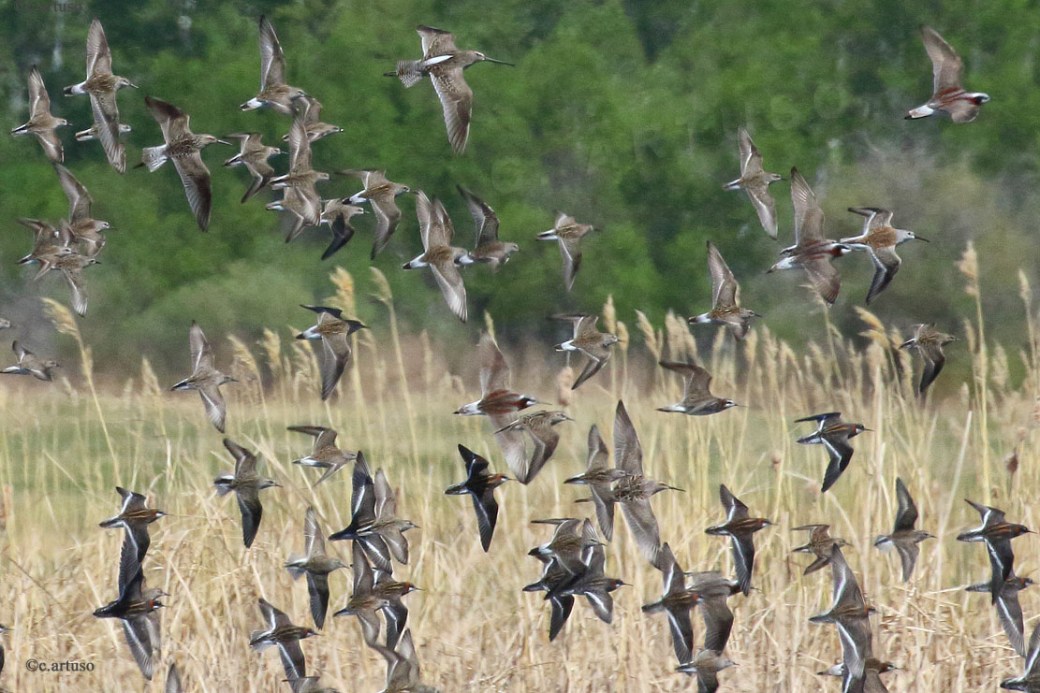
shorebird flock in flight_RNPH_WIPH_LBDO_DUNL_STSA_WRSA_SESA_7091_Christian Artuso.jpg

Shorebird flock in flight including species such as, RNPH, WIPH, LBDO, DUNL, STSA, WRSA and SESA. Copyright Christian Artuso.

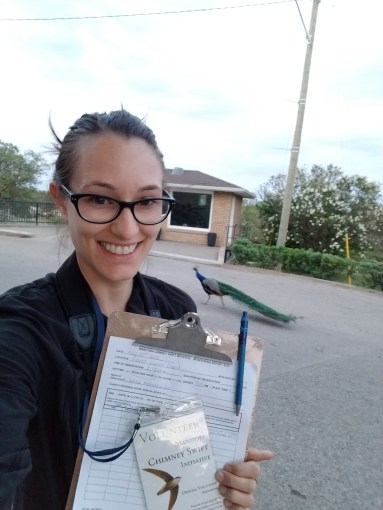
Before calling day one quits, a group of us drove to the town of Souris for some Chimney Swift monitoring. After about an hour and half of monitoring chimneys and being somewhat harassed by wild Indian domestic Peafowl squawking in the town, many more Chimney Swifts were discovered than previously thought! Three known roosts in Souris with 19 Chimney Swifts seen using eight different chimneys equaling a whole lot of activity!

20180523_214306

One out of five Indian domestic peafowl wild in the town of Souris and being somewhat of a bother during Chimney Swift monitoring. Copyright Sabina Mastrolonardo.

—–

By the end of the two and half days, the group saw 26 shorebird species including an astonishing banded (leg-flagged) Red knot and over 160 bird species in total!

Manitoba Shorebird Conservation, Management, and Monitoring Workshop Day 1

A Morning at Oak Hammock Marsh Celebrating International Migratory Bird Day

On May 12th, Oak Hammock Marsh Interpretive Center celebrated International Migratory Bird Day. Tim Poole and Lynnea Parker helped lead a morning bird walk with Paula Grieef from Oak Hammock Marsh and Dr. Christian Artuso from Bird Studies Canada.

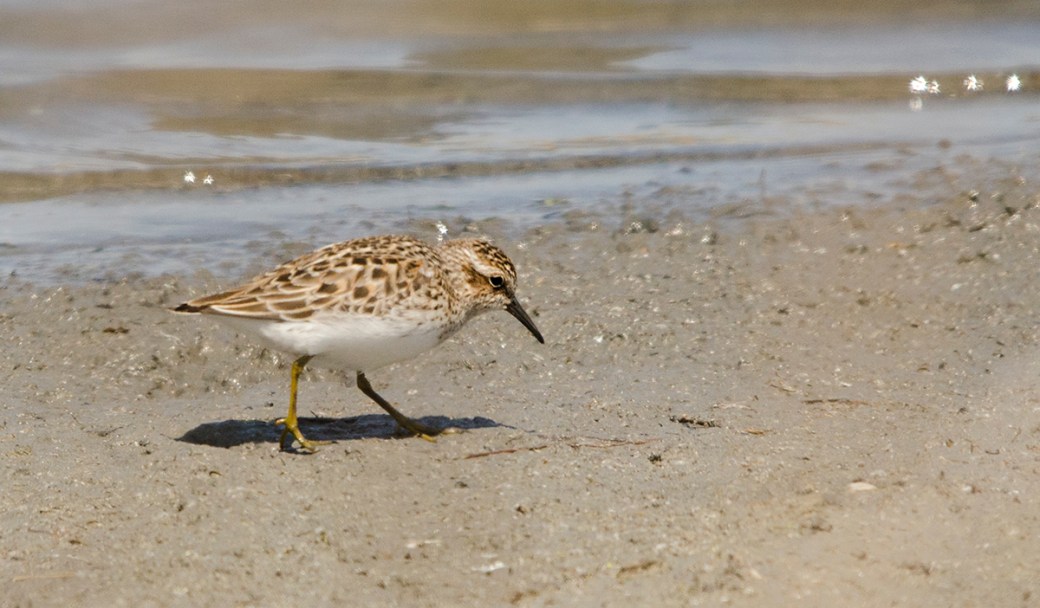
In total, 40 members of the public attended this successful event. 39 different species were observed, including 8 species of waterfowl and 8 species of shorebird. We had several birding scopes set up during this event to provide participants with close-up views of the various species. One of the more noteworthy shorebirds seen was the Least Sandpiper. 24 of these little peeps were spotted running up and down the muddy flats at the front pond to the Interpretive Centre and other locations around the marsh (photo below).

_DSC3240 web

Least Sandpiper foraging for food at Oak Hammock Marsh, photo by Lynnea A. Parker

13 Wilson’s Phalarope (photo below) were seen swimming in circles, a behaviour which  is unique to the Phalarope family. Phalaropes swim in tight circles in order to stir the water and snatch aquatic bugs which ascend to the surface.

Wilson's Phalarope_8236.jpg

Wilson’s Phalarope foraging, photo by Christian Artuso

Marbled Godwits provided the biggest show of the morning, getting up to, what can only be described as ‘a bit of springtime business’.

Thank you to Oak Hammock Marsh for hosting, and for the large numbers of people who came to make this a successful morning out.

Complete list of species seen during the morning bird walk:

Species Number
Canada Goose 18
Tundra Swan 16
Blue-winged Teal 14
Northern Shoveler 9
Mallard 21
Green-winged Teal 18
Ring-necked Duck 6
Lesser Scaup 7
Horned Grebe 1
Double-crested Cormorant 3
Northern Harrier 1
Virginia Rail 1
Sora 1
American Coot 7
Killdeer 4
Marbled Godwit 3
Least Sandpiper 24
Wilson’s Phalarope 13
Spotted Sandpiper 1
Greater Yellowlegs 1
Willet 2
Lesser Yellowlegs 4
Ring-billed Gull 6
Forster’s Tern 3
Common Raven 1
Purple Martin 8
Tree Swallow 12
Barn Swallow 5
American Robin 3
Palm Warbler 1
Yellow-rumped Warbler 1
White-throated Sparrow 1
Song Sparrow 4
Lincoln’s Sparrow 1
Swamp Sparrow 3
Yellow-headed Blackbird 9
Red-winged Blackbird 40
Brown-headed Blackbird 4
Common Grackle 8

Two IBA Events Announced!

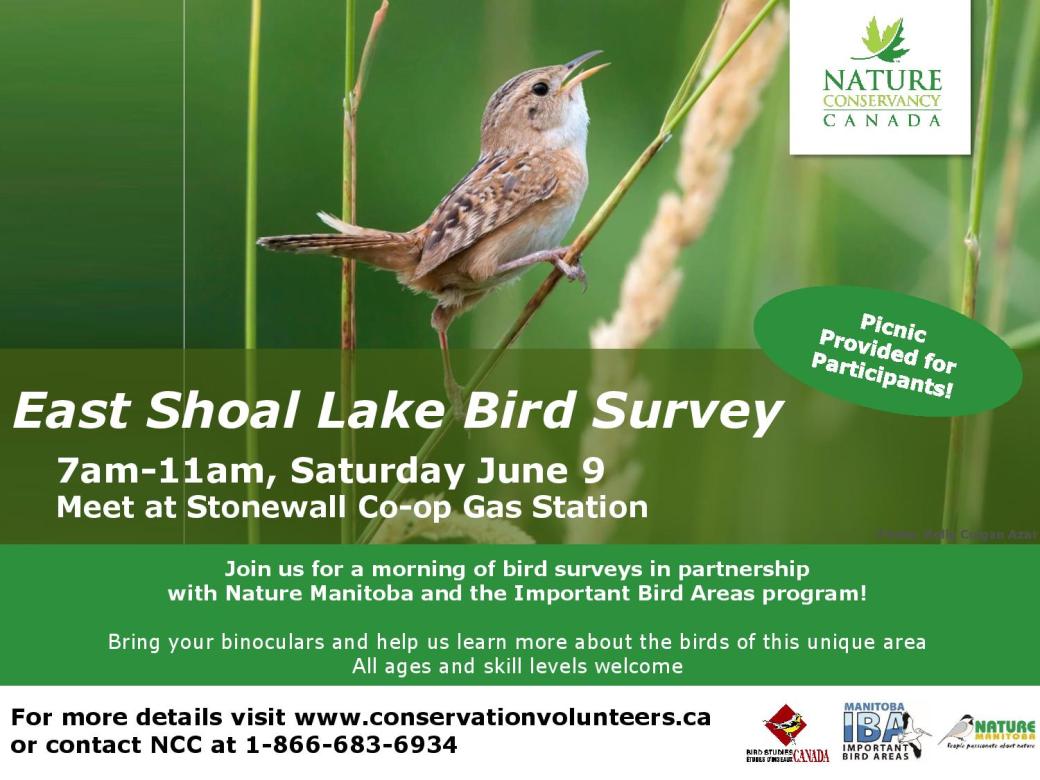
The Manitoba IBA Program is involved in organising two upcoming blitzes, one at Oak Lake and Plum Lakes IBA and the other, a morning bird survey blitz with NCC at East Shoal Lake. Posters are attached, but here are some details

Oak Lake and Plum Lakes, June 3rd

Oak Lake is one of Manitoba’s premier places for grassland and wetland birds. Huge numbers of waterbirds breed in the area. We recently recommended to the IBA Canada Program a change in the boundary to take in the Maple Lakes and Pipestone areas. There is a huge colony of Franklin’s Gulls in the Maple Lakes, at least 50,000 noted by provinical biologist Ken De Smet in 2017, and we would love to get an estimate of numbers in 2018. There are also grassland birds around Pipestone and along the west of the lake, shorebirds around the Plum Lakes, and Red-headed Woodpeckers in various places. Basically, this place is a gem!

OakLake&PlumLakes_Bird-Blitz_EventPoster_2.jpg

East Shoal Lake, June 9th

We will be surveying areas in and around the NCC’s East Shoal Lake property on June 9th. We will focus on Species At Risk. This will take the form of a smaller, more localised blitz, with the focus on locating threatened species. There might be some early, early morning surveys looking for such glories as Yellow Rail and Least Bittern, but this will be confirmed later on once we have scoped the status of the habitats. Unlike other IBA blitzes, this will involve more footwork, walking on tracks.

ESL Bird Survey 2018 Poster-page-001.jpg

If you are interested in any of this, please email  and we will get you signed up!

North, West, and East Shoal Lakes IBA Bird Blitz

On Sunday, May 6th, 14 birders split into 4 groups and covered over 177 km of the North, West, and East Shoal Lakes IBA (IBA map). With a late start to spring this year we were not sure what to expect in terms of species diversity and numbers. On Saturday, the day before the blitz, Tim Poole and Lynnea Parker noted that ice coverage on Lake Manitoba was still quite extensive at Sandy Bay Marshes IBA near Langruth. Lynnea was therefore glad to observe that West and East Shoal Lakes were mostly ice-free. North Shoal Lake was partially open along the roadsides and marshes.

122 species were observed in the morning with good numbers of waterfowl and grebes. Group 1 with Pierre, Bill, Wally, and William were particularly fond of the 171 American Robins and 159 Red-winged Blackbirds they thoroughly counted. However, the robins and blackbirds paled in comparison to the 611 Western Grebes which were spotted rafting together at West Shoal Lake (Group 1 checklist).

Shoal lakes 2018 Birding blitz-180506-001-IMGS5791_smaller size

View of West Shoal Lake with a large number of Western Grebes rafting in the distance, photo by Pierre Richard

western grebe 1 William Rideout

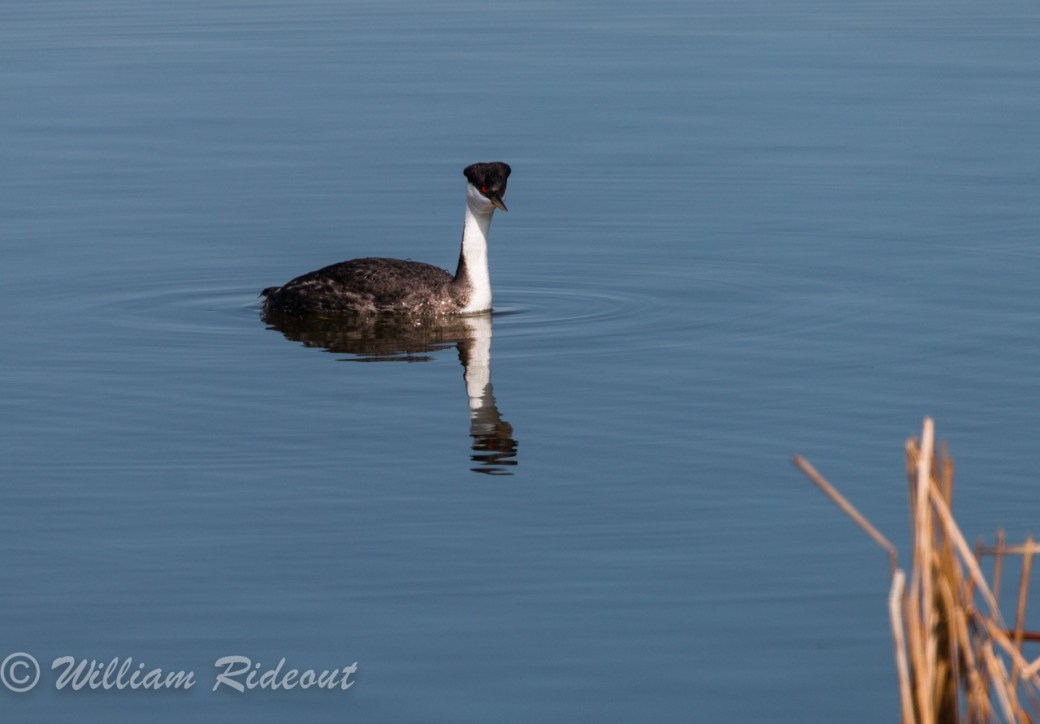
Western Grebe, photo by William Rideout

At the Sandy Bay Grebe Watch event on May 5th, Tim and Lynnea had been hoping to see several hundred Western Grebes. Due to the heavy ice cover, only 112 Western Grebes were counted. It would seem our missing Grebes were over at West Shoal Lake instead! A further 500 were spotted by Bob Jones at Delta Marsh the previous day.

Group 2 with Jo, Betsy, Christian, and Mohammad surveyed the east side of East and North Shoal Lakes. Christian turned back the clock and took up his Atlas nickname ‘Moose Legs’, walking the rejuvenated wetland also known as PR415, which runs between North and East Shoal Lakes (Christian’s Checklist). The decommissioned, and partially flooded road was highly productive with 94 species, including high counts of waterfowl, Double-crested Cormorant, American White Pelican, American Coot, Sandhill Crane, Gulls, and Blackbirds. Unfortunately for Christian, he missed the Snowy Egret spied by Group #4 which was found on the same decommissioned road just outside his survey area to the west. Group #4 didn’t feel bad however, as Christian managed to find a Clark’s Grebe which they didn’t see. Photos below feature a pair of Lesser Yellowlegs (upper left), pair of Canvasbacks (middle left), flock of American White Pelicans (lower left), and a Marbled Godwit preening (right) (photos by Christian Artuso). (Additional checklists for this group: #1, #2, #3, #4, #5)


Group 3 with Joanne, Richard, Louise, and Eric surveyed the IBA area north of North Shoal Lake. They had many species of waterbirds despite having less open water in their area. Good sights from Group 3 included 4 Trumpeter Swans, 18 Red-necked Grebes, and 1 Semipalmated Plover (Checklist). The photos below by Joanne Smith include Red-necked Grebe (Left) and Willet (Right).


Group 4 with Lynnea, Cam, and Jeff surveyed the northern part of West Shoal Lake, west side of East Shoal Lake, and west side of North Shoal Lake. The highlights from this group included a Snowy Egret, good numbers of Green-winged Teal and Blue-winged Teal, and 11 Great Egret. Access to the open water was limited, but the marshy areas were moderately productive. Photos below were taken by Cam Nikkel and feature a Forster’s Tern (Left) and a Great Egret (Right).


Overall, highlights of the day included: 13 Greater White-fronted Goose, 766 Western Grebe, 1 Clark’s Grbe, 490 American White Pelican, 6 American Bittern, 32 Great Egret, 1 Snowy Egret, 3 Black-crowned Night-Heron, 116 Sandhill Crane, and 58 Bonaparte’s Gull.

After the morning blitz everyone gathered at Rosie’s Cafe in Inwood for a glorious lunch before wrapping up the event.

Compiled IBA Event Checklist:

Snow Goose 1,455
Ross’s Goose 8
Greater White-fronted Goose 13
Cackling Goose 9
Canada Goose 1,554
Trumpeter Swan 8
Tundra Swan 99
Wood Duck 2
Blue-winged Teal 340
Northern Shoveler 73
Gadwall 59
American Wigeon 26
Mallard 591
Northern Pintail 42
Green-winged Teal 428
Canvasback 662
Redhead 75
Ring-necked Duck 145
Greater Scaup 7
Lesser Scaup 313
Greater/Lesser Scaup 4
Bufflehead 31
Common Goldeneye 17
Hooded Merganser 4
Common Merganser 18
Red-breasted Merganser 8
Ruddy Duck 19
Ruffed Grouse 1
Sharp-tailed Grouse 1
Common Loon 15
Pied-billed Grebe 45
Horned Grebe 56
Red-necked Grebe 36
Eared Grebe 1
Western Grebe 766
Clark’s Grebe 1
Double-crested Cormorant 479
American White Pelican 490
American Bittern 6
Great Blue Heron 14
Great Egret 32
Snowy Egret 1
Black-crowned Night-Heron 3
Turkey Vulture 1
Osprey 2
Northern Harrier 11
Cooper’s Hawk 1
Bald Eagle 15
Broad-winged Hawk 1
Red-tailed Hawk 17
Virginia Rail 3
Sora 3
American Coot 537
Sandhill Crane 116
American Avocet 8
Semipalmated Plover 1
Killdeer 41
Marbled Godwit 19
Pectoral Sandpiper 1
Wilson’s Snipe 52
Wilson’s Phalarope 7
Greater Yellowlegs 22
Willet 23
Lesser Yellowlegs 114
Bonaparte’s Gull 58
Franklin’s Gull 1,305
Ring-billed Gull 2,802
Herring Gull 102
gull sp. 742
Caspian Tern 3
Common Tern 3
Forster’s Tern 173
Mourning Dove 15
Belted Kingfisher 7
Yellow-bellied Sapsucker 31
Downy Woodpecker 3
Hairy Woodpecker 2
Northern Flicker 28
Pileated Woodpecker 1
American Kestrel 6
Merlin 4
Eastern Phoebe 9
Blue Jay 6
Black-billed Magpie 25
American Crow 13
Common Raven 15
Tree Swallow 98
Barn Swallow 35
Black-capped Chickadee 2
Marsh Wren 23
Ruby-crowned Kinglet 7
Eastern Bluebird 4
Hermit Thrush 4
American Robin 208
Gray Catbird 1
European Starling 15
American Pipit 5
Orange-crowned Warbler 6
Palm Warbler 6
Yellow-rumped Warbler 5
LeConte’s Sparrow 2
American Tree Sparrow 2
Chipping Sparrow 1
Clay-colored Sparrow 6
Lark Sparrow 2
Fox Sparrow 1
White-crowned Sparrow 9
Harris’s Sparrow 1
White-throated Sparrow 7
Vesper Sparrow 3
Savannah Sparrow 53
Song Sparrow 115
Lincoln’s Sparrow 1
Swamp Sparrow 52
Yellow-headed Blackbird 665
Western Meadowlark 23
Red-winged Blackbird 2,676
Brown-headed Cowbird 54
Rusty Blackbird 104
Brewer’s Blackbird 32
Common Grackle 115
Purple Finch 1

Sandy Bay Grebe Watch

On Saturday, May 5th we held a Grebe Watch event at the Sandy Bay Marshes IBA. The Sandy Bay Marshes are located along the western shoreline of Lake Manitoba, just east of Langruth and Sandy Bay First Nation (Map). This IBA is known for its large concentrations of Western Grebes in the spring, with 500-1000 breeding pairs recorded in 1986! The purpose of this event was to see if Western Grebes (and other Grebes) were present and document their numbers.

On Friday, May 4th Tim Poole (IBA Coordinator) noted that the bays along the shoreline of Lake Manitoba were still heavily covered in ice. In light of the bays being covered in ice, the Grebe Watch was cancelled for individuals who had signed up from afar, such as Winnipeg. The event went ahead for local residents. The cold start to spring this year has seemingly delayed spring migration for many species of waterbirds.

Sandy Bay IBA Blitz-Langruth-Manitoba-000-LARGE-Lynnea A Parker2-1080641

Hollywood Beach, Sandy Bay Marshes. Photo by Lynnea A. Parker

It was a successful turnout with 8 people from the community and 1 person from Winnipeg joining us at Hollywood Beach. We started off the morning by gathering on the main beach and scanning for waterbirds. Tim and Lynnea Parker (IBA Assistant) set up spotting scopes to show the public a variety of species, including Western Grebe, Tundra Swan, Redhead, Canvasback, Bonaparte’s Gull, Common Tern, and Marbled Godwit.

P1040253

Western Grebe, Photo by Tim Poole

As anticipated, the Western Grebes were present in the IBA, but not in the high numbers we were initially hoping to see. We suspect the cold weather and ice along the shoreline was a contributing factor to the low numbers. In total, we recorded 70 species of birds including 112 Western Grebe. At the end of this blog post there is a  list of species which were detected.

We would like to thank everyone who did attend the Grebe Watch event, and we hope this opportunity has encouraged more people to take an interest in monitoring and reporting birds within the Sandy Bay Marshes.

Species Detected (70 Total)

24        Canada Goose

35        Tundra Swan

150      Blue-winged Teal

1          Northern Shoveler

26        Gadwall

12        American Wigeon

54        Mallard

6          Northern Pintail

280      Green-winged Teal

16        Redhead

8          Ring-necked Duck

34        Lesser Scaup

6          Bufflehead

4          Common Goldeneye

8          Common Merganser

1          Red-breasted Merganser

3          Ruddy Duck

6          Common Loon

3          Red-necked Grebe

112      Western Grebe

46        Double-crested Cormorant

18        American White Pelican

3          American Bittern

1          Turkey Vulture

4          Northern Harrier

2          Bald Eagle

2          Broad-winged Hawk

6          Red-tailed Hawk

2          Rough-legged Hawk

1          Virginia Rail

1          Sora

8          American Coot

12        Sandhill Crane

12        Killdeer

6          Marbled Godwit

3          Willet

9          Lesser Yellowlegs

6          Bonaparte’s Gull

4          Franklin’s Gull

16        Ring-billed Gull

2          Herring Gull

74        Common Tern

45        Rock Pigeon

2          Mourning Dove

4          Northern Flicker

2          American Kestrel

1          Merlin

3          Eastern Phoebe

1          Black-billed Magpie

1          American Crow

3          Common Raven

5          Tree Swallow

12        Barn Swallow

2          Black-capped Chickadee

1          Marsh Wren

1          Swainson’s Thrush

3          Hermit Thrush

2          American Robin

1          European Starling

25        Palm Warbler

6          Dark-eyed Junco

2          White-throated Sparrow

1          Savannah Sparrow

10        Song Sparrow

6          Swamp Sparrow

45        Yellow-headed Blackbird

4          Western Meadowlark

400      Red-winged Blackbird

18        Brewer’s Blackbird

6          Common Grackle

1          Yellow-rumped Warbler

Lone Wolf on the Riverton Sandy Bar IBA

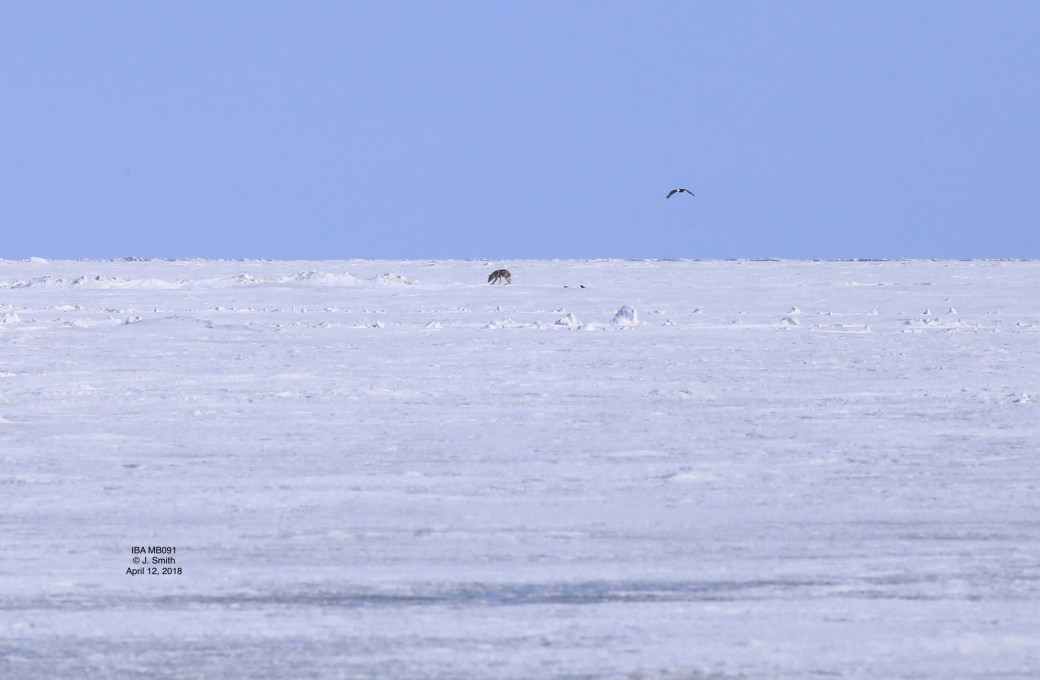
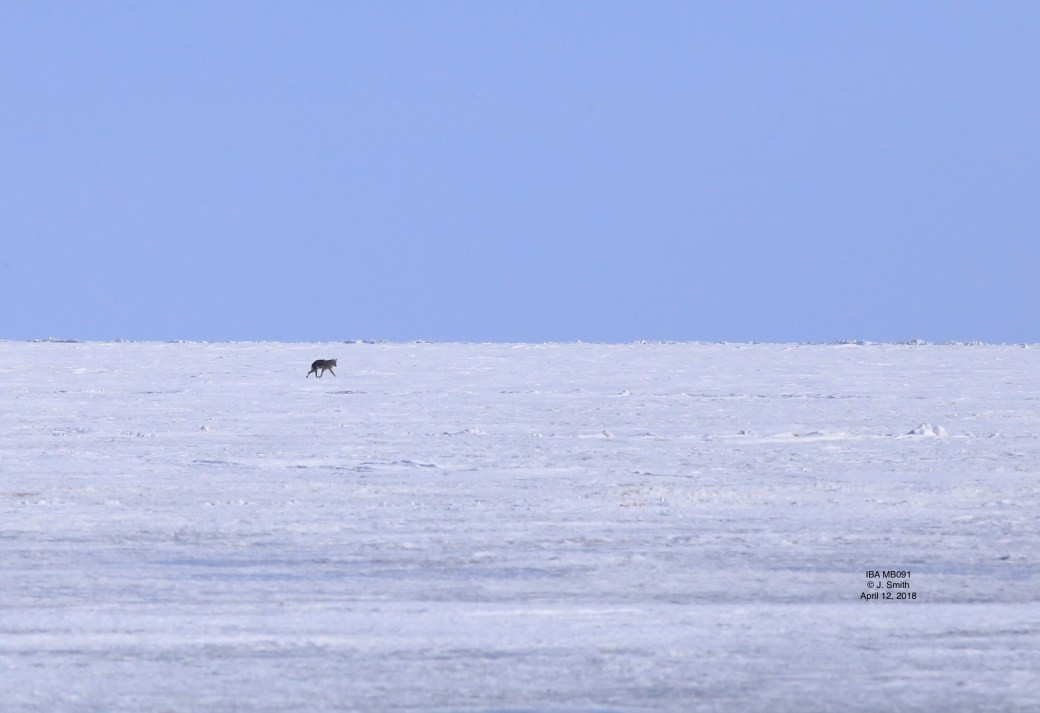
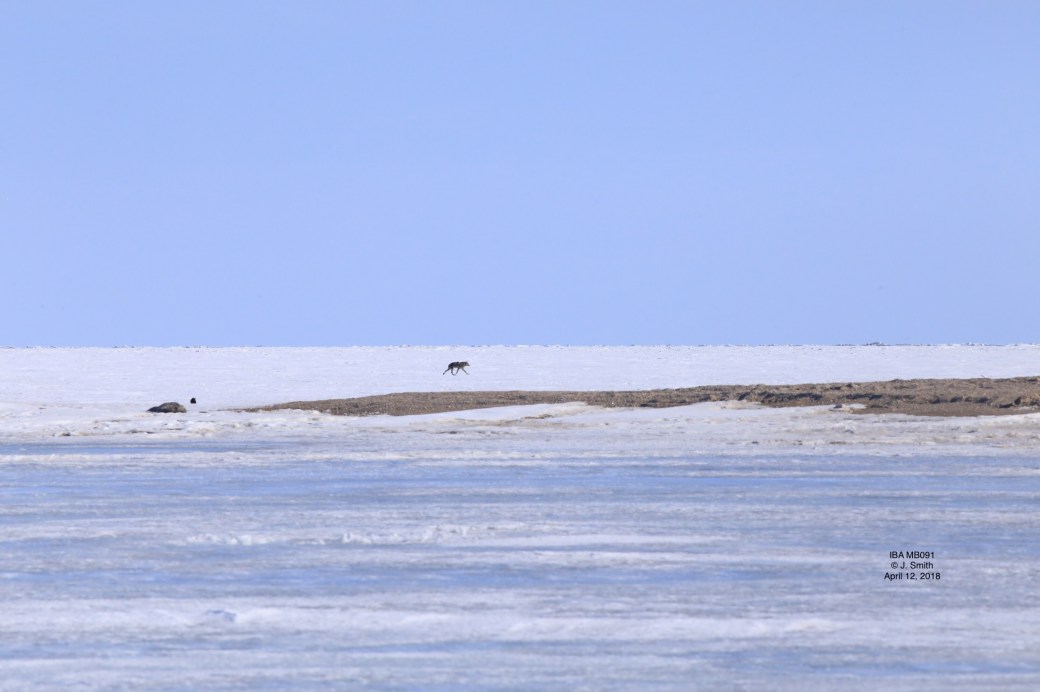
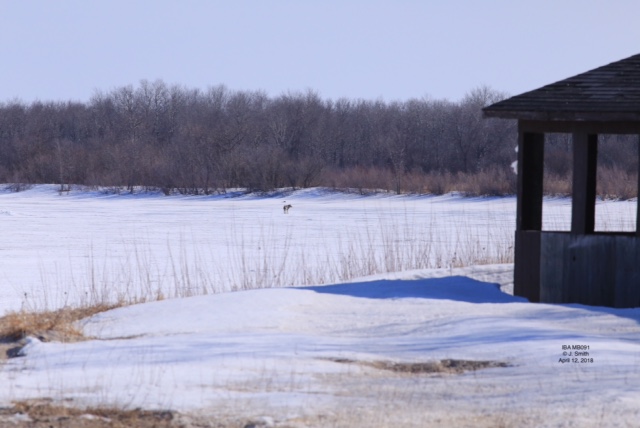
It is always nice to report something a bit different in one of Manitoba’s IBAs, and this is no exception. The Churchill and Vicinity IBA or the Saskatchewan River Delta IBA are probably the most likely places to see wolves within Manitoba’s IBA network. It was therefore a pleasant surprise to receive reports from Caretaker, Joanne Smith, late last Thursday, that she had spotted a Timber Wolf on the Riverton Sandy Bar IBA.

The series of photos below begin with the wolf, seemingly being closely watched by a Bald Eagle, as it walks on Lake Winnipeg. The Bald Eagle seems to then chase off a raven, before the wolf follows the sandbar towards solid land, and even a building in the final photo.

Thanks Joanne for the use of your photos, certainly makes a nice difference to post this on our website!

IMG_0303IMG_0306IMG_0311IMG_0312IMG_0316

IMG_0317