Manitoba IBA is Hiring a Summer Assistant

We are looking for a summer student for this summer, funded via the Canada Summer Jobs Program. Here are the details.

Manitoba Important Bird Areas Program Assistant

The Manitoba Important Bird Area (IBA) Program is hiring a Program Assistant. This position is based out of Winnipeg, or remotely depending on the successful candidate, and includes travel to various IBAs in southern Manitoba, with periods of time in the Souris River Watershed District. The position is a 280-hour contract at $15/hr depending on experience – start date June 2020.

For more information on the Manitoba IBA program, visit: http://importantbirdareasmb.ca.

Responsibilities

Working closely with the IBA Coordinator, the responsibilities of the Program Assistant are to:

  • Conduct monitoring for Avian Species at Risk in southwestern Manitoba for a significant period of the contract
  • Assist with monitoring populations of threatened birds and landowner outreach in Manitoba’s IBAs including in southwestern Manitoba;
  • Assist with organising events and activities for the Manitoba IBA Program;
  • Monitor the threatened Chimney Swift in urban areas of Manitoba, including southwestern Manitoba;
  • Work remotely with citizen scientists to assist in data collection, data entry and analysis for the threatened Chimney Swift;
  • Research and develop educational materials for landowners and the general public to promote Manitoba’s IBAs and Chimney Swifts;
  • Assist with Manitoba IBA blog site and social media set-up;
  • Assist with volunteer and partner communications via email and phone;
  • Other duties as assigned.

Qualifications

The successful applicant will have:

  • A minimum of 2 years of post-secondary education in biology, conservation or environmental science degree / diploma program
  • Knowledge of and demonstrated interest in the natural history of Manitoba
  • A keen interest in, knowledge of and ability to identify birds in Manitoba
  • Previous experience in environmental education and outreach is a strong asset
  • Experience with & knowledge of WordPress, Facebook and the Microsoft Office suite
  • Exceptional written and interpersonal communication skills
  • Strong organizational skills and attention to detail
  • Ability to work well as a team and independently
  • Willing to drive to remote locations in southwestern Manitoba and do overnight stays if necessary (rental or use of own car permitted and expenses will be covered)

Interested in applying?

Applicants must meet the following criteria to be eligible for the position:

  • youth aged 15 to 30,
  • valid Class 5 driver’s licence,
  • living in Manitoba, and
  • legally entitled to work in Canada.

How to Apply:

Interested applicants should forward their resume and short 1-page cover letter as 1 PDF file by email to the IBA Coordinator at iba@naturemanitoba.ca (Subject line: IBA Program Assistant) by June 1st, 2020.

Only those candidates selected for an interview will be contacted.


Manitoba Important Birds Area Wetland Bird Identification Webinar + Link to Shorebird Webinar


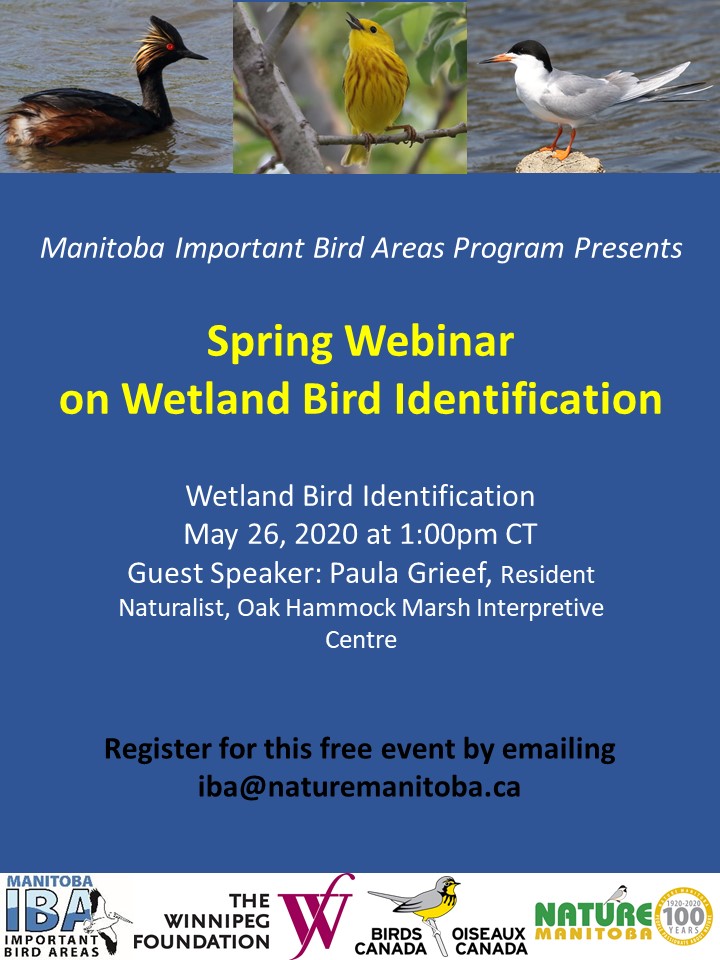
IBA Manitoba Wetlands Poster

A big thank you for everyone who attended our recent webinar on Identification of Manitoba Shorebirds. If you missed it, a recording of the webinar is available online on the Manitoba IBA program’s Youtube page.

We will be hosting our second webinar on Identification of Manitoba’s Wetland birds on Tuesday, May 26th at 1:00 pm CT. Our guest presenter this time is Paula Grieef. Paula is a Resident Naturalist at Oak Hammock Park Interpretive Centre, a longtime member of our IBA Manitoba Steering Committee, and a Board Member for the Delta Marsh Bird Observatory at Oak Hammock Marsh WMA.

To register for the Wetland Birds webinar please email iba@naturemanitoba.ca. We hope to see you (virtually) there!


IBA Manitoba Spring Webinar Series

Shorebirds Poster

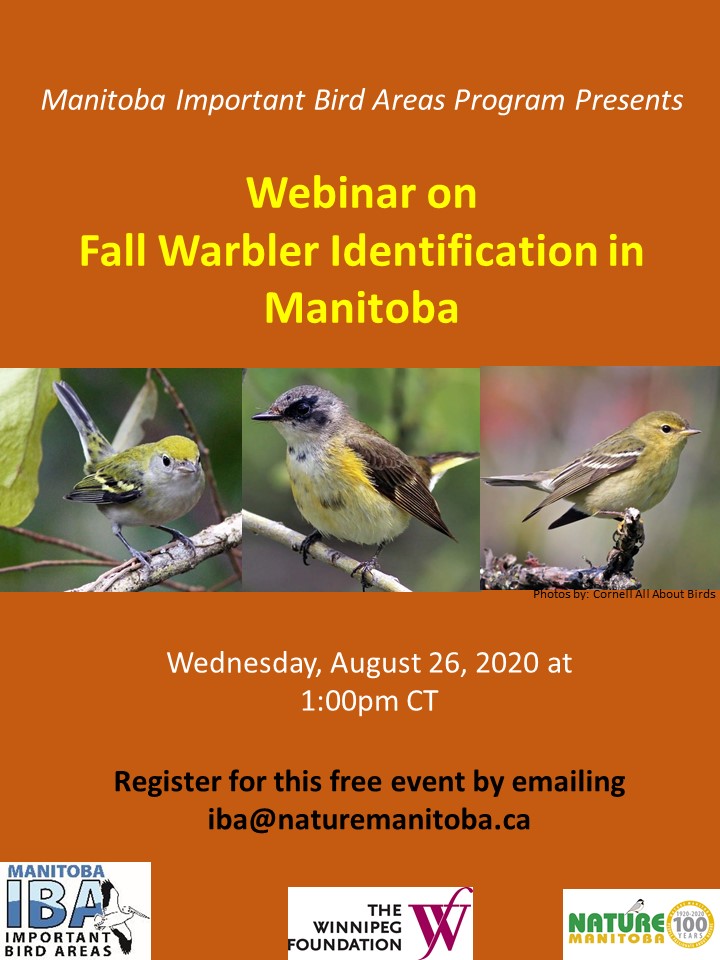
I am excited to announce the first webinar of a new series held by the Manitoba Important Bird Areas Program. Although we cannot hold a spring shorebird workshop in-person this year, please join us electronically to learn or brush up on your shorebird identification skills with Dr. Christian Artuso.

Dr. Christian Artuso is dedicated ornithologist and conservationist with many of years working with our local birding scene in Manitoba. Christian has been key in helping to set up the International Shorebird Survey (ISS) in Manitoba. He coordinated our Manitoba Breeding Bird Atlas and has been a member of the Manitoba Important Bird Areas Program Steering Committee since its inception. A big thank you to Christian to start us off on this series as our guest speaker.

Our Shorebirds webinar will take place on May 13, 2020 at 1:00pm CT. Please register by emailing iba@naturemanitoba.ca. We hope to see you (virtually) there!


Birding at Home

While this is a challenging time both globally at here at home, here at IBA Manitoba we are encouraging you to keep up with birding as we move into the spring! Below are some links that can bring a little birding into your day.


Backyard Birding

Whether you are a beginner or experienced birder, now is the perfect time to start backyard birding. You don’t even need a backyard, a window or balcony with a view of the sky will work as well. You can even start a yard list of different birds and when you first see them (or use eBird.org to enter sightings into a citizen science database) to keep a record of your sightings. It can certainly help to have a pair of binoculars and a bird identification guide (book, app or website) handy!

https://www.allaboutbirds.org/news/ – All About Birds is a website run by Cornell University that has a variety of birding resources from bird identification, to life history information and species range maps.

https://merlin.allaboutbirds.org/ – A bird identification app for Android and iPhone also developed by Cornell University.

Bird Guides – There are a number of bird guides available that cover Manitoba. Some are broken down into Eastern or Western North America (Manitoba falls right in the middle, but personally I’ve always gone with Eastern), others cover all of North America.


Manitoba Stay-at-Home Nocturnal Owl Survey

Normally around this time, Nocturnal Owl surveys are being conducted by volunteers all around rural Manitoba. Due to the need to stay near home, the nocturnal owl surveys are now being done by volunteers our own backyards. Surveys are conducted 40 minutes after sunset. Surveys last 5 minutes each, where volunteers look and listen for number, species and direction of owls. And don’t forget zero counts (i.e. no owls) are important results for science as well! Currently this citizen science program is ending April 20th 2020, but you can certainly count for yourself after that period as well!

https://importantbirdareasmb.ca/manitoba-stay-at-home-nocturnal-owl-survey-form/ – Link to the Google Docs reporting form on Manitoba IBA’s website and for more information.

IMG_5596

A backyard owl (although out during the afternoon). By Amanda Shave

Nature Manitoba’s 100 Birds for 100 Years

As part of their 100th anniversary, Nature Manitoba is holding a contest for people to see 100 bird species during 2020. Check out the website for a downloadable version of the bird list. It includes birding for beginner to expert skill levels.

http://naturemanitoba.ca/100-birds-100-years


Update your Birding Skill Level

No matter your current skill level, there is always room for improvement! Expand your knowledge of birding by sight or sound. Once we can resume our normal activities, you’ll be able to wow your friends and family with your knowledge of birds.

Helpful links:

https://www.allaboutbirds.org/news/ – All About Birds is a website run by Cornell University that has a variety of birding resources from bird identification, to life history information, species range maps and more.

https://www.xeno-canto.org/– A free worldwide data base of bird calls and sounds. It can be interesting to hear the regional dialects of some bird species.

https://ebird.org/explore– A citizen science database that is used primarily for citizen science. It also has resources such as videos, recordings, photos and range maps for species found in Manitoba and around the world.


Excited for Birds Arriving in Spring?

There are a number of websites that track the arrival of birds on spring migration. Some websites are species specific, while others are general. Below are a few to increase your anticipation:

ebird.org – The bar charts function (https://ebird.org/GuideMe?cmd=changeLocation) comprised of citizen science data reported in past years gives an estimation of the timing (and species abundance) for a specific location throughout the year. You can also use the “Species Map” function with the “current year” to track birds moving on spring migration (https://ebird.org/map).

Annotation 2020-04-14 140927

Example bar chart for Oak Hammock Marsh IBA (eBird.org)

Annotation 2020-04-14 141202

Example species map for Cliff Swallows sightings as of April 14, 2020 (eBird.org)

https://birdcast.info/– Unfortunately BirdCast only tracks birds in the U.S.A., however their method is very neat! They use an array of weather satellites that can pick up on the high densities of birds that travel on spring migration. These densities of birds are then plotted on a map, similar to how meteorologists show precipitation maps on your local news. You can watch birds as they arrive up to the U.S.A./ Canada border.

Annotation 2020-04-14 141858

BirdCast by Cornell Laboratory

Virtual Birding

There are a number of organizations and individuals that host cameras trained on bird feeders, migration stopover sites or nest camera. See below for a few favourites (some may not have started up yet for the season).

http://www.species-at-risk.mb.ca/pefa/r-resources.html – Peregrine Falcon Cameras (includes cameras in Winnipeg and Brandon).

https://video.nest.com/live/w3xeU1YLng and http://67.215.63.156/mobile/main.html?lang=en&_=0.4702988833454287 – Oak Hammock Marsh Interpretive Centre cameras on bird feeders and the marsh respectively.

https://www.allaboutbirds.org/cams/all-cams/ – AllAboutBirds.org also hosts a large variety of bird cameras year-round from around the world.

Annotation 2020-04-14 143454

Bird feeder camera at Oak Hammock Marsh Interpretive Centre

Safe Birding Guidelines

Lastly, no matter how you bird, remember to follow safe birding guidelines. This includes normal advice such as giving birds a respectable distance when observing them, to remembering to social distance if you leave your home.

https://ebird.org/canada/news/please-bird-mindfully – eBird Canada on birding mindfully.

https://www.birdscanada.org/responding-to-covid-19-what-birds-canada-is-doing-and-how-you-can-help/ – Birds Canada response to birding during COVID-19.

A Note to IBA Manitoba Volunteers

As with many organizations, we are currently working to adapt our short and longer-term plans to deal with the realities of COVID-19. While indoor events that we have held in past springs are currently on hold, we are hoping to continue our work at outdoor events and activities under current government advice. If advice from the government changes, we will change our plans accordingly. As always we encourage volunteers to monitor IBAs using the IBA Protocol on eBird.ca (https://www.ibacanada.com/documents/eBird_IBA_protocol_EN.pdf) and continuing to count shorebirds under the International Shorebird Survey (https://importantbirdareasmb.ca/2018/08/13/the-international-shorebird-survey-iss-in-manitoba-an-encouraging-start/). We still hope that you will consider continuing to contribute to the program by monitoring independently in this way.

For now, Manitoba IBA continues to look forward to the spring and the arrival of our many feathered friends!

Greater Yellowlegs_9667Greater Yellowlegs. Copyright Manitoba IBA Program.

COSEWIC Updates in 2019

As we end off 2019 here is a quick overview of COSEWIC status changes for two birds that we see in our Manitoba Important Bird Areas.

COSEWIC (Committee on the Status of Endangered Wildlife in Canada) is an independent advisory panel that provides information to the Minister of Environment and Climate change in Canada. They are responsible for identifying and assessing the conservation status of wildlife species in Canada.


Hudsonian Godwit

This large shorebird was assessed by COSEWIC in May 2019 as “Threatened”. Previously it had no status under COSEWIC, and currently has no status under SARA Schedule 1. While populations on the breeding grounds are not well monitored, the monitoring on migration and the nonbreeding grounds indicate substantial recent population declines.

Hudsonian Godwit_0368

Hudsonian Godwit. Copyright by Christian Artuso.

The Hudsonian Godwit breeds in the arctic, with its Manitoba range near Churchill. It is a long-distance migrant that travels to the southern third of South America. Northern Manitoba residents may see the Hudsonian Godwit during migration and breeding seasons in northern IBAs such as Nelson River Estuary and Marsh Point IBA and Kaskattama River Mouth IBA. Those of us in southern Manitoba can see the Hudsonian Godwit in our IBAs in Manitoba as they pass through in the spring and fall on migration.

Threats to the Hudsonian Godwit identified by the COSEWIC committee on the breeding ground include a decrease in suitability for nesting and prey availability due to climate change and an over abundance of geese. Threats at the nonbreeding grounds include loss of habitat and disturbance in South America.

In 2019 Hudsonian Godwits were seen at IBA events in both the spring and autumn at Whitewater Lake IBA. If you are interested in seeing Hudsonian Godwits and other shorebirds in 2020 be sure to stay on the lookout for our Shorebird Blitzes and/or International Shorebird Survey opportunities.


Chestnut-collared Longspur

Just last month (November 2019) the Chestnut-collard Longspur was reassessed from Threatened to Endangered by COSEWIC. It is still listed as Threatened under SARA Schedule 1. There has been a long-term decline of 95% of Chestnut-collared Longspurs since the 1970s. COSEWIC also lists a range contraction of the Chestnut-collared Longspur to the south and west. This fits with what we have seen in Manitoba where these birds can be seen in the southwestern corner of the province, when previously they were recorded near to Winnipeg and even at Oak Hammock Marsh according to The Birds of Manitoba.

Chestnut-collared Longspur_9910_corner_Artuso

Chestnut-collared Longspur. Copyright by Christian Artuso.

In Manitoba this flashy grassland bird breeds in the southwestern corner of the province. It requires large continuous parcels of grassland for breeding. The Chestnut-collared Longspur’s nonbreeding range extends throughout the southwestern United States and into northern Mexico.

The main threat identified by COSEWIC for the Chestnut-collared Longspur is habitat loss, degradation and fragmentation. This is impacting the Longspur in both its breeding ground in Canada, as well as its nonbreeding range in northern Mexico.

Both the Southwestern Mixed-grass Prairie IBA and the Ellis-Archie and Spy Hill Community Pastures IBA have held continentally important occurrences of the Chestnut-collared Longspur in recent summers.

New Manitoba IBA Coordinator

Hello everyone, my name is Amanda and I am just starting work as the new Important Birds Area coordinator. I have been a volunteer for the IBA program at several blitzes over the past couple of years so we may be familiar faces to each other. Prior to this position I was working as an environmental policy analyst in Manitoba, but my passion has been birds for many years. I completed my undergraduate degree at the University of Manitoba with work terms at Agriculture and Agri-Foods Canada as a riparian health technician and at Ducks Unlimited Canada working on the Carp Exclusion Project at Delta Marsh, Manitoba. It was working and living in the middle of Delta Marsh during two springs and summers that my interest in birds took flight.

From 2015-2017 I complete my M.Sc. degree at the University of Manitoba in the Avian Behavior and Conservation lab. There I studied purple martins, a long-distance migratory bird that catches insects on the wing (aerial insectivore). Recent publications have detailed how aerial insectivores and long-distance migrants are both showing population declines. For purple martins, like many insectivorous birds, it is important that they arrive at the breeding grounds when weather is nice enough to allow for insects to emerge. If birds arrive too early a lack of food and cold weather decrease breeding success, while arriving too late may mean that they do not have enough time and resources to raise their young before autumn migration.

As climate change progresses in North America we are expecting earlier springs and warmer temperatures. If purple martins do not adjust spring arrival timing it may lead to a mismatch, where martins become out of sync with their environment at the breeding grounds, unless they are able to adapt. My work was to examine how purple martin migration and breeding timing may be affected by climate change across North America.

3

Adult male purple martin. Photo by Amanda Shave

My work involved two approaches both which could only be done with the help of citizen scientists locally and across North America. The first was working on the ground in Manitoba with local citizen scientists to deploy light-level tracking devices, called geolocators, on purple martins. These tracking devices weight less than 5% of a bird’s body mass and use sun rise/sun set and solar noon to estimate latitude and longitude. The tracking devices are put on the birds during the breeding season and retrieved in the following year (they do not transmit data). Luckily for us purple martins generally return to the same breeding sites each year.

Geolocators give us a location for each day they are on the bird, so that we can track time and place of fall roosts, migrations and overwintering sites of these birds as they migrate to the Amazon each year. Overall, I found that spring temperatures along migration did not predict martin migration timing. Instead individual birds had highly similar migration time between different years of spring migration, suggesting that migration timing may be inherent to individuals rather than directed by weather en route.

2

Purple martin house at Oak Hammock Marsh. Photo by Amanda Shave

I also used a data set collected by citizen scientists across North American over 20 years through the Purple Martin Conservation Association’s Project MartinWatch. Citizen scientists monitor purple martin colonies throughout the breeding season for egg-laying, hatching and fledging timing and numbers of young. With this dataset I determined that purple martins lay earlier in warmer springs and fledge more young when they lay earlier. I found that selection favoured earlier breeding in most years but there was not increasing pressure to select for earlier breeding over the 20-year period. This suggests that purple martins may be able to adjust their breeding timing to earlier spring conditions. However, if breeding trends continue to become earlier, eventually breeding timing might be limited by the arrival date of purple martins at their breeding grounds from spring migration.

1

Purple martin chicks during a nest check following the PMCA’s MartinWatch protocols. Photo by Amanda Shave.

In my roles as a researcher using data collected by citizen scientists, and as a volunteer citizen scientist myself, I have seen firsthand the importance of work done by the public plays in the scientific process. So often science is constrained by time and resources, so the knowledge and help provided by citizen scientists working together provides valuable information and different viewpoints than any one person working alone. If you are interested in joining our team of volunteers, I would love to hear from you at iba@naturemanitoba.ca or (204) 943-9029.

Research engagement opportunity for landowners and livestock producers in Southwestern Manitoba

The Manitoba IBA program is excited to announce the launch of a new research project aimed at understanding livestock producer and landowner motivations for engaging in grassland conservation activities. Because much of Manitoba’s high-quality native grasslands are privately owned, it is essential that conservation organisations are able to work collaboratively with the people who own and work on the land. That is why the Manitoba IBA Program and Bird Studies Canada, with the support of Manitoba Habitat and Heritage Corporation, West Souris River Conservation District, and Turtle Mountain Conservation District will seek to recruit landowners and producers to participate in an online survey. Participation in this survey will help us understand local people’s environmental values and views on avian Species-At-Risk. Through better understanding landowners and producers, we hope to identify practical ways of addressing conservation issues in Southwestern Manitoba.

Southwestern Manitoba is a stronghold for much of the province’s remaining high-quality mixed-grass prairie habitats. Four Manitoba Important Bird Areas (IBAs) can be found in the Southwest, including our newest addition: Ellice-Archie and Spy Hill Community Pastures Important Bird and Biodiversity Area. The three other IBAs include: Whitewater Lake, Oak Lake/Plum Lakes, and Southwestern Manitoba Mixed-Grass Prairie.  Southwestern Manitoba is home to many avian Species-At-Risk, such as the Chestnut-collared Longspur, Sprague’s Pipit, Baird’s Sparrow, Loggerhead Shrike, and Ferruginous Hawk.

Top left: Chestnut-collared Longspur, bottom left: Loggerhead Shrike, top right: Baird’s Sparrow, middle right: Sprague’s Pipit, bottom right: Ferruginous Hawk. Photos taken by Christian Artuso. 

In the spring of this year, the 12th Prairie Conservation and Endangered Species Conference (PCESC) took place in Winnipeg. The theme of this conference was “working landscapes”, in acknowledgement of the fundamental role that landowners and producers play in grassland conservation across the prairie provinces. Helping landowners and producers retain and manage grassland properties is vital for supporting the retention and recovery of our grassland Species-At-Risk.

If you are a landowner or livestock producer in Southwestern Manitoba and would like to participate in this project, you may proceed to the online survey HERE. Surveys must be completed by November 10th, 2019. Participants will also have a chance to enter a contest to win a $100 pre-paid VISA card (winning ballot will be drawn on November 25th, 2019).

Lynnea Parker is the coordinator for this project.

Funding for this research project has been provided by Bird Studies Canada through the Manitoba Conservation Trust and a Young Professional Stewardship grant awarded at the PCESC this spring.

The Shorebird Blitz at Whitewater Lake, September 1st 2019

On September 1st, the Manitoba IBA Program organised a blitz at the Whitewater Lake IBA. The intention was to count shorebirds, including the International Shorebird Survey (ISS) transect routes. Bonnie Chartier, one of our IBA Steering Committee members in Manitoba led the trip. Tim Poole, (still) the Manitoba IBA Coordinator gives a summary of proceedings.

Alas I was unable to get out for the Whitewater Lake IBA Blitz and it sounds as though I missed a good one! We had to postpone from the previous weekend due to some appalling weather. Seriously, there seemed to be a magnet for poor weather to overlap with IBA events in 2019. We have never had so many issues with weather before! Although it was a long weekend, 12 willing volunteers were able to get out and count the great birds of this IBA.

Each group was asked to cover an area, and two groups were asked to include ISS routes and enter these under the ISS Protocol on eBird, with the Manitoba IBA Program switching  all checklists into IBA Protocol. This eBird malarkey gets complicated! We had four groups with some excellent birders coming forward to help out during the morning.

Whitewater Lake - August 2019 IBA Blitz Boundaries.jpg

Our summary of the day begins with Group A, the western group, covering the western ISS route and the parts of the IBA around Deloraine. Gillian, Erica and Jane were our team here.

WWL-West Route Map

This area has previously been teeming with birds. However seven species of duck demonstrates that maybe times are a changing at Whitewater. The most abundant duck was Blue-winged Teal (102 individuals). Indeed, long-legged waders seem in short supply, especially when compared to previous years. I would have fallen over backwards during one of our 2017 blitzes if someone were to tell me there would only be three White-faced Ibis, a Great Egret and not a single Cattle Egret in this area in 2019.

Great egret escaping

Long-legged waders, such as this Great Egret seem to be thin on the ground in 2019. Photo copyright Randall Mooi

Shorebirds were fairly abundant, although maybe, being late summer, numbers were lower than earlier in the season. Still, 300 dowitchers remains a good total. There were also 18 Red-necked Phalarope, 27 Pectoral Sandpiper and 65 Least Sandpiper, part of a total of 14 species for the morning.

semipal plover

Full of character, a Semipalmated Plover. Copyright Randall Mooi

Group B included blitz leader for the day, the indefatigable Bonnie. She was joined by Glennis and Lynnea for the morning. One surprise was a Ferruginous Hawk. The story goes that Bonnie called Ferruginous Hawk, someone else who shall remain nameless called Krider’s Hawk but took a photo, and lo and behold Ferruginous won.

For IBA-FRHA-001-Whitewater Lake-Manitoba-Lynnea A Parker-6946

Blurry Ferruginous Hawk. Copyright Lynnea Parker

This made it  four Buteo species morning, with Red-tails, Swainson’s and Rough-legged also identified. There were reasonable numbers of Canada Goose (316), Blue-winged Teal (197) and Mallard (151). The number of species of duck (five in this case, and all dabblers) was low across the board, many must still be on their moulting grounds. For example, thousands of Canvasback and Redhead moult in the Long Island and Long Island Bay IBA and the Sagemace and Coleman Bay Islands IBA.

For IBA-Mixed Flock Shorebirds-Whitewater Lake-Manitoba-Lynnea A Parker-6942

A young Northern Harrier somehow not managing to flush the local shorebird populace. Photo copyright Lynnea Parker

Of course the subject of the blitz was to capture those all important shorebirds. We set this group along the eastward ISS transects and they also had time to cover the all important Sexton’s Island ISS, plus the considerable stretch of PR448 in-between.

WWL_East Route Map (1)

In total Group B counted 17 species of shorebird. Sexton’s was quiet, just a single Black-bellied Plover with a handful of yellowlegs and Killdeer for company. The really big numbers were in the east, with 443 American Avocet, 277 White-rumped Sandpiper, 681 Semipalmated Sandpiper, 170 Short-billed Dowitcher and 140 Long-billed Dowitcher. The peaks of Pectoral Sandpiper had clearly been and gone from Whitewater Lake, only 13 counted in this area.

For IBA-Mixed Flock Shorebirds-Whitewater Lake-Manitoba-Lynnea A Parker-6931

Stilt Sandpipers and Lesser Yellowlegs. Photo copyright Lynnea Parker

Group C were first time blitzers Tami and Mike with more experienced pros Lewis and Ken. This group took on an area starting in the southeast and stretching west of the old mound. They had some decent numbers, including 255 Stilt Sandpipers at the end of 124W.

STSA

Stilt Sandpipers foraging in the lake shallows. Photo copyright Randall Mooi.

They also had 66 American Avocet.

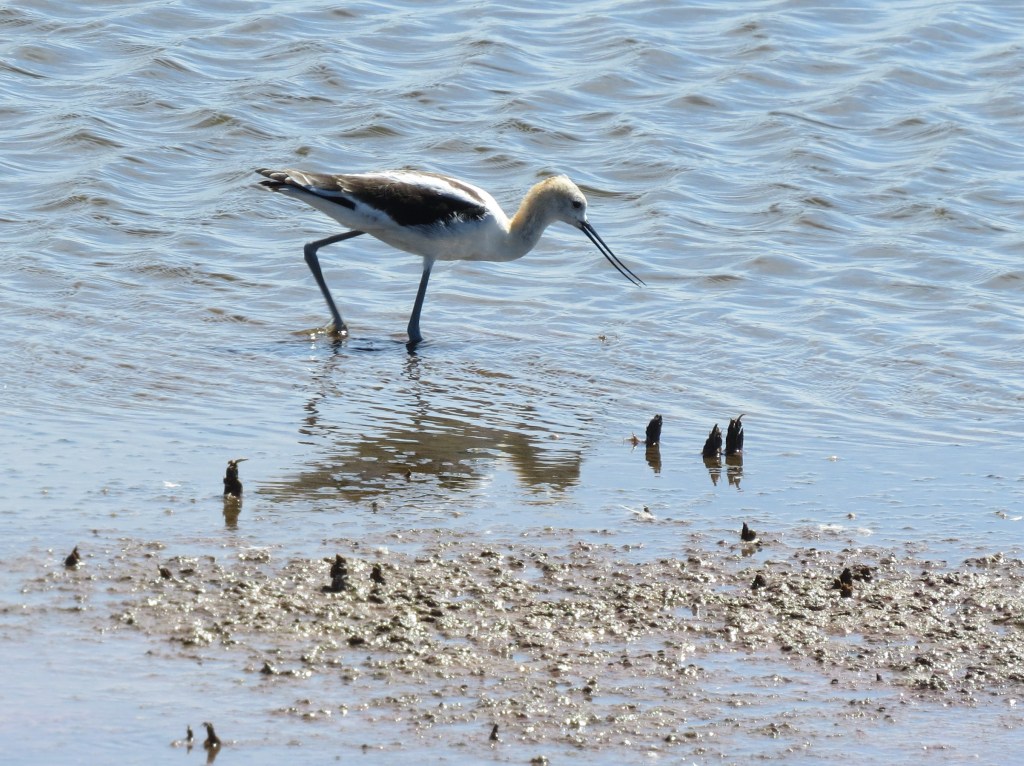
avocet fall plumage

This fall plumage American Avocet still has a certain majesty even without the striking salmon plumage on its head and neck. Copyright Randall Mooi.

Canada Goose (864) and Red-winged Blackbird (1081) were unsurprisingly the most abundant birds in their area. A Prairie Falcon was a very nice bonus bird.

Group D were the Moois, Randy and Odette. Randy being a zoologist as well as a very good birder, had great fund photographing anything that he could find. From caddis flies….

clipboard caddisfly procreation

A convenient spot for a pair of caddis flies to, er, well do what caddis flies do. Copyright Randall Mooi

to some sort of sand beetle…

beach drift ii

Copyright Randall Mooi

fields of foxtail…

foxtail and whitewater

Copyright Randall Mooi

and even Odette!

Odette on south shore of Whitewater Aug 31

Copyright Randall Mooi

They had one Canvasback, but boy was it posing…

canvasback conversations

Copyright Randall Mooi

Canvasback portrait

Looking like one of Randy’s museum specimens. Copyright Randall Mooi

Grebe numbers, most notably Western Grebe appear to have been low at Whitewater Lake in 2019. In 2017, Randy and Tim counted over 1,000 Western Grebes in this area. In 2019 there was only a single bird, plus a Pied-billed and two Eared.

eared grebe ashore

A single Eared Grebe looking beached. Copyright Randall Mooi

Shorebird numbers were very good in Area D. There were 177 Stilt Sandpiper, plus over 250 of both species of dowitcher (due to the complexities of distinguishing between these species, most remained unidentified).

dowitchers

Dowitchers loafing around. Copyright Randall Mooi

Three Buff-breasted Sandpiper were encountered as well. Another highlight were the two Hudsonian Godwit, a threatened species in Canada, and also relatively rare to encounter in this region during fall migration.


Hudonian Godwits. note the overall greyness which in fall is in sharp contrast to Marbled Godwit. All copyright Randall Mooi.

In total this group encountered 17 species of shorebird during the morning, an impressive total! They also saw another single Prairie Falcon and 19 White-faced Ibis.

ibis in silhouette

At least there are still some White-faced Ibis at Whitewater Lake. Photo copyright Randall Mooi


In total, our volunteers counted over 13,000 birds, representing 98 species. The most abundant species was Canada Goose (1,969), followed by Red-winged Blackbird (1,704). It would appear there has already been some evidence of migration of Yellow-headed Blackbird, as usually numbers of this species in fall re much higher. Diving ducks are still to gather here in any significant numbers, but there were good totals of dabblers. Grebe numbers and long-legged waders appear very low compared to past counts, and this must be associated with the fast changing water levels. The lake does at last seem to be rescinding from the peaks a few years ago. We also missed the peak swallow migration because in previous years they were hard to count! One group of birds seemingly doing ok here are raptors, there being over one hundred counted.

For IBA-Mixed Flock Shorebirds-Whitewater Lake-Manitoba-Lynnea A Parker-6911

Shorebirds ahoy! Copyright Lynnea Parker

Shorebirds were our target group of birds. Semipalmated Sandpiper gather at Whitewater in very good numbers in fall, and were the most abundant species (706). There were 549 American Avocet counted, 448 Stilt Sandpipers, 302 White-rumped Sandpiper and 186 Lesser Yellowlegs. Dowitchers totaled nearly 900, but most were unidentifiable.

For IBA-Mixed Flock Shorebirds-Whitewater Lake-Manitoba-Lynnea A Parker-6896

Try counting that lot. Photo copyright Lynnea Parker

Finally, thank you to all our volunteers, especially Bonnie for taking on responsibility in my absence and Glennis for her hospitality. Also to Gillian, Erica, Jane, Lynnea, Lewis, Ken, Tami, Mike, Randy and Odette.

Thank you also to our amazing funders for making these events possible.

And finally, below is our total list for the day.

Species Name Species Count
Canada Goose 1,969
Blue-winged Teal 924
Northern Shoveler 163
Gadwall 47
Mallard 861
Northern Pintail 118
Green-winged Teal 95
Canvasback 2
Redhead 2
Bufflehead 15
Ruddy Duck 27
Gray Partridge 22
Sharp-tailed Grouse 9
Pied-billed Grebe 1
Eared Grebe 2
Western Grebe 13
Rock Pigeon 60
Mourning Dove 141
Sora 2
American Coot 120
Sandhill Crane 4
American Avocet 549
Black-bellied Plover 6
Semipalmated Plover 8
Killdeer 56
Hudsonian Godwit 6
Marbled Godwit 2
Stilt Sandpiper 448
Sanderling 9
Baird’s Sandpiper 53
Least Sandpiper 89
White-rumped Sandpiper 302
Buff-breasted Sandpiper 3
Pectoral Sandpiper 58
Semipalmated Sandpiper 706
Short-billed Dowitcher 185
Long-billed Dowitcher 183
Short-billed/Long-billed Dowitcher 515
Wilson’s Snipe 7
Wilson’s Phalarope 8
Red-necked Phalarope 18
Spotted Sandpiper 2
Greater Yellowlegs 94
Willet 15
Lesser Yellowlegs 186
Franklin’s Gull 708
Ring-billed Gull 858
Herring Gull 13
Forster’s Tern 5
Double-crested Cormorant 71
American White Pelican 189
Great Egret 2
Black-crowned Night-Heron 1
White-faced Ibis 22
Turkey Vulture 2
Northern Harrier 32
Bald Eagle 17
Swainson’s Hawk 16
Red-tailed Hawk 37
Rough-legged Hawk 3
Ferruginous Hawk 2
hawk sp. 1
American Kestrel 1
Merlin 5
Peregrine Falcon 1
Prairie Falcon 2
Western Kingbird 4
Eastern Kingbird 10
Black-billed Magpie 1
Common Raven 3
Horned Lark 12
Tree Swallow 100
Bank Swallow 6
Barn Swallow 53
Cliff Swallow 35
House Wren 1
Sedge Wren 8
Marsh Wren 5
European Starling 30
American Robin 1
Cedar Waxwing 1
House Sparrow 111
American Goldfinch 7
Clay-colored Sparrow 7
Lark Sparrow 1
Vesper Sparrow 28
Savannah Sparrow 54
Song Sparrow 3
Swamp Sparrow 2
sparrow sp. 8
Yellow-headed Blackbird 310
Bobolink 1
Western Meadowlark 34
Orchard Oriole 1
Red-winged Blackbird 1,704
Brown-headed Cowbird 2
Brewer’s Blackbird 62
Common Grackle 283
Northern Waterthrush 1
Yellow Warbler 1
passerine sp. 76
For IBA-Mixed Flock Shorebirds-Whitewater Lake-Manitoba-Lynnea A Parker-6936

Oh go on, one final one. Copyright Lynnea Parker