Being the Caretaker for Riverton Sandy Bar IBA (MB091) in 2014

by: Joanne Smith, Caretaker at Riverton Sandy Bar IBA. All photos copyright Joanne Smith with the exception of caretaker photo by Lynda Baker
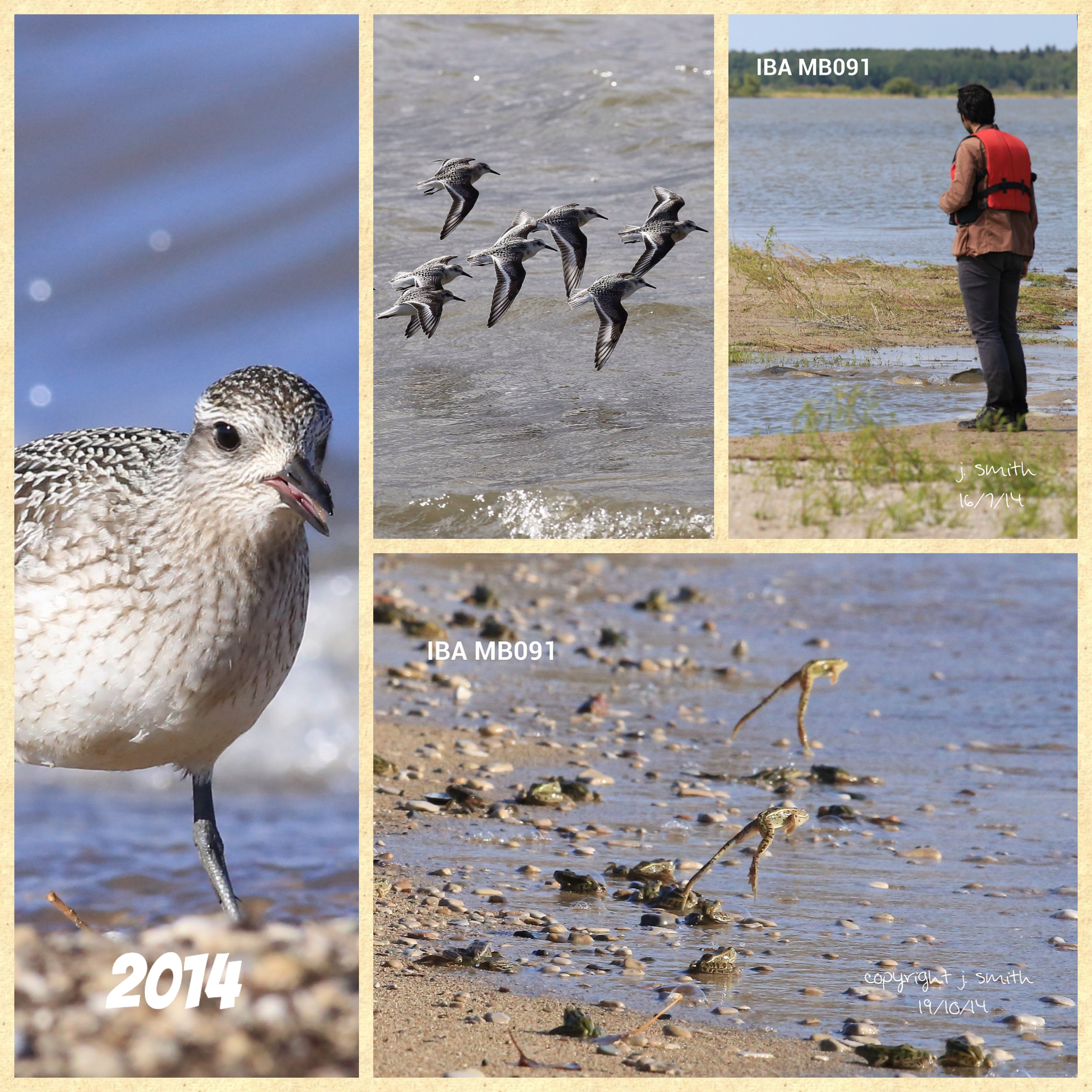
Black-bellied Plover, Sanderling, Northern Leopard Frog and Nature Manitoba summer student Marshall Birch

Black-bellied Plover, Sanderling, Northern Leopard Frog and Nature Manitoba summer student Marshall Birch

It has been rather interesting to see how an IBA can change within a few short months.  In 2014, the Sandy Bar sand spit (east of Riverton on the west shore of Lake Winnipeg) went from being a snow covered area with six foot high drifts in May, to a beautiful beach area accessible by foot in June, to a flooded area only accessible by boat in July and finally back to a normal looking beach area by October.  The area was normal in that it was again accessible by foot and the land area was probably about the same however, the shape had completely changed.

Highlights of Riverton Sandy Bar.

Riverton Sandy Bar IBA

On May 9th, there were still 4 ft snow drifts at the south western part of Sandy Bar but by May 16th the shoreline was basically bare with some ice remaining on Lake Winnipeg.  By this date, the two target species for this IBA, Common Tern and Ring-billed Gull, had both arrived.

From left to right and top to bottom: Common Tern nest, Common Tern, Sweet White Clover erosion and Caspian Tern, Common Tern and Ring-billed Gulls

From left to right and top to bottom: Common Tern nest, Common Tern, Sweet White Clover erosion and Caspian Tern, Common Tern and Ring-billed Gulls

In June, ground nesting signs were placed in two areas on Sandy Bar as well as the official IBA sign to alert visitors to the importance of this area.  Funding for the nesting signs was provided by Manitoba Conservation.

For those who were in Manitoba during the July Canada Day weekend, you may remember the rain/wind storm that resulted in high lake levels. Many young birds were found washed ashore on a few of the southern beaches of Lake Winnipeg.  This storm made some huge changes to the appearance of Sandy Bar.  A large portion of the sand bar was under water and the storm had washed away one of the nesting signs which had been bolted onto a steel post.  It is believed that this storm likely destroyed nests at Sandy Bar as there were only one juvenile Common Tern and one juvenile Ring-billed Gull seen during the summer visits to the area.  However, one advantage of having much of the sand bar under water was that it deterred ATV access.

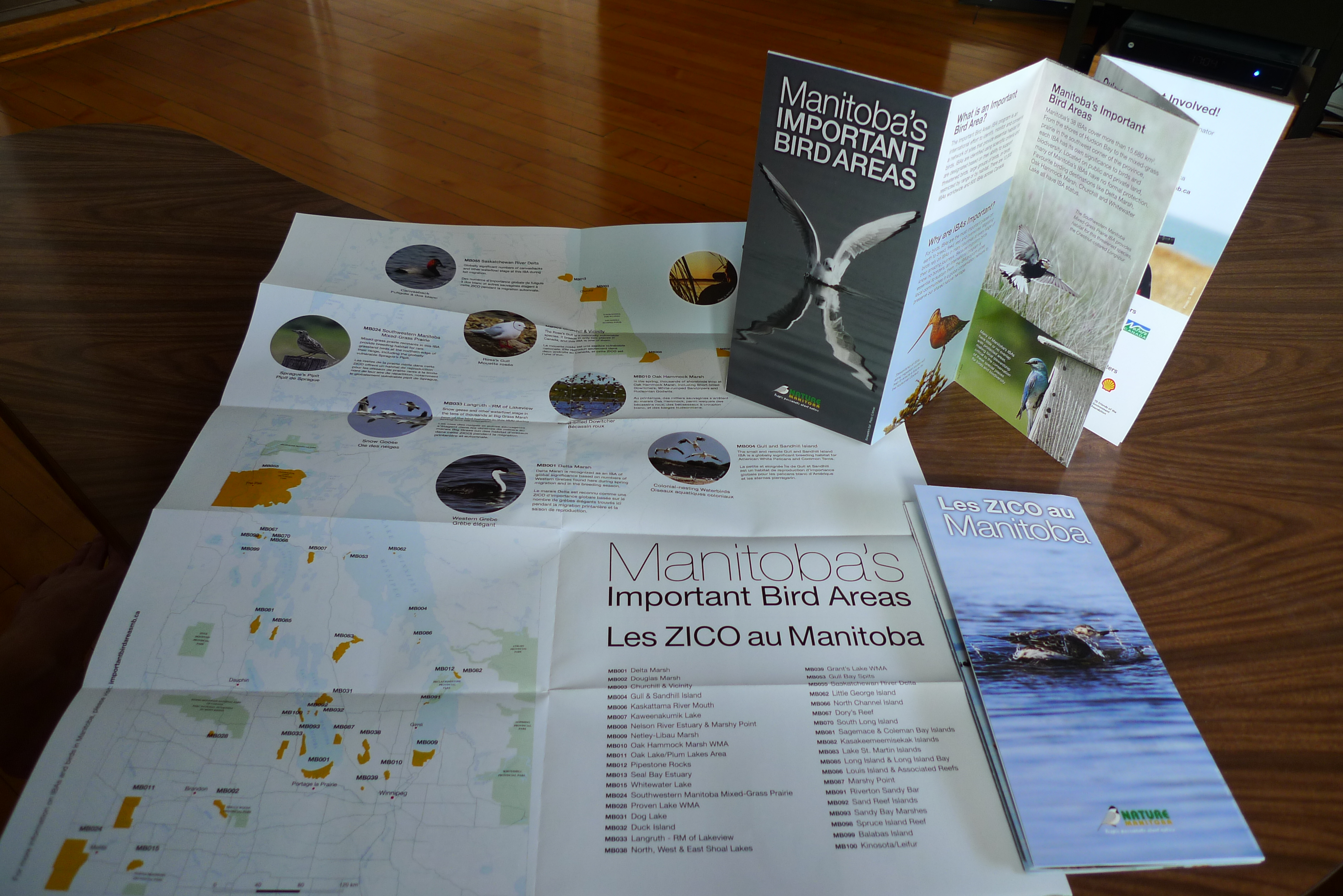
In August, an information box was erected on the Chamber of Commerce notice board with Manitoba IBA brochures that were available for anyone interested in learning about all of Manitoba’s 38 IBA’s.

From right to left and top to bottom: Juvenile Bald Eagle, approximately 1500 Frankin's Gulls, the only Juvenile Common Tern seen in 2014 and Green-winged Teals in fall migration

From right to left and top to bottom: Juvenile Bald Eagle, approximately 1500 Frankin’s Gulls, the only Juvenile Common Tern seen in 2014 and Green-winged Teals in fall migration

Juvenile Bald Eagles from the nearby nest, juvenile Spotted Sandpiper and a Great Blue Heron were common sights at Sandy Bar during the summer months. Fall migration brought with it a few interesting birds such as one Red Knot of the endangered ‘rufa’ subspecies and a number of “Species at Risk” Rusty Blackbirds.  The regular fall visitors Ruddy Turnstone, Least Sandpiper, Sanderling, Dunlin, Green-winged Teal and Caspian Tern were also seen in late summer and early fall.
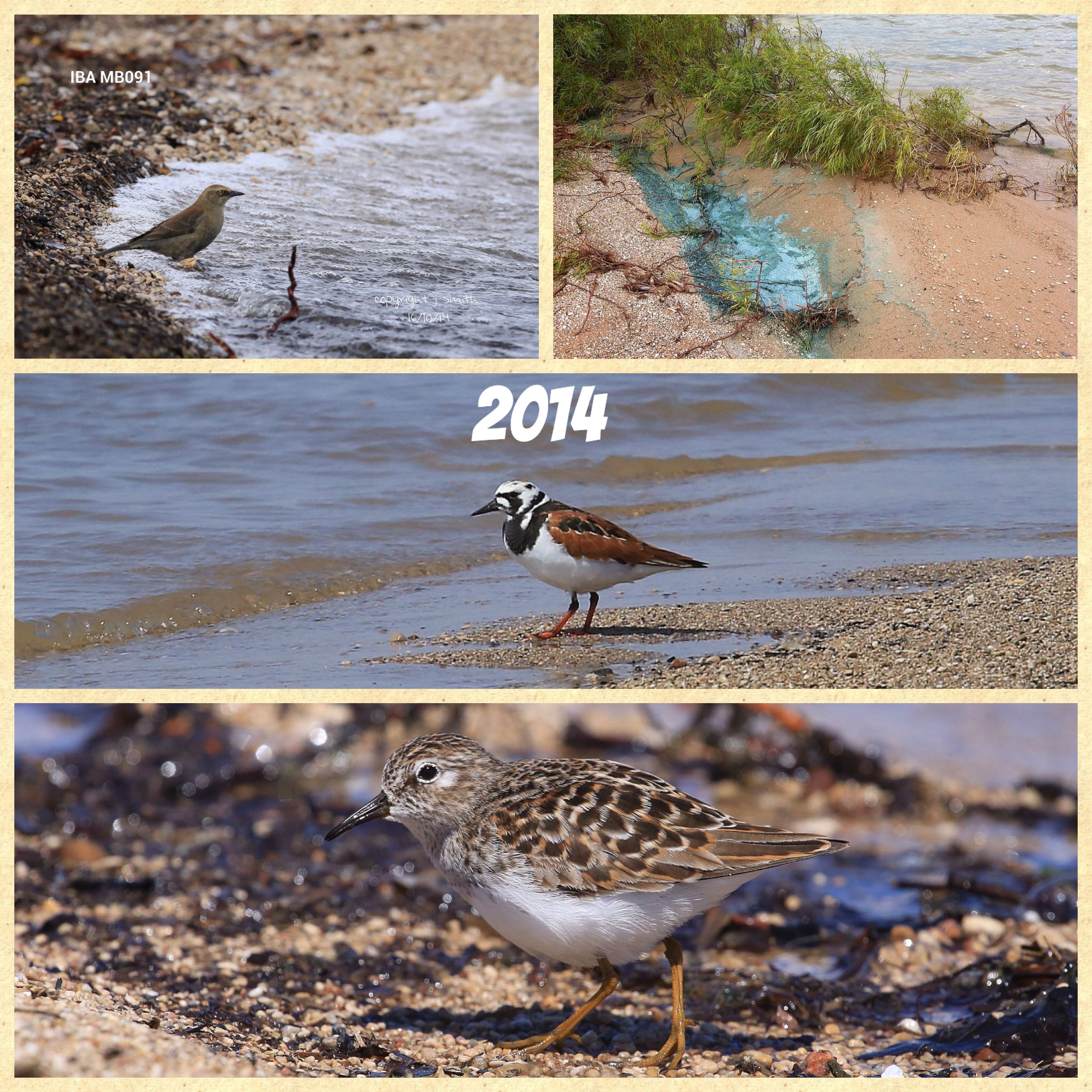
From top to bottom: Rusty Blackbird, Blue-green Algae Ruddy Turnstone and Least Sandpiper

From top to bottom: Rusty Blackbird, Blue-green algae, Ruddy Turnstone and Least Sandpiper

In 2014 Manitoba Conservation and Water Stewardship designated Riverton Sandy Bar as a Special Conservation Area.  This means that all-terrain vehicles will now be banned from this area from April 1 to September 15.  It will also forbid human use of the area should a piping plover be reported.  This will also be of great benefit for other ground nesting birds such as the Common Tern.

Top to bottom: White Sweet Clover, Dunlin, ATV tracks and Ring-billed Gull

Top to bottom: White Sweet Clover, Dunlin, ATV tracks and Ring-billed Gull

To help make IBA Riverton Sandy Bar appealing to Piping Plovers, it has been suggested that pulling the white sweet clover from the sand bar would be beneficial.  In a previous conservation plan, it was suggested that if project funding was limited, encroachment by woody vegetation should be considered the highest ranking threat to avian nesting habitat along the Sandy Bar.

For those who may be interested in helping to “Weed for a Day” at IBA Riverton Sandy Bar, there will be a morning set aside within the next few weeks where volunteers can meet to help pull some of the clover from the area.  No experience necessary!  All that is required is a pair of work gloves and a little ambition. Many hands make for light work…and hopefully for successful nesting birds!
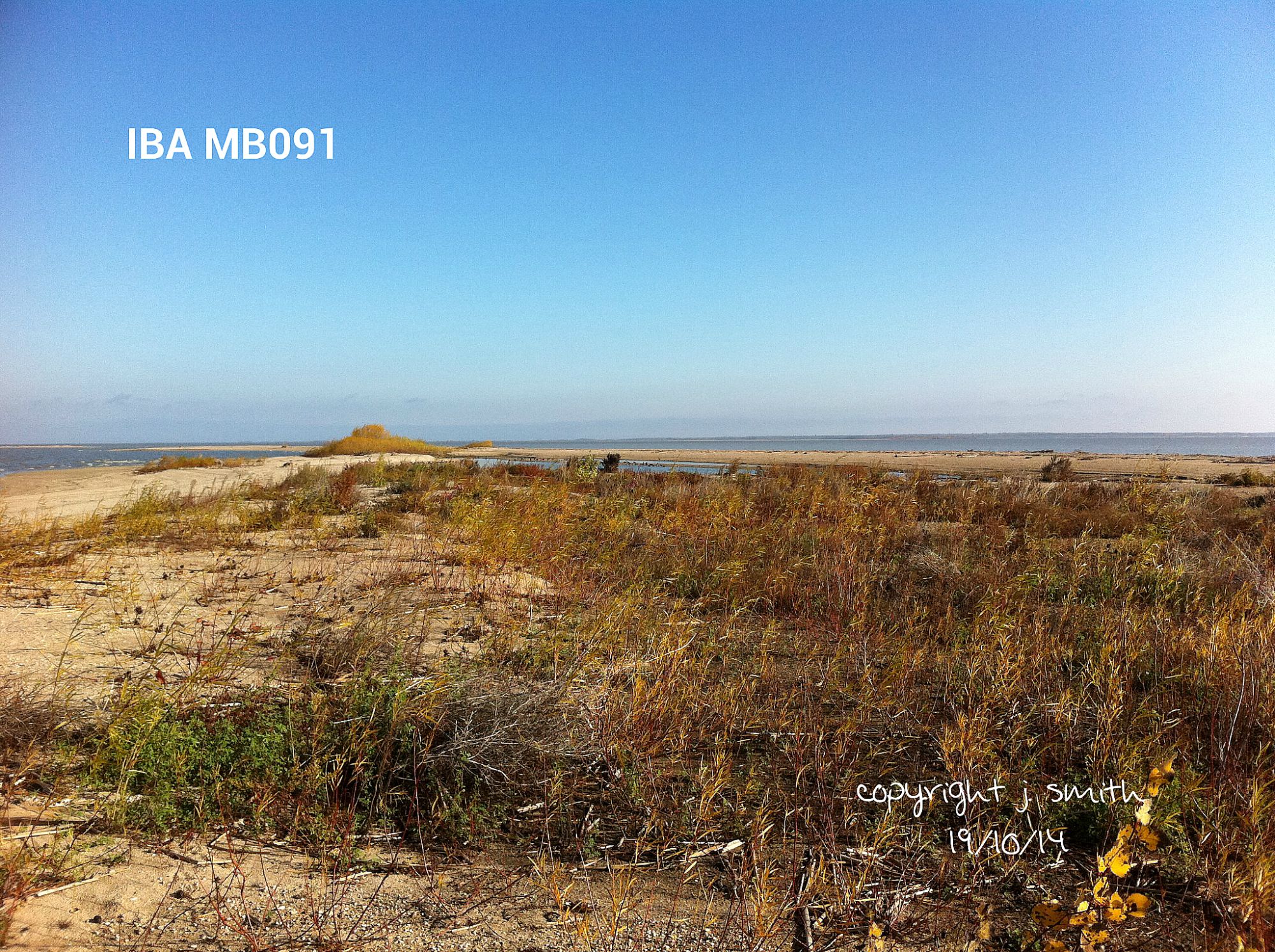
Weeds to pull on Riverton Sandy Bar

Weeds to pull on Riverton Sandy Bar

For more information on the weed-pulling day, please contact:

Joanne Smith

Email: picsmith@live.ca

Click the link to see Joanne’s Riverton Sandy Bar Facebook page
Article in MB Breeding Bird Atlas Newsletter

The following is an article which appears in the latest MB Breeding Bird Atlas newsletter. In it, Tim Poole, the Manitoba IBA Program Coordinator, suggests how former atlassers can continue to gather important bird data while helping the IBA Program.

Manitoba’s Important Bird Area (IBA) program

What are IBA’s?

Important Bird Areas (IBAs) are places with lots of birds. Simple. In fact the populations of birds within each IBA is, or has been, significant, either at a global, continental or national scale. IBAs are not just Canadian; there are 12,000 of them across the world, representing the largest global network of important sites for biodiversity. To achieve IBA status, each candidate site has been assessed against standard criteria from Birdlife International. For some sites in Manitoba this might mean that they provide habitat for significant but small populations of a globally threatened species like the Piping Plover or that they hold significant assemblages of migrating waterfowl or shorebirds. Take Douglas Marsh for example. There were estimated to be 500 pairs of Yellow Rail present in 1995, an impressive 11.6% of the total global population of this species. Therefore Douglas Marsh meets the criteria based on the population of a single species. At Whitewater Lake spring shorebird counts are as high as 23,068 birds and total waterfowl counts exceed 250,000 birds, making the site globally significant. These figures are impressive and yet worrying at the same time: How many Yellow Rails are currently breeding at Douglas Marsh? Are there still 250,000 waterfowl at Whitewater Lake? Do we know? What is the current state of the habitats? Has land-use changed since 1995? Whitewater Lake and Douglas Marsh have some formal protection but what about the 78% of IBAs with none? The Manitoba IBA Program seeks to provide answers to these questions by engaging volunteers. We need your help!

WWL_shorebird flock_AMGP_SBDO_LBDO_PESA_LESA

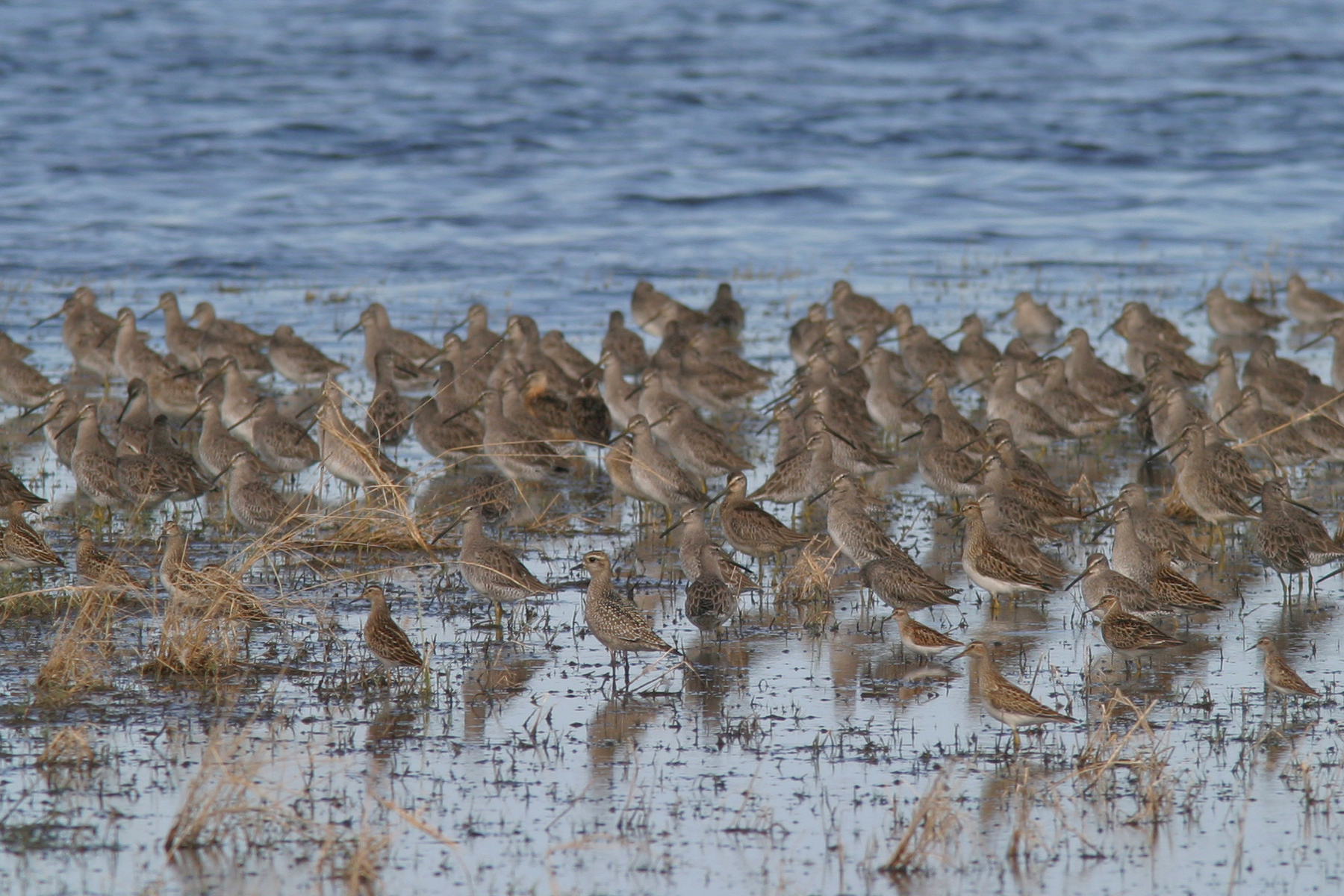
Many of Manitoba’s IBA’s were identified because of large congregations of shorebirds. Here at Whitewater Lake there are American Golden Plover, Short-billed Dowitcher, Long-billed Dowitcher, Pectoral Sandpiper and Least Sandpiper. Copyright C. Artuso.

Many of Manitoba’s IBA’s were identified because of large congregations of shorebirds. Here at Whitewater Lake there are American Golden Plover, Short-billed Dowitcher, Long-billed Dowitcher, Pectoral Sandpiper and Least Sandpiper. Photo by C. Artuso.

Caretakers

Across Canada there are a number of IBA Caretakers, including 3 in Manitoba. The role of a Caretaker is to monitor birds, assess habitats, document changes and 6 Other Citizen-Science Initiatives build community awareness around one particular site. A Caretaker could be an individual, a group of like-minded friends or a local bird watching club or community group. The minimum commitment is 15 hours per year to cover 3 visits (spring migration, summer breeding, fall migration), although caretakers may wish to go the extra mile. If you wish to become a caretaker but do not have the time or resource to cover the entire site, then why not become a caretaker for a smaller subsection? Sites without a current caretaker includes well known birding spots as Delta Marsh, Whitewater Lake, Oak Lake/Plum Lakes, Langruth and Churchill. Plenty of opportunities then!

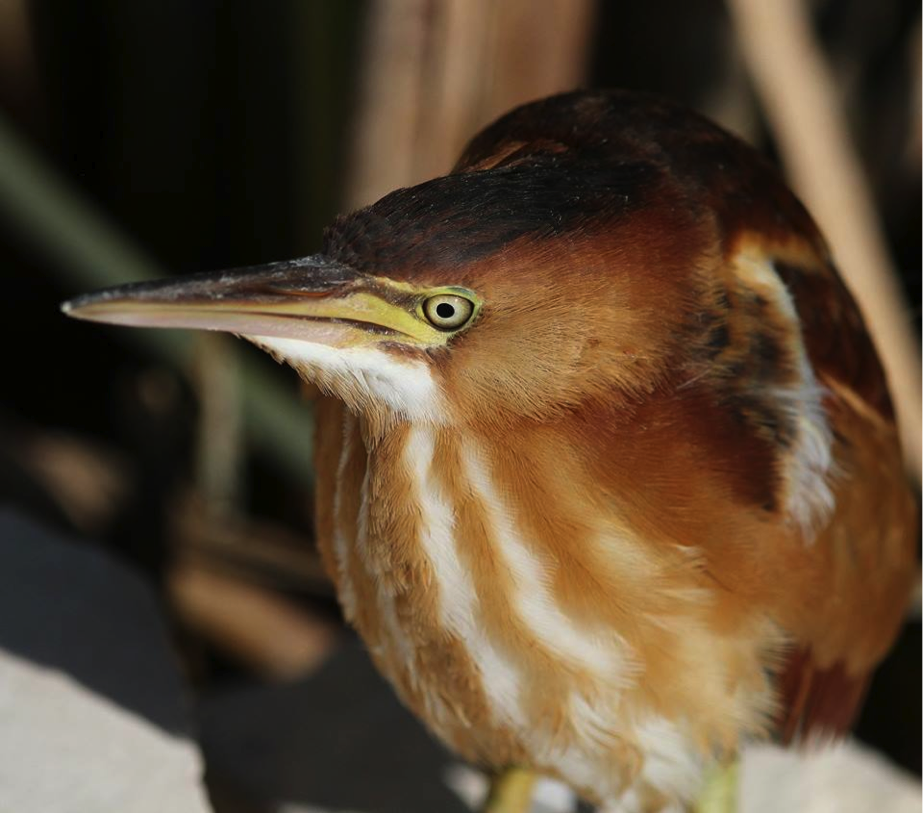
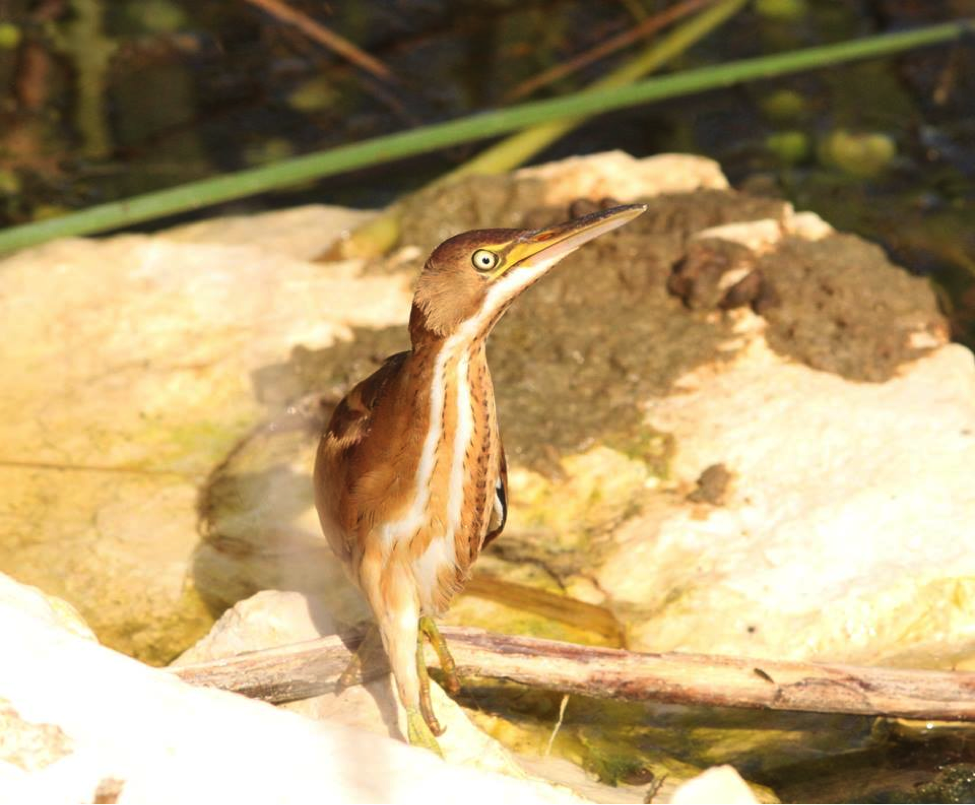
North, West and East Shoal Lake Caretaker, Donna Martin discovered breeding Least Bittern in North Shoal Lake in 2014. See here for more details. Copyright Donna Martin

North, West and East Shoal Lake Caretaker, Donna Martin discovered breeding Least Bittern in North Shoal Lake in 2014. See here for more details. Copyright Donna Martin

Roving Birders

If caretaking a particular IBA is not your style, you can still help in various ways. This year we are rolling out our roving recorder program. It is very simple. If you are planning a trip to an IBA, you are already halfway to becoming a Roving Recorder. By the end of May we will be adding maps to our website of many of the more accessible IBAs. Each map will contain a specific monitoring area making data recording simpler. We will make monitoring forms available. All you have to do is record all the birds you encounter in each subarea. All IBA data should be recorded on eBird which will upload automatically into the IBA system. If you do not wish to enter data on eBird we will even do it for you!

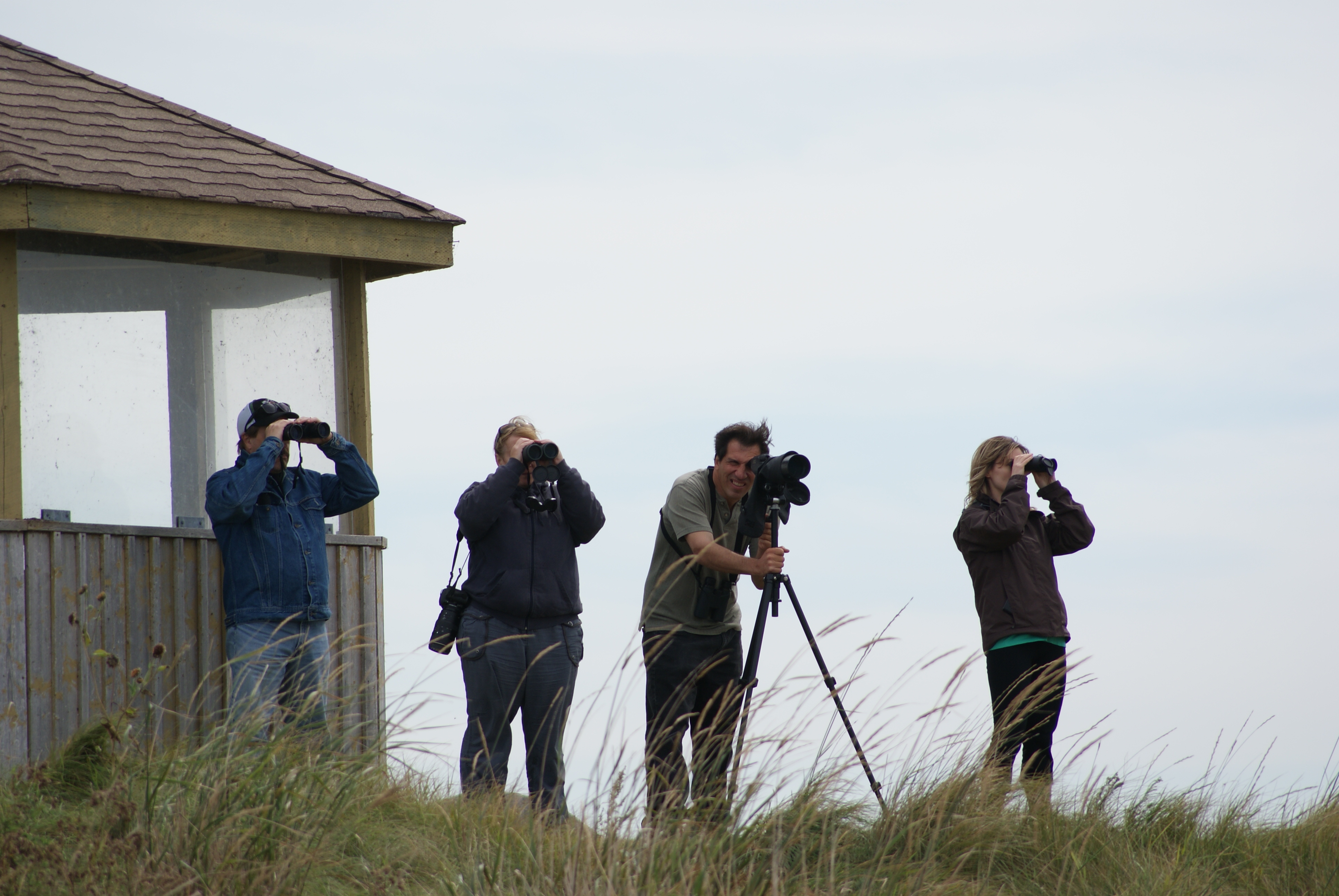
Groups of birders at Whitewater Lake. Photo by Bev Sawchuk.

Groups of birders at Whitewater Lake. Photo by Bev Sawchuk.

What next?

By volunteering with the program, you are not only taking part in grassroots conservation but joining a network of people globally committed to conservation of our best sites. Our IBAs are amongst the best and most treasured birding spots in Manitoba and we can keep them that way.

We can send volunteer packages by mail or you can download them here:

IBA Monitor Welcome Package 2014

IBA Site Caretaker Welcome Package 2014

Using eBird for the Manitoba Important Bird Area program.

These provide information, a volunteer job description and even a brief introduction to using eBird for IBA. Contact Tim Poole at iba@naturemaniotba.ca or 204-943-9029.

New Manitoba IBA Coordinator

There have been a few changes for the Manitoban IBA Program in the last month. Diana Teal has moved back to Toronto. All those associated with the Manitoba IBA Program wish to thank Diana for her hard work and achievements over the previous year. Our new Manitoba IBA Coordinator writes his 1st blog, introducing himself and sharing some of his background.

Hello, my name is Tim Poole and I am just beginning life as the Manitoba Important Bird Area Coordinator. I have been working on the Manitoba IBA Program for only a couple of weeks so it is about time that I produce a first blogpost. Rather than talk about myself, I thought it might be interesting to blog a bit about some of my past experiences working in IBA’s in Scotland.

I moved to Manitoba in May from the UK with my wife, who is from Winnipeg and son. Before that I worked as the Capercaillie Project Officer for the Royal Society for the Protection of Birds (RSPB) in Scotland (see here). This was a partnership post, part funded by 2 government agencies, Forestry Commission Scotland (see here) and Scottish Natural Heritage (see here) and was a focal point for advocating conservation management for the western capercaillie (Tetrao urogallus) in Scotland.

Caper adjusted

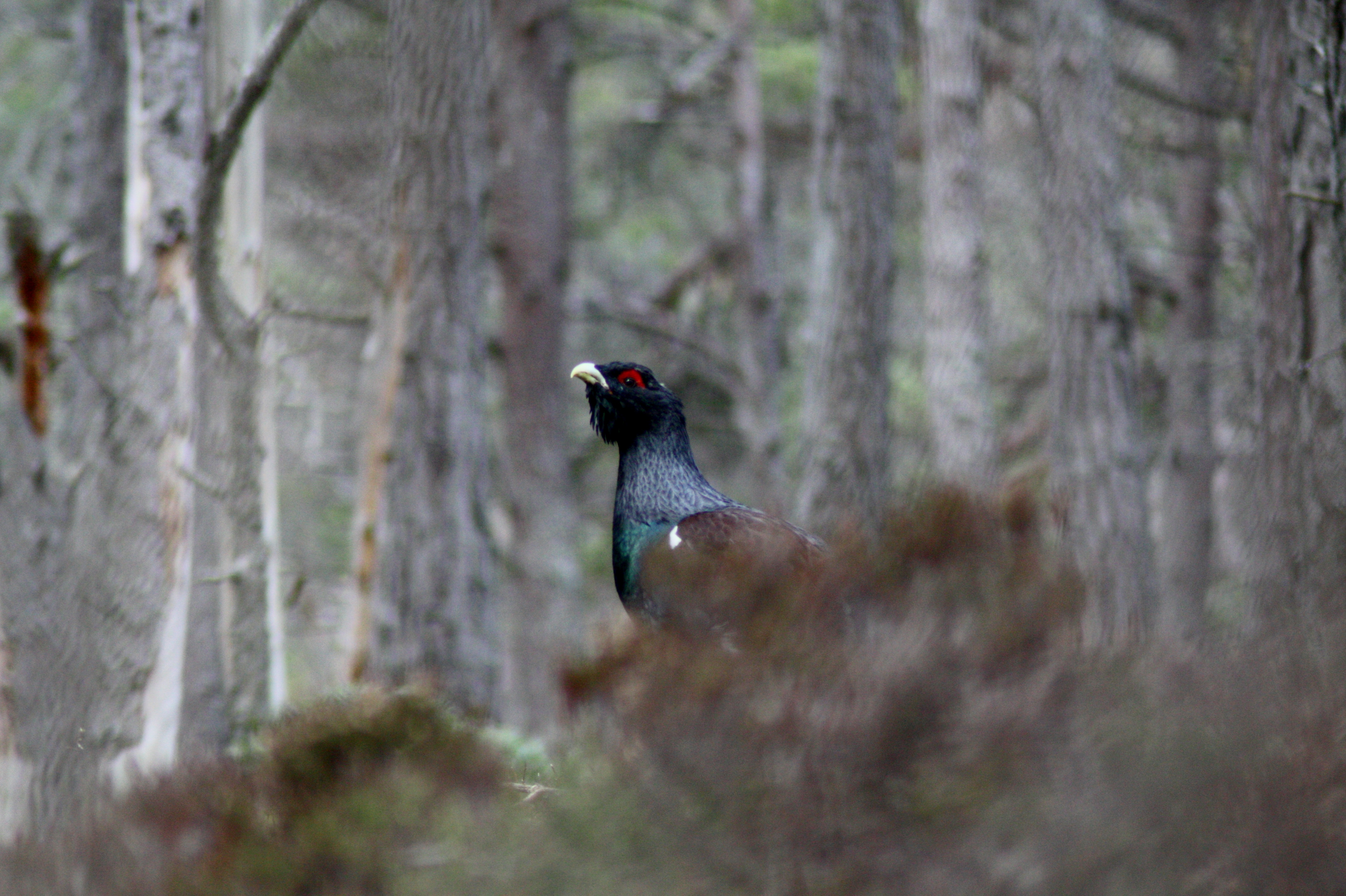
Male (or cock) capercaillie photographed in an IBA in the Cairngorms National Park, UK. Photo by Tim Poole

So what is a capercaillie? It is a large grouse, the world’s largest in fact. The common name comes from Scots Gaelic and is translated depending on what you read as ‘horse of the woods’ or ‘great cock of the woods’. Although globally not endangered, being found across the Boreal forests of Fennoscandia and Russia, the capercaillie has declined in the western and southern parts of its range. Recent estimates in Scotland are of a population around 1280 birds with the population increasingly being confined to a single area in the Cairngorm National Park (the BTO Atlas demonstrates the range decline since 1968 here).

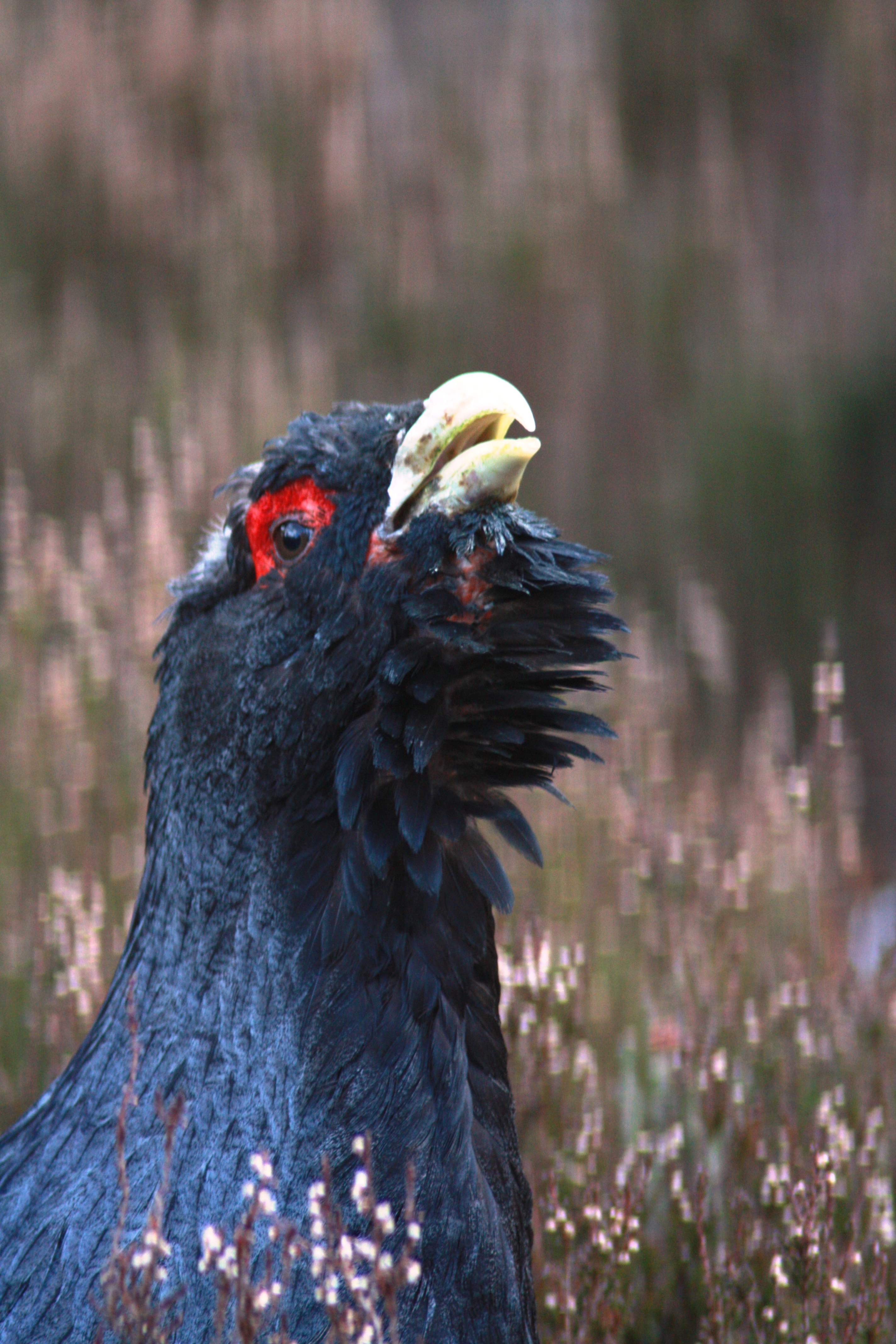
Male capercaillie in an IBA in Scotland. Photo by Tim Poole

Male capercaillie in an IBA in Scotland. Photo by Tim Poole

Wherever capercaillie occur in the world it is likely that blue whortleberry (Vaccinium myrtilis) (known as blaeberry in Scotland and bilberry in England) is nearby. Adults feed on the leaves, shoots and fruits but these plants are vitally important for young chicks which require an abundance of invertebrates in the early weeks of life. Like spruce grouse, capercaillie feed on conifer needles in winter, hence one writer describing them as having ‘the most boring diet’ in the bird world.

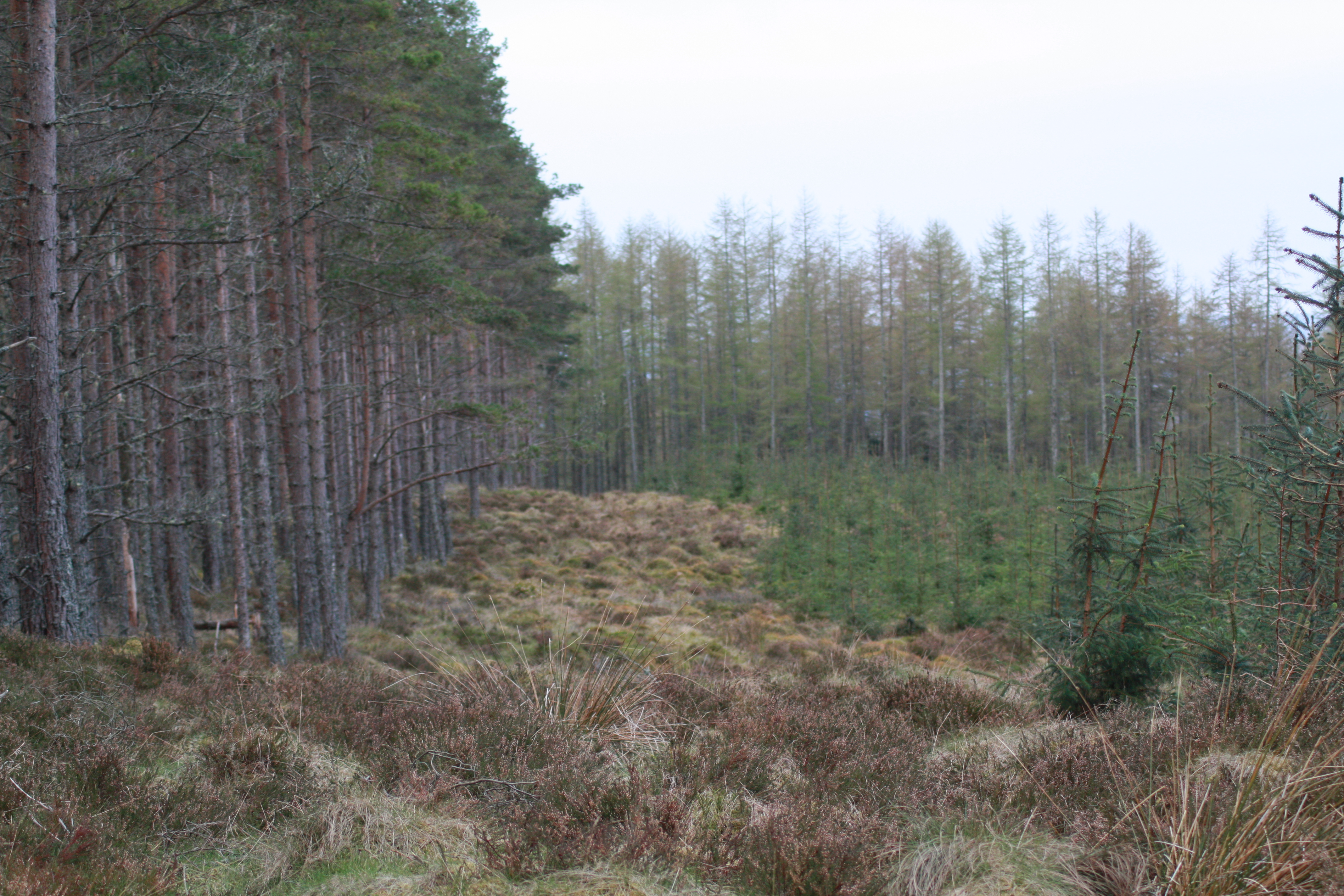
Semi-natural forest dominated by Scots pine is the typical habitat for capercaillie in Scotland. The trees provide plenty of sturdy roost branches for a large bird. There is also juniper and heather which provide cover for chciks. Photo by Tim Poole.

The primary habitat in this IBA is semi-natural Scots pine forest. This is ideal chick habitat with abundant whortleberry, and cover provided by juniper and heather. Capercaillie are large birds and also need sturdy branches on which to roost. Photo by Tim Poole.

Mixed species conifer plantation on a bog. A cock capercaillie was displaying in this area earlier in the morning. Hens feed on nutritious bog plants prior to egg laying. Photo by Tim Poole

Mixed species conifer plantation on a bog. A cock capercaillie was displaying in this area earlier in the morning. Hens feed on nutritious bog plants prior to egg laying. Photo by Tim Poole

The IBA situation in the UK is very different, and somewhat confusing. For starters, we never referred to those 3 letters because of another 3 letters, SPA. SPA stands for ‘Special Protection Area’ and all IBA’s are also SPA’s. SPA’s are legally protected under the European Union Birds Directive, and each country is obliged to implement it, meaning that the UK Government and Scottish Governments are legally responsible for maintaining site condition.

This is where my role became relevant. I was responsible for providing advice to government and landowners on best practice management for capercaillie in the SPA’s of which there were 11 all of them covered by IBAs.

Map of Scotland outlining the distribution of SPA's all of which are also IBA's.  Capercaillie core areas were an effective mechanism for targeting resource.

Map of Scotland outlining the distribution of SPA’s all of which are also IBA’s. Capercaillie core areas were used to target management resource.

Many, but not all the SPA’s, are also protected for their important habitat (less than 1% of the original Caledonian pinewood and bog woodland remains) and other bird species (e.g. Scottish crossbill, osprey, golden eagle). Cooperation between forest managers, government and conservation bodies ensured that conservation was prioritised in these sites and indeed in adjacent sites. Timber harvesting was possible as long as it was planned sensitively and forest thinning, opening up the canopy in dense plantations was indeed beneficial to wildlife.

Selective thinning of trees have enhanced this habitat for capercaillie. Thinned trees were left in situ as deadwood. Glades were created to create ideal conditions for wood ants and tree regeneration. Photo by Tim Poole

Selective thinning of trees have enhanced this habitat for capercaillie. Thinned trees were left in situ as deadwood. Glades were created to create ideal conditions for wood ants and tree regeneration. Photo by Tim Poole

Capercaillie are a lekking species (lek = ‘to play’ in Swedish), where males display in close proximity in spring to attract females. Each spring, a team of volunteers, including estate staff, counted the total number of cocks attending leks. Many volunteers sleep overnight in canvas hides, approximately 4 foot square. Scotland is famous for its fabulous weather, so anyone staying overnight was advised to use a bivvy bag to keep the rain off their body.

IMG_6615

Hide overlooking a lek in an active pine plantation. Capercaillie lek in open areas of forest with flat ground and perches for hens to watch. Racks and rides created by timber operations often create the ideal lek habitat. Photo by Tim Poole

Capercaillie are an early riser, beginning to call around 0430 just after the tawny owl ceases to hoot. They carry on calling, strutting, ‘flutter jumping’ and occasionally fighting until the hens have left the area and the sun has risen. Hens can visit multiple leks on any given morning and will bide their time before mating. During the very peak days, cocks will remain on the lek for extended periods of time, ignoring both the need to feed and conserve energy. This can sometimes leave a tired observer trapped in a hide for much of the day!

119

Cock capercaillie in whortleberry at a lek in April 2014. Photo by Tim Poole

Annual counts of lekking capercaillie are used to estimate the population of a site. Much like the Manitoba IBA Program, we relied on the hours and enthusiasm of volunteers to monitor these sites and provide a long-term picture of what is happening. We are therefore keen to recruit more volunteers to the scheme. If you are interested, please contact me at iba@naturemanitoba.ca or (204) 943-9029.

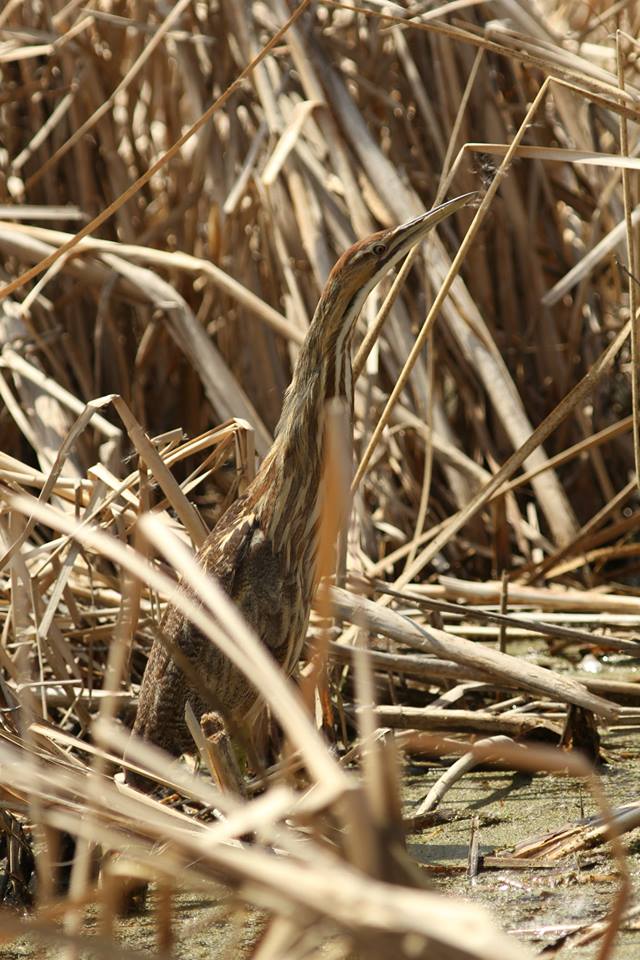
A Close Up Look at an Elusive and Endangered Species: The Least Bittern (lxobrychus exilis)

by: Donna Martin, Caretaker at the North, West and East Shoal Lakes IBA

copyright Donna Martin

Least Bittern – copyright Donna Martin

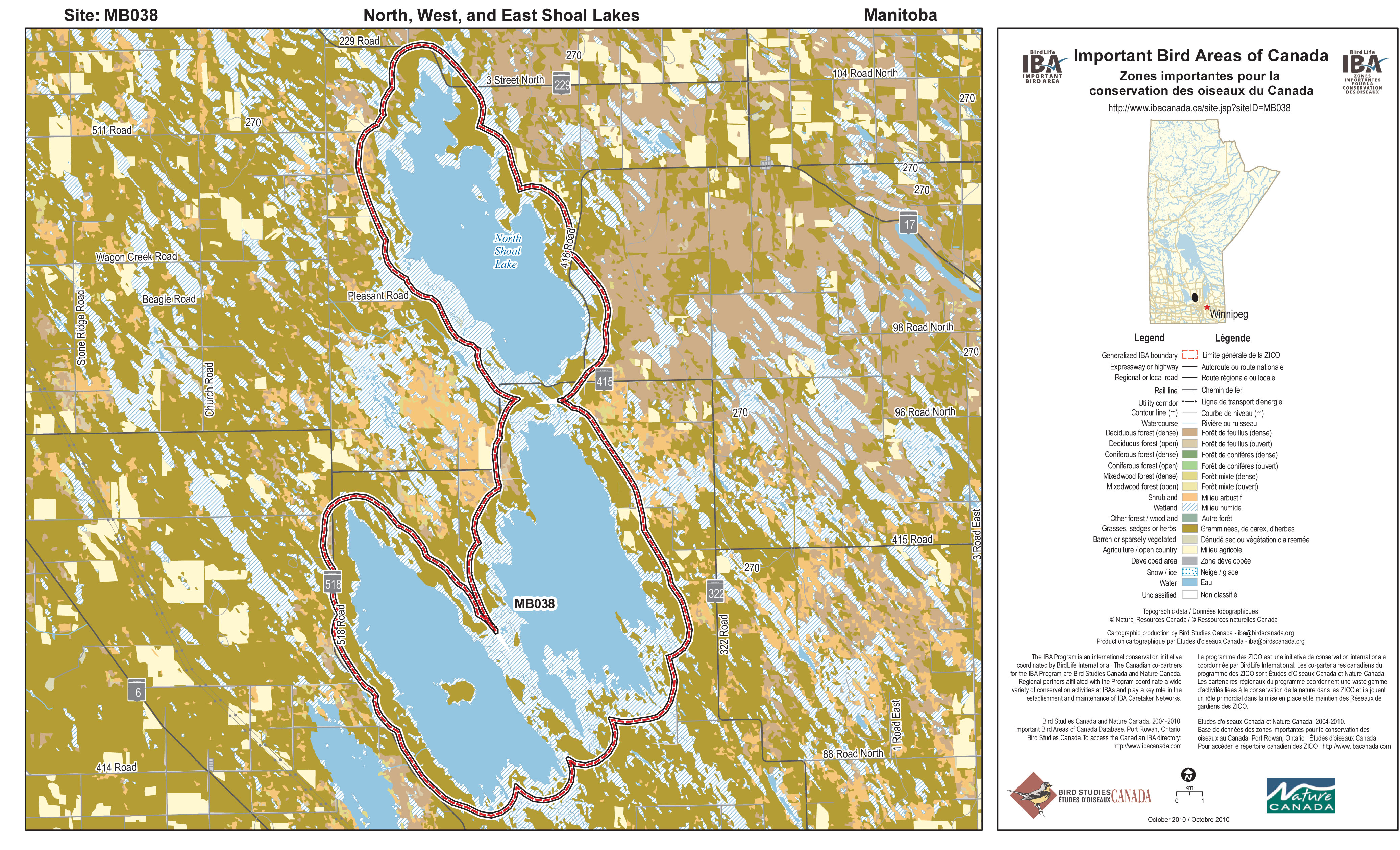
I am the volunteer caretaker of North, West and East Shoal Lakes Important Bird Area, which is located within the southwestern part of Manitoba’s Interlake Region.  Identified as MB038, this IBA is approximately 15 km east of Lake Manitoba, in Manitoba, Canada.

The North, West and East Shoal Lake IBA is a landlocked drainage basin consisting of three large bodies of water. Land use surrounding this IBA is mainly grazing, with a small percentage used for forage crops. Open deciduous forests are found scattered around all three areas, mostly in early successional stages. In recent years, water levels have risen to an all-time high, which has affected land use surrounding all three lakes and has impacted the avian species that use this area for breeding and staging.  The marshes associated with these lakes are mostly cattail marshes, which is prime habitat for least bitterns and other waders, waterfowl and marsh birds.

North, West and East Shoal Lakes IBA

North, West and East Shoal Lakes IBA

Between 1985 and 1996, 46 pairs of Piping Plovers (1.5% of the Great Plains population) were found nesting here (IBA Canada, http://bit.ly/1ugivvD). However, they have not been recorded here since the early 1990’s (IBA Canada, http://bit.ly/1ugivvD).  Historic records also identified large numbers of breeding American White Pelican, four species of grebe, Black-crowned Night Heron, and to a lesser extent, Common Tern, Double-crested Cormorant, Herring Gull and Ring-billed Gull (IBA Canada, http://bit.ly/1ugivvD).  At one point, fall staging records documented over 100,000 Canada Geese and approximately 200,000 snow geese using this area, along with large numbers of waterfowl species (IBA Canada, http://bit.ly/1ugivvD).  Also recorded were various species of shorebirds, using the area for staging during both the spring and fall (IBA Canada, http://bit.ly/1ugivvD).

A moderate shift in both the number and species using this area has been observed and hopefully with continued survey effort over the next few years, we will update and document the breeding bird data and staging usage for this IBA.

One of five juvenile Least Bitterns found in the North Shoal Lake area on Sept 15,  2014 - copyright Donna Martin

One of five juvenile Least Bitterns found in the North Shoal Lake area on Sept 15, 2014 – copyright Donna Martin

This year, we were excited to document two adult male Least Bitterns early in the breeding season. Observed by quite a few people, these two birds were identified in two different areas of the IBA. The first bird was found in the North Shoal Lake area and the second bird was spotted in the East Shoal Lake area.

Both adult birds were very skittish and although I saw both on most days I was out there, they would fly into the dense cattail reeds at the first sign of approach.

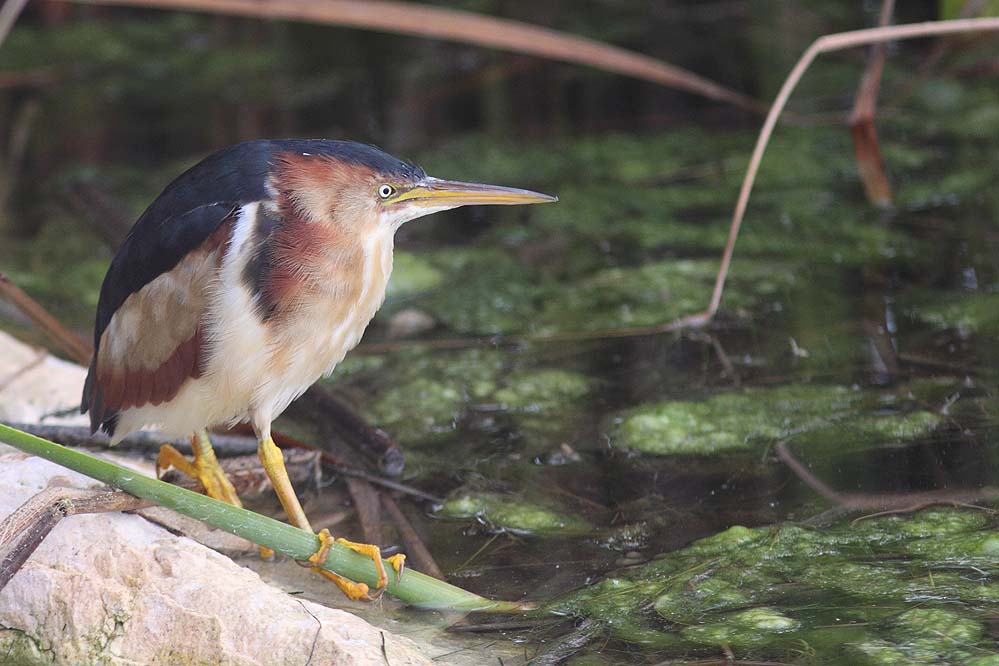
Adult male Least Bittern – copyright Christian Artuso

The Least Bittern is classified as a small heron of about 30 cm, just bigger than a robin. It breeds in marshes associated with emergent vegetation and needs some open, clean and clear water, as it hunts the marsh edges by sight. This bird is seldom seen but most often detected by call.

Listed by Manitoba’s Endangered Species and Ecosystem Act (ESEA) as an endangered species and considered nationally threatened by the Committee on the Status of Endangered Wildlife in Canada (COSEWIC), it was a great bird to find associated with this IBA.

According to the Species at Risk Public Registry, there are approximately 1500 pairs of Least Bitterns in Canada, with the majority of breeding populations found in Ontario, Quebec, Manitoba, New Brunswick and Nova Scotia (http://www.sararegistry.gc.ca/species/speciesDetails_e.cfm?sid=51).

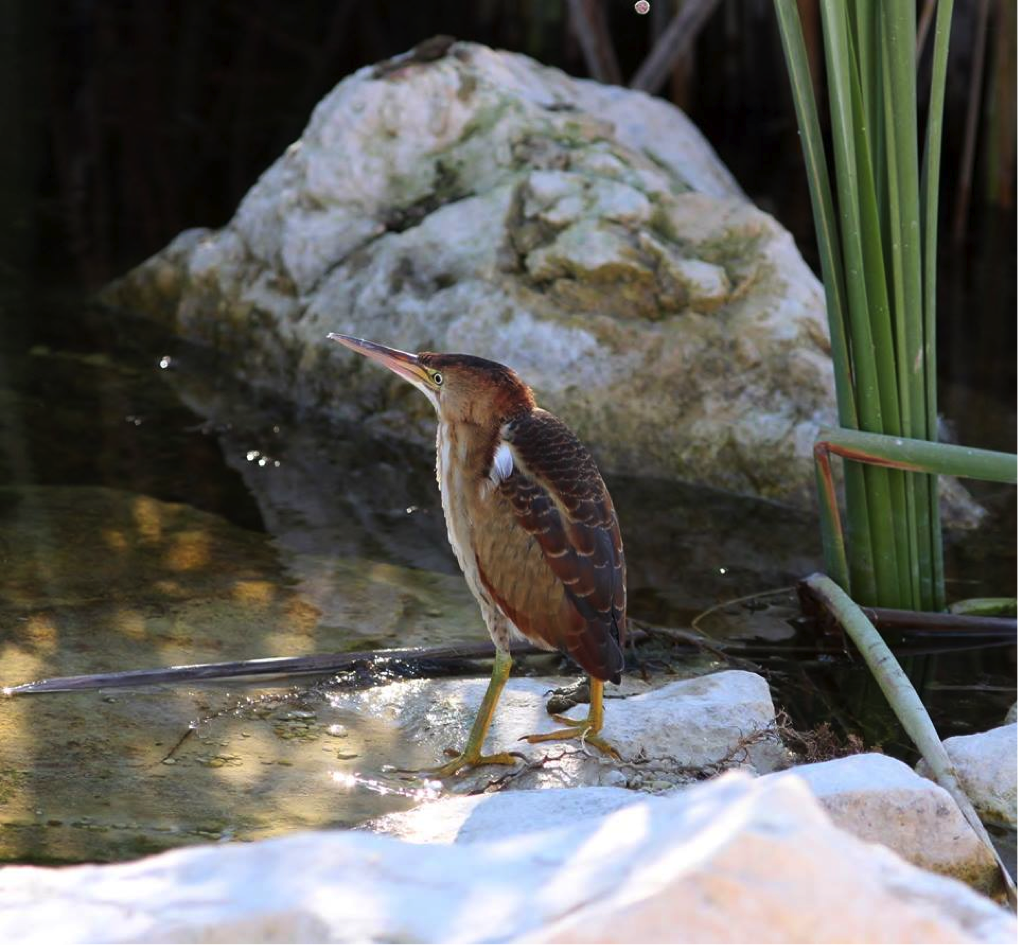
One of the 5 juvenile Least Bitterns found in the North Shoal Lake area - copyright Donna Martin

One of the five juvenile Least Bitterns found in the North Shoal Lake area – copyright Donna Martin

It was great to document the two adult Least Bitterns early in the season, but it was even more exciting to find 5 hatch year birds in early September.

Trips to the IBA revealed one Juvenile Least Bittern on September 6, 2014. Two juveniles were seen on September 10, 2014 and September 14 revealed three birds, all believed to be hatch year birds. On September 15, five juveniles were seen in the same area in North Shoal Lake.  The juveniles found this year appeared more tolerant than the adults found earlier in the season, which allowed for some great photographic opportunities and documentation.

This was the first juvenile Least Bittern found on September 6, 2014 -copyright Donna Martin

This was the first juvenile Least Bittern found on September 6, 2014 – copyright Donna Martin

The Least Bittern is protected under the Federal Species at Risk Act (SARA), Migratory Birds Convention Act, and the Manitoba Endangered Species Act.

The main threats to this species are mostly anthropogenic, with loss from destruction of habitat, shoreline development, wetland drainage and invasive species. It has a low threshold and does not tolerate human disturbances well and will leave suitable habitat if human activities become too great. Climate change could also be a threat, as it can alter water levels, which can alter habitat.

Close up view of a Least Bittern seen at North Shoal Lake, September 15, 2014 -copyright Donna Martin

Close up view of a Least Bittern seen at North Shoal Lake, September 15, 2014 – copyright Donna Martin

The Least Bittern was an exciting species to find this summer.  Efforts next year will include trying to document breeding evidence, behavior, density and numbers of young birds of this species.

– Donna Martin


Additional Least Bittern info and photos can be found on Christian Artuso’s Birds and Wildlife Blog at http://artusobirds.blogspot.ca/2014/09/least-bittern-shoal-lakes-iba.html

Impact of Flooding at the Oak Lake/Plum Lake IBA

Thank you to David Hatch for this detailed account of the effects of flooding in the Oak Lake/Plum Lake IBA area.

July 8, 2014

Immediate impacts on local nesting birds of the massive flooding in the Oak Lake area of southwestern Manitoba

Over a four-day period between Thursday, June 26 and Sunday, June 29, the area received 200-215 mm of rain, coupled with winds in the 70 kilometre range on the final day. Prior to this deluge, the area was already saturated with far too much rain.

Oak Lake [the actual lake] and its massive network of wetlands, meadows, pastures croplands and aspen woods, plus the Oak Lake recreational area are located southwest of the town of the same name and are south of Hwy. #1 and north of Hwy. #2. The wetland complex is also primarily west of Road 140 W and east of Road 150 W.

The impact of this latest flooding is devastating to local farmers and extremely disheartening, so it is almost sacrilege for me, raised in the local area and still where my heart resides, to talk about the impacts on birds.

The colonies of Franklin’s Gulls, Black-crowned Night Herons and Eared Grebes are drowned out, becoming parts of broad expanses of open water. So also are two of the three Cattle Egret colonies. One small colony of 200-300 birds still remains and here is some good news. It is a site of frantic activity with many birds carrying stocks and leaves of aquatic vegetation to rebuild or raise their nests as the water continues to rise. In mid-June, this particular colony also had six or more Great Egrets and at least one Snowy Egret hanging around it and possible nesting. Both species are still present and they are also carrying nesting material.

The biggest surprise was that now Black -crowned Night Herons and as many as 17 White-faced Ibis have arrived in this maze of cattail beds and are carrying nesting material. Possibly, they are birds flooded out from other wetlands and, finding this colony still intact, have decided to try a new area. To reach this colony one has to know the terrain very well and trudge and wade for nearly two hours to get close enough to see with a telescope what is occurring. I remained still a long distance from these colonial nesters so as not to disturb them.

Although White-faced Ibis have been in the Oak Lake marshes in the nesting season during 2012 and 2013, I have not had any evidence that they were nesting, but from a distance it sure appeared that they were this week. This year was the first year that I have had any evidence that Cattle Egrets or any other egrets were nesting in the Oak Lake area, even though they arrive in the area in late August annually now and remain well into October. In the fall of 2012 and 2013, some of the roosts were attracting hundreds of birds with it possible to see a dozen flocks of 10-25 birds arrive before dusk to spend the night in the cattails.

I only spent July 2 and 3 in the Oak Lake area, but there was not a Franklin’s Gull around. Where could thousands of pairs go so quickly? Are they searching for a new possible colony site far from here or has their nesting season ended for 2014? Many local residents enjoy birds and have oriole feeders, which every summer are daily used by both Orchard Orioles and Baltimore Orioles. Every person with an oriole feeder told me they had not seen an oriole since the heavy rains and furious winds of June 29. One couple had been enjoying watching a Baltimore Oriole on its nest on a low branch of an American Elm only three meters from the oriole feeder, but the bird disappeared in the winds. Last year it had nested within a meter or two of the same location and given the family great pleasure. Where would all the orioles go so suddenly after the rainstorm? I did not record either species during this visit.

The number of pairs of Gadwall, Blue-winged Teal, Lesser Scaup and Redheads observed was astonishing. Will these four species of late nesters still attempt to raise a brood? Nesting habitat is at a premium as many meadows and pasture fields have stretches of flood waters that extend for 2000-3000 acres across them. The marshes have become open water devoid of the emergent vegetation essential to anchor and protect floating nests.

Even Hwy #256, which connects Oak Lake Provincial Park, resort and golf course with the TransCanada Hwy has a third of a meter of water over the pavement, but is still open to traffic.

I spent much time off the west side of the lake utilizing Road 150 W, where it was passable and a few connecting roads. Despite the challenge, I recorded four singing Chestnut-collared Longspurs and 13 Sprague’s Pipits. Both species were doing a great deal of singing. With little patches of dry ground and the cool temperatures, hopefully there will be much re-nesting for these now-scarce, prairie residents.

Large numbers of three other grassland-nesting species, were also highly vocal and may also make another nesting attempt. They were Willet [heard in eight sited] and the much more common locally Upland Sandpiper and Marbled Godwit. Even if these species had young before the major four-day storm, it would have been difficult for their offspring to survive the overland flooding. All three species were making so much noise that it sounded like they had just returned from the south in spring and were staking out territories. Upland Sandpiper, which can have a prolonged nesting season, are often seen in the Oak Lake area with young as late as in the first week of August, but normally the Willets and Marbled Godwits are drifting south out of the Oak Lake area by then.

Finally, one last piece of really good news. Both pairs of Trumpeter Swans, which had broods on my mid-June visit, were located and still have their broods. They nested in quiet, isolated marshes, but now that everything is so flooded, they are so conspicuous from the air, that they look like white sailing ships on a lake.

Please respect private land and indeed all land and give these species a chance to salvage their nesting season. In my travels around the world, I have seen so many researchers and photographers in particular do much damage to breeding birds, that I am very guarded in ever reporting breeding bird activity, but felt the damage from this flooding and the stories associated with it should be passed along. The less disturbance nesting birds have by humans, the better it is for the birds.

Good birding,

David Hatch

North, East and West Shoal Lakes IBA – Trip Report

by Marshall Birch, IBA Program Assistant

The North, West, and East Shoal Lakes area – not to be confused with the town of Shoal Lake in Western Manitoba, or the Shoal Lake in Western Ontario that Winnipeg receives its water supply from – is a vibrant and easily accessible Important Bird Area (IBA) located in the southern portion of the Interlake area, under an hour North-West of Winnipeg. We visited the area to meet with IBA Caretaker Donna Martin, deliver IBA signs for the site, and take a look around.

IBA_-_shoal_-_pelican

American White Pelican – Photo by Donna Martin.

The N,W and E Shoal Lakes were originally one lake. With the construction of the Wagon Creek drain in 1912, water levels fell four to five meters and separated the Lake into three distinct cells now known as the North, West, and East Shoal Lakes. All three lakes have shallow, marshy edges and provide excellent habitat for waterfowl, wading birds, and shorebirds alike, with American White Pelican, Cackling Goose, Snow Goose, and Piping Plover being the IBA trigger species for the area.

IBA_-_shoal_-_kilderr

Kildeer – Photo by Donna Martin.

To access West Shoal Lake, we headed up Highway 6 and turned North onto PR 518 at the small town of Woodlands. The gravel road runs along the West side of West Shoal Lake, with the water coming right up to the roadside ditches. You could have a successful day of birdwatching just by driving slowly along and keeping your eyes peeled, though pulling over on this very low-traffic road to take a look is definitely worth your time. PR 518 / Ideal Road will take you all the way up to Highway 229, which runs along the North edge of North Shoal Lake. While there are a few turn-offs along the way to get in closer to the lakes in certain areas, including PR 415 which runs between the lakes, the conditions of these roads are likely to vary with weather conditions, and we found quite a few “road closed” signs. This, along with time constraints, kept us from visiting East Shoal Lake, though the West and North lakes provided us with a satisfyingly large selection of bird species.

IBA_-_Shoal_-_Great_Egret

Great Egret – Photo by Donna Martin.

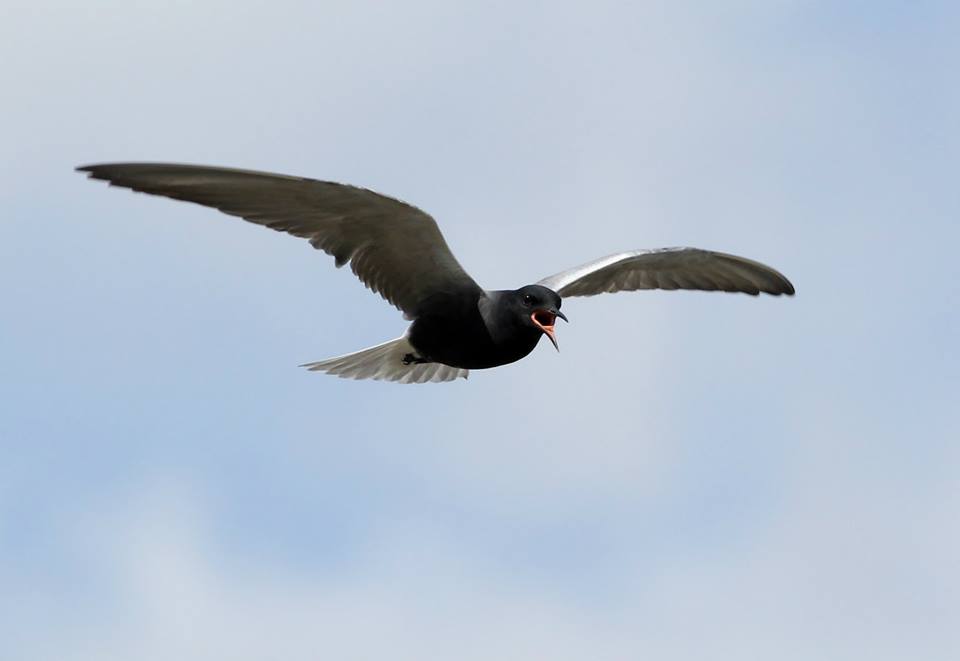
American White Pelicans were definitely in abundance, whether soaring overhead in groups or resting on the lake. We were also able to spot a good number of Great Egrets as well. Other birds of special interest included a number of Great Blue Herons and Black-crowned Night-Herons, several Eared Grebes, many Killdeer on the road (one performing it’s “broken-wing act” rather exuberantly to distract us from its nest), a Double-Crested Cormorant, and one Least Bittern (at North Shoal Lake). Ina addition, we spotted Mallards, Blue-winged Teals, Canada Geese, Shovelers, Ruddy Ducks, American Coots, Lesser Scaups, Canvasbacks – along with numerous Franklin’s Gulls, Black Terns, Red-winged Blackbirds and Tree Swallows.

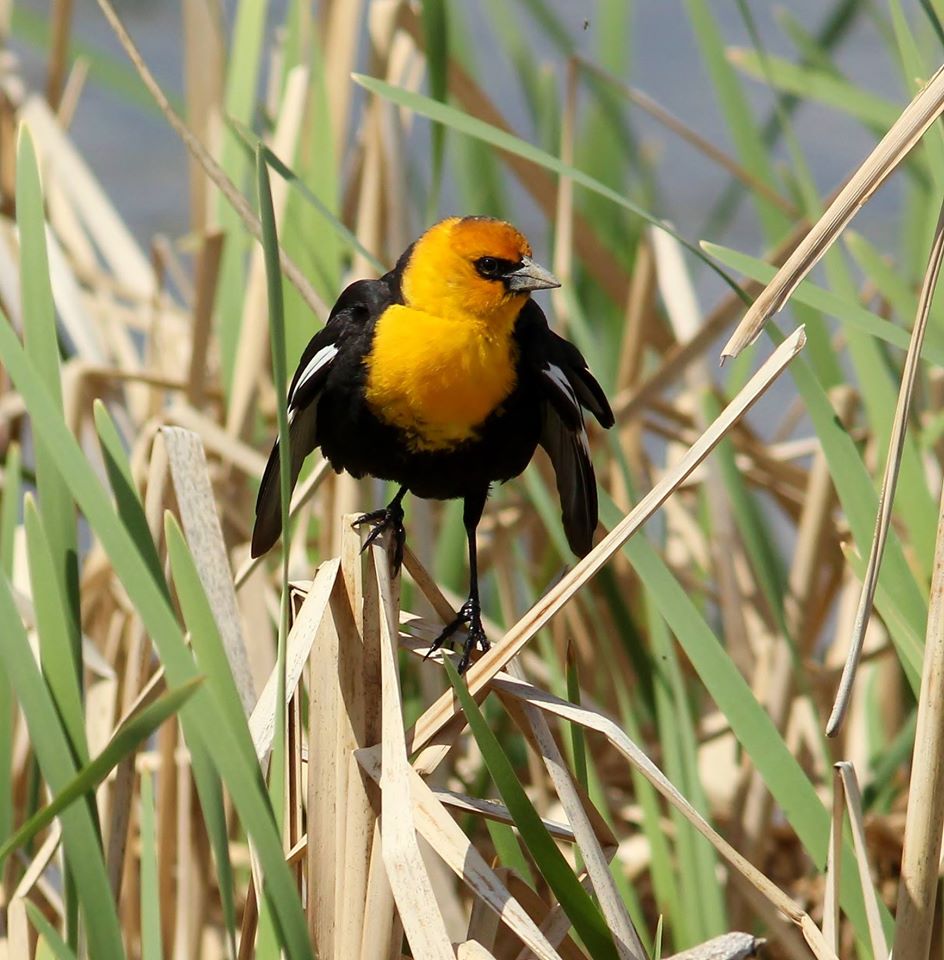
iba_-_shoal_-_yellow_headed_blackbird

Yellow-headed Blackbird – Photo by Donna Martin.

The proximity to major centres, such as Winnipeg and Portage la Prairie, combined with the ease of access to viewing areas, make the Shoal Lakes IBA an ideal birding destination for those looking for a day trip out of the city. The diversity of birds visible from the roadside was impressive enough that any serious boating would be unnecessary for anyone but the more serious and experienced birders. Still, for those willing to go the extra mile, one could imagine a boat could allow opportunities for even more incredible birdwatching. The Shoal Lakes should definitely be a destination in mind for any Manitoban interested in birding.

Grant’s Lake and Oak Hammock Marsh IBA – Trip Report

by Marshall Birch, IBA Program Assistant

Our second Important Bird Area (IBA) trip of the season involved visiting two IBAs not far from Winnipeg – Grant’s Lake and Oak Hammock Marsh. The two provided an interesting contrast between a pair of IBAs that have received very different levels of exposure, funding, and conservation work. Oak Hammock Marsh is probably the most well-known wetland in Manitoba, and has become a popular day-trip destination for Winnipeggers looking to get out of the city and see some wildlife, due to its well-maintained trails and impressive interpretive centre. Grant’s Lake is somewhere near the opposite end of the spectrum. Somewhat difficult to locate down backroads half-an-hour-or-so North-West of Winnipeg, signage is sparse – the main welcoming sign, which signifies the site as a Wildlife Management Area, is toppled over along side a waterway at the edge of the site. Luckily for us, birds don’t visit IBAs for their infrastructure, so both sites provided exciting birding opportunities.

IBA_-_grant_s_-_broadwinged_hawk

Red-tailed Hawk – Photo by Donna Martin.

After a few wrong turns near the town of Grosse Isle, and a chance sighting of a group of five Sandhill Cranes in a nearby agricultural field, we were able to locate the Grant’s Lake IBA. Unlike our past trip to Whitewater Lake, water levels did not seem especially high – in fact, it was difficult to assess exactly where the lake actually was from the viewing points we were able to access. Information on the lake, including its condition this season, was not easy to find, though it is evident that what we were able to see were actually marshy, stream-like ditches that radiate out from the centre of the IBA where the lake itself lies. These waterways were created by Ducks Unlimited, with the goal of separating the area into various sites to promote a larger diversity of species within the region. Historically, the lake had been much larger. Recent and past activities such as irrigation for the agricultural land that surrounds the site have shrunken Grant’s Lake to a much smaller version of what it once was. Still, the area is a hotspot for waterfowl, especially migrating Canada and Snow Geese, the two trigger species for this IBA.

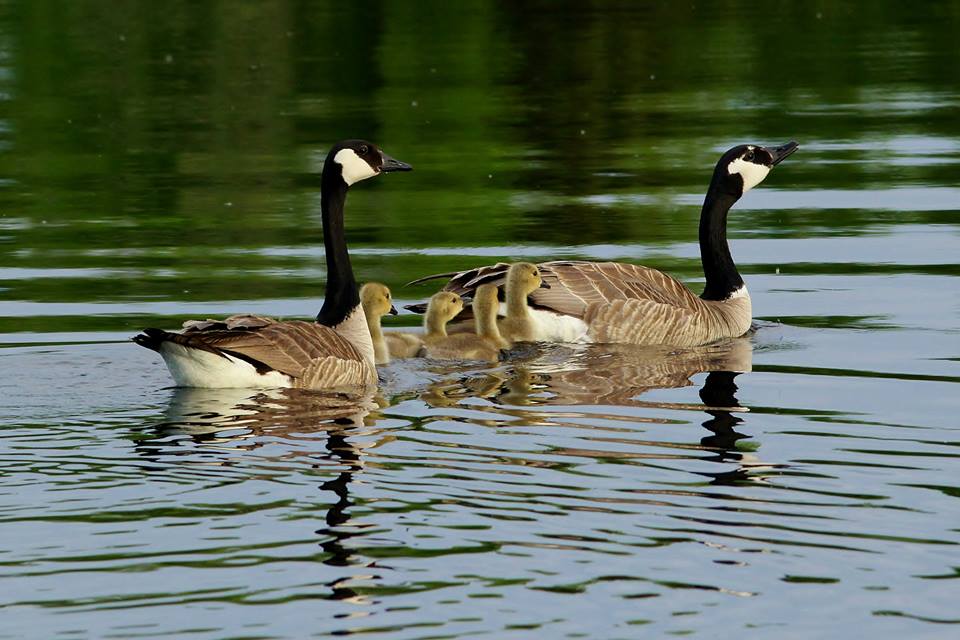
iba_-_grant_s_-_canada_geese

Canada Geese with Goslings – Photo by Donna Martin.

Even from the just within the edges of the IBA, barely beyond the managed hunting area that surrounds the site, we were able to view a wide array of waterfowl and other interesting bird species. The site was rife with Red-winged and Yellow-headed Blackbirds, as well as many waterfowl species such as Mallards, Blue-Winged Teals, Northern Shovelers, and Canada Geese, along with some goslings. The Geese were especially noticeable due to a large amount of boisterous honking that seemed to be coming from the centre of the IBA. Several Red-tailed Hawks were seen, but they tended to quickly take off after being harassed by groups of Red-winged Blackbirds. Near the entrance with the fallen sign was a small bridge over a stream that was inhabited by at least a dozen Barn Swallows, which are a threatened species in Manitoba. Aside from these, we spotted an American Bittern and several Kildeer, as well as one deer, and a decent supply of wood ticks (mostly discovered on the trip home).

iba_-_grant_s_-_american_bittern

American Bittern – Photo by Donna Martin.

Oak Hammock Marsh is much easier to find and access than Grant’s Lake. Admittedly though, what you may gain in accessibility, you may lose in tranquility, as Oak Hammock Marsh is a well-loved and busy place. All the same, when we set out to explore the IBA around two o’clock, we were the only ones on the paths. The site is a man-made freshwater marsh, the construction of which began with efforts to restore the former St. Andrew’s Bog in 1967 with the cooperation of Manitoba Natural Resources, Ducks Unlimited Canada, the federal government, local landowners, and other conservation organizations. The paths, of which there are over 50 kilometres in the entire site, are actually dykes which have been built to separate different cells in the area. The cells represent different wetland ecosystems, with water which enters from nearby Wavey Creek being controlled to regulate levels. The cells are periodically cycled through wet and dry seasons in an attempt to mimic natural cycles, and to provide habitats for different species.

iba_-_oak_hammock_-_black_tern

Black Tern – Photo by Donna Martin.

We only had time to go for a relatively quick walk around the area, seeing the popular Coot and Teal Cells, as well as the boardwalk, these areas provided us with an impressive array of species. Ducks were plentiful, especially on the Southern end of the Coot Trail, with Mallards, Ruddy Ducks, Northern Shovelers, Blue-winged Teals, American Coots, Redheads, and Lesser Scaups being spotted. Both cells had been left with fairly high water levels, so few shorebirds were seen, though we did see several Kildeer, as well as a pair of Willets calling loudly and performing courtship rituals. The Teal Cell had an large number of Black Terns, which nest at Oak Hammock Marsh, as well as many Red-winged and Yellow-headed Blackbirds. The boardwalk and area around the interpretive centre and parking lot had many Tree Swallows swooping about, as well as Purple Martins at the bird houses, and Yellow Warblers in the trees. We noticed a few Barn Swallow nests in a gazebo near the boardwalk, one of which contained Swallow hatchlings, though no adults were spotted.

iba_-_oak_hammock_-_willet

Willet – Photo by Donna Martin.

For the less serious birder, or someone just looking for a nice day out at a marsh, Oak Hammock Marsh is likely the better bet. Interpretive signage allows you to learn as you explore, and more amenities, such as bathrooms, drink machines, and a parking lot, may make the trip more comfortable for some. It’s worthwhile stopping in the interpretive centre before going for a hike as well, as the many labelled taxidermied species will help you determine what you’re seeing around the marsh. If you have the extra time however, along with an interest in local wetlands and bird species, Grant’s Lake is worth the trip. It would be especially rewarding to visit with a canoe or boat, which would allow you access to the central lake. For those looking for a quieter setting, Grant’s Lake may in fact be your first choice over Oak Hammock Marsh. For serious birders in the area, it would be highly recommended to visit both areas, whether at different times on a combined trip.

Whitewater Lake IBA – Trip Report

by Marshall Birch, IBA Program Assistant

On June 5, 2014 the Manitoba IBA team met with Dale Banman, Economic Development Officer with the Turtle Mountain Community Development Corporation, to visit Whitewater Lake on our first tour of a Manitoba Important Bird Area (IBA) of the season.

Whitewater Lake is a moderately-saline, alkaline lake, located in southwestern Manitoba between the towns of Boissevain and Deloraine, just north of the Turtle Mountain Provincial Park. The site has been designated an IBA, primarily due to large populations of waterfowl and shorebirds, with the IBA trigger species being Snow Geese, White-rumped Sandpipers, Black-crowned Night-Herons, Franklin’s Gulls, and Mallards. The lake is also a Provincial Wildlife Management Area, which provides some protection to the area by regulating activities such as logging, hunting, mining, agriculture, and hydroelectric power generation. Our goals were to explore the IBA, learn as much about it as we could from our guide Dale, put up IBA signs, and maybe see a bird or two.

Black-crowned Night Heron

Black-crowned Night Heron – Photo by Donna Martin.

Under normal conditions, the lake averages a depth of around two metres. It covers an area of roughly six to ten thousand acres of crown land, which is surrounded by private agricultural land, with some oil drilling development evident along the south shore. The lake has historically been subject to major fluctuations in size and depth. Throughout most of the 1930’s and 1980’s, arid and drought seasons lead it to periodically dry up entirely. Though less common in the past, the lake has also been known to flood into adjacent land during wet seasons, due partly to a lack of any natural outlet for the lake – an issue that has led some to suggest creating an outlet, though this is something of a controversial issue.

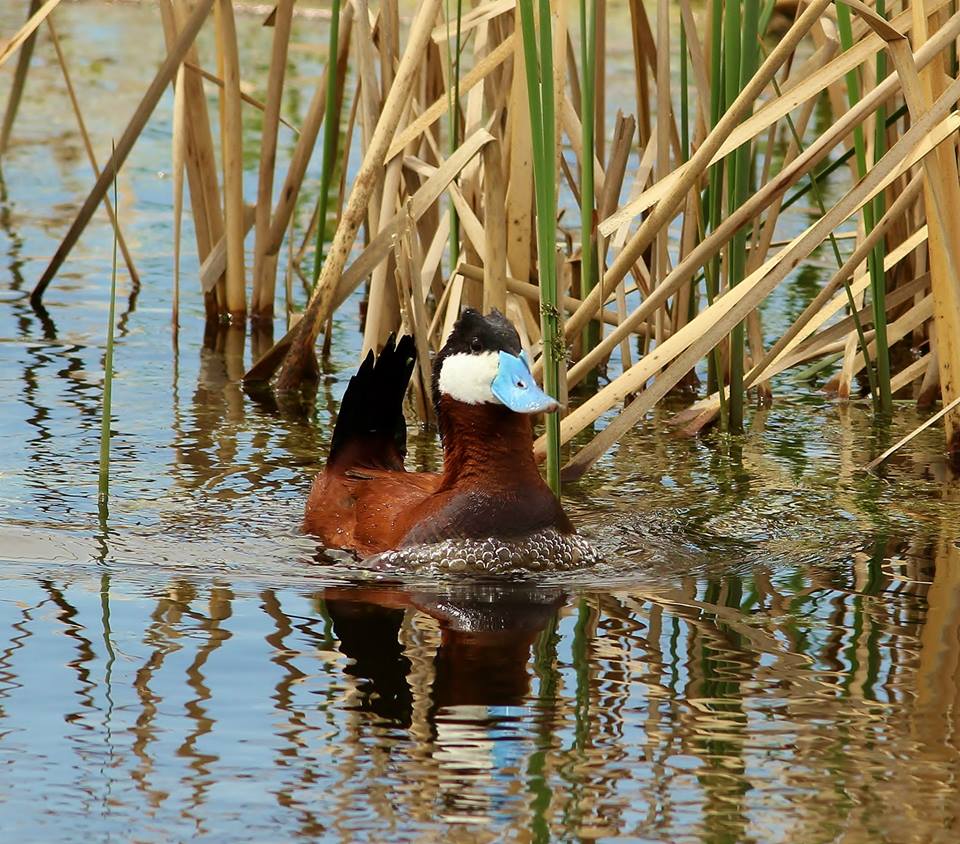
Ruddy Duck

Ruddy Duck – Photo by Donna Martin.

Unfortunately, the area has been experiencing high lake levels for about five years, a condition which leads to a poor habitat for shorebirds, and the trend has continued this season. Dykes, which were built by Ducks Unlimited throughout the 1990’s as part of their Habitat Restoration Project with the aim to control lake levels during especially dry or wet years, and which were also used as hiking paths with interpretive signage, have all been breached, leaving little space for viewing. Luckily for us, the area that remained supplied a wide number of species easily viewable from the main drive in.

Wilson's Phalarope

Wilson’s Phalarope – Photo by Donna Martin.

After installing signs which labelled the space as an IBA, we checked out the viewing mound, from which we were able to see a large amount of Red-winged and Yellow-headed Blackbirds, as well as Barn Swallows, and the occasional indeterminable duck silhouette in the distance. It was when we moved back along the road we had come in on, surrounded by high water, reeds, and cattails, that we were able to view a wider array of species. A pair of Black-crowned Night-Herons were perched in the tall grass along the water’s edge, and Franklin’s Gulls flew over head, diving into the water to hunt near by – both trigger species for the IBA designation of the site. While the high water made for inopportune conditions for shorebirds, we did see some Kildeer and a Wilson’s Phalarope flitting amongst the reeds. The conditions were favourable for waterfowl, however, and we were able to identify many species – Mallards, Ruddy Ducks, American Coots, Canvasbacks, Canada Geese, Snow Geese, Redheads, Northern Shovelers, and Eared Grebes were all seen. One cormorant was spotted as well.

Shoveler

Northern Shoveler – Photo by Donna Martin.

Satisfied that we’d gotten a good look at most of what was accessible of the IBA, we headed off for a quick tour of the surrounding area, which provided viewing opportunities of hawks swooping about in the distance, and many more Red-winged Blackbirds. While it was a shame that so much of the IBA had been inundated with high water levels, there was still plenty to see in the areas that remained accessible. One can imagine how impressive the area could be under ideal conditions – certainly a destination that warrants a return trip.

On the way back along the Number 2 highway we saw a group of Wild Turkeys too!