Winnipegosis trip blog 1 – Marshy Point IBA

Last weekend (May 7th) Christian Artuso of the Manitoba Breeding Bird Atlas and Tim Poole, IBA Coordinator were invited to deliver a workshop on the IBA Program to local people in Winnipegosis. In this first blog, Tim describes the first part of the journey to Winnipegosis and a brief visit to Marshy Point IBA.

Late Friday morning Christian and I set out for  Winnipegosis. We had a rough plan of action for the day which involved checking out a couple of IBAs before hitting the Narrows. Marshy Point was the first of these IBA’s. Although mostly present on privately-owned land, parts of Marshy Point can be accessed by public road. The IBA is nestled on the eastern shore of Lake Manitoba west of Highway 6 between Oak Point and Lundar.
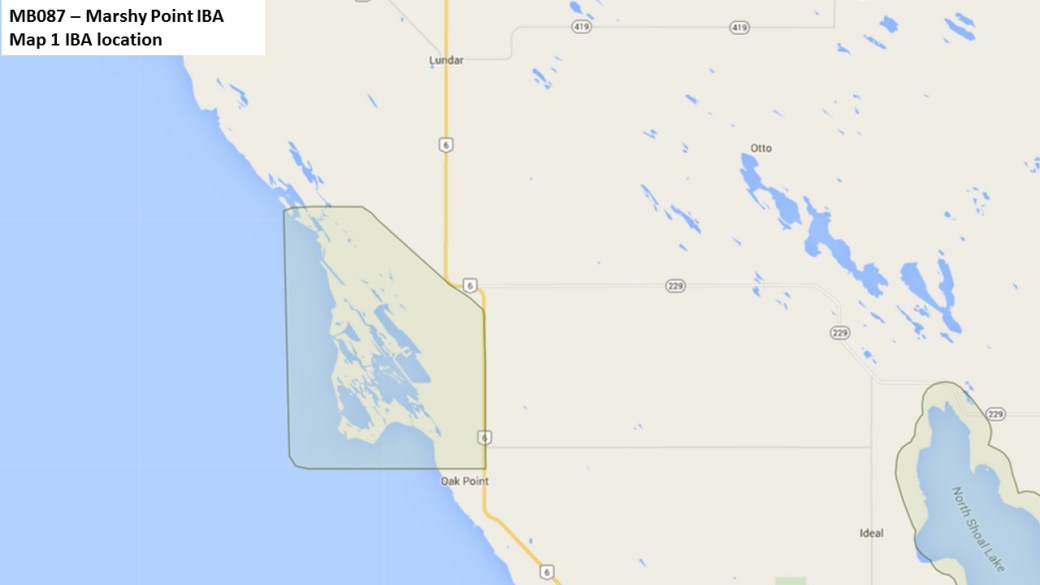
Slide1

Most of the IBA is private and cannot be accessed by volunteers. However there are some possibilities for recording bird data if you do not mind leaving the highway for a short period. The IBA can effectively be split into three zones for monitoring purposes:
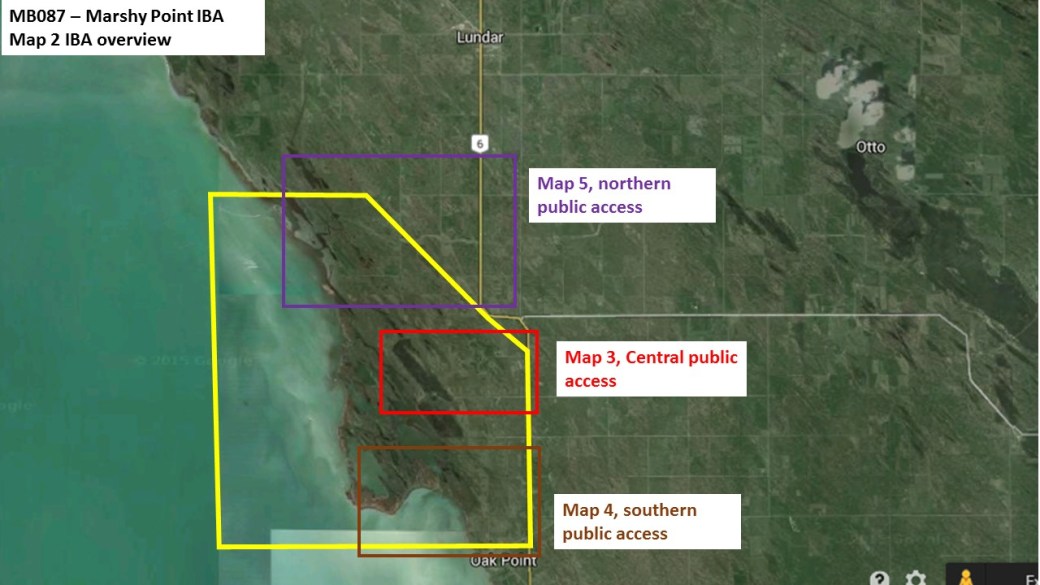
Slide2

We did not access the IBA along the southern and central access routes but for completion, here are the access maps on Google Earth Images:
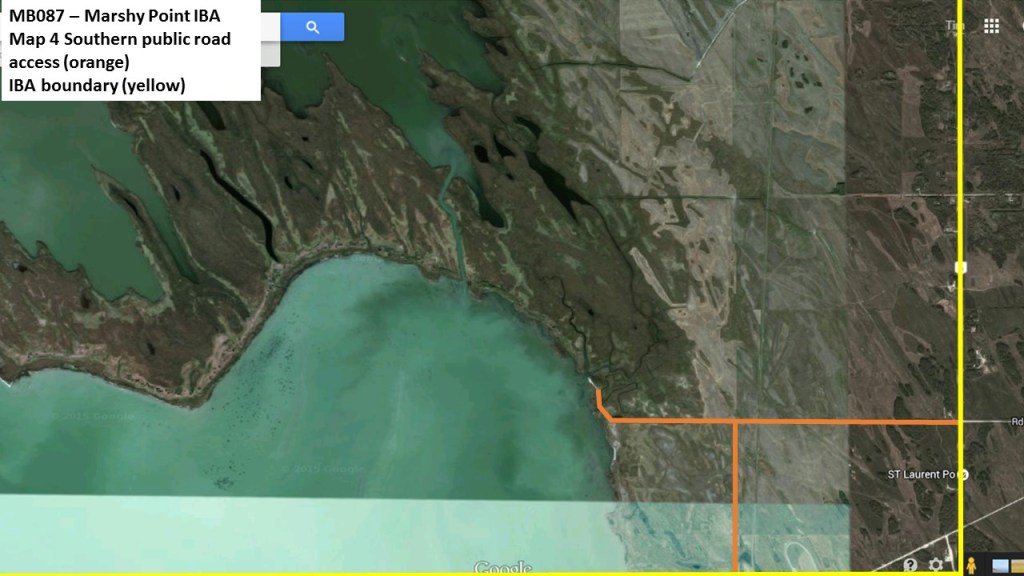
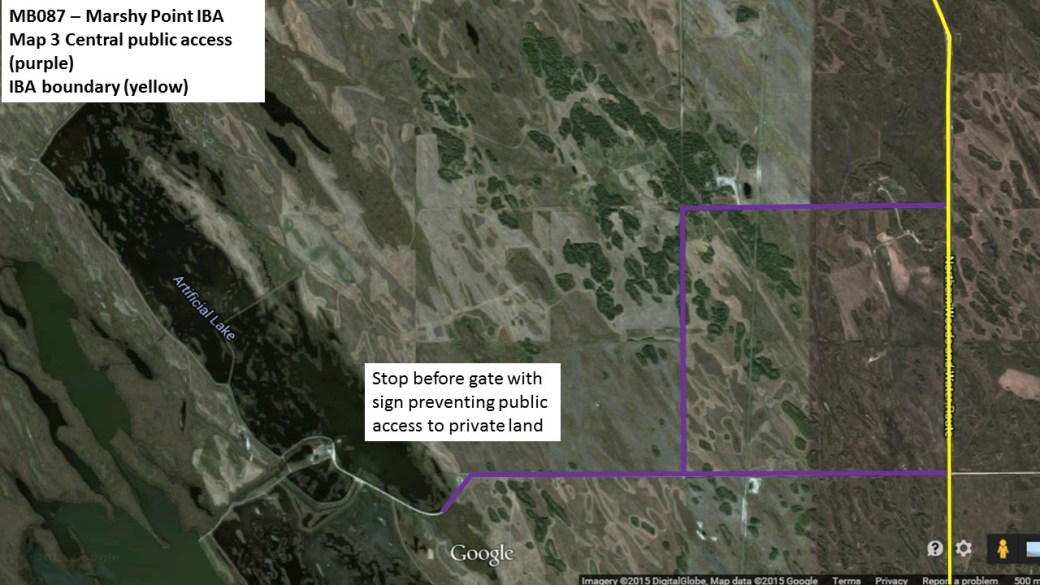
Slide5MB087-Marshy Point IBA Public Access.jpg

Further north we drove and then turned west off Highway 6, heading towards the hatchery road. The fish hatchery on Lake Manitoba is within the IBA and our ultimate destination was the parking area where provincial fisheries staff take the boat across to the hatchery. The route we took can be seen from our GPS track below:
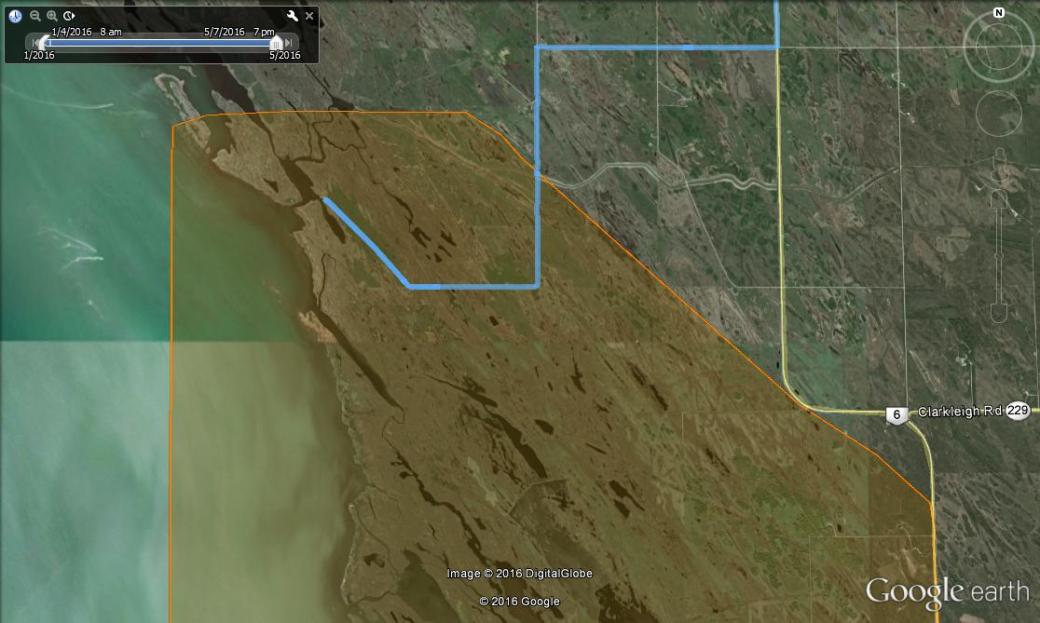
Marshy Point access.jpg

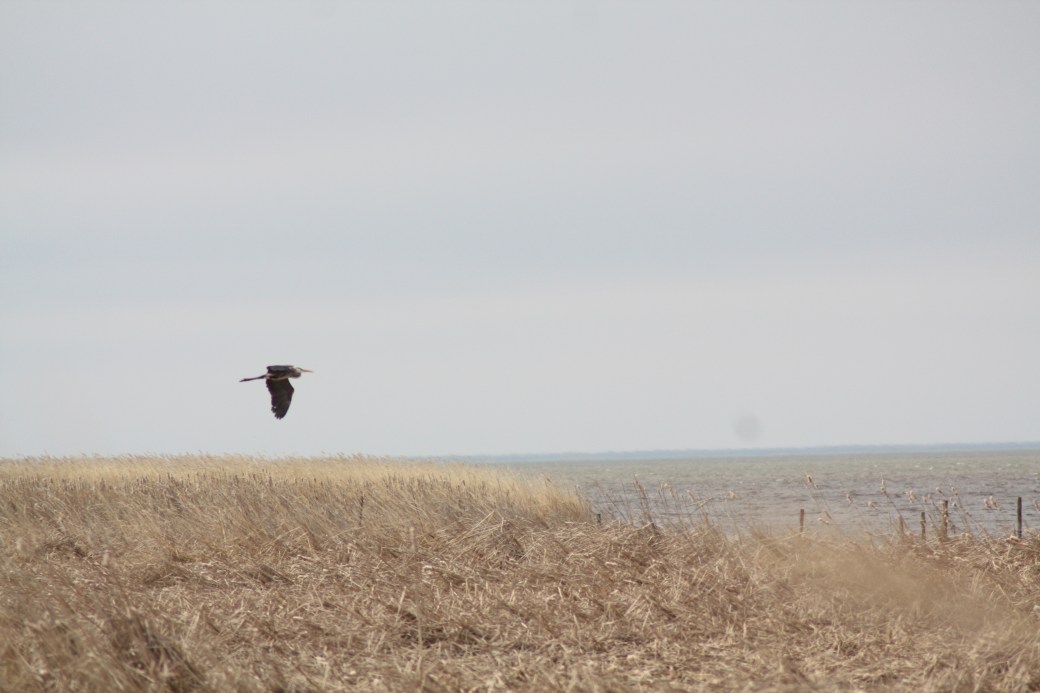
In total we were able to record 36 species in and around the IBA, including our first shorebirds of the day, two Wilson’s Phalaropes in a small pool. In addition there was a group of 16 Lesser Yellowlegs among the cattails and 13 species of waterfowl. It would be interesting given time to explore the other areas on the maps above to determine where best for birds in the accessible part of the IBA. There were also American White Pelicans and a Great Blue Heron in flight, plus a failed attempt at photographing Gadwalls with their white speculum showing.
IMG_1069.JPG

Onwards we headed towards the Narrows, next stop, Dog Lake IBA.

IBA Blitz at Delta Marsh

The Province of Manitoba and the Manitoba IBA Program will be coordinating a blitz of all of Delta Marsh over the weekend of May 28 and 29. Monitoring will take place on both mornings. We will be hoping to organise a thank you meal on one of the lunchtimes. We are looking for different groups of people, including:
1. Experienced boat handlers (boats will be available)
2. Experience of counting birds from a boat
3. Are happy to monitor birds on foot through a hemi-marsh i.e. get your feet a bit wet
4. Would be happy to drive around the roads and tracks monitoring the birds in the area
The plans are still being developed but if you are available to come to Delta Marsh on either of those dates, please contact us on iba@naturemanitoba.ca

Update on IBA Program

For anyone able to pick this up and not on our email distribution list, here is a quick update on some of the goings on in the Manitoba IBA Program
Upcoming Events
  • We have a program of events planned for 2016, including at least 5 bird blitzes. news on these will be distributed by email and on the blog in due course. In the meantime we have a busy start to May. On May 7th, Christian Artuso and I will be heading up to Winnipegosis to deliver a workshop on the IBA Program. We will give an introduction to the IBA Program and some of the birds you would expect to encounter in the local IBAs, including Sagemace and Coleman Bay Islands (http://www.ibacanada.ca/site.jsp?siteID=MB081). If you know of anyone living in the area who might be interested, please get in contact with me.
  • Closer to Winnipeg, International Migratory Bird Day is coming up and Oak Hammock Marsh is the place to be. We will be giving a birding walk at 8am in the morning, demonstrating to people how to carry out the IBA Protocol and hopefully see some fun birds. At 10am Christian and I will be giving a talk on the IBA Program and how to use eBird. The cost of attending is the standard cost of entering the centre. Christian will be giving another talk at 11am on Manitoba’s returning songbirds and then at 1am, Paula Grieef will give what I am sure will be an excellent workshop on birding by ear. To complete the day, there will be an opportunity from 2:30pm to look at some binoculars (see http://www.oakhammockmarsh.ca/events/international-migratory-bird-day/). In addition, if there is any interest in doing a quick IBA blitz at Oak Hammock following some of the events listed, then please let me know.
  • If you are further afield and not going to make it to Oak Hammock, then I really would encourage you to visit your local IBA and collect as much bird data as possible. This is a fantastic opportunity to get out and enjoy the birds in your area. If you do get out, then please send me your completed eBird checklists – it would be fun to post the number of IBAs monitored and what was seen on our blog.
The Blog
Following a rush of blood to the head, there are now a number of new blogs on the website including:
Funding news
We would like to thank our new funders who have in recent months generously donated to the program. We have recently received new funding from MEC Advocacy and Awareness, The Winnipeg Foundation, TD Friends of the Environment Fund, Blennerhassett Family Foundation and Province of Manitoba Green Team. For a full list of funding partners see https://importantbirdareasmb.ca/donors-and-supporters/. Thanks are also due to Environment Canada’s EcoAction Community Fund who supported the program since 2014 until March 31st 2016.
La Riviere Raptor Festival
It was great to see some familiar faces and some new faces at the La Riviere Raptor Festival. It was a fantastic day for all the family and I would really encourage people who did not attend this year to check it out in 2017.
Grassland Bird Conservation Guide
The final output from the EcoAction Program is the new Landowners Guide to Grassland Bird Conservation in Manitoba. If you haven’t see it already, please check it out on our website at https://importantbirdareasmb.ca/manitoba-grassland-bird-initiative/.
Volunteer Reporting
I have updated the volunteer hour reporting forms and will post to the website. If you wish to use one of our bird checklists to record data and send to me to enter into eBird, you can download the copies at https://importantbirdareasmb.ca/volunteer/maps-and-monitoring-forms/. Remember, if you visit and IBA and eBird it, we can record the volunteer hours. These hours are an important part of fundraising to continue the program.
Other IBA news
Bird Studies Canada are looking for a new IBA Coordinator for Ontario with the deadline just a few days away. If you are, or know of anyone interested in this post, please see http://www.birdscanada.org/news/important-bird-and-biodiversity-areas-coordinator-ontario

Whitewater Lake IBA, a Birders Paradise

In celebration of Nature Week from Travel Manitoba, it’s a great opportunity to share some images from Manitoba’s top places for birds. Donna Martin has kindly sent us some fantastic images from a day out last week at Whitewater Lake near Deloraine. We are also fortunate to have two amazing volunteer Caretakers for this site, Colin Blyth and Gillian Richards. If you travel to Whitewater Lake in the coming weeks, we would love to see your checklists entered on eBird. If you need some help with this, please let us know at iba@naturemanitoba.ca.

IMG_3403

Formerly a rarity in Manitoba, the White-faced Ibis has seemingly become numerous at Whitewater Lake. Photo copyright Donna Martin

IMG_3710

Whitewater Lake is not just a great place for birds. Note the changing landuse in the background, a forewarning of things to come? Photo copyright Donna Martin

IMG_4032

A close-up of a wonderful White-faced Ibis. In the coming weeks, the lake will become a temporary home to thousands of migrating shorebirds. Photo copyright Donna Martin

IBA Monitoring Priorities – Delta Marsh

Our second in the series of IBA monitoring priorities looks at the needs around Delta Marsh IBA. After a few exchanges on Facebook recently regarding the boundary of the Delta Marsh IBA, it seemed like a good time to use this site for the next blog.

Delta Marsh, made famous by a combination of Delta Waterfowl and one of North America’s leading bird banding stations, is known for large and diverse populations of birds. Many birdwatchers visit the IBA during spring migration to check the ridge for migrant songbirds on their route north. What is most impressive are the large concentrations of waterbirds, especially ducks and geese. In addition, the marsh has been known as a place for marsh birds such as Yellow Warbler and Common Yellowthroat.

On the south edge of Lake Manitoba, the IBA includes Ambroise Beach and Delta Beach.

You can see a pdf of the IBA boundary by clicking on the link below:

http://www.ibacanada.ca/maps/sites/MB001.pdf

and a Google map here:

http://www.ibacanada.ca/mapviewer.jsp?siteID=MB001

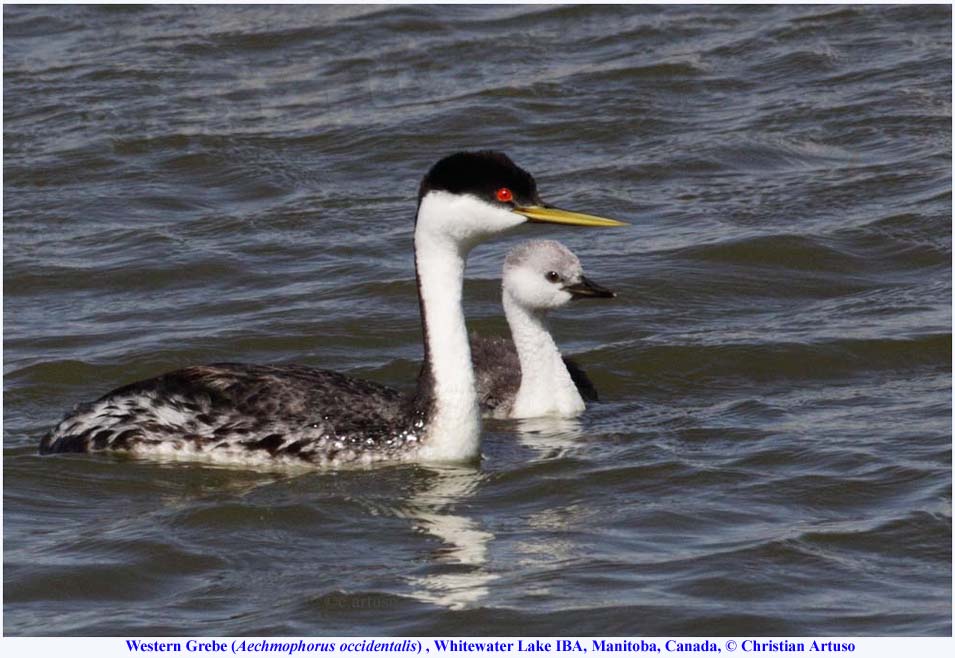
Fall migration is probably the key period at Delta Marsh for both diving (Canvasback, Redhead, Lesser Scaup) and dabbling (Mallard, Gadwall, American Wigeon, and Northern Pintail) ducks.  Around 100,000 waterfowl have been detected during aerial surveys. Canada Geese and Snow Geese also stage in large numbers in spring and fall. The beaches are also good places to monitor shorebirds such as Sanderling and Ruddy Turnstones. Western Grebe are a significant breeding and staging species.

According to the original IBA citation, the following are priority species:

  1. Black-crowned Night-Heron
  2. Forster’s Tern
  3. Snow Goose
  4. Mallard
  5. Western Grebe

18_Artuso_Western Grebe_7872_adult and juv

The original citation also highlights the globally important populations of waterfowl. Other IUCN-listed species such as Rusty Blackbird and Horned Grebe are also worthy of paying special attention.

Donna RUBL

The internationally threatened Rusty Blackbird in all its rusty glory. Photo copyright Donna Martin

The monitoring priorities for 2016 are:

  • Complete checklists to be entered into eBird. If possible these checklists should follow the IBA Protocol.
  • Prioritise counting large flocks of waterbirds.
  • Enter any birds counted outside the IBA under the IBA Protocol while ensuring the eBird point is not in the IBA
  • Add checklists of count of non-target species encountered during other events e.g. fall hawk watches, Nature MB birding trips
  • Do not be afraid to include monitoring in some areas outside the IBA, especially Lake Francis to the east but make sure any birds recorded outside the IBA are listed on separate checklists.

delta iba protocol

For anyone interested in learning a bit more about how to do this, there will be a short walk and talk on May 14th as part of the International Migratory Bird Day (see here).

I can provide a larger printed version of the map and include roads, etc for anyone who requests it. Please use the contact details provided on this website.

Trumpeter Swans, IBA and The Express Weekly News

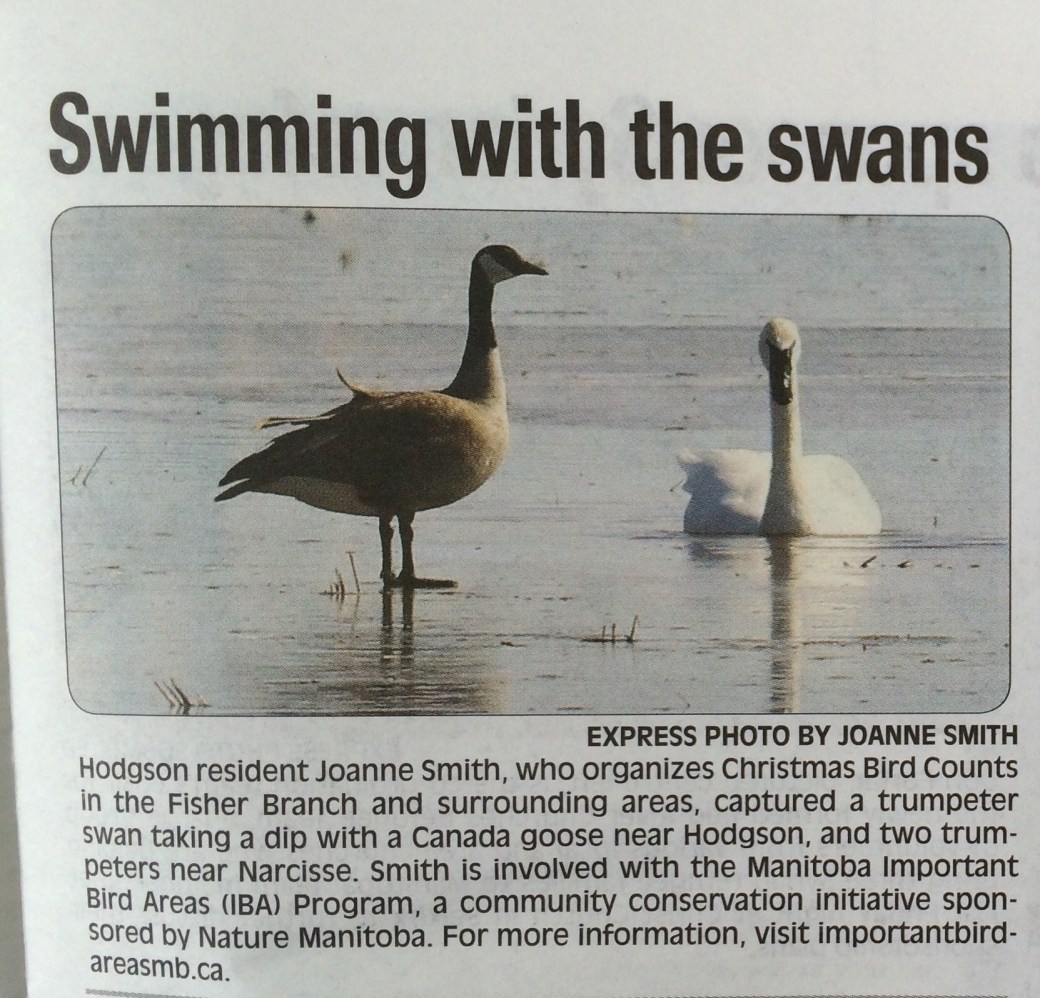
Nice little piece in The Express Weekly News this week, with a photo taken by Riverton Sandy Bar IBA Caretaker, Joanne Smith. The lovely photo of a Trumpeter Swan swimming next to a Canada Goose standing on some ice sums up current weather conditions nicely. Although taken near her home in Hodgson rather than Riverton, the text mentions the IBA Program, so well done Joanne!

Joanne photo Express Weekly.jpg

New Landowners Guide to Grassland Birds in Manitoba

Since June 2013 the Manitoba Important Bird Areas Program have been working on the Manitoba Grassland Conservation Initiative. This program was established with the aim of engaging landowners and communities in Manitoba about the fast declining populations of grassland birds. Over the intervening period, the program has delivered the objectives of the program. This has included attendance at local fairs, giving talks promoting the program, finding out about how landowners view grassland birds in a stakeholder survey, involving volunteers in monitoring the grassland IBAs and providing workshops on the birds of the prairies. At the culmination of funding from Environment Canada’s EcoAction Community Funding Program, we have produced a ‘Landowners’ Guide to Grassland Bird Conservation in Manitoba’. This guide provides an overview of the issues which cause bird populations to thrive and those which cause them to decline. It gives a brief overview of the added activities, in addition to farming livestock, which might benefit birds. Finally it describes some of the threatened species that might be found on each parcel of land. Designed by Carrie-Anne Lander and based on a literature review from Marshall Birch, we hope it will be a valuable addition to bird conservation in Manitoba.

Picture2

Image of the front cover of the guide

A copy of the guide can be downloaded at the bottom of this page: https://importantbirdareasmb.ca/manitoba-grassland-bird-initiative/. If you would like a hard copy of the guide, please contact Tim Poole at iba@naturemanitoba.ca or (204) 943-9029.

IBA Monitoring Priorities – Oak Hammock Marsh IBA

With a seemingly early spring jolting the world around us to life, it seems like the time has come to get ready for annual monitoring of Manitoba’s 38 IBAs. Over the next month or so, I am going to attempt to post some quick reviews of monitoring and caretaker opportunities for individual IBAs. This will help anyone going out to these places to consider entering their data under the IBA protocol. Today, I am going to start with the most well-known and well-visited IBA in Manitoba, Oak Hammock Marsh.

Oak Hammock Marsh is the most well visited IBA in Manitoba. Funnily enough I suspect it has the least entries under the IBA Protocol of all the most well known Manitoban IBAs. It would be fantastic if people would consider entering all their checklists in eBird (or send them to me to enter them), so to build a more accurate reflection of bird populations in this IBA. For anyone interested in learning a bit more about how to do this, there will be a short walk and talk on May 14th as part of the International Migratory Bird Day (see here).

If you don’t know, Oak Hammock Marsh is a 20 minute drive north of the Winnipeg perimeter between highways 7 and 8 (see directions). You can see a pdf of the IBA boundary by clicking on the link below:

MB010 Oak Hammock Marsh WMA

Originally designated for large populations of waterbirds, including waterfowl, shorebirds and other marsh birds, Oak Hammock Marsh is especially important during migration season. There are globally important populations of Canada Goose in spring and fall and Snow Goose during fall. Being a hemi-marsh, the water levels are human-controlled. Currently most of the marsh is not in drawdown and therefore the habitats are more suitable for waterfowl than shorebirds. The sod fields north of Oak Hammock, although not in the IBA are the best place currently for the globally Near-threatened Buff-breasted Sandpiper. The original trigger species were:

  1. American Coot
  2. Black-crowned Night-Heron
  3. Canada Goose
  4. Franklin’s Gulls
  5. Hudsonian Godwit
  6. Lesser Snow Goose
  7. Mallard
  8. Short-billed Dowitcher
  9. Tundra Swan
  10. White-rumped Sandpiper

Other key species to look out for are:

  1. Buff-breasted Sandpiper
  2. Rusty Blackbird

The monitoring priorities for 2016 are:

  • Complete checklists to be entered into eBird. If possible these checklists should follow the IBA Protocol.
  • Prioritise counting large flocks of waterbirds.
  • Although not in the IBA, enter Buff-breasted Sandpiper data from the sod fields to the north under the IBA Protocol.
  • Participate in the Oak Hammock Marsh Summer Breeding Census (watch the Manitoba Birds Yahoo Group for details.
  • Participate in the fall goose counts (more details will appear on http://www.oakhammockmarsh.ca/).

IBA Protocol routes exist and follow the Oak Hammock Marsh Summer Census zones. If possible enter your checklists under the zones used in this map:

MB010 Oak Hammock Marsh IBA monitoring route map

Any questions please let me know  on the contact details provided on this website.

Southern Cone Grassland Alliance – an Inspiration

I thought I would share a link to a story I received this morning from Birdlife International about Birdlife Americas Southern Cone Grassland Alliance. The alliance has just received an award for ‘International Cooperation’ from the prestigious U.S. Forest Service’s 2016 Wings Across the Americas Awards for outstanding conservation achievement. See Birdlife America’s Southern Cone Grassland Partnership.

Late last year, Bird Studies Canada’s (and MB IBA steering committee chair), Christian Artuso, presented a talk, together with Audubon, on North American grassland bird conservation at a gathering of ranchers, NGOs, government officials and academics in Brazil. This gathering was arranged by an inspirational partnership for conservation involving ranchers from four countries (Argentina, Uruguay, Brazil and Paraguay), conserving native grasslands and in return receiving a grassland bird-friendly beef certification. This certification provides ranchers with a higher price for their beef.

Why is this of interest to the Manitoba IBA Program? For starters, cattle producers, especially in the Southwestern Manitoba Mixed-grass Prairie IBA, face many of the same challenges as those in South America. In both Manitoba and the Southern Cone, almost all grasslands are privately owned. Retaining cattle production is vital to retaining the remaining patches of native grassland, especially given the loss of native bison in Manitoba. Conserving native grasslands is also key to conserving our special grassland birds such as Sprague’s Pipit, Chestnut-collared Longspur and Ferruginous Hawk. In both cases, cattle production is beneficial to birds.

Landowners must also turn a profit to retain cattle on the landscape. Across the Americas native grassland have been converted to crops or in some cases in the north, areas of grassland are given over to energy extraction due to financial pressures. This has meant that in North and South America, entire grassland ecosystems have become endangered, leading to declines of well-known grassland birds such as Bobolink and Loggerhead Shrike.

Also of interest is how this type of initiative might influence migratory birds from Manitoba. Birds of the Manitoba grassland like the Upland Sandpiper and Swainson’s Hawk spend the winter on South American grassland. What’s more, some open tundra species of the high Arctic, think Buff-breasted Sandpiper, and those of the Hudson Bay lowlands, say, Hudsonian Godwit, also winter on the grasslands of the Southern Cone. This demonstrates the importance of a fully functioning network of sites for conservation, such as IBAs, across borders and continents. It also presents a challenge to decision-makers and stakeholders in North America in responding to such a positive initiative.

Could a similar certification award and partnership could work in North America? Maybe in a few years there will be an option of purchasing grassland bird-friendly beef from the native prairies of southwestern Manitoba. That would certainly be a step in the right direction for threatened grassland birds!Upland Sandpiper