Spring 2023 ISS Roundup

This past spring our wonderful volunteers and Manitoba IBA staff conducted International Shorebird Surveys (ISS) within the province. Started by Manomet, the goal of these surveys is to track long-term global shorebird trends. Spring International Shorebird Surveys are conducted annually between April 1st and June 15th, with the peak of the season occurring between April 24th and May 16th.

In Manitoba, four of our IBAs are surveyed using the ISS protocol: Whitewater Lake; North, East, and West Shoal Lakes; Oak Lake/Plum Lakes; and Oak Hammock Marsh. Within each site, there are pre-set routes. Whitewater Lake has four routes on the east side of the lake, three on the west side and one stationary route. Oak Lake/Plum Lakes has five routes, two of which are stationary. Oak Hammock Marsh has three routes, although one was not accessible this year due to high water levels. Finally, North, East and West Shoal Lakes IBA has four routes around the lakes. We try to survey each route three times in the spring and three times in the fall. While all species observed can be recorded, only shorebird observations are included in this roundup.  

Last year, many areas were flooded and water levels were higher than the norm. This year however, much of the usual preferred habitat was drier than usual, while some areas were inaccessible due to flooding. These conditions in addition to a late spring created an interesting survey period. Below is a summary of the results from the spring survey period.

Whitewater Lake

2023 Spring Whitewater Lake Shorebird Counts
SpeciesTotal # of Individuals Proportion of Individuals (%)
American Avocet454
American Golden Plover161
Baird’s Sandpiper242
Black-bellied Plover656
Dunlin171
Killdeer171
Least Sandpiper31627
Lesser Yellowlegs18016
Marbled Godwit91
Pectoral Sandpiper30
Red-necked Phalarope171
Ruddy Turnstone71
Sanderling101
Semipalmated Plover10
Semipalmated Sandpiper30426
Short-billed Dowitcher30
Spotted Sandpiper10
Stilt Sandpiper262
Upland Sandpiper30
White-rumped Sandpiper40
Willet111
Wilson’s Phalarope787
Total1157100
Total Number of species22
Data based on 16 surveys.

Whitewater Lake was visited four times during the spring ISS period. Route E1 was surveyed once. Routes E2, E3, W1 were each surveyed twice. Lastly, routes W2, W3, and Sexton (the stationary spot) were each surveyed three times. Large numbers of Least and Semipalmated Sandpipers were observed during the spring migration, as well as numerous Lesser Yellowlegs, Wilson’s Phalarope, and Black-bellied Plovers.

A big thank you to Carson Kearns, Colin Blyth, Duane Diehl, Gillian Richards, Jackie Dixon, Kathryn Hyndman, Tim Poole, Veronica White, Cam Tramley, Baylana Hiebert, and the Westman Naturalists for monitoring Whitewater Lake!

Oak Lake/Plum Lakes

2023 Spring OPL Shorebird Counts
SpeciesTotal # of Individuals Proportion of Individuals (%)
American Avocet24
Killdeer1019
Least Sandpiper24
Marbled Godwit12
Shorebird sp.611
Spotted Sandpiper47
Willet24
Wilson’s Phalarope2750
Total54100
Total Species8
Data based on 3 surveys.

Oak Lake/Plum Lakes was visited once this season. Routes 1, 2, 3 and 4 were all surveyed. Route 5 was not surveyed due to the roads being flooded. The most numerous species seen at Oak Lake/Plum Lakes was Wilson’s Phalarope and Killdeer, with one Marbled Godwit sighting.

A big thank you to Amanda Shave and Shannon Landels for making it out to this site!

North, East, and West Shoal Lakes

2023 Spring North, East and West Shoal Lakes Shorebird Counts
SpeciesTotal # of Individuals Proportion of Individuals (%)
Greater Yellowlegs23
Hudsonian Godwit58
Killdeer1829
Lesser Yellowlegs1117
Marbled Godwit610
Solitary Sandpiper12
Spotted Sandpiper1524
Willet23
Wilson’s Phalarope12
Wilson’s Snipe1117
Total72114
Total Species10
Data based on 11 surveys.

North, East and West Shoal Lakes was surveyed on four occasions this spring season. Routes 1, 2 and the campground stationary route were each surveyed once. Routes 3 and 2 were surveyed 4 times each. The most numerous shorebirds seen were Lesser Yellowlegs and Spotted Sandpipers, with some sightings of Hudsonian and Marbled Godwits.  

A big thank you to Bonnie Chartier, Mike Karakas, Tami Reynolds, Jo Swartz, Betsy Thorsteinson, Tim Poole, Veronica White and Cam Tramley for monitoring the North, East and West Shoal Lakes!

Oak Hammock Marsh

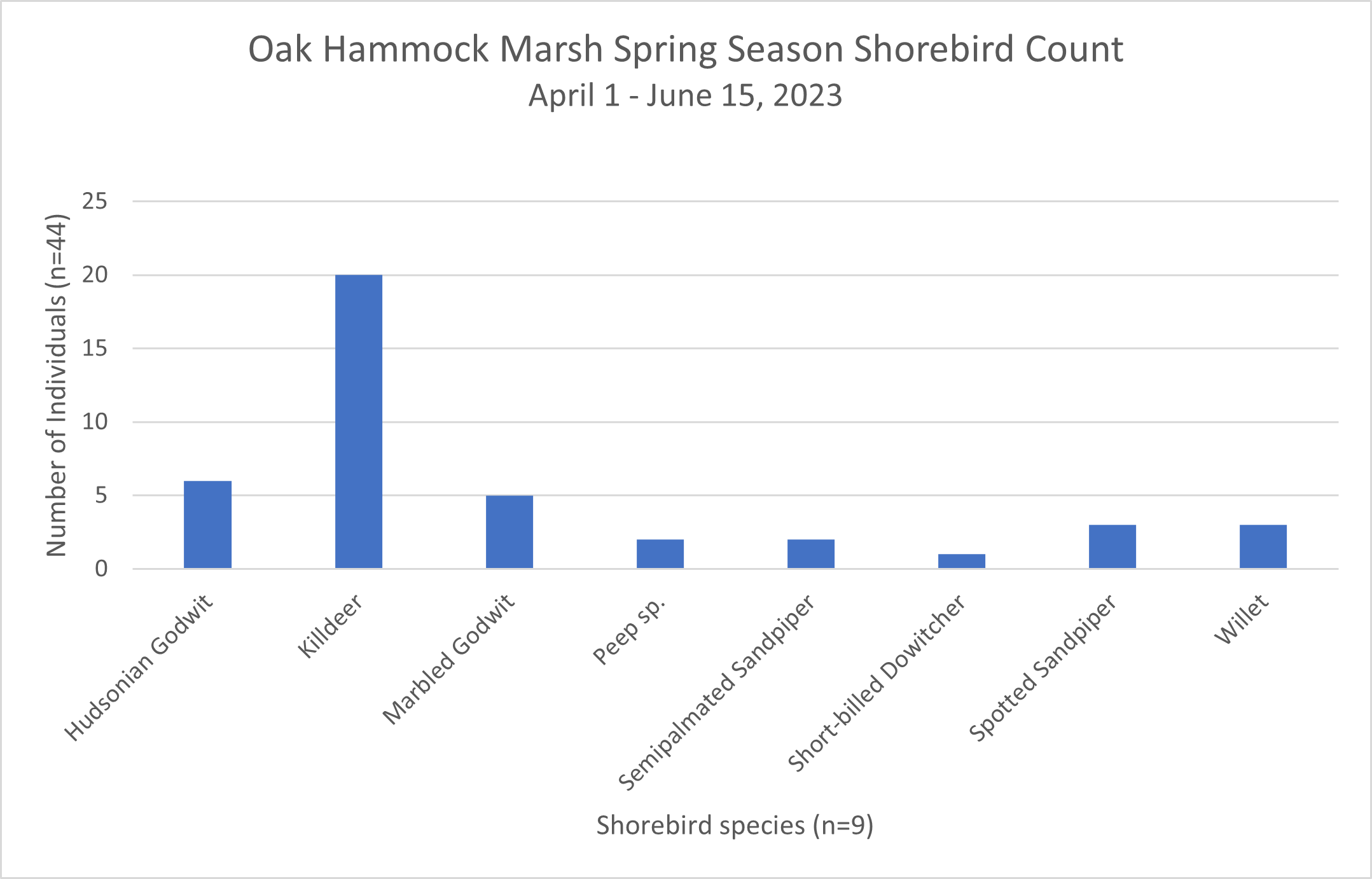
2023 Spring OHM Shorebird Counts
SpeciesTotal # of Individuals Proportion of Individuals (%)
Hudsonian Godwit614
Killdeer2045
Marbled Godwit511
Peep sp.25
Semipalmated Sandpiper25
Short-billed Dowitcher12
Spotted Sandpiper37
Willet37
Wilson’s Snipe25
Total44100
Total Species9
Data based on 12 surveys.

Oak Hammock Marsh was visited a total of four times, with all routes being surveyed each visit. The most numerous shorebird seen was Killdeer. There was one sighting of a Semipalmated Sandpiper, as well as other peeps.

A big thank you to Amanda Shave, Tami Reynolds, Mike Karakas, Tim Poole, Veronica White, and Aynsley Woods for monitoring Oak Hammock Marsh.

Based on the above summaries, it is clear the drier weather and late spring in Manitoba affected the spring ISS monitoring season. All four of the IBAs monitored showed low numbers similar to the last few years, as the past few years have also had weather influences. Like last year, Whitewater Lake had the greatest number of individuals and species, compared to the other IBAs.

Summaries like this one are possible due to the time and effort put in by our volunteers, so a very big thank you goes out again to all who went out and monitored this spring! If you are interested in volunteering for our fall International Shorebird Surveys, we are looking for volunteers. Our fall ISS period runs from July 11th – October 25th, 2023. Email iba@naturemanitoba.ca for more information.


Oak Hammock Marsh Bird Walk

On Saturday June 17th, the Manitoba IBA program led a bird walk at the Oak Hammock Marsh IBA. Our group of 8 met in the parking lot of the Harry J. Enns Interpretive Centre at 10am. Marissa, our coordinator, led our voyage! I (Aynsley) was also there to assist. Before embarking on our journey, we spoke with Paula, Oak Hammock Marsh’s Resident Naturalist and IBA Steering Committee Member. She informed us that the trails were in good condition, and that there is a variety of birds around due to the late migratory season. Our group consisted of a mix of intermediate and beginner birders! With the sun shining and the birds chirping, we set off on our adventure.

Our group scoping out the Shorebird Scrape. Photo by Aynsley Woods.

The walk began along the Killdeer Trail, where we stopped near the dock to look out at the nesting island. Here we saw a few duck species including Blue-winged Teal and Mallard. We also saw a few shorebirds including Spotted Sandpipers and a Killdeer. We continued our walk turning down the Duck Pond Trail. Along this trail we made a few stops pointing out some Clay-coloured Sparrows, a Yellow-headed Blackbird, a Western Meadowlark, some Red-winged Blackbirds, and more!

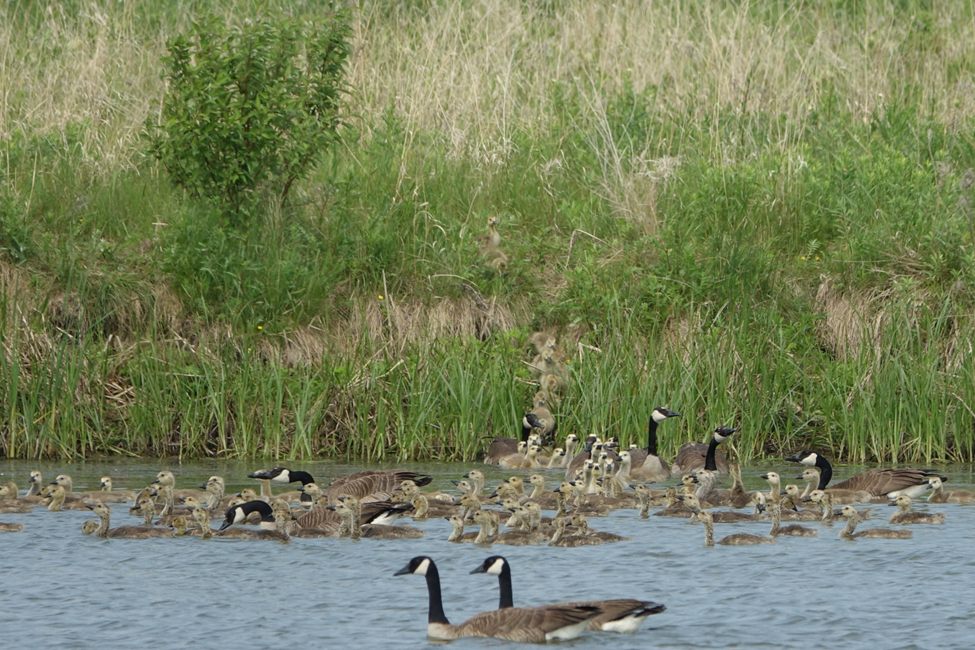
Gosling galore! Photo by Marissa Berard.

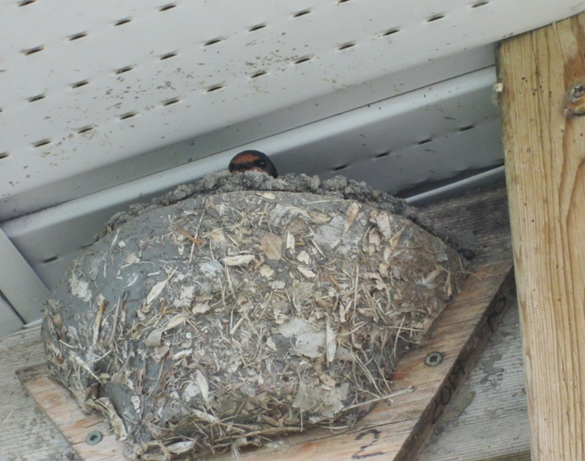
We continued our walk stopping at the scrape. Here we saw some Canada Geese with dozens of fluffy yellow goslings, some nesting Barn Swallows, a pair of Trumpeter Swans, some Lesser Yellowlegs, a Green-winged Teal, and more! The Shorebird Scrape at Oak Hammock Marsh is an important area for shorebirds as well as other birds. It is a shallow depression where water collects and slowly dries over the summer creating prime muddy and shallow water habitat for foraging shorebirds. By having the scrape in the marsh, it allows the area to stay wetter and muddier longer throughout the summer. These areas do require some yearly maintenance to keep down tall vegetation, which is less attractive to shorebirds.

Barn Swallow. Photo by Aynsley Woods.

We turned around and headed down the Harrier Trail. We didn’t see too much down this trail, but we spotted a Clay-coloured Sparrow. Our group continued and decided to take a short break at the benches near the cabin. While sitting and enjoying the beautiful morning, we spent some time observing a very photogenic Tree Swallow.

At this point in the morning, it was beginning to get quite warm out. A few members of our group headed inside to cool off, while the remainder of our group decided to take a walk down the Boardwalk. Along the Boardwalk we heard a Sedge Wren, a Common Yellowthroat, and saw some more Red-winged Blackbirds. We turned around and finished our walk back at the parking lot near the Harry J. Enns Interpretive Centre.

Overall, the weather and trails were awesome and there was a great variety of birds to be seen! A big thank you to everyone who came out! The full checklist of species can be found below:

SpeciesCount
Alder Flycatcher1
American White Pelican8
Bank Swallow5
Barn Swallow15
Blue-winged Teal4
Canada Goose150
Clay-colored Sparrow2
Common Grackle2
Common Yellowthroat4
Eastern Kingbird3
Gadwall2
Green-winged Teal1
Killdeer3
Lesser Yellowlegs3
Mallard1
Marsh Wren 
Northern Shoveler4
Purple Martin3
Redhead1
Red-winged Blackbird15
Sedge Wren1
Spotted Sandpiper2
Tree Swallow2
Trumpeter Swan2
Western Meadowlark1
Yellow-headed Blackbird3
Yellow Warbler2

-Aynsley

2022 Fall International Shorebird Survey Round Up

The Manitoba IBA program has been coordinating annual spring and fall International Shorebird Surveys (ISS) in 4 of our IBAs: Whitewater Lake IBA, Oak/Plum Lakes IBA, Oak Hammock Marsh IBA, and Shoal Lakes IBA. The goal of these surveys is to track trends of global shorebirds long-term. Thanks our incredibly dedicated volunteers and staff, 2022 was another great season surveying for shorebirds across Manitoba! Each year presents its own challenges and unique weather patterns, and 2022 was no different. The high spring water levels carried into the fall, which resulted in flooded fields, ditches, and other areas similar to the spring season. Results of the 2022 ISS Spring roundup can be found here.

We try to visit each route 3 times in the spring season and 3 times in the fall season to count shorebirds in migration. The fall ISS period encompasses July 11th to October 25th, with August 10th – September 10th considered the peak of the survey period. Below you will find the results for the Fall 2022 season. Please note, multiple species are observed during the ISS, but only shorebirds are included in this data.

Whitewater Lake

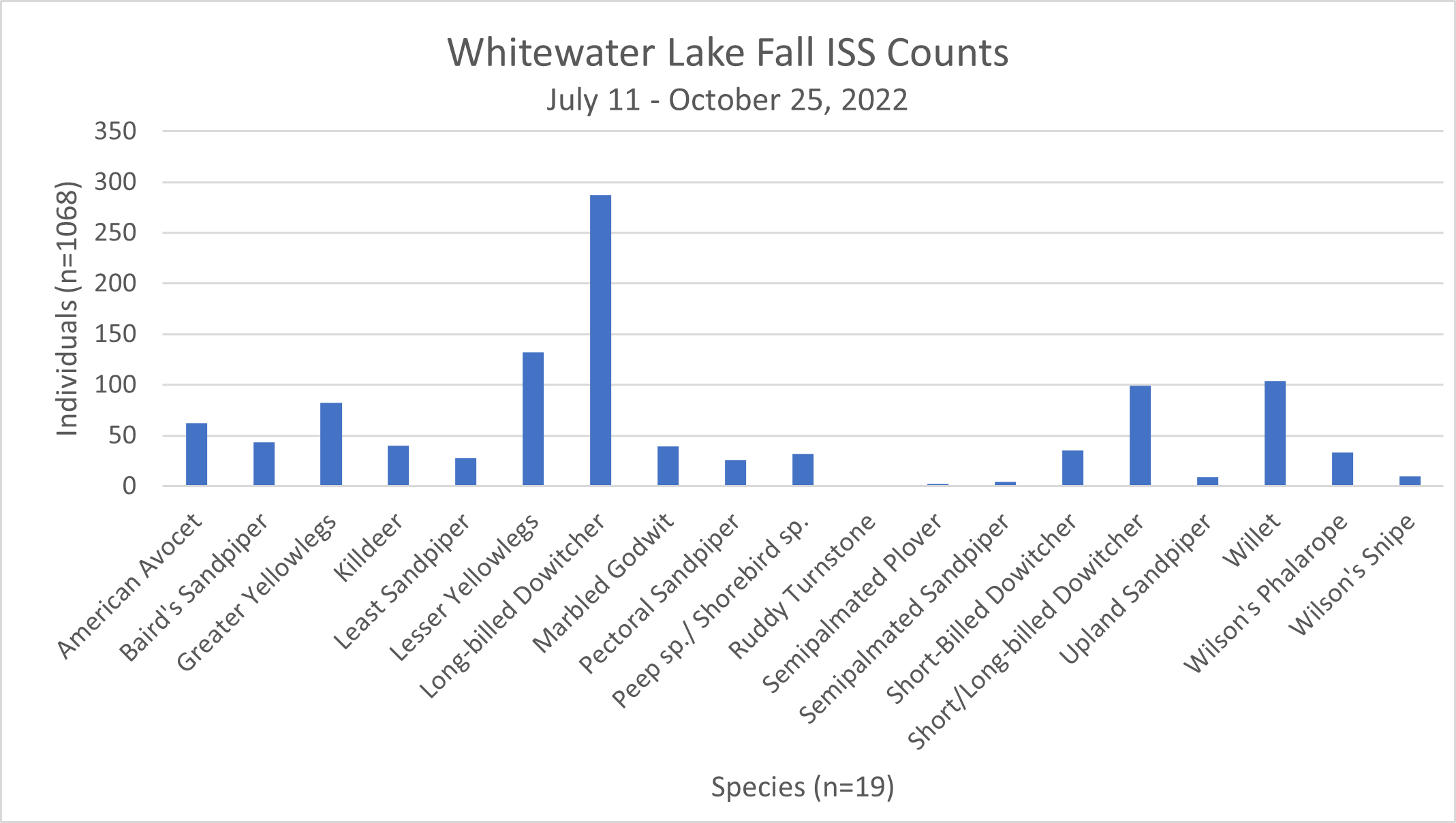
2022 Fall Whitewater Lake Shorebird Counts
SpeciesTotal # of Individuals Proportion of Individuals (%)
American Avocet626
Baird’s Sandpiper434
Greater Yellowlegs828
Killdeer404
Least Sandpiper283
Lesser Yellowlegs13212
Long-billed Dowitcher28727
Marbled Godwit394
Pectoral Sandpiper262
Peep sp./ Shorebird sp.323
Ruddy Turnstone10
Semipalmated Plover20
Semipalmated Sandpiper40
Short-Billed Dowitcher353
Short/Long-billed Dowitcher999
Upland Sandpiper91
Willet10410
Wilson’s Phalarope333
Wilson’s Snipe101
Total1068100
Total # of Species19
Data based on 16 surveys.

Whitewater Lake was surveyed a total of 21 times over the season. On the east side of the lake, routes E1, E2, and E3 were each visited once. Sexton’s point is the only stationary route, and was surveyed 5 times. Switching to the west side of the lake, W1 was surveyed 3 times, W2 surveyed 7 times, and W3 surveyed 4 times. W2 had the highest number of shorebirds observed compared to all other Manitoba ISS routes. A large number (over 100 individuals) of Lesser Yellowlegs, Long-billed Dowitcher, and Willets were each observed at Whitewater Lake during the fall migration.

A big thank you to Gillian Richards, Glennis Lewis, Kathryn Hyndman, Tim Poole and Aynsley Woods for surveying Whitewater Lake!

Oak Lake/Plum Lakes

2022 Fall Oak Lake Shorebird Counts
SpeciesTotal # of Individuals Proportion of Individuals (%)
American Avocet32
Greater Yellowlegs2516
Killdeer2415
Least Sandpiper75
Lesser Yellowlegs2114
Long-billed Dowitcher3523
Pectoral Sandpiper85
Semipalmated Plover11
Solitary Sandpiper11
Spotted Sandpiper53
Upland Sandpiper21
Willet21
Wilson’s Phalarope1610
Wilson’s Snipe53
Total155100
Total # of Species14 
Data based on 8 surveys.

Over the fall season, Oak/Plum Lakes IBA was surveyed a total of 9 times. Routes 3 and 5, both of which are stationary routes, were not surveyed due to flooding and roads being inaccessible. Route 1 was surveyed the most out of all Oak/Plum Lakes routes for a total of 4 times. Route 2 was surveyed twice. Finally, route 4 was surveyed 3 times. One interesting observation was the one Semipalmated Plover individual.

A huge thank you to Glennis Lewis, Ward Christianson, Marlene Christianson, and Gillian Richards for surveying these routes!

Shoal Lakes

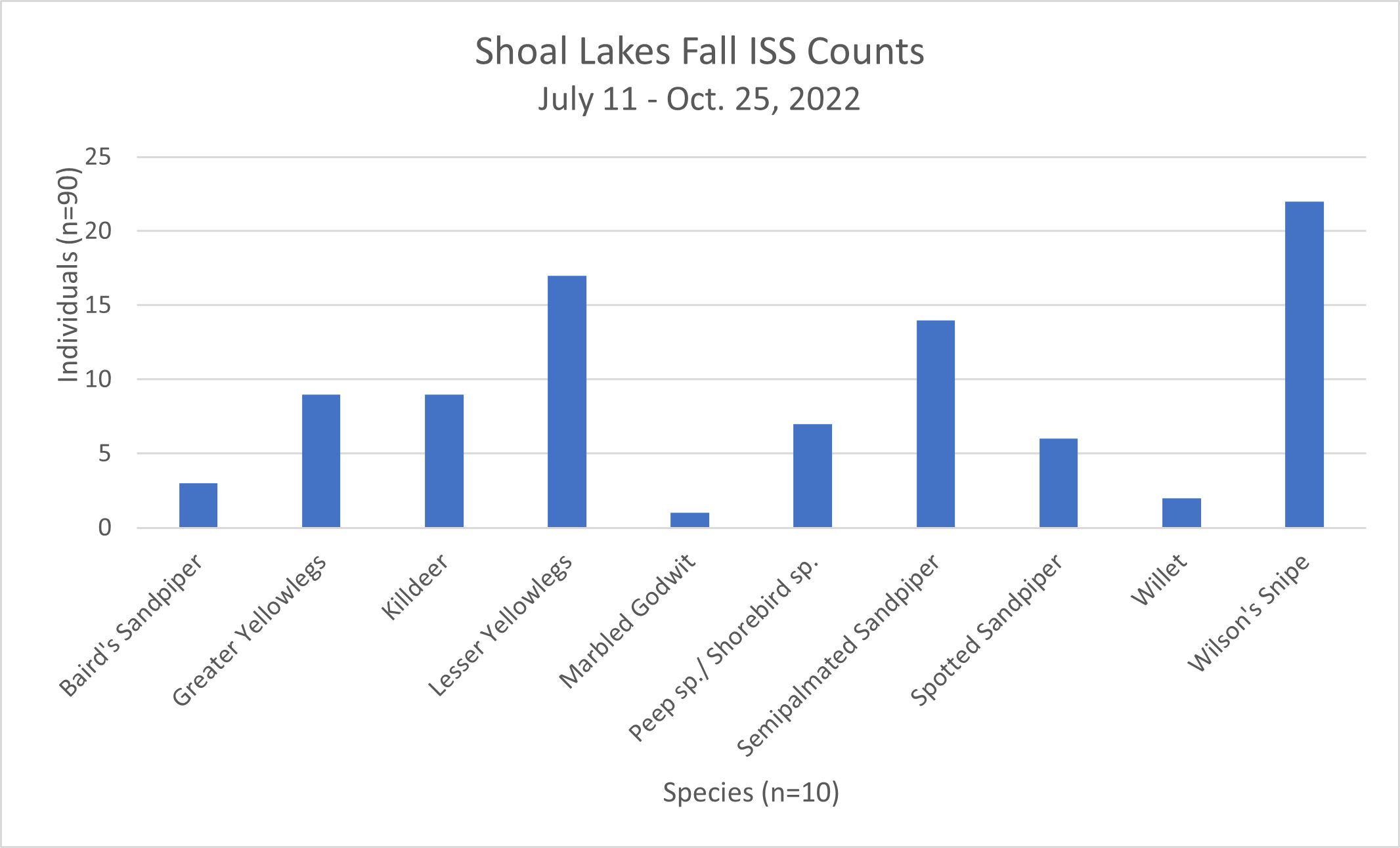
2022 Fall Shoal Lakes Shorebird Counts
SpeciesTotal # of Individuals Proportion of Individuals (%)
Baird’s Sandpiper33
Greater Yellowlegs910
Killdeer910
Lesser Yellowlegs1719
Marbled Godwit11
Peep sp./ Shorebird sp.78
Semipalmated Sandpiper1416
Spotted Sandpiper67
Willet22
Wilson’s Snipe2224
Total90100
Total # of Species10
Data based on 7 surveys.

The North, East, West Shoal Lakes IBA was surveyed a total of 15 times over the fall season. Route 1 and the campground (stationary route) were each surveyed 3 times. Routes 2 and 3 were surveyed twice. Route 4 was surveyed 5 times. Shoal Lakes had the lowest number of observed shorebirds compared to the other Manitoba ISS sites.

An enormous thank you to Bonnie Chartier, Tami Reynolds, Cam Nikkel and Tim Poole for surveying these routes!

Oak Hammock Marsh

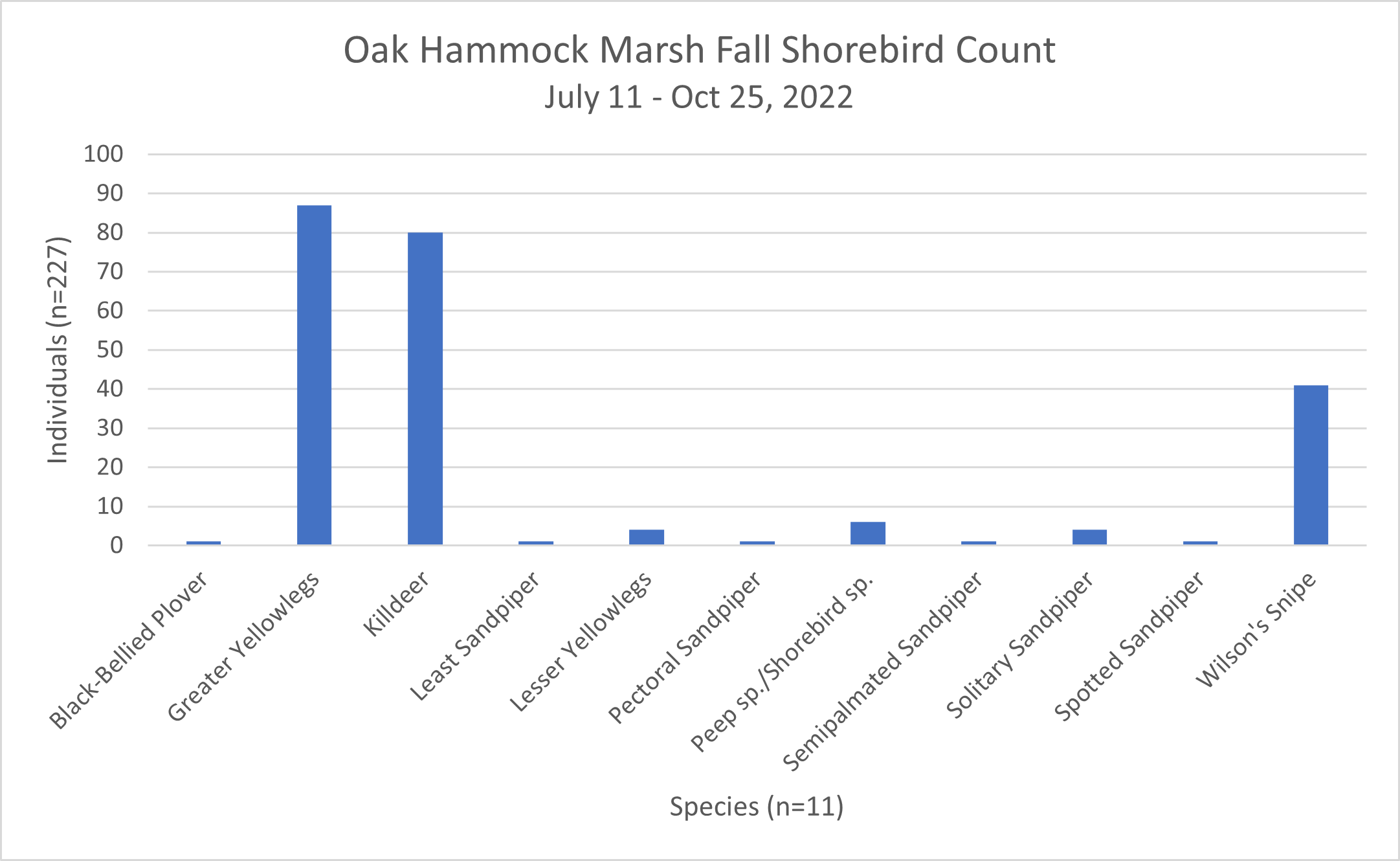
2022 Fall OHM Shorebird Counts
SpeciesTotal # of Individuals Proportion of Individuals (%)
Black-Bellied Plover10
Greater Yellowlegs8738
Killdeer8035
Least Sandpiper10
Lesser Yellowlegs42
Pectoral Sandpiper10
Peep sp./Shorebird sp.63
Semipalmated Sandpiper10
Solitary Sandpiper42
Spotted Sandpiper10
Wilson’s Snipe4118
Total227100
Total # of Species11
Data based on 10 surveys.

Over the fall season, Oak Hammock Marsh was surveyed a total of 14 times. Route 3 was surveyed once due to the high-water levels and road conditions from the spring. Route 1 was surveyed 6 times. Route 2 was surveyed 7 times. The most numerous species found here were Greater Yellowlegs and Killdeer.

A huge thank you to Bonnie Chartier, Tami Reynolds, Mike Karakas, Peter Douglas, and Tim Poole for surveying Oak Hammock Marsh!

Round Up

As mentioned in the summaries above, the Manitoba 2022 International Shorebird Surveys were affected by weather conditions. High water levels and road blockages affected accessibility as well as the quality of habitat for the shorebirds. Compared to 2021, the fall 2022 monitoring data shows a decrease in observed individuals at Whitewater Lake.

Once again, a big thank you to all our volunteers this year! This important data could not be gathered without your help.  

If you are interested in volunteering for our 2023 International Shorebird Surveys, we are always looking for volunteers! Email iba@naturemanitoba.ca for more information.

-Aynsley Woods

Introducing program assistant, Aynsley Woods

March 8th marks International Women’s Day, and what a perfect time to introduce and celebrate Aynsley Woods! Aynsley has been working as the Manitoba IBA program assistant over the winter months. Aynsley put together a little introduction post – keep reading to learn more about her.

Hi! My name is Aynsley Woods (she/her). I am the new program assistant for MB IBA. I am currently in my final year of my bachelor’s degree in Evolution and Biodiversity at the University of Manitoba. My focus is on the behaviour of migratory species. I would like to focus on shorebirds, as they tug at my heart strings, but I am also open to all other species and organisms including insects and fungi! My family owns a cottage in Nopiming Park, where I try to spend my free time when I’m not studying or working. I was very fortunate this past summer to work with the Fish and Wildlife Branch of the province, and survey many species including Western Grebes, Spotted Sandpipers, Trumpeter Swans, and Red-headed Woodpeckers. I worked closely with Tim Poole on Chimney Swift monitoring and was also involved in goose banding.  

I have been working very closely with the Program Coordinator, Marissa. I am very excited to be part of the MB IBA program, and to learn more about birds and conservation outreach programs regarding birds! This is a wonderful opportunity as I have a great love of birds and wildlife in general. I’ve always loved the idea of getting more people involved in conservation and being aware of the fascinating world around us!

Hello, from the new coordinator!

Hello! My name is Marissa Berard (she/her), and I am the new coordinator for the Manitoba Important Bird Areas (IBA) Program. These are certainly big shoes to fill – Amanda contributed so much to this program and will certainly be missed! I love birds a lot, and feel very lucky to have the opportunity to be a part of this program and work alongside so many incredible volunteers. I am excited to not only keep learning about birds (truly a lifelong learning journey), but also to contribute to conserving important bird habitat through stewardship activities and outreach. 

I have been involved in the bird world for a while, both in terms of monitoring and public outreach. While working on my honours thesis (which focused on Atlantic cod) with Dr. Gail Davoren at the University of Manitoba, I was fortunate to spend two summers in Newfoundland and help out with a variety of seabird research, including with puffins, razorbills and common murres.

Puffins on a seabird island in Newfoundland (Photo by Marissa Berard).

After graduating, I worked at an environmental consulting company doing a variety of species at risk and avian monitoring including golden-winged warbler and grassland bird surveys. I then moved to Riding Mountain National Park to work with Parks Canada, first as an interpreter and then in the Resource Conservation department where I worked primarily with species at risk including Chimney Swifts and Red-headed Woodpeckers. Living near Riding Mountain has allowed me to spend a lot of time around the Proven Lake IBA, exploring the area both on foot and from a canoe.

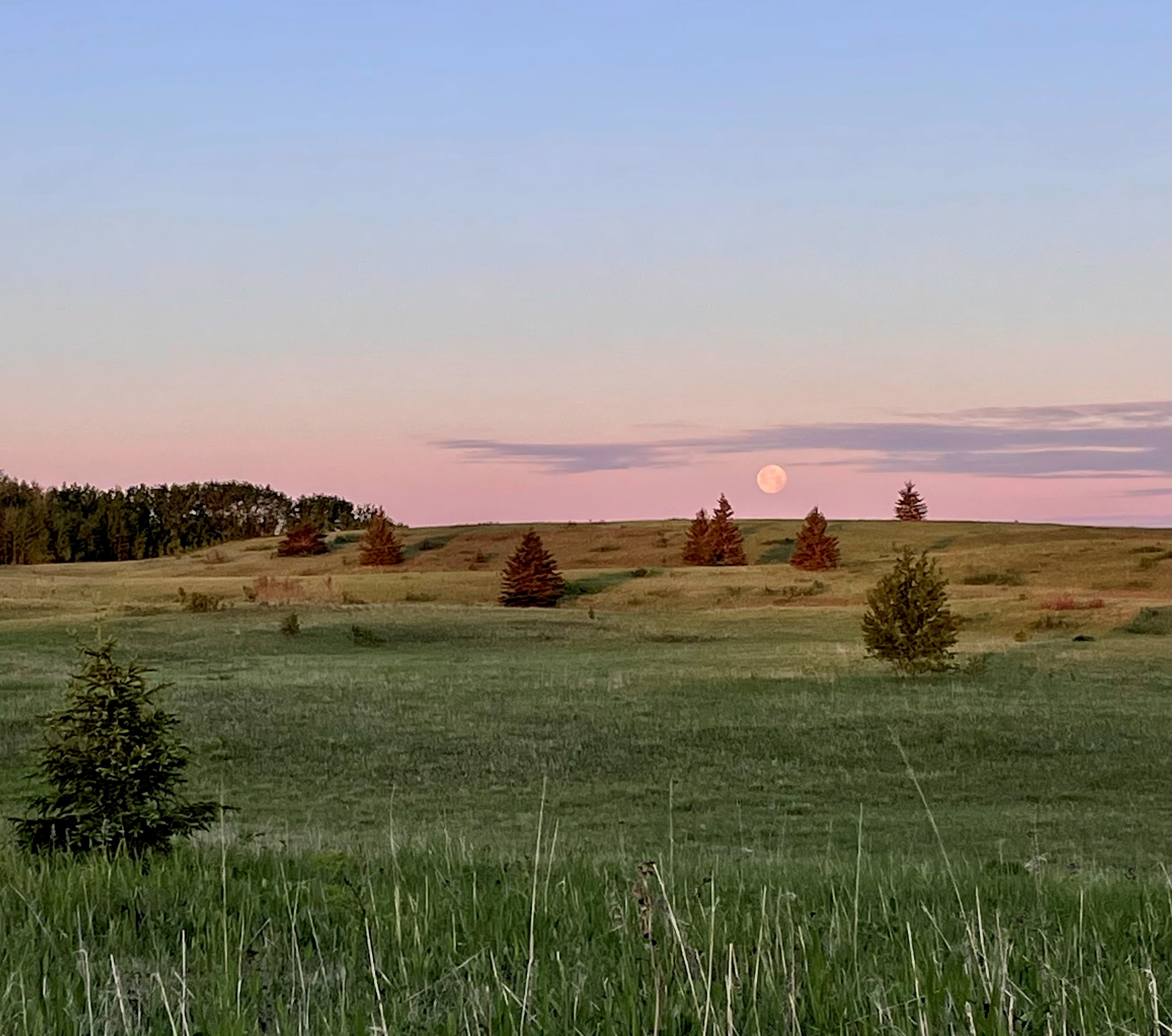
The strawberry moon during an early morning June breeding bird survey (Photo by Marissa Berard).

While I absolutely love field work, I am also passionate about the outreach side of things. I love to give bird identification workshops and have done some volunteering with the FortWhyte Alive Birding & Breakfast program. One of the things I love about birding is that in many ways, it is a very accessible activity. Whether you are in downtown Winnipeg or out in the forest, there are birds around. I would love to create more opportunities for a variety of folks to get involved with the IBA program, and birding in general.  

As I recently shared on the MCSI website, my favourite bird of all-time (though my family and friends would argue that I have several of these), remains the black-capped chickadee. Though a common occurrence, I love the chickadee’s lively heartiness and deeply appreciate their perpetual presence on my cross-country ski outings during our long Manitoba winters, even on the coldest of days. 

A few other non-bird related things about me… In my spare time I love to hike and cross-country ski, do beadwork, play instruments and watch live music. My first language is French, and I am a proud Red River Métis with family ties to Saint-Boniface, Saint-Vital, and several other communities surrounding what is now Winnipeg.

I am very excited to be in this role and cannot wait to meet all of you!

Marissa

Upcoming volunteer opportunities!

We’ve got some exciting volunteer opportunities coming up! All experience levels welcome.

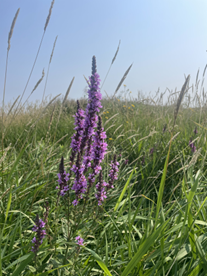
Purple Loosestrife Pull – Oak Hammock Marsh IBA

Come help protect valuable wetland and shorebird habitat! On Monday, Sept 5th we will be heading to Oak Hammock Marsh to remove invasive purple loosestrife. We will be meeting in the parking lot by the Discovery Centre at 10:00am and will head to the stand as a group. After the loosestrife pull, we will head over to the café for lunch. To sign up or for more information, email iba@naturemanitoba.ca.

Red-headed Woodpecker Blitz – Kinosota-Leifur IBA

On Saturday, September 10th, we will be blitzing the Kinosota-Leifur IBA in search of Red-headed Woodpeckers. We will begin at 8:00 am, and will meet up afterwards for a complimentary picnic lunch. All experience levels welcome. Carpooling from Brandon or Winnipeg may be able to be arranged. To sign up or for more information, email iba@naturemanitoba.ca.

Oak Lake Red-headed Woodpecker Blitz

On July 23rd, Manitoba IBA held a second Red-headed Woodpecker blitz for the month of July. Using predetermined birding areas and routes with past sightings marked, four groups headed down to the Oak Lake/ Plum Lakes IBA on what turned out to be a sunny and not too hot Saturday.

A Red-headed Woodpecker (Photo by Ariel Desrochers)

This was our first blitz down in Oak Lake for Red-headed Woodpeckers this year. Luckily we were able to do a blitz last summer in August, which provided us with a guide to areas in the IBA that may have the Woodpecker. We had eight people split into pairs to make up 4 groups, which meant we could cover a larger area of the IBA. Below is the overview of the routes explored during the blitz. The protocol for exploratory Red-headed Woodpecker surveys allows for responsible use of playback of their call, as long as the birder has a permit.

Not shown on the map is Group 4, made up of Amanda and Duane, who birded North of the No. 1 HWY which is an area that we have only briefly previously explored.

Possible Red-headed Woodpecker habitat north of the TransCanada. Unfortunately no Red-headed Woodpeckers were seen in this patch. (photo by Amanda Shave)

Group 1 was made up of Glennis and Sandy. During the blitz, they did not observe any Red-headed Woodpeckers. Once the event was over, they continued to bird and eventually came across one individual, so every group that day saw at least one at some point in the day. Exciting sightings for Group 1 included three Turkey Vultures, one Bobolink (a threatened species), and five Lark Sparrows.

Group 2 was made up of Gillian and Kathryn. Throughout the course of the event, they observed five Red-headed Woodpeckers. In addition to the woodpeckers, they identified a number of other species including some that were not identified by any other group. This includes a Wild Turkey and a White-faced Ibis. They also identified species such as an Eastern Wood Pee-wee, two Vesper Sparrows and Americans Goldfinches.

Group 3 was Wally and I (Ariel). We birded north of the Lake, starting on PR. 254. During our surveys, we saw a lot of suitable habitat for Red-headed Woodpeckers (fields with sparse standing dead trees) that turned up no sightings, including an area that had sightings the previous year. In the first hour or so, we were pleased to see a variety of waterfowl and some birds of prey. Eventually we managed to identify a Red-headed Woodpecker by its call after using our speaker to playback their sound. After that we managed to identify a few more for a total of seven for the day. Other Interesting birds we spotted that morning were a group of about 100 Franklins Gulls, Pied-billed Grebes, two Baltimore Orioles, and various birds of prey including, Red-tailed Hawks, Swainson’s Hawk and a Northern Harrier. We were also we fortunate enough to actually see a Sora, strutting across the road (most often Sora are identified by their distinctive “whinny” call, rather than seen).

A male Bobolink (Photo by Ariel Desrochers)

Group 4 was made up of Duane and Amanda. While birding a less visited area of the IBA, they observed a wide variety of birds. Last year Glennis explored this area during out 2021 Red-headed Woodpecker Blitz. She noted some good habitat, but had no luck seeing individuals. Duane and Amanda came across several of the good habitat areas pointed out by Glennis this year. It was only going down a two-track dirt and grass road (thanks to Duane’s truck!) that we were able to get a Red-headed Woodpecker sighting! This is a first for our IBA blitzes in this area, and we will have to keep searching in this area for upcoming blitzes as well. Some of their other interesting sightings include Cedar Waxwings, one Common Merganser, many Yellow-bellied Sapsuckers including recently fledged young (which they thought would be their only woodpecker species of the day for most of the survey time), an Orchard Oriole, and a Brown Thrasher.

A great shot of a Red-headed Woodpecker by Duane Diehl
Two Black Terns (Photo by Ariel Desrochers)
Refueling after the blitz, and trying on our snazzy Manitoba IBA hats (Photo by Amanda Shave)

Around noon, the groups met up at the Oak Lake marina for a snack and to share our sightings for the day. We had a total of 13 Redheaded Woodpeckers seen during the blitz. Around 1:00 pm, we set off back to Winnipeg while Groups 1 and 2 continued to bird for fun (and to try and find more Red-headed Woodpeckers). A summary of all the species identified can be found below. We saw a total of 82 species (plus woodpecker sp. and sparrow sp.) and a total of 1,023 individuals. Thank you to our Duane Diehl, Gillian Richards, Kathryn Hyndman, Glennis Lewis, Sandy Hominick and Wally Jansen for making the drive down and blitzing with Amanda and I!

Species Number of Individuals
American Coot4
American Crow16
American Goldfinch 25
American Kestrel10
American Robin17
American White Pelican 24
Baltimore Oriole4
Barn Swallow29
Black Tern55
Black-billed Magpie15
Black-capped Chickadee4
Blue Jay6
Blue-winged Teal7
Bobolink13
Brewer’s Blackbird10
Brown Thrasher2
Brown-headed Cowbird2
Canada Goose1
Canvasback2
Cedar Waxwing18
Chipping Sparrow1
Clay-colored Sparrow11
Cliff Swallow1
Common Grackle20
Common Merganser1
Common Raven10
Common Yellowthroat 6
Eastern Bluebird1
Eastern Kingbird32
Eastern Wood-Pewee1
European Starling1
Forster’s Tern2
Franklin’s Gull115
Gadwall9
Gray Catbird4
Great Blue Heron1
Horned Lark1
House Sparrow10
House Wren 31
Killdeer4
Lark Sparrow13
Least Flycatcher 14
Lesser Scaup7
Mallard63
Marbled Godwit 2
Marsh Wren 1
Merlin1
Mourning Dove37
Nelson’s Sparrow1
Northern Flicker11
Northern Harrier2
Northern Shoveler1
Northern Waterthrush 1
Orchard Oriole 1
Pied-billed Grebe 6
Purple Martin1
Red-eyed Vireo 2
Redhead1
Red-headed Woodpecker13
Red-necked Grebe2
Red-tailed Hawk6
Red-winged Blackbird94
Ring-billed Gull2
Ring-necked Duck1
Rock Pigeon 4
Ruddy Duck3
Savannah Sparrow12
Sedge Wren 3
Song Sparrow21
Sora10
Sparrow sp. 34
Swainson’s Hawk2
Tree Swallow27
Turkey Vulture26
Vesper Sparrow3
Western Kingbird5
Western Meadowlark29
White-faced Ibis1
Wild Turkey 2
Wilson’s Snipe9
Woodpecker sp. 1
Yellow Warbler9
Yellow-bellied Sapsucker10
Yellow-headed Blackbird5
Total Number of Individuals 1,023

Spring 2022 International Shorebird Survey Roundup

This spring, volunteers and the staff of Manitoba IBA headed out to once again conduct International Shorebird Surveys at four IBAs: Oak Hammock Marsh; the North, East and West Shoal Lakes; Oak/Plum Lakes; and Whitewater Lake. Last year, dry weather altered the preferred habitat of shorebirds and this year was the same, although instead of dried up wetlands and ditches, flooded fields and higher water levels were the norm, creating an interesting survey period.

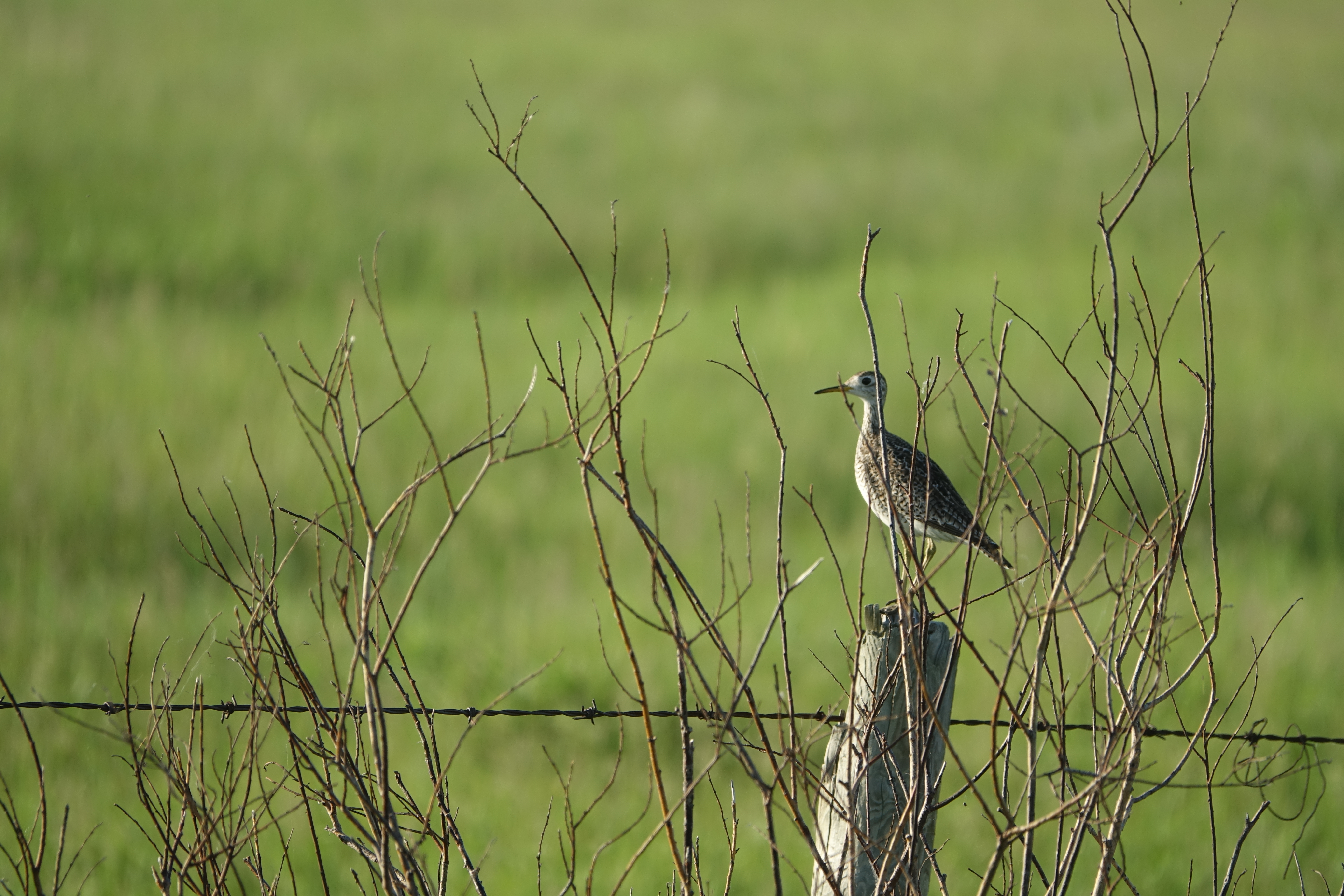
An Upland Sandpiper (Photo by Amanda Shave)

The Spring International Shorebird Surveys (ISS) are conducted between April 1st and June 15th with the peak of the season occurring between April 24th and May 16th. Using our protocol (adapted from the ISS Protocol from Manomet), four IBAs are surveyed, with a number of routes to cover. Whitewater Lake has 4 routes on the east side of the lake, 3 on the west side and one stationary route. Oak Lake has 5 routes, 2 of which are stationary. Oak Hammock Marsh has 3 routes, although one was not assessable this year due to high water levels. Finally, the North, East and West Shoal Lakes has 4 routes. Each route at each location is normally monitored three times in the spring. While all species observed should be recorded under ISS protocol lists, only shorebirds are included in the data. Some surveys that were completed for ISS did not contain any shorebird sightings, so while a site may have been monitored a number of times, the surveys with actual shorebird sightings may be less. All four locations are summarized below:

Oak Hammock Marsh

Species Total # of Individuals Proportion (%) of Individuals
Killdeer23
Marbled Godwit610
Willet 812.90
Wilson’s Phalarope4674.19
Total 62100
Total # of Species4
Based on 6 surveys

The results from Oak hammock Marsh show us the contrast between this spring and last spring. This year, only four species were identified during the ISS period. The number of individuals amongst those species is also much lower than spring 2021.

Route 1 and Route 2 were surveyed once during this period and the shorebird scrape was monitored twice. Route 3, the Teal Dike, became flooded and collapsed so it was not assessable to monitor. Overall the high water levels would most likely have affected the habitat for shorebirds, thus the lower numbers.

West, East and North Shoal Lakes

SpeciesTotal # of IndividualsProportion (%) of Individuals
American Avocet1222
Greater Yellowlegs 24
Killdeer1324
Shorebird sp. 47
Lesser Yellowlegs12
Marbled Godwit 59
Spotted Sandpiper11.82
Whimbrel 610.91
Willet 712.73
Wilson’s Phalarope47.27
Total 55100
Total # of Species 10
Based on 10 Surveys

Shoal Lakes was surveyed 14 times over the spring ISS period. It is important to note that multiple routes can be surveyed on one day. Route 1 was surveyed five times, route 2 was surveyed twice, route 3 was surveyed once, route 4 was surveyed five times and the stationary “Campground” point was surveyed three times.

Oak/Plum Lakes

SpeciesTotal # of IndividualsProportion (%) of Individuals
American Avocet23
Killdeer1723
Least Sandpiper11
Marbled Godwit 45
Pectoral Sandpiper11
Spotted Sandpiper1013.33
Willet912
Wilson’s Phalarope3040
Wilson’s Snipe11.33
Total75100
Total # of Species9
Based on 6 surveys

Oak Lake has rive shorebird routes, including two that are stationary (route 3 and 5). Of these routes, route 1 was surveyed twice, route 2 was surveyed twice, route 3 and route 4 were surveyed once. Flooding over a low spot in the access road meant that Route 5 (a small wetland), was not able to be surveyed. In total, volunteers visited the IBA to surveyed six times.

Whitewater Lake

SpeciesTotal # of Individuals Proportion (%) of Individuals
American Avocet333
Baird’s Sandpiper374
Dunlin61
Greater Yellowlegs 10
Hudsonian Godwit 152
Killdeer141.47
Least Sandpiper30.31
Lesser Yellowlegs 232.41
Marbled Godwit 50.52
Pectoral Sandpiper151.57
Peep sp. 666.92
Red Necked Phalarope 31533.02
Ruddy Turnstone30.31
Sanderling40.42
Semipalmated Sandpiper 16617.40
Shorebird sp. 101.05
Short-billed Dowitcher10.10
Spotted Sandpiper30.31
White-rumped Sandpiper17618.45
Stilt Sandpiper70.73
Willet151.57
Wilson’s Phalarope353.67
Wilson’s Snipe10.10
Total954100
Total # of Species23
Based on 10 Surveys

Whitewater Lake was visited by volunteers to survey 14 times in total. Sexton’s point, the only stationary route, was surveyed three times. On the west side of the Lake, route W1 was surveyed three times, route W2 was surveyed six times and route W3 was surveyed twice. On the east side of the lake, each route was monitored once due to wet conditions and dirt roads.

Based on these summaries, it is clear that the wet weather Manitoba has experienced this spring affected the ISS monitoring season. All four IBAs showed numbers inconsistent with previous years and there was much less variety in the shorebird species observed. Like last year, Whitewater Lake had the highest counts for shorebirds of the four IBAs but the number was greatly reduced. We have several hypothesis as to why this might be, but of course we do not know for certain. Perhaps it is possible that migratory shorebirds were simply staying in areas where it was less wet, possibly areas across the border in Saskatchewan, as the IBAs all had much higher water levels that the previous year. Or if the shorebirds were in Manitoba, perhaps they were spread over the higher-than-normal number of ephemeral (temporary) wetlands spread across the landscape this year, instead of clustering at our usual shorebird “hotspots”. If weather is indeed influencing numbers of shorebirds, It will be interesting to see what the Fall ISS period brings, and then next spring.

Another thing to consider is volunteer “effort”. Of course our volunteers put in a lot of effort to go out and count shorebirds, but effort also has a meaning scientifically as well. Ideally when comparing between years we want to amount of effort to be standardized as much as possible. For example, going out to survey for 5 hours on three different mornings (15 hours of “effort”) will likely net you more birds than surveying for five hours on one morning (5 hours of “effort”). Our big disruptor of effort this year was the residual snow late into the spring, wet road conditions (on dirt roads), and/or collapsed dikes. While trying to survey each route three times in the spring is important, volunteer safety and safe route access is more important.

Once again, summaries like this are possible because of the time and effort of volunteers, so thank you to everyone who went out and monitored this spring! A big thank you to Glennis Lewis, Tim Poole and Ansley Woods for surveying at Oak Lake; Gillian Richards for surveying at Oak Lake and Whitewater Lake, Duane Diehl and Tom and Renee Will for surveying at Whitewater Lake; Bonnie Chartier, Mike Karakas, Tami Reynolds for surveying at Oak Hammock Marsh and the Shoal Lakes; and Jo Swartz and Jan Bradley for surveying at the Shoal Lakes.

If you are interested in volunteering for our fall International Shorebird Surveys, we are looking for volunteers! Believe it or not, we are already in the fall ISS survey period, which runs until October 25th, 2022. Email iba@naturemanitoba.ca for more information.

-Ariel

What’s in a name? The Red-headed Woodpecker

On July 9th we headed out to the North, East and West Shoal Lakes to blitz for the Red-headed Woodpecker. Red-headed Woodpeckers were seen by all and a great lunch was eaten afterwards with friends – couldn’t ask for a better day!

We last ran a blitz for Red-headed Woodpeckers in the North, East and West Shoal Lakes IBA in 2020, which was coincidently the first blitz we ran after COVID-19 had started. In 2021 we established Red-headed Woodpecker survey routes, but were unable to run an event to trial them due to COVID once again! The routes were instead trialed by volunteers who went out birding singly or with people from their “bubbles”. This year we finally were able to run the survey routes as intended at Shoal Lakes and they seemed to work quite well. Of course, when we run a bird blitz we record all species that we see, so in addition to photos of the very charismatic Red-headed Woodpecker we also have many other beautiful birds to document in this blog.

As some of you already know the Red-headed Woodpecker is an Endangered species under the federal Species at Risk Act and a Threatened species under our provincial act – which is why we were out to try and gather populations numbers within this IBA. Since the same survey routes were run last year (following the same methods), the intention is to be able to compare numbers between years to see if there is an increase, a decrease, or if they stay the same in this local area.

With the Red-headed Woodpecker survey, volunteers drove along a pre-set 20 km route, stopping in areas of good habitat for this species. Good Red-headed Woodpecker habitat includes open areas with little understory vegetation, with standing dead trees (called snags). Common places for habitat in the Shoal Lakes IBA tends to be woodlots or cattle pastures with a mix of living aspen, and snags. Cattle grazing and/or mowing keeps the understory short. Once beside good habitat volunteers first looked and listened for Red-headed Woodpeckers for two minutes. If nothing was seen they then conducted playback (playing the territorial “querr” or “tchur” call to attract the woodpeckers) for 30 seconds before looking and listening for another two minutes. The coordinates of all Red-headed Woodpeckers seen or heard were recorded. To ensure we were not double counting individuals, we stopped every 300m in good habitat.

An example of good Red-headed Woodpecker habitat. Photo by Amanda Shave.

Group 1 consisted of our fantastic husband and wife duo of Katharine and John Schulz, as well as Al Mickey. Al was one of our Red-headed Woodpecker survey route testers in 2021, so he knew all about our methods. They covered the western side of the Shoal Lakes. Unfortunately, this group was the least successful with the Red-headed Woodpeckers, with one individual spotted. That being said, they still saw a total of 50 species, so the west side of Shoal Lakes was still hopping with birds! Of particular note was a group of eight Great Egrets that were spotted roosting in a tree. While we often see egrets and herons foraging in wetlands and waterbodies, they actually nest and roost in trees. So next time you are on the lookout for this group of birds, perhaps look up! They also recorded two Barn Swallows, another Species at Risk.

Great Egret in a tree. Photo by Katharine Schulz.
Common Goldeye with young. Photo by Katharine Schulz.

Group 2 consisted of Nelson, Jody and Paul and they covered the Red-headed Woodpecker route at the south end of the Shoal Lakes IBA. This group observed two pairs of Red-headed Woodpeckers (four individuals total) during their survey. For other Species at Risk, this group also counted four Barn Swallows. Not to be left behind on Group 1’s Great Egret sightings, Group 2 had 17 Great Egrets – the North, East and West Shoal Lakes is a “great” place to spot them! Group 2 also recorded a Great-crested Flycatcher, a couple of Brown Thrashers and an Orchard Oriole, all species less commonly reported birds for this IBA. This was also the first IBA blitz for all three group members, so a big welcome to all three and I am glad they had such a great variety of sightings.

Male Common Yellowthroat. Photo by Katharine Schulz.

Group 3 consisted of Garry Budyk and Rudolf Koes. They had specifically asked to be in the northwest corner of the IBA – their traditional Shoal Lakes blitz area! Garry and Rudolf saw five Red-headed Woodpeckers on their official survey route and three woodpeckers outside of their survey route (but still in their assigned blitz area). Two of the woodpeckers were drumming (usually a territorial behaviour) one woodpecker was carrying food – mostly likely to bring back to the nest for the next generation of Red-headed Woodpeckers, and another two were seen using a cavity.

Red-headed Woodpecker on a fence post (the post was a tree in it’s former life, right?) Photo by Garry Budyk.

Garry and Rudolf saw a number of other bird species of course including a variety of waterfowl (Green-wing Teal, Redhead, Canvasback, Ring-necked Duck, Lesser Scaup, Bufflehead, Hooded Merganser and Ruddy Duck). They also saw several species of grebes including the Pie-billed Grebe, Red-necked Grebe and Western Grebe. Grebes were not our focus on this blitz, but we have conducted blitzes for Western Grebes at the Shoal Lakes IBA in the past. A few other Species at Risk were also noted including 11 Barn Swallows, two Bobolink, and a Least Bittern. Other notable species included one Brown Thrasher, one Chestnut-sided Warbler, two Nelson’s Sparrows, three Great-Crested Flycatchers and 48 Black Terns.

Least Bittern peeking out from the reeds. Photo by Rudolf Koes.
Young grebe. Photo by Garry Budyk.

Finally we have Group 4, which birded along the east side of the Shoal Lakes. This group consisted of myself (Amanda) and three new birders to the IBA Program, Amrita, Sukh and Karen. It was their first time out for an IBA event, so a big welcome to Amrita, Sukh and Karen as well! During out Red-headed Woodpecker survey we had two sets of pairs seen. One pair was tracked down heading into a nest cavity. With the frequency of entries and exits it seemed like the pair was feeding young.

Parental exchange between a pair of nesting Red-headed Woodpeckers. The active cavity can be seen on the same tree as the perching individual. Photo by Amanda Shave.

While transiting from one area of good woodpecker habitat to the next, we passed between the Shoal Lakes on Provincial Road 415. Here we came across several species of marsh birds including a cluster of approximately 56 Forster’s Terns all foraging in the same wetland pond area, three Great Egrets, and a variety of waterfowl such as Blue-winged Teal, Green-Winged Teal, Ruddy Ducks, Red-necked Grebes, Western Grebes and more. Nearby a wet meadow our driving also alerted a pair of Marbled Godwit and Killdeer who were probably nesting in the area based on their behaviour. In the same area we also recorded a male Bobolink sitting on the powerlines.

Forster’s Tern taking a break from foraging. Photo by Amanda Shave.

After finishing our Red-headed Woodpecker route, we had a bit of time before we needed to meet up for lunch, and we were able to get two more pairs of Red-headed Woodpeckers outside of our formal survey area. Group 4 had a total of nine Red-headed Woodpeckers.

Another former-tree providing perching habitat for one half of a Red-headed Woodpecker pair. Photo by Amanda Shave.

At noon we all met in Inwood for lunch at Rosie’s Cafe and a debrief! It was a busy morning with a total of 23 Red-headed Woodpeckers seen! This exceeds the IBA threshold of 14 Red-headed Woodpeckers (1% of the Canada-wide population for this species) once again this year. The high concentration of Red-headed Woodpeckers in this IBA continues to indicate the important habitat that exists in this area of the province for this Endangered Species. In total we saw 2552 individual birds, made of of 103 species. Thank you to all of the volunteers who came out to blitz the North, East and West Shoal Lakes!

SpeciesCount
American Bittern4
American Coot14
American Crow30
American Goldfinch 26
American Kestrel22
American Redstart 4
American Robin19
American White Pelican 10
American Wigeon2
Bald Eagle5
Baltimore Oriole11
Barn Swallow9
Barn Swallow11
Black Tern109
Black-and-white Warbler1
Black-billed Magpie 19
Black-capped Chickadee3
Black-crowned Night-Heron1
Blue Jay2
Blue-winged Teal22
Bobolink 6
Brewer’s Blackbird15
Broad-winged Hawk1
Brown Thrasher 4
Brown-headed Cowbird46
Bufflehead1
Canada Goose 5
Canvasback2
Cedar Waxwing8
Chestnut-sided Warbler1
Chipping Sparrow3
Clay-colored Sparrow89
Common Goldeneye1
Common Grackle 76
Common Raven 19
Common Yellowthroat 107
Cooper’s Hawk1
Double-crested Cormorant 1
Downey Woodpecker1
Eastern Kingbird30
European Starling40
Forster’s Tern67
Franklin’s Gull51
Gadwall 11
Gray Catbird17
Great Blue Heron5
Great Crested Flycatcher 4
Great Egret 44
Greater Yellowlegs 2
Green-winged Teal64
Hooded Merganser2
House Sparrow5
House Wren61
Killdeer16
Least Bittern2
Least Flycatcher52
LeConte’s Sparrow1
Lesser Scaup1
Lesser Yellowlegs1
Mallard38
Marbled Godwit4
Marsh Wren44
Merlin3
Mourning Dove41
Nelson’s Sparrow2
Northern Flicker13
Northern Harrier4
Northern Pintail10
Northern Shoveler62
Orchard Oriole2
Pied-billed Grebe11
Pileated Woodpecker1
Purple Martin1
Red-eyed Vireo26
Redhead23
Red-headed Woodpecker23
Red-necked Grebe3
Red-tailed Hawk7
Red-winged Blackbird327
Ring-billed Gull8
Ring-necked Duck15
Rose-breasted Grosbeak2
Ruby-throated Hummingbird1
Ruddy Duck5
Sandhill Crane10
Savannah Sparrow54
Sedge Wren29
Sharp-tailed Grouse5
Song Sparrow64
Sora65
Swamp Sparrow10
Tree Swallow24
Turkey Vulture4
Veery14
Warbling Vireo33
Western Grebe8
Western Meadowlark106
White-throated Sparrow1
Wilson’s Snipe52
Woodpecker sp.1
Yellow Warbler80
Yellow-bellied Sapsucker3
Yellow-headed Blackbird134
Yellow-throated Vireo3
Total Individuals2552
Total Species Identified103

-Amanda

Down South – 2022 Grassland Bird Blitz

For our second event southwestern Manitoba, we set out with a small group of volunteers on the morning of Sunday, June 19th for our first grassland bird blitz in 3 years. We birded the Southwestern Manitoba Mixed Grass Prairie IBA from dawn to high noon in search of grassland Species at Risk.

Sun rising over the prairie. Photo by Ariel Desrochers.

For the Grassland Survey, we were 4 groups covering 4 different areas of the IBA. All groups were on the road by 5:30 am, the earlier the better for grassland birds. Below is a map of the areas in which each group was assigned.

We were watching birds, little did we know, we were also being watched. Photo by Amanda Shave.

Group 2, which was comprised of Jackie and I, covered the region just southeast of Melita. The songbirds on our route were loud in the morning and easily identifiable by both sight and ear. The only target species we were able to identify was the Bobolink, but we saw a number of other interesting birds including a Say’s Phoebe, which Jackie was surprised to see. I was pleased to see my first Horned Lark. In addition to the bird species, we also came upon a group of six jackrabbits, which I initially misidentified as a small gathering of Canada Geese from afar.

Wilson’s Snipe. Photo by Ariel Desrochers.
Loggerhead Shrike. Photo by Melanie Rose.

Amanda was alone as Group 4 and covered the Poverty Plains area. She identified Grasshopper Sparrows and Baird’s Sparrows from our target species. While on route, she encountered a large stick nest up in a tree. Initially she could not identify the two young raptors in the nest due to the distance. After looking closely at the photo afterwards realized they were Ferruginous Hawks, which is very exciting as they are only found in the southwest and are uncommon.

It didn’t take long for the prairie to heat up and by 9:00 am, the land had become relatively quiet. My partner headed home early and I later joined with Amanda for the second half of the morning, and we were pleased to identify more of our target species, including Grasshopper Sparrows, Bobolinks, and a Loggerhead Shrike! Seeing the Loggerhead Shrike was a first for both of us. We had heard one the day before on our community grassland bird walk near Melita, but had not seen it. Amanda had another interesting find for us was an unknown male and female songbird perched on a fence. After flipping through our bird guide, we identified the pair as Orchard Orioles. By the end of the morning, it had become very hot and the only birds we were seeing and hearing were Brown-headed Cowbirds, so we decided to wrap up and head back to Melita.

Look closely to see the Male Orchard Oriole on the fence wire. Photo by Ariel Desrochers.

Group 3 was comprised of Melanie and Katharine. They birded the area southwest of Melita and along the Saskatchewan border. From our target species, they were able to identify Grasshopper Sparrows, Bobolinks, a Loggerhead Shrike and Sprague’s Pipit. Origianlly they also had a photo of a mystery bird on a wire – but a photo came through once again – it was a female Chestnut-collared Longspur. Much trickier to identify than the flashy males! Besides those, some of the other interesting species to note were Horned Larks, a Red-tailed Hawk and Sandhill Cranes.

Group 1, Ken and Colleen, birded closer to Melita itself and including in the Broomhill and Blind Souris areas. For our target species, they observed Bobolinks, Grasshopper Sparrows and the Sprague’s Pipit. They also identified two Ferruginous Hawks. Other interesting species that they identified was a White-faced Ibis, Green-winged Teal and a Broad-winged Hawk.

Eastern Kingbird in a moment of quiet. Photo by Amanda Shave.

After around 6 hours of birding, we met up at the Melita Chicken Chef for lunch and discussed what we had seen over much needed glasses of water and cups of coffee (and air conditioning). After lunch we were on our way home, just in time to avoid some wild weather and tornado warnings!

An Upland Sandpiper striking a pose. Photo by Amanda Shave.

We want to thank our volunteers Katharine, Colleen, Ken, Melanie and Jackie for joining us in the southwest for our Grassland Bird Blitz! A complete table with all the species observed by each group and some additional images can be found below.

Willet (perhaps trying to mimic the classic Upland Sandpiper pose). Photo by Amanda Shave.
A Yellow-headed Blackbird in the middle of belting out his song. Photo by Amanda Shave.
The mysterious bird captured by Katharine and Melanie – turned out to be a female Chestnut-collared Longspur. Photo by Katharine Schulz.
Swainson’s Hawk. Photo by Amanda Shave.

For our target grassland species at risk we had 1 Chestnut-collared Longspurs, 4 Ferruginous Hawks, 2 Baird’s Sparrows, 4 Loggerhead Shrikes, 14 Bobolinks, at 3 Sprague’s Pipits. We also had 11 Grasshopper Sparrows, which are not currently a Species at Risk, but whose numbers are declining. In total we counted 80 species and 1472 individuals.

Species Count
American Bittern2
American Coot2
American Crow 6
American Goldfinch 3
American Robin 6
American Wigeon X
Baird’s Sparrow2
Baltimore Oriole 1
Barn Swallow19
Black Tern5
Black-billed Magpie 4
Blue-winged Teal 32
Bobolink14
Brewer’s Blackbird12
Brown Thrasher 4
Brown-headed Cowbird133
Buteo sp. 1
Cedar Waxwing6
Chestnut-colored Longspur 1
Clay-colored Sparrow67
Cliff Swallow26
Common Grackle 4
Common Yellowthroat 19
Double-crested Cormorant X
Eastern Kingbird71
Ferruginous Hawk4
Franklin’s Gull 9
Gadwall6
Grasshopper Sparrow11
Gray Catbird2
Green-winged Teal 1
Great Blue Heron1
Hairy Woodpecker1
Horned Lark 10
House Sparrow18
House Wren 27
Killdeer14
Least Flycatcher 16
Lesser Yellowlegs1
Loggerhead Shrike4
Mallard31
Marbled Godwit8
Marsh Wren 1
Mourning Dove44
Northern Flicker1
Northern Harrier2
Northern Pintail 18
Northern Shoveler 20
Orchard Oriole 2
Redhead6
Red-tailed Hawk4
Red-wing Blackbird369
Ring-billed Gull1
Ring-necked Pheasant 1
Rock Pigeon (Feral Pigeon)3
Ruddy Duck 1
Sandhill Crane 6
Say’s Phoebe 1
Sedge Wren 10
Sharp-tailed Grouse 2
Shorebird sp. 2
Snow Goose X
Sprague’s Pipit 3
Song Sparrow 4
Sora 13
Swainson’s Hawk2
Tree Swallow 1
Upland Sandpiper24
Vesper Sparrow27
Warbling Vireo5
Western Kingbird7
Western Meadowlark 104
White-faced Ibis X
Willet 11
Wilson’s Phalarope 8
Wilson’s Snipe24
Yellow Warbler 17
Yellow-headed Blackbird76
Savannah Sparrow46
Grand total1472
“X” indicates that the bird was present in the survey but a count was not taken